Skip to content
DevMeme
2548 of 7435
When every bug fix just spawns a brand-new flavor of wrong
Bugs Post #2823, on Mar 4, 2021 in TG

When every bug fix just spawns a brand-new flavor of wrong

Why is this Bugs meme funny?

Level 1: Leaky Boat of Code

Imagine you have a little toy boat, and oh no – it has a leak and water is getting in! You quickly patch that leak with some tape. Phew, problem solved! But then, uh oh, a new leak starts on a different part of the boat. Now you have to fix that one next. This meme is joking that writing code can be just like that. Fixing a bug in your code is like patching the leak. You fixed one problem, and you're happy for a moment, but then another hole (problem) shows up elsewhere in the boat (the program). The boat is not sinking from the first hole anymore, but it's still not completely fixed – it's leaking differently now.

In simpler words, the meme is funny because it’s true to life: often when you solve one issue, you accidentally cause a new, different issue. It’s a playful way for programmers to say, “My work isn’t done, but at least it’s a new problem now!” Just like with the leaky boat, you keep patching and moving on to the next leak. The humor makes us smile because anyone who’s tried to fix something – not just code, even like repairing a bike or tidying up a mess – knows that feeling: you fix one thing, and notice another thing out of place. In the end, we laugh and keep fixing, one bug (or leak) at a time, until hopefully the boat (our program) sails smoothly without any leaks.

Level 2: Whack-a-Mole Bug Fixing

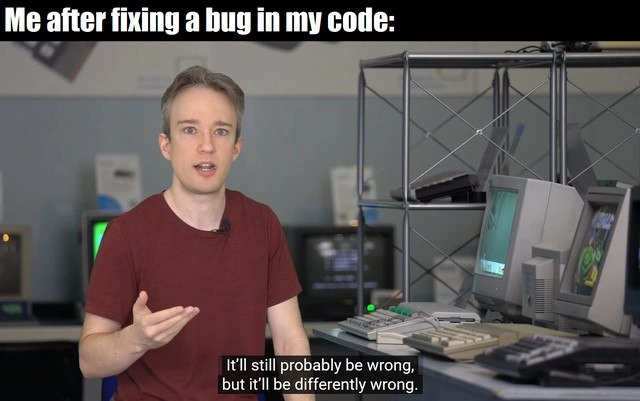
Let's break down what's happening in this meme in simpler terms. The top caption says, "Me after fixing a bug in my code:" and below it we see someone (with an ironically blurred face for anonymity) saying, "It'll still probably be wrong, but it'll be differently wrong." In plain speak, a bug is a mistake or error in the code that causes the program to behave in a way it shouldn't (like crashing or giving wrong results). Fixing a bug means changing the code to correct that mistake. But here's the punchline: often when we correct one mistake, we unintentionally cause a new mistake somewhere else. The meme's subtitle jokes that after your fix, the program will likely still have something wrong with it – just not the same wrong as before. It's like saying, "Okay, I solved that issue... let's see what I've broken in the process!" This is a super common feeling in software development, especially when you're new or when the code is really complicated.

Why does this happen? Sometimes code is connected in ways we don't realize. You change one part (like fixing a typo in one function) and something you didn't expect fails (maybe another function that relied on that typo behavior!). This is called a regression – where a change meant to improve things makes something else go backward (breaks something that used to work). Beginners often first encounter this when debugging school projects or simple apps: you fix a bug where your program was, say, sorting names incorrectly, but then you discover it no longer handles names with special characters because of that fix. It's frustrating, but it's how we learn to code more carefully. We write tests and try examples to catch these side effects. Debugging and troubleshooting is the process of finding what’s wrong (the bug) and trying to fix it, then testing again. Good developers learn to anticipate side effects and test the software after every fix to make sure nothing else broke.

The meme is very relatable because every coder has had that moment of triumph fixing something, followed by facepalming when a new error pops up. It's practically a running joke in programming circles. In fact, there's a common metaphor for it: playing "whack-a-mole." Whack-a-mole is an arcade game where plastic moles pop out of holes and you hit one down with a hammer, but then another pops up elsewhere. If your codebase is the field of mole holes, each bug you fix is like smacking one mole down – pop, there goes that bug – but then pop! a new bug appears in another part of the code. The line "differently wrong" perfectly captures that whack-a-mole vibe.

Even the background of the image – those old CRT monitors and keyboards – adds to the humor. CRT monitors are those big, boxy screens from the 80s and 90s (before flat screens). Showing them here is a fun way to say that this bug-fix-whack-a-mole problem is old-school; it's been around as long as people have been programming. We had debugging struggles back when those monitors were state-of-the-art, and we still have them now with modern laptops and cloud servers. The person in the meme (perhaps intentionally blurred to represent "any developer") is gesturing as if explaining or shrugging – like "Well, I did fix the bug... sorta!" The tone is self-deprecating: the developer is poking fun at themselves, admitting that their fix might not be perfect. This attitude is common in developer culture – we laugh at our mistakes and the unpredictability of coding, because if you take every bug too seriously you'd go crazy.

Level 3: The Hydra of Debugging

For experienced developers, this meme elicits a knowing groan – it’s capturing the Hydra-like nature of bug fixing in real projects. In Greek mythology, the Hydra grows two new heads for every one cut off. In programming, fixing one bug often seems to spawn two more in its place. Why is this such a relatable developer experience? Because we've all been there: you finally squash that pesky bug that's been causing, say, a null pointer exception, and you celebrate... only to find out your "fix" unexpectedly caused a regression in a completely different part of the app. Now a feature that was working before is differently broken. This endless debug cycle is practically a rite of passage in software development. The meme text, "It'll still probably be wrong, but it'll be differently wrong," is a tongue-in-cheek way of saying progress has been made – the original bug is gone – yet cautioning that the software isn't perfect yet (maybe it never will be). It's self-deprecating humor from a developer who has gained some battle scars: they’re half proud of the fix, half bracing for whatever new issue it might uncover.

This scenario often arises due to complex interdependencies and a lack of understanding of the full context. No code exists in isolation; a change to one module can affect data or control flow in another. Perhaps the bug fix introduced a subtle side effect or uncovered another hidden bug that was dormant. For instance, imagine a fix that corrects an off-by-one error in an array loop. Great, the original error is resolved. But now, because the loop runs one more iteration, it might trigger a performance issue or an out-of-bounds error on a different data set. Congratulations, you've got a differently wrong outcome now! This is why senior developers chortle at this meme – it satirizes the debugging frustration we all face when dealing with legacy code or tightly coupled systems. It highlights an implicit truth: regression bugs (bugs reappearing or new ones introduced in old features) are a constant thorn.

The presence of those vintage CRT monitors in the background isn't just for hipster aesthetics – it reinforces that this problem is as old as computing itself. Even in the era of beige terminals and CRT screens, programmers were dealing with this same headache. Back then, you might fix a bug in a COBOL program on a mainframe, only to find the printouts now misalign on the 80th column – differently wrong again! The meme connects that retro vibe with a modern quip, implying that decades of advancement in tech haven't eliminated the fundamental challenge of software quality. Tools have evolved (fancy debuggers, automated tests, CI/CD pipelines), but the core experience remains: every bug fix carries a risk. In large teams or fast-paced environments, this can be exacerbated by poor communication or technical debt. A quick fix (like a band-aid on the code) might not consider the big picture, leading to unintended consequences later. There's even an inside-joke principle: Murphy's Law of Software: "If you fix a bug, you will surely introduce another bug." Seasoned devs add wryly, "especially if you deploy on a Friday."

And then there's the psychological aspect: developers often joke in a self-deprecating way to cope with stress. Saying my code is "differently wrong" is a humorous acceptance that perfection is impossible and that we're engaged in a continuous process of improvement (or at least change). It’s a bit like gallows humor for coders – laughing so we don't cry. It also conveys a tiny sparkle of pride: "Hey, at least it's a new bug, not the same old one!" Over time, one hopes that each iteration of wrongness is less severe than the last (maybe the app crashes less, or the bug is now just a minor glitch). This iterative tightening of screws is essentially how real-world software debugging works. The meme nails the self-deprecating bug fix mindset: you celebrate the small victory of fixing one thing, fully aware you'll be back in the trenches soon to tackle the next oddball issue your fix revealed.

Level 4: The Conservation of Bugs

At the most abstract level, this meme hints at a quasi-law of software development: bugs aren't so much eliminated as they are transformed. Every time we change code, we're altering a complex system of interactions. In theory, determining whether a fix introduces no new issues is akin to solving a mini verification problem each time. Given a sufficiently complex program, proving it entirely correct (and free of any bug) is fundamentally hard – in the general case, it's undecidable. This is reminiscent of the Halting Problem in theoretical computer science: you can't write a universal program that predicts whether any given program will run correctly for all inputs (that's why we rely on testing and not omniscient proof). When we fix one bug, we might be narrowing the space of incorrect behavior in one area, but the system's overall state space is so huge (virtually infinite paths, inputs, and interactions) that another part often falls outside the green zone of correctness.

This humorously reflects an almost thermodynamic principle of coding: a Second Law of Debugging. Just as entropy in a closed system never decreases, the total complexity (and potential for something to go wrong) in a big software project tends not to decrease after a quick fix – at best, you redistribute it. A clever term sometimes used is "bug conservation": a quick patch might not remove the underlying complexity or error conditions; it merely shifts them, manifesting as a different bug later. Unless you rigorously address root causes and account for all side effects (which is often as hard as mathematically proving your program correct), you're playing a wack-a-mole game against an inherently complex, high-dimensional problem space. In large codebases with lots of state and interdependencies, code changes have emergent effects – like the butterfly effect of software. A tiny tweak in one module might subtly change a timing or a data assumption that causes a failure elsewhere. Seasoned engineers know this all too well: even with code review, static analysis, and tons of tests, there's a chaotic element to non-trivial programs. The meme's punchline “differently wrong” wryly acknowledges this theoretical reality: the code's behavior after a fix might still violate some expectation (wrong), just a different one than before. In other words, we've moved the system from one incorrect state to another, hopefully closer to correctness, but not there yet.

Description

The meme shows a video still framed by a black banner on top with white text that reads, "Me after fixing a bug in my code:". In the center sits a casually dressed person in a maroon t-shirt; their face is blurred for anonymity while they gesture with one hand. Behind them is a shelf stacked with several vintage beige CRT monitors and classic keyboards, reinforcing an old-school tech vibe. A subtitle at the bottom of the frame states: "It'll still probably be wrong, but it'll be differently wrong." The joke captures the familiar developer experience where resolving one defect often introduces a fresh, slightly mutated issue, highlighting the endless debugging cycle and the inevitability of regressions in complex codebases

Comments

12
Anonymous ★ Top Pick I eliminated the seg-fault in the monolith - now it’s a race condition distributed across three microservices and a Kafka topic. Progress, but horizontally
  1. Anonymous ★ Top Pick

    I eliminated the seg-fault in the monolith - now it’s a race condition distributed across three microservices and a Kafka topic. Progress, but horizontally

  2. Anonymous

    After 20 years in the industry, I've learned that debugging isn't about eliminating bugs - it's about carefully curating which bugs your users will learn to call 'features' and which ones you'll fix just enough to create more interesting edge cases for the next sprint

  3. Anonymous

    Ah yes, the classic refactoring strategy: transforming a deterministic bug into a non-deterministic one. It's not a fix, it's a lateral move in the state space of wrongness - like migrating from a segfault to a race condition. At least now when it fails in production, you can honestly say 'well, it worked differently in dev.'

  4. Anonymous

    My patch traded a predictable null pointer for a stochastic cross‑service race - QA calls it progress, SRE calls it the conservation of wrongness

  5. Anonymous

    Fixed the O(n²) timeout; now it's an O(n) distributed deadlock. Progress!

  6. Anonymous

    We didn’t fix the invariant - we just rotated the failure 90 degrees and called it a hotfix

  7. @iksunen 5y

    Ого, Том Скотт уже в мемах

  8. @iksunen 5y

    Кстати рекомендую всем его канал

  9. @iksunen 5y

    Ah sorry this oughtta be primarily English speaking channel. So I was amazed to see Tom Scott starting to get meme-ized, and also highly recommended everyone naturally curious to check out his channel

    1. dev_meme 5y

      Since when exactly @dev_meme became “mainstream”? 😂

  10. @digital_insanity 5y

    Tom Scott is meme by himself

    1. @iksunen 5y

      Can't agree more, just haven't seen him in mainstream memes

Use J and K for navigation