Skip to content
DevMeme
2549 of 7435
Godot Explains Save Encryption Politically
GameDev Post #2824, on Mar 4, 2021 in TG

Godot Explains Save Encryption Politically

Why is this GameDev meme funny?

Level 1: The Treasure Box

It is like a game keeps your treasure in a box, and players might open the box to give themselves more treasure. The normal explanation would be, “Put a lock on the box.” This meme is funny because the instructions sound like, “Put a lock on the box or society may collapse.”

Level 2: Locked Save Files

Godot is a game engine, which means developers use it to build games, handle scenes, scripts, assets, input, and file I/O. A save game is a file that stores progress: levels completed, items collected, character stats, settings, currency, and similar data.

If a save file is easy to read, a player might open it in a text editor and change values. For example, they could change coins: 10 to coins: 999999. Encryption transforms readable data into unreadable-looking data unless the program has the right key to decrypt it again. That makes save editing harder.

The funny part is that the screenshot does not explain this in a plain way. It starts from game monetization and social critique before returning to the practical question of protecting saved games. For a new developer, the useful lesson is that documentation can explain both a technical mechanism and the reason it exists. This page just appears to choose the most dramatic possible reason.

Level 3: Threat Model Manifesto

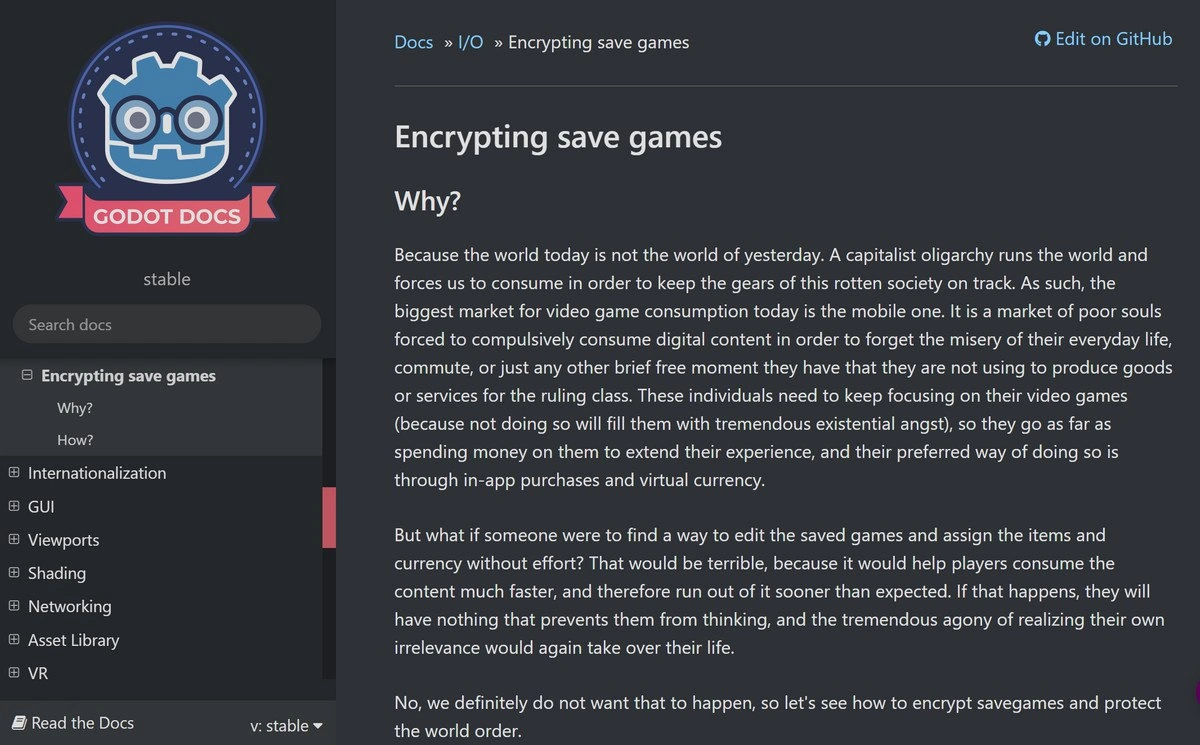
The screenshot shows a dark Godot Docs page at Docs » I/O » Encrypting save games, with the left navigation highlighting “Encrypting save games” and the main heading asking:

Why?

That is already a normal documentation setup. A game engine page about encrypted save files should explain cheating, tampering, save editors, local storage, and maybe a few practical warnings. Instead, the visible body veers into a bleak critique of mobile game consumption, in-app purchases, virtual currency, and a “capitalist oligarchy.” It eventually lands on the wonderfully over-serious idea that encrypting savegames helps “protect the world order.”

The joke is the mismatch between technical documentation and ideological monologue. Documentation usually tries to be dry, direct, and task-oriented: here is the problem, here is the API, here is the code. This page appears to treat a save-file encryption tutorial as a chance to explain why modern games monetize attention and why players editing local saves would threaten the business loop. That sudden escalation is funny because the actual engineering task is small: prevent or discourage users from changing saved inventory, progress, or currency values. The prose makes it sound like the fate of civilization depends on whether someone can give themselves 999 gems.

There is a real security concept underneath the satire: threat modeling. A save file is data stored on a player's device. If it is plain text or easy to edit, players can modify values directly: health, coins, unlocked items, completion flags, or premium currency. Encrypting the save can raise the cost of tampering by making the contents unreadable without the key.

But the practical game-dev caveat is that client-side encryption is not magic. If the game can decrypt the save on the player's machine, then the decryption code and key material, or at least the path to them, are also present somewhere on that machine. For offline games, encryption mostly stops casual editing. For competitive or monetized games, stronger protection usually requires server-side authority: the server owns the important state, validates changes, and refuses impossible progress. Otherwise the client is being asked to guard secrets from its owner, which is a brave and historically doomed business model.

That is why the meme sits across GameDev, Security, and Documentation. It is not just “docs said something weird.” It is docs accidentally exposing the economic reason behind a security feature. Save encryption is framed not as protecting player experience or preventing corrupted data, but as preserving the monetization loop. The page says the quiet part loudly, then hands you the tutorial. Somewhere a product manager is nodding and pretending this was always in the acceptance criteria.

Description

The image is a dark-mode Godot Docs page with a left sidebar showing "GODOT DOCS", "stable", "Search docs", "Encrypting save games", "Why?", "How?", "Internationalization", "GUI", "Viewports", "Shading", "Networking", "Asset Library", "VR", "Read the Docs", and "v: stable". The main page breadcrumb reads "Docs » I/O » Encrypting save games", has an "Edit on GitHub" link, and the headings "Encrypting save games" and "Why?". The body explains, in unusually ideological prose, that a "capitalist oligarchy" drives mobile game consumption, in-app purchases, and virtual currency, then asks what would happen if someone edited saved games to assign items and currency without effort, concluding: "No, we definitely do not want that to happen, so let's see how to encrypt savegames and protect the world order." The joke is the mismatch between routine game-development documentation and a bleak social critique used to justify save-file encryption.
Comments

16
Anonymous ★ Top Pick Most docs say "use AES"; Godot apparently opened with the political economy of whale retention.
  1. Anonymous ★ Top Pick

    Most docs say "use AES"; Godot apparently opened with the political economy of whale retention.

  2. @batov_n 5y

    Page not found

  3. @Darkangeel_hd 5y

    https://web.archive.org/web/20210104024155/https://docs.godotengine.org/en/stable/tutorials/io/encrypting_save_games.html

  4. @HenricMumphreyVonDickenCock 5y

    I honestly hope it's a joke

  5. @FunnyGuyU 5y

    Encryption simply offers more challenge.

  6. @f3rr0us 5y

    I hate it when I'm reminded of the Orwellian reality we live in.

  7. @SheepGod 5y

    https://github.com/godotengine/godot-docs/commit/b872229427dddb9b749f46af597e85e25cf2955a

    1. @ArchieWindragon 5y

      That's really good natured of them

    2. @beriff 5y

      >possessive plural noun >bruh

      1. Deleted Account 5y

        what

        1. @beriff 5y

          Just use "player" or "players" nobody does players' really

          1. Deleted Account 5y

            you can't do that tho without rebuilding the whole sentence, even then it won't have the same meaning

            1. @nuntikov 5y

              Sus

  8. Deleted Account 5y

    Bruh

  9. @The_first_hunter 5y

    I'm a fan of godot nevertheless

  10. @Magilarp 5y

    When the impostor has not done any suspiscious actions as of yet thus coming to any conclusion would be premature

Use J and K for navigation