Skip to content
DevMeme
2547 of 7435
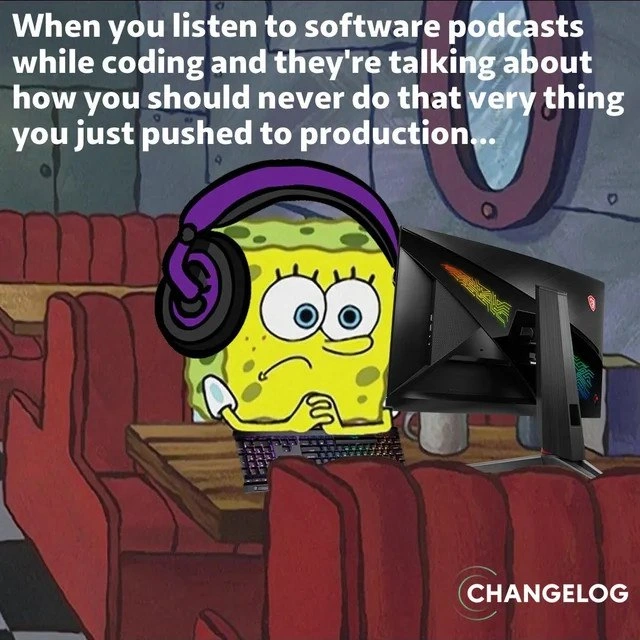
When the podcast roasts the code you just shipped to prod
Production Post #2822, on Mar 4, 2021 in TG

When the podcast roasts the code you just shipped to prod

Why is this Production meme funny?

Level 1: Oops, Too Late

Imagine you’re watering a plant at home. You think, “I want it to grow faster, I’ll give it lots of water.” You pour a big jug of water into the pot. Later that day, you’re watching a gardening show on TV, and the host says, “One thing you should never do is overwater your plant, because it can actually drown the roots.” You freeze, eyes wide, looking at your poor plant now sitting in a puddle. Uh-oh… that’s exactly what I did! You feel a mix of worry and a little bit of silly embarrassment. You didn’t know it was wrong when you did it, but now an expert is saying it is, and you hope your plant will be okay.

That’s the same feeling this SpongeBob meme is joking about, but with writing computer code. The SpongeBob picture shows someone who just did something they thought was okay when working on a computer. Then they hear a smart person (on a podcast, like a radio show) say “never do that!” It’s a classic oops moment. It’s funny because of the timing: the advice came just a bit too late. We can all relate to doing something and only afterwards learning it wasn’t the best idea. The meme makes us laugh and cringe at the same time, because we know exactly how SpongeBob (the worried guy with headphones) feels in that red diner booth: a little scared, a little guilty, but wiser for next time.

Level 2: Deployment Anxiety

Let’s break down what’s happening in this meme in more straightforward terms. Production (often just called “prod”) is the live environment where real users interact with your software. Shipping or pushing code to production means you’ve deployed new changes into that live system. It’s kind of like putting a new part into a running machine – if something’s wrong with that part, the whole machine could sputter. So, deployments are both exciting and nerve-wracking. Deployment anxiety is that nervous feeling developers get when releasing code: “Did I break anything? Will users start seeing errors? Is everything going to work as expected?” If you’re new to coding, imagine the mix of pride and worry when you first upload a project for everyone to use – that’s the vibe here.

Now, in the image, we see SpongeBob (the famous cartoon character) sitting in a lonely diner booth with big headphones on, looking worried while staring at his monitor and keyboard. Developers love using SpongeBob memes to represent themselves because he’s expressive and, well, we grew up with him! Here, SpongeBob represents a programmer. He’s got a gaming monitor and a flashy RGB keyboard, which are just fun details showing he’s a bit of a techie. The key part is the caption at the top: “When you listen to software podcasts while coding and they’re talking about how you should never do that very thing you just pushed to production…” This one sentence sets the scene.

Let’s unpack it:

  • Software podcasts are like talk shows or radio shows but for developers. People discuss programming tips, tools, and best practices. Many devs listen to podcasts (like The Changelog, whose logo appears in the meme) to learn new things while they work.
  • “That very thing you just pushed to production” refers to some coding practice or deployment decision our SpongeBob-dev did, which the podcast suddenly says is a big no-no. To “roast” code means to criticize or make fun of it. So the podcast hosts are essentially saying, “Here’s a bad thing some developers do…” and it turns out SpongeBob just did exactly that in his code deployment.

Imagine you’re a junior developer who just finished a task. Maybe you were in a rush and, for example, you deployed code on Friday evening or you skipped writing some tests to save time. You feel relieved that the feature is shipped. Then you put on a popular dev podcast in the background, and the experts on the show start explaining why doing that is risky or wrong. Your stomach drops because you realize, “Uh-oh, I just did that risky thing!” It’s a learning moment, but it’s also scary because your code is already live.

Why would SpongeBob (the developer) be sitting alone in a diner booth? This is a nod to feeling isolated with your worry. Deployment can be a lonely moment – sometimes you’re the only one still at the office or online late, verifying that everything is okay. The diner setting (red booth seats, a table, a lonely cup of coffee) emphasizes that lonely, anxious vibe. It’s like after everyone else went home, you’re left all alone with your thoughts about the code you released.

The meme touches on best practices – these are the recommended guidelines and methods that experienced developers say you should follow to avoid problems. When the podcast says “you should never do X,” they’re talking about a best practice (meaning you should avoid X and do something safer instead). If you’re new, nobody expects you to know all the best practices right away. We often learn them by hearing advice or, unfortunately, by making mistakes. For example, a podcast might warn “never deploy on a Friday” because if something goes wrong, your team might be stuck fixing it late or over the weekend. If as a newcomer you didn’t know that and you just deployed on a Friday evening, hearing that advice afterward would make you pretty anxious!

DevOps is another term hinted in the description (DevOps nerves). DevOps is a culture and set of practices that aim to bridge development (writing code) and operations (running that code on servers). It involves things like automated testing, continuous integration, and monitoring – all tools to make deployments smoother and safer. A DevOps-minded team tries to catch mistakes before code reaches production. But even with good DevOps practices, things slip through. When they do, developers rely on monitoring and quick fixes… and sometimes just hope and prayer. The “nerves” part is real: even with great tools, hitting the deploy button can make your heart race, especially early in your career.

So, the relatable experience here is: you do something in your code or deployment that you think is fine. Then you learn from a respected source (podcast, blog, senior engineer, etc.) that it’s actually a mistake or risky move. You get that sinking feeling of “Oh no, did I mess up production?” It’s both funny and uncomfortable. Funny, because the timing is almost comic – what are the odds you’d hear that advice right after pushing your code? Uncomfortable, because production issues are serious. If that code fails, real users might be affected.

In summary, this meme is popular in developer circles because it perfectly captures a “learning the hard way” scenario. It’s SpongeBob – a character even non-tech folks know – showing the emotion of a developer’s worry and regret. The tags like ProductionIssues and DeploymentAnxiety are exactly about that: issues that happen in production environments and the anxiety around deploying code. Every developer has a story of a deployment that made them sweat. This meme says, “Don’t worry, you’re not alone – we’ve all been SpongeBob in that booth at some point!” and does so in a lighthearted way. It’s a gentle reminder to double-check your approach before you ship… and also a chuckle at the fact that we often realize our goofs only afterward.

Level 3: Production Podcast Panic

Picture this: you’ve just pushed code to production (the live environment serving real users) after a long day. You’re still wearing your oversized headphones, catching up on your favorite software podcast (perhaps The Changelog, given that logo in the corner). Suddenly the hosts start roasting a coding practice – emphatically warning “Never do that in a production deployment!” – and with horror you realize they’re describing exactly what you just implemented. 😱 In this SpongeBob diner scene, our wide-eyed developer avatar isn’t just laughing at a joke; he’s living it in real time. It’s a classic case of post-release dread fueled by community wisdom arriving a few hours too late. The humor bites because it’s too real: every experienced developer has shipped a quick fix or questionable change, only to learn afterward (via a blog, podcast, or senior colleague) that it was a textbook anti-pattern.

From a seasoned engineer’s perspective, this meme nails a shared trauma. It highlights the gap between best practices and on-the-ground reality. In theory, you’re supposed to follow all the rules:

  • Never deploy untested code or skip code review
  • Avoid making database schema changes on a Friday at 5 PM
  • Don’t disable error logging or ignore that failing CI pipeline

Yet in practice, high pressure and tight deadlines often lead to “YOLO” deployments – the ones where you cross your fingers and hit git push origin main late in the day. It’s only after the adrenaline fades that the doubts creep in: Did I miss something? Is that code thread-safe? What if the caching strategy breaks under real traffic? Hearing experts condemn the very shortcut you took is the ultimate validation of those fears. The meme captures that DevOps anxiety: SpongeBob’s thousand-yard stare is basically every developer waiting to see if the last hotfix will blow up overnight.

This scenario also underscores how DevOps culture is as much about psychology as technology. We invest in automated tests, code reviews, and continuous integration pipelines not just for code quality, but to let us sleep at night. When those processes are bypassed (say, rushing a patch directly to prod to fix an incident), we’re left jittery and alone with our thoughts – much like SpongeBob in that empty diner booth at dusk. The image’s vibe screams “What have I done?” as the developer contemplates whether to quietly prepare a rollback or pray no one notices. It’s comical because we’ve all been there, nervously checking monitoring dashboards after a sketchy deploy, hoping to dodge the on-call pager’s wrath.

Why is it so common to learn about pitfalls only after falling into them? Tech moves fast, and even diligent devs sometimes lack context for every decision. Maybe you’re a newer coder who wasn’t aware that the pattern you used has a notorious edge case, until the podcast folks start war-storying about how that exact approach took down production systems in the past. Or perhaps you did know better, but business pressure (“We need this live now!”) overrode prudence. There’s an unwritten rule in the industry: “Good judgment comes from experience; experience comes from bad judgment.” The meme humorously reminds us of this loop. That software podcast is effectively giving you a free code review, just a tad late – a disembodied senior engineer saying “Buddy, that was a bad idea,” as you nervously sip your post-deployment coffee.

Notice the small details reinforcing the joke: SpongeBob’s big purple headphones and high-end RGB keyboard suggest he’s a serious geek, trying to keep up with tech trends via podcasts while coding. The CHANGELOG logo tells us which show he’s listening to – a real-life podcast known for industry insights. It’s the perfect setting for an “Oh no… they’re talking about me” moment. The contrast is deliciously painful: on the screen, your code is running in prod; in your ears, experts are lampooning that very code structure or deployment method. It’s like getting called out in front of the whole class, except the class is the global developer community. That cocktail of embarrassment and impostor syndrome (when you suddenly feel like you’re a “bad developer” because you broke a rule) is something developers universally recognize. We laugh at the meme, but it’s a sympathetic laugh – we’ve felt that punch in the gut when a seemingly clever shortcut turns out to be a known booby trap.

In the big picture, this meme pokes fun at release culture and the fine line between confidence and panic in software deployment. Modern teams preach “automate all the things and never push on Fridays,” yet real-life often finds us debugging live issues in a hurry or merging that last-minute PR because the feature is already late. The meme’s genius is tying that familiar guilt to a very specific medium – the software podcast – highlighting how interconnected our learning ecosystem is. You might be deploying code while literally listening to lessons on how to deploy code properly. And when those two worlds collide in the worst way, you get SpongeBob’s worried face: a developer half wishing he could hit undo, and half hoping the podcast isn’t foretelling a production outage. It’s a senior-engineer nightmare packaged as comedy, reminding us that in tech, timing is everything – especially when it comes to learning what not to do after you’ve done it.

Description

Cartoon scene of SpongeBob sitting alone in a red-booth diner, wearing oversized purple headphones and staring worriedly at a wide gaming monitor and RGB keyboard placed on the table. White caption text at the top reads: "When you listen to software podcasts while coding and they're talking about how you should never do that very thing you just pushed to production..." The lower-right corner has a small “CHANGELOG” podcast logo, reinforcing the software-podcast context. The meme humorously captures a developer’s anxiety about discovering best-practice advice only after deploying questionable changes to a live environment, highlighting release risk, deployment culture, and DevOps nerves

Comments

23
Anonymous ★ Top Pick Podcast: “Feature flags are for gradual rollouts, not business logic.” Me, staring at prod: “Interesting take on our entire billing system’s Boolean-Driven Architecture.”
  1. Anonymous ★ Top Pick

    Podcast: “Feature flags are for gradual rollouts, not business logic.” Me, staring at prod: “Interesting take on our entire billing system’s Boolean-Driven Architecture.”

  2. Anonymous

    The only thing worse than discovering your architectural decision was featured as an anti-pattern in Martin Fowler's latest blog post is hearing it described in real-time on a podcast while your deployment pipeline is already halfway through promoting that exact pattern to production - and you know the rollback will require explaining to the CTO why you need to coordinate a maintenance window across three time zones

  3. Anonymous

    That moment when the podcast host says 'and that's why you should NEVER deploy on Friday without proper testing' while you're frantically checking your git log from 10 minutes ago. At least you're learning... just with a slightly more expensive feedback loop than unit tests would have provided. The real question is: do you pause the podcast to rollback, or keep listening to find out exactly how bad this is going to get?

  4. Anonymous

    It's not hypocrisy - it's applying 'contextual eventual consistency' to best practices, prod edition

  5. Anonymous

    That moment when a podcast says “never deploy a schema change without a feature flag or canary” and you realize your 2am force-push ran a blocking migration on the primary - suddenly blameless culture feels like an optimistic consistency model

  6. Anonymous

    That moment the podcast says “never ship a non‑idempotent migration behind a feature flag,” and your rollback plan is git revert for code and hope-as-a-service for the database

  7. @doodguy1991 5y

    "don't use go statements!" -self proclaimed expert

    1. @mihart00 5y

      Real problem for Go programmers

      1. @Supuhstar 5y

        X3

    2. @Supuhstar 5y

      Don't use goto - Me, a 10-year software engineer with a degree in computer science

      1. @doodguy1991 5y

        No

        1. @Supuhstar 5y

          Okay, toddler :P

          1. @doodguy1991 5y

            Go ahead. Goto statements are jump statements dummy. Are you saying assembly language is "toddler level"?

            1. Deleted Account 5y

              This

            2. @Supuhstar 5y

              No I'm saying your stubbornness is toddler level :P Toddlers love to just keep saying "no" And even the most low-level of non-assembly languages have better, more descriptive options for each need

            3. Deleted Account 5y

              I believe they meant that using these outside of low level programming is bad form and leads to strange bugs.

              1. @Supuhstar 5y

                Jump = necessary for Turing machines goto = never necessary

                1. @RiedleroD 5y

                  I kinda miss goto in some higher-level languages sometimes.

                  1. @Supuhstar 5y

                    Give me a place you miss it and I'll give you a better alternative 🥰

                    1. @RiedleroD 5y

                      ummm ok? wait, I don't know one off the top of my head, but I can look in some of my older repos.

                      1. @RiedleroD 5y

                        aight I can't find anything rn, but most of my problems arise from the fact that python has quite limited loops. It did get better with the walrus operator, but not by much.

                        1. Deleted Account 5y

                          I think I know what you mean actually.

    3. Deleted Account 5y

      Dijkstra

Use J and K for navigation