Skip to content
DevMeme
4878 of 7435
The Dramatic and Bizarre Lore of Denuvo DRM Crackers
Security Post #5339, on Aug 8, 2023 in TG

The Dramatic and Bizarre Lore of Denuvo DRM Crackers

Why is this Security meme funny?

Level 1: Three Wizards and a Lock

Imagine there’s a super special treasure box (that’s the video game) with a magical lock on it. This lock is so tricky that almost nobody in the world can open it without the proper key. Now, only three people know the secret spell to open this magic lock. Sounds like a fairy tale or a cartoon, right? Well, that’s basically what this joke is saying about a real-life situation!

In this story, the game’s copy protection is the magic lock, and the three people are like wizards or master locksmiths (we call them hackers or crackers in tech). Here’s the funny part: these three aren’t just normal boring folks – they’re as colorful as characters in a story:

  • Wizard 1 – The Evil Sorcerer: The first person is kind of like an evil wizard. She’s incredibly powerful in terms of her skill (she can open the un-openable lock!), but she has a really mean personality. She often says hurtful things about a certain group of people (she’s transphobic, meaning she doesn’t like transgender people, which is like disliking someone for who they are – not nice at all). And when she talks, she sounds like a classic cartoon villain – you know, the bad guy who gives a dramatic speech, laughs “Mwahaha,” and calls themselves the greatest in the world. So picture this: a genius, but one who talks as if she’s casting dark spells and declaring herself queen of the world. That’s wizard number one.

  • Wizard 2 – The Good Rival: The second person is like the good witch or the clever heroine of the tale. She’s a transgender girl (which is the group the first wizard was being mean about, adding to the irony). She goes by the nickname FitGirl, like how heroes often have cool code names. Now, FitGirl’s specialty is a bit different – instead of breaking the lock from scratch, she’s more known for taking treasures that have already been unlocked and then magically shrinking them. In real terms, after a game is cracked by someone, FitGirl makes a smaller, easier-to-download version of that game for people. She’s very popular because she helps everyone get the treasure chest contents more easily. The mean wizard lady doesn’t like FitGirl (perhaps because FitGirl represents everything she’s against and is also successful). So people kind of see FitGirl as the rival or opposite of the evil sorcerer. FitGirl is generally friendly in her messages and has a supportive fan base. It’s like in a story where a kind, savvy witch stands up to the evil sorceress.

  • Wizard 3 – The Sports Fan: The third person is a bit of a funny one. He’s like a wizard who only cares about one very specific type of treasure chest – say, chests that contain soccer balls. In reality, this means he cracks only football (soccer) video games. It’s as if in a magical kingdom, there’s a guy who isn’t interested in the crown jewels or the golden apples – he just says, “Hey, does that chest have a football in it? If so, I’ll open it. If not, I don’t really bother.” He’s presumably quite good at opening those sports-game chests, but you won’t see him messing with the others. This makes him a bit of a quirky side character. People find this amusing because it’s so oddly specific – like, out of all the adventures, this wizard chooses only the soccer-themed ones.

So, why is this funny? Because it’s true and yet it reads like a fairy tale or comic book plot. In the real world, these are hackers dealing with game security, but describing them this way turns them into larger-than-life characters. It’s humorous to think that something as modern and technical as video game piracy ended up with an evil villain, a heroic rival, and a specialist with a funny quirk. It’s almost as if the world of breaking game locks has its own superhero story going on.

People are laughing at the tweet (the meme) because it paints a clear, ridiculous picture: “Only three people know how to do this super hard thing. One’s basically a supervillain, one’s like her archenemy who’s a good gal, and the third is off doing his own thing with sports games.” If you didn’t know any better, you’d think this was the synopsis of a new fantasy novel or a cartoon series. But it’s real! Reality can be quite silly sometimes.

In very simple terms: The meme is using a fun story-like description to explain that breaking the security of certain video games is so hard that almost nobody can do it. And the few who can are a notably strange bunch, with dramatic feuds and unique fixations. It highlights an emotional truth – people love a good guys vs. bad guys story – in a place you wouldn’t expect to find it (the world of computer game hacking). Even if you don’t know the tech details, you can chuckle at the fact that these real hackers unintentionally resemble characters from a fantasy tale. It’s a reminder that behind complicated computer stuff, there are humans with big personalities – and that combination can be unexpectedly entertaining, almost like playground lore or a bedtime story for geeks.

Level 2: Digital Locks

Let’s break this down in simpler terms. Imagine a video game as a treasure chest full of fun content. Game companies put a special lock on that chest called Denuvo DRM. DRM stands for Digital Rights Management, which basically means “digital locks on software to prevent copying or using it without permission.” In the context of games, DRM tries to stop piracy (people getting the game for free illegally) by making it really hard to open or run the game without the proper key (usually a valid purchase or online verification).

Now, Denuvo is known as one of the toughest locks out there – it’s like a high-tech unpickable lock. It uses anti-tamper protection, meaning it’s designed to detect and resist any meddling. For instance, a game with Denuvo might constantly check “Is this game legitimately bought? Is everything as expected?” If something seems off (like someone modified the game to bypass a check), the game might stop working. Denuvo can integrate deeply with the game’s code, so it’s not just one lock – more like many mini-locks throughout the game. It might encrypt parts of the game code (scramble them) so you can’t even see them unless the game is running and confirms you’re allowed. It may also require occasional online verification with a server to ensure the game isn’t a fake copy. All these measures make it incredibly difficult to crack.

Cracking software means finding a way to remove or bypass these locks so the software can run without official permission. A person who does this is often called a cracker (not the saltine kind, but someone who “cracks” protection). To crack a game with Denuvo, a cracker has to do a lot of reverse engineering. Reverse engineering is like taking apart a car’s engine to see how it works, except here the engine is a compiled game program (just ones and zeros). It’s a bit like trying to solve a puzzle or a maze: the cracker will use special programs to disassemble the game into assembly code (low-level machine instructions). They’ll look for clues in that code where the game checks for a license or does a security check. It’s common to search for telltale things like error messages (“Please purchase the game”) or known patterns of license verification. Once they find those, they try to alter the game’s code. For example, if the code says “if not valid, then quit the game,” the cracker can change it to “always assume valid” so that it never quits. The tricky part is Denuvo hides those checks under layers of obfuscation (which is like deliberately messy code) so it’s really hard to locate the correct things to change. It’s not just one switch; there could be dozens of intertwined checks.

Because it’s so difficult, very few people have the knowledge to do this for Denuvo-protected games. The tweet (meme) humorously says “there’s like only 3 people that know how to crack Denuvo DRM.” That’s an exaggeration, but not by much – in recent years, the number of individuals or groups consistently cracking the newest Denuvo games at any given time has been extremely small (a handful). Many others have tried and failed or just don’t have the time/expertise. Being a successful cracker in this space requires understanding how games are built, knowledge of computer architecture, and lots of practice with debugging and assembly coding. It’s a niche skill set, kind of like locksmithing for digital locks, but these locks keep changing shape (since Denuvo updates its methods).

Now, the funny part is who these few people are. The meme describes them with very colorful language:

  • One of them is described as “a turbo-transphobe that speaks like a JRPG villain.” Let’s unpack that: transphobe means someone who is hostile towards or strongly prejudiced against transgender people (unfortunately, a form of bigotry). “Turbo-transphobe” implies this person is extremely vocal about those negative views. So, not a nice character trait. This cracker is also said to speak like a JRPG villain. JRPG stands for Japanese Role-Playing Game – think of famous game series like Final Fantasy or Dragon Quest. In those games, the villains (bad guys) often have very dramatic, over-the-top dialogue. They monologue about power and destiny, they laugh maniacally, they use fancy archaic words – basically they’re theatrical. So, saying this real-life person speaks like a JRPG villain suggests she writes or talks in a very dramatic, pompous way as if she’s the evil queen in a fantasy story. Indeed, the cracker in question (known as Empress) writes long messages alongside her cracks that sound like a delusional bad guy speech, complete with grandiosity and insults. So picture an extremely talented hacker who’s also spewing hateful comments and doing so in a “Mwahaha, behold my power!” style. It’s both intimidating and cringey, which the meme captures in a humorous way.

  • Her rival is described as “a trans girl that goes by the alias of FitGirl.” Here we have another person in the piracy scene, but on the opposite side in terms of personality and values. FitGirl is an alias (online nickname) of a real person who is known for making repack versions of pirated games. A repack is essentially a repackaged game – FitGirl takes games that have already been cracked and then compresses them or repackages them in a smaller download, often giving options to exclude certain content (like you can choose to not download languages you don’t need). Her repacks are popular because they save bandwidth and are generally reliable. FitGirl is widely respected in the community for the quality of her work (and at times for her witty blog posts addressing issues with games or cracks). Now, importantly, the meme identifies FitGirl as a trans girl, meaning she is a transgender woman. That’s the opposite of transphobe in terms of identity/stance – she is part of the transgender community, whereas the other person has been hostile towards that community. This sets up a kind of natural rivalry or at least a foil: the bigoted cracker vs. the trans repacker. In reality, they have clashed indirectly because the cracker (Empress) has launched personal attacks against FitGirl in some posts, and FitGirl has responded to clarify things or call out lies. So the meme paints them as rivals, almost like protagonist and antagonist. FitGirl, being generally positive or neutral in tone in her communications, comes off as the heroine to many observers, especially in contrast to the hatefulness of the other. The alias “FitGirl” by the way is just a catchy nickname – in practice, these aliases help keep real identities secret since what they’re doing (cracking games, redistributing them) is illegal. It’s common in hacker culture to have such pseudonyms.

  • The third person is “only cracks football games.” This is pretty straightforward: apparently there’s another individual out there who focuses specifically on cracking football video games (likely the soccer games like EA Sports’ FIFA series, or Konami’s eFootball/PES, etc.). Why only football games? It could be personal interest – maybe that person loves football and ensures those games get cracked if no one else cracks them. Or it could be a joke that the only games this person manages to crack are the sports ones, implying they’re not as generally skilled or simply choose a narrow target. In the context of the meme’s storytelling, this adds a bit of silliness: it’s like saying “the third expert is kind of a one-trick pony – he shows up only when there’s a soccer game to crack.” Within piracy communities there have been cases of specific games being cracked by unexpected or one-off contributors (for example, someone might find a workaround for a specific title only). So there is a kernel of truth, but it’s phrased in a funny way. It humanizes the lore: not everyone is in a grand ideological battle; one guy just cares about FIFA.

All these descriptions together create what the tweet calls “piracy lore.” Lore usually means the backstory or set of stories in a fictional universe (like lore in Lord of the Rings or Star Wars). Applying it to piracy is tongue-in-cheek because it’s treating these real events and people like the plot of a fantasy tale. And indeed, over years, the interactions of these tech-savvy individuals has become a kind of story that observers recount. If you’re a newcomer in a forum and ask “Why do people talk about Empress and FitGirl like they’re characters?”, you’ll get this whole rundown – essentially what the tweet says. It’s the culture around game cracking: not just the technical part of copying games, but the personalities, the drama, the community discussions.

It’s worth noting that normal gamers or developers might not follow this stuff closely. This is very niche internet culture. But when someone condenses it in an accessible way (like this tweet), it suddenly becomes a shareable piece of trivia. People find it fascinating that such a bizarre set of circumstances is real. The tweet’s engagement (over a million views) shows that it went far beyond the core piracy aficionados – it reached general tech enthusiasts and gamers, many of whom had a reaction like, “Wait, is this for real? It sounds like a movie plot.”

Also, consider the Security aspect: this is all fundamentally about breaking security on software. In the cybersecurity world, we often see a cat-and-mouse dynamic between developers deploying protections and hackers finding exploits. This meme is basically a comedic case study of that dynamic in the gaming world. Denuvo (security measure) vs. crackers (hackers). And as often happens, the number of people capable of successfully defeating a top-tier security measure is small. The meme chooses “3 people” as a humorous low count. This highlights how specialized the knowledge is. It also implies a kind of fragile situation: if only three people have the “know-how,” what if they get bored or caught? In fact, there have been arrests and legal actions in the past against game crackers (some notable ones have been caught by authorities, which sometimes temporarily leaves fewer active crackers). So the number can literally fluctuate due to such events. But typically, someone new eventually steps up to carry the torch, because the demand (from people who want pirated games) creates incentive.

From a newbie perspective, it might be surprising that cracking games isn’t more common. One might think “surely lots of hackers out there can do this.” The reality is, many could if they devoted themselves, but the effort is huge and the reward is basically underground fame (and possibly some community donations). It’s not a career path because it’s illegal. So only a few very dedicated (and perhaps a bit obsessive) individuals go that deep down the rabbit hole. That’s why it feels like this weird little world of its own, almost a secret club. And like many secret clubs, it has its own legends and feuds.

To put it simply: Denuvo DRM is a super-strong game lock, and cracking it is super hard. So hard that hardly anyone can do it. The ones who can have become kind of famous online, and they have really eccentric personalities. One is basically acting like a villain with offensive views, another is like a hero with a cool codename who stands against that negativity (even if indirectly), and a third is a quirky specialist who just focuses on one type of game. This combination is both informative (teaching us about the state of game piracy) and entertaining (because it reads like a bizarre story). For someone newer to tech or gaming, it’s an example of how even in real life, truth can be stranger than fiction. People really do develop reputations like characters in a game or movie, especially in online and underground communities.

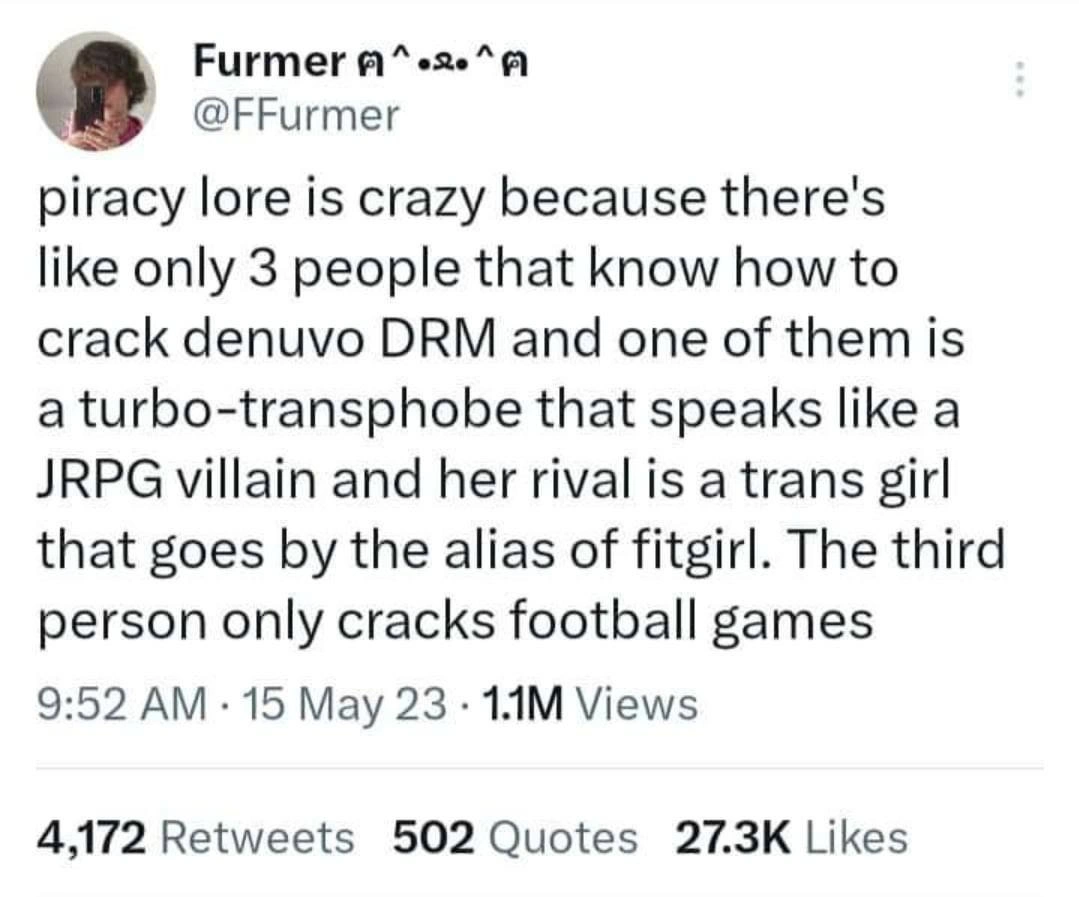
Lastly, a quick note on the format: The meme is shown as a Twitter screenshot. This has become a popular meme format – someone’s tweet is so spot-on or funny that it gets screenshot and shared around, sometimes even more than the tweet itself. In the screenshot, you see the tweet text, the user handle (@FFurmer), and the engagement metrics (retweets, likes). This visual instantly tells viewers, “Hey, this is a viral tweet with a funny take.” For many, reading a tweet image is actually more common than encountering that tweet on Twitter. It’s like taking a quote and turning it into a meme. So the presentation is familiar to internet users: white background, profile pic, then the text in tweet format – they know it’s likely going to be a witty observational one-liner or story, which it is in this case.

In conclusion at this level: The meme is explaining who cracks these tough game locks in a humorous way. If you understand what Denuvo and cracking means, the fact that only a few eccentric individuals can do it (and that their personal drama is so wild) is both informative and comical. It underscores the intersection of security and gaming culture – showing that behind the scenes of your favorite game release, there might be this whole other subplot involving hackers and digital cat-burglars who almost sound like comic book characters. It’s a reminder that every field, even game piracy, has its heroes, villains, and quirky characters that people end up telling stories about.

Level 3: Hacker Folklore

For seasoned developers and security enthusiasts, this meme hits on a very real and amusing situation: modern PC game piracy has evolved into something of a legendary saga. The tweet in the image reads like a plot summary of an anime or a JRPG (Japanese Role-Playing Game), yet it’s describing actual people in the tech underground. The humor comes from the contrast between the dry, technical world of DRM (Digital Rights Management) and the almost mythical lore that has developed around those who crack it. Let’s unpack why this scenario is both true and absurd in just the right way.

First, Denuvo DRM is infamously known among gamers and developers alike. It’s a commercial anti-piracy technology used by game companies to prevent copying or tampering with games. Over the past decade, Denuvo became notorious for being incredibly difficult to crack; some early versions went unbroken for months, an eternity in piracy time. This set the stage for a kind of “folk hero vs. villain” dynamic in the game cracking community. When an incredibly tough DRM like Denuvo exists, the people who manage to crack it naturally gain almost rockstar status in certain circles. And because so few can do it, each one of these individuals becomes well-known, almost like characters in an ongoing drama. This is the hacker culture element at play: personalities matter. In the old days of the warez scene (piracy groups), groups like CODEX, CPY, or Razor1911 were famous. Nowadays, we have individual names rising to fame.

The tweet outlines a cast of three such “DRM breakers,” and each one sounds like they’re ripped from a novel:

  • The Villainous Cracker: The tweet describes “one of them is a turbo-transphobe that speaks like a JRPG villain.” This almost certainly refers to a cracker known by the alias EMPRESS. She is currently (in the 2020s) one of the only people releasing working cracks for the newest Denuvo-protected games. Technically brilliant? Absolutely. But she’s also notorious for her unhinged, venomous tirades in the fine print of her releases or on forums. She has espoused transphobic views (hence “turbo-transphobe”) and writes in an over-the-top, grandiose style. For example, in her release notes she might declare “I have once again DESTROYED the vile demon that is Denuvo!” and then segue into a bizarre rant about “purging” things from society. Reading her proclamations feels like listening to a JRPG villain monologue – you can almost picture the dark cape and evil laughter. This combination of unmatched skill and a toxic persona makes her a controversial figure. In community discussions, people half-jokingly compare her to a supervillain: immensely powerful but spewing hateful ideology. It’s a mix of awe (“she cracked the uncrackable again!”) and disgust (“oh no, here comes another crazy hate-filled manifesto”). The meme captures this with the phrase “speaks like a JRPG villain” – it’s funny because it’s true. She literally addresses the public as if she’s Sephiroth or some final boss delivering a speech. You couldn’t write a more on-the-nose antagonist for the piracy scene if you tried.

  • The Rival Heroine: Enter the foil to the villain – “her rival is a trans girl that goes by the alias of FitGirl.” This refers to FitGirl, who is very well-known in the gaming culture for distributing pirated games in a consumer-friendly way. FitGirl specializes in “repacks,” which means she takes already-cracked games and compresses them into smaller download sizes, often stripping out fluff (like unnecessary languages or videos) to make piracy more accessible to people with slow internet. Important distinction: FitGirl typically does not crack the DRM herself; she relies on others (like Empress or scene groups) to actually remove the protection, then she repackages the result. So why is she talked about as if she cracks Denuvo too? Likely because FitGirl is a prominent personality on the end-user side of piracy, as famous as the crackers in some respects. And interestingly, FitGirl is a transgender woman. Now the “rivalry” mentioned in the tweet stems from real drama: Empress (the first person) has openly attacked FitGirl in her rants, accusing FitGirl of all sorts of conspiracies and insulting her gender identity. FitGirl, on the other hand, has occasionally responded more calmly on her blog denying those wild allegations. It’s a literal good-vs-evil internet feud for many onlookers: the hateful villain versus the composed, inclusivity-representing figure. The tweet highlights this because it’s almost poetic justice – the one person the “villain” cannot stand happens to be a trans woman succeeding in an adjacent part of the piracy world. It’s important to note this is very inside baseball: you’d only know about this feud if you followed piracy forums or read Empress’s long diatribes. But for those in the know, seeing it summarized in one sentence is hilariously apt. It reads like a comic book: “Evil witch and brave heroine duking it out in the shadows of cyberspace.” The reality is more mundane (forum posts and repack releases), but the meme frames it as an epic saga, which tickles tech folks’ funny bone.

  • The Sports Game Specialist: Finally we have “The third person only cracks football games.” This one adds a punchline quality to the meme. After two larger-than-life characters, the third is described by a oddly specific niche. This likely alludes to another figure in the cracking scene, often humorously referred to in forums for focusing on a narrow category like EA’s football (soccer) games. There have indeed been cases where certain annual sports titles (like FIFA or Football Manager) were cracked by someone different from the main scene groups, sometimes earlier or exclusively. It could be referencing a person like “mr_goldberg” (who actually makes Steam emulator for games and did crack some things, though not sure about sports specifically) or perhaps a scene group that only bothered with those. The exact identity isn’t as famous as the first two, but the idea is clear: this is the eccentric specialist who doesn’t engage in the larger battle except for his one peculiar domain – let’s call it the “football games guy”. The comedic effect here is strong: you imagine this third hacker as a quiet, introverted genius who doesn’t get into the community drama or big ideological fights. He’s in his corner diligently cracking FIFA 2023 because darn it, he really wants to play soccer games without paying. It’s such an oddly specific and anti-climactic role that it makes the whole situation even more absurd (in a funny way). In narrative terms, if the first two are the main hero and villain, the third is the quirky side character who shows up with a soccer ball, says “I only care about football,” and leaves. It humanizes the “lore” with a touch of silliness.

Now, why does this resonate with a tech audience beyond just these characters? Because it highlights a broader truth in the industry: highly specialized knowledge often ends up concentrated in a few hands, and those hands might belong to some very peculiar people. Seasoned devs have seen analogous scenarios. For instance, you might hear “only two engineers alive understand this ancient COBOL banking system” or “only one person at the company knows how the build server’s magical script works (and he’s... interesting).” Here, it’s only a trio of hackers who can reliably crack a particularly tough DRM. That scarcity creates legend. It’s the classic bus factor of one in action (or bus factor of three, in this case) – if those folks disappear, a whole area of expertise could go dark for a while. That’s both scary and darkly amusing. The meme taps into that feeling; everyone in tech has encountered or heard of a "wizard" that keeps some crucial knowledge alive.

Another layer is the endless cat-and-mouse game between DRM makers and crackers. Older devs and security analysts nod knowingly at this: no matter how advanced the protection, given enough time, someone ingenious (or stubborn) will crack it. We’ve seen it with older DRM like SecuROM, SafeDisc, StarForce – each one had its heyday of being “uncrackable,” until it wasn’t. Denuvo is just the latest and greatest boss fight. Companies invest millions in these protections hoping to secure that lucrative launch window where games sell at full price. And to be fair, Denuvo often does hold off pirates for days or weeks, which in AAA game sales is significant. But the other side of the coin is the passionate, almost principled stance of crackers who see it as a challenge or even a duty to eventually liberate the game. There’s a rebellious hacker ethos: “All software wants to be free” or “I’ll show that no lock is unbreakable.” When only a few can do it, the stakes and bragging rights are even higher. It’s akin to scaling Mount Everest – few can, those who do become legends. In the piracy forums (which are the hacker culture watering holes), people actually cheer or bet on who will crack a big title and when. There’s drama, suspense, and celebration involved, almost like a sporting event. So the tweet calling it “piracy lore” is spot on – it’s a long-running story for those following along, complete with surprise twists (a new Denuvo version appears, or Empress suddenly announces a crack out of nowhere) and colorful characters.

The JRPG villain voice bit is something senior gamers/programmers chuckle at specifically because many of us grew up with those games (think Final Fantasy villains with grand speeches). To see a tech person in real life unintentionally mimic that style is a mix of cringe and comedy gold. It’s memetic: once pointed out, you can’t unsee it. Empress releasing a crack with a 5-page rant about vanquishing enemies definitely reads like Kefka or Sephiroth from a Final Fantasy game. So the meme rightly labels it, getting a knowing laugh from anyone familiar with both JRPG tropes and this niche scene.

We should also talk about the transphobia vs. trans aspect, because it’s a real-world issue reflected in this lore. Empress’s hateful commentary towards transgender individuals has made a lot of people uncomfortable or outright angry, even those who appreciate her technical work. On the other hand, FitGirl being openly trans (and popular) stands as a repudiation of that hate. The meme frames it almost like poetic justice: the bigot’s arch-nemesis is the very type of person they disparage. For a community that’s often male-dominated and sometimes not the most progressive, seeing this dynamic is striking. It surfaces issues of diversity and toxicity in tech/gaming subcultures, albeit through an unexpected lens. Seasoned community members might reflect on how the piracy scene, of all places, ended up with a mini gender identity clash. It’s one of those stranger-than-fiction moments that many find darkly humorous or satisfying, depending on perspective (e.g., seeing the trans person succeed in spite of the hate).

Another subtle nod here is how Twitter has become a platform where these niche tech lore bits get exposed to a wider audience. The meme is literally a screenshot of a tweet with over 1.1 million views and thousands of likes/retweets. That means this little inside joke about Denuvo crackers escaped the confines of piracy forums and tech discussions and went mainstream viral. Developers on Twitter often share such tidbits with a dash of humor, and when a tweet is phrased perfectly (as Furmer’s tweet is), it becomes a meme itself. It’s common now to see a hilarious explanatory tweet screenshot travel through Reddit or meme pages, because it resonates. In this case, it resonated with both security folks (who deal with cracking software and anti-tamper tactics) and gamers (who might not know the nitty-gritty but definitely know the frustration of DRM). The fact that the tweet sums it up like an epic tale helped it spread — it’s much more fun to read “turbo-transphobe who talks like a villain vs. trans girl hacker named FitGirl, plus a football guy” than a dry statement like “very few people have the skill to crack Denuvo.”

From an organizational perspective, one could even draw parallels: imagine a company that uses a super advanced system that almost nobody knows how to manage, so they rely on one outside consultant who is brilliant but a nightmare to work with (that’s our villain). Then there’s a friendly competitor or colleague who does things differently and more amicably (FitGirl’s vibe), and maybe a third specialist who only deals with a specific module of the system (the sports-only cracker). It sounds like a farce, but it happens in tech. Sometimes the “best” solution (like using top-notch DRM) creates an ironic dependency on some quirky experts when things need fixing or circumventing.

In sum, Level 3 perspective highlights why this meme makes those in the know smirk and nod: it captures the eccentric reality behind a technical challenge. It’s funny because it’s true, and also because it frames infosec and piracy drama in the language of pop culture (villains, rivals, lore). It underlines the continual arms race in security (for every lock, someone eventually finds a pick), and it adds the human element – the fact that those “someones” can be as operatic, principled, or petty as characters in a story. This is the gaming culture and hacker culture equivalent of office lore or industry folklore. To a senior developer, it’s a reminder that technology is as much about people (and their quirks) as it is about code.

Level 4: Arcane Anti-Tamper

At the deepest technical level, Denuvo DRM represents an advanced form of anti-tamper protection that borders on software sorcery. Denuvo is not a simple CD-key check; it's a complex web of code obfuscation, runtime encryption, and hardware-specific locks designed to thwart even expert reverse engineers. Under the hood, parts of the game’s binary might be encrypted or hidden behind a custom virtual machine. This means the game’s code isn’t fully visible in the executable — instead, encrypted code is decrypted on the fly with keys unique to each game or machine. The idea is to make the binary as puzzle-like as possible: self-modifying code, dynamic checks, and anti-debugging traps are scattered throughout. If you try to attach a debugger or modify a single byte, Denuvo’s protection code might detect it and trigger a crash or slow down the game. It’s like a minefield laid inside the game’s code.

Cracking such a system requires reverse engineering prowess at the level of a grandmaster. A cracker must dissect machine-level instructions and figure out how to bypass or remove the integrity checks without breaking the game. Unlike writing normal software, this is like trying to unlock a safe without the combination, where the safe is designed to destroy its contents if tampered with incorrectly. The analogy in computing is breaking into a program that is actively fighting back. Crackers often rely on tools like disassemblers (e.g. IDA Pro, Ghidra) and debuggers (x64dbg, GDB) to step through the game’s assembly instructions. They search for the routines that validate licenses or call home to a server, and then carefully patch those out. For example, a simplified version of a DRM check might look like this in pseudo-code:

if (!isLicenseValid()) {
    printf("Please purchase the game.\n");
    exit(1);
}

A cracker will alter the binary so that this check is always bypassed – essentially making isLicenseValid() always return true, or skipping the exit(1) call. On the assembly level, this could mean replacing a conditional jump (JNZ, "jump if not zero") with an unconditional jump (JMP) to skip over the game-quitting code. They might do something like:

0x401200: 75 0A                ; JNZ 0x40120C (jump to error handling if license invalid)
; ... bytes ...
0x40120C: E8 5F 12 00 00       ; call exit()

By patching 0x401200 from the byte 75 (JNZ) to EB (JMP), the cracker forces the code to always jump over the call to exit(), effectively neutering the DRM check. This is a trivial example—Denuvo’s actual checks are far more convoluted, buried under layers of encryption and virtualized code paths. The “anti-tamper” nature means Denuvo doesn’t just check a license once; it sprinkles many mini-checks throughout the game’s runtime. At random intervals or key events, the game might suddenly verify something, like ensuring certain code hasn’t been altered or calling an internal cryptographic function that only succeeds if the game is unmodified. Each of these check-ins must be found and patched too, otherwise the game might run for hours and then crash when a delayed check fails.

From a theoretical standpoint, Denuvo leverages the principle of security through complexity. There’s a parallel to cryptography here: it’s easy to perform a cryptographic encryption (locking the content) but hard to reverse it without the key. Similarly, Denuvo’s developers create an encryption-like lock around game code; only authorized machines (with a valid license) effectively hold the key. However – crucially – the encrypted code must run on the customer’s CPU eventually. This is where the fundamental asymmetry comes in: given enough skill and time, a determined attacker can observe the decrypted code when it’s running in memory or bypass the checks by altering the execution flow. Breaking Denuvo doesn’t mean breaking AES or RSA (the strong cryptography that may be used to secure keys); instead, crackers look for ways to trick the program into thinking the check passed or remove the check entirely. They aren’t solving the encryption mathematically (that would be astronomically hard); they are circumventing it. In academic terms, it’s like exploiting the implementation rather than cracking the underlying cipher.

Why is it that “only 3 people” in the world can crack this DRM? It comes down to the extreme specialization required. Cracking Denuvo involves mastery of low-level computing: understanding CPU instructions, memory layout, and even how to manipulate or emulate hardware responses. It’s a blend of operating system internals (to intercept calls, handle anti-debug) and virtual machine deconstruction (to understand Denuvo’s custom VM that obscures game code). Each new version of Denuvo changes the “puzzle” slightly – new traps, different encryption seeds, more tangled code – so it becomes a continuous cat-and-mouse game. The barrier to entry is enormous: you need not just knowledge, but the patience to spend days or weeks on a single crack, iterating through crashes and encrypted blobs of data to gradually peel back layers of protection. It’s telling that in the global hacker culture, very few have both the skill and the motivation to do this regularly. Those who do almost take on a mythical status: the DRM sorcerers. They operate at a level of expertise where reversing such protection is an art form as much as science. And much like arcane wizards, they guard their methods closely — the fewer people know the tricks, the longer those tricks will work before the DRM creators adapt. Thus, a sort of esoteric knowledge circle is formed, where maybe a handful of elite reverse engineers can actually carry out a full Denuvo crack from scratch. The meme exaggerates it as “only 3 people” for effect, but it’s not far off – the real number of consistently successful Denuvo crackers in recent years is indeed very small.

In summary, at the deepest technical layer, this meme hints at the incredibly complex security engineering behind modern game DRM. Denuvo’s protection is akin to a final boss in a game – a multi-phase battle where each phase (each new version of Denuvo) is harder than the last. And just as in a game, only a few players (hackers) have ever "beaten" this boss. The humor calling it “DRM sorcery” isn’t just metaphorical; to most developers and security experts, what these few crackers do truly looks like black magic. They are effectively casting spells in the form of assembly patches to dispel Denuvo’s arcane protections. It’s a realm where code and cryptography blend, and where an intimate knowledge of computer architecture is your spellbook. No wonder only a tiny elite group can do it – and as we’ll see, their personalities and rivalries are just as colorful as the feat itself.

Description

A screenshot of a tweet from user "Furmer" (@FFurmer) with a light theme. The tweet text reads: "piracy lore is crazy because there's like only 3 people that know how to crack denuvo DRM and one of them is a turbo-transphobe that speaks like a JRPG villain and her rival is a trans girl that goes by the alias of fitgirl. The third person only cracks football games". Below the text, the tweet's engagement metrics show 4,172 Retweets, 502 Quotes, and 27.3K Likes. This meme delves into the niche subculture of software piracy, specifically the small, highly skilled group of individuals who can break Denuvo's notoriously difficult anti-tamper technology for video games. The humor stems from the absurdly dramatic and personal rivalries described, which contrasts sharply with the anonymous, deeply technical nature of their work. It's a piece of 'internet lore' that resonates with those familiar with the ongoing cat-and-mouse game between game publishers and piracy groups
Comments

22
Anonymous ★ Top Pick The only thing with more complex and bitter rivalries than a legacy microservices architecture is, apparently, the Denuvo cracking scene
  1. Anonymous ★ Top Pick

    The only thing with more complex and bitter rivalries than a legacy microservices architecture is, apparently, the Denuvo cracking scene

  2. Anonymous

    Executive summary of our legacy auth service’s bus factor: picture Denuvo - knowledge split between a self-styled JRPG villain, FitGirl on a side quest, and a guy who only checks in code if the ticket says “FIFA.” Still think documentation is optional?

  3. Anonymous

    The bus factor for Denuvo cracking is literally three, and two of them are locked in an ideological battle that makes vim vs emacs look like a friendly debate. Meanwhile, the third one just wants everyone to know that Football Manager 2024 definitely needs a 500-word philosophical manifesto in the NFO file

  4. Anonymous

    When your entire industry's bus factor is literally three people, and the succession planning involves JRPG villain monologues and football game exclusivity deals. This is what happens when the knowledge transfer documentation is 'figure it out yourself' and the onboarding process is 'git gud at x86 assembly and anti-debugging techniques.' Denuvo essentially has better job security through obscurity than most enterprise authentication systems - protected not by cryptographic complexity, but by the fact that the Venn diagram of people who can crack it and people who care enough to do so is three non-overlapping circles

  5. Anonymous

    When your anti-tamper relies on a bus factor of three plus scene drama, that’s not cryptography - it’s Sociology-as-a-Service

  6. Anonymous

    Denuvo’s real DRM isn’t code - it’s a bus factor of three: two nodes locked in a flame‑war fork and one that only commits during football season

  7. Anonymous

    Denuvo's HA cluster: three feuding nodes where partition intolerance is the real vulnerability

  8. @zaspirin 2y

    fitgirl is just a repacker

  9. @yehorson 2y

    This text remembers me about recompiling stuff on Linux...

    1. Deleted Account 2y

      Just ./configure --prefix=/usr/local make -j4 Copy and paste to google every error message Repeat until make does not print errors sudo make install

      1. @Vanilla_Danette 2y

        I get errors when trying to install ◉⁠‿⁠◉

        1. @affirvega 2y

          there's a hidden jump if error to step 3 🥴 Copy and paste to google every error message Repeat until make does not print errors

          1. @Vanilla_Danette 2y

            LoL, yeah Google is a good friend, until she isn't

            1. @affirvega 2y

              Google is she? o.o but true

              1. @Vanilla_Danette 2y

                No I just felt I wanna call it a she Mommy Google type of vibes

            2. @Vanilla_Danette 2y

              Sometimes you can't tell it what you need exactly, it doesn't get it

  10. @chipmunkcustodian 2y

    Who is the first guy? I don't even play games but sounds like a gigachad

    1. @doodguy1991 2y

      It's a TERF. Empress is a biological girl that hates trannies

      1. @plusdanshi69 2y

        That crazy whatever the hell it is that posts huge pieces of man-hating speeches every time it manages to crack smth first? Dear god

  11. @heito_r 2y

    Drama 🥱

  12. @heito_r 2y

    I just wanna play videogames

  13. @Vanilla_Danette 2y

    I saw two Gordon Freeman pfp in the comments preview and has to check here

Use J and K for navigation