ChatGPT Miscounts The Dota Patch
Why is this Games meme funny?
Level 1: Wrong Label
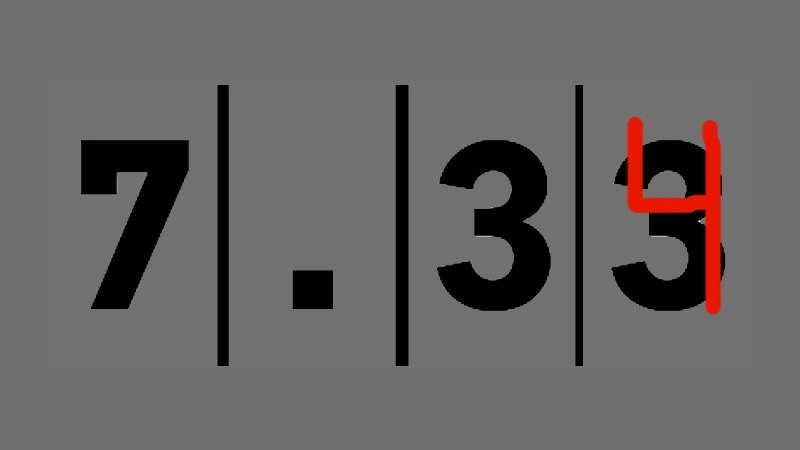
This is funny because the picture shows a big important number, then someone has to correct one digit with a red mark. It is like printing a birthday cake that says "Happy 35th" when the person is turning 34, and then trying to fix it with frosting while everyone is already looking.
Level 2: Version Strings Bite
Versioning is how software names releases. A project might use numbers such as 1.2.0, 7.34, or 2023.08. These labels help developers and users know which build, patch, or update they are talking about. In games, patch numbers become especially important because balance changes can completely alter how the game is played.
The visible number looks like 7.35, but the red mark changes the last digit so it points back toward 7.34. That is why the image feels like a correction. Someone is effectively saying, "No, not that patch, this patch." The lack of any other text makes the mistake look even bigger, because the whole image is just the number.
Patch management is the process of preparing, testing, publishing, and communicating updates. In a game like Dota 2, a patch might change character abilities, item stats, bugs, matchmaking behavior, UI elements, or event content. The public patch number becomes the label that ties all of that together.
For a newer developer, this is a lesson in how tiny details become important near release time. A single wrong digit in a README might be ignored during development, but on release day it can confuse users, support staff, and automated tooling. That is why teams review not only the code, but also the changelog, release notes, tags, screenshots, package names, and anything else users will treat as official truth.
The ChatGPT joke is that AI tools can produce convincing-looking text or images that still need human review. But the same is true of people. The funny part is not that a machine made a mistake; it is that the mistake looks exactly like the kind of thing everyone misses until the internet sees it.
Level 3: Patch Number Panic
The image is almost aggressively minimal: a large black 7 . 3 5 on a gray background, with the final 5 marked over in red so it reads more like a corrected 4. Paired with the post text "Those jokes with ChatGPT went too far" and a Dota 2 news reference, the joke lands as a tiny release-numbering mistake elevated into a whole AI-era accusation: even the patch banner may have hallucinated the version.
Game patch numbers are weirdly sacred to their communities. A number like 7.34 is not just a label; it becomes shorthand for a metagame, a balance philosophy, hero changes, item builds, tournament preparation, and thousands of players arguing with absolute confidence after reading half the notes. So when a graphic appears to say 7.35 but needs a red correction back to 7.34, it feels like the release process tripped over its own name tag at the podium.
The developer humor sits in versioning and release management. Software teams treat version identifiers as small pieces of text, but those small pieces of text coordinate documentation, patch notes, deployment artifacts, changelogs, support tickets, cache keys, branch names, marketing assets, and user expectations. A wrong digit can be harmless visually, or it can cause a surprisingly annoying chain reaction:
- people search for the wrong release
- users think a newer build has shipped
- documentation looks inconsistent
- automation may tag or publish the wrong artifact
- community discussion splits around a typo
That is why engineers get twitchy around version numbers. A version string is metadata, but metadata is how systems agree on reality.
The ChatGPT angle adds a more recent flavor. The meme suggests that "AI-generated" mistakes have become such a familiar punchline that any strange wording, mismatched detail, or suspiciously confident error can be jokingly blamed on ChatGPT. It does not matter whether an AI tool was actually involved. The accusation works because large language models are excellent at producing output that looks finished while occasionally being wrong in exactly the kind of tiny, visible way a tired human reviewer also misses. A proud tradition of blaming the newest tool for the oldest production problem continues.
There is also a game-development twist. Live games run on relentless update cycles. Balance patches, seasonal events, UI changes, client updates, localization, screenshots, news posts, and social assets all have to align. The code may be correct, the patch notes may be correct, and the graphic can still contain the one number every player will notice. Release trains do not fail only in compilers; sometimes they fail in the exported PNG.
Description
The image is a minimal gray graphic with oversized black version-like characters reading as "7 . 3 5," with tall vertical black separator bars around the dot and digits. A red hand-drawn correction mark overlays the final "5" to make it look like a "4," implying the number should be 7.34 rather than 7.35. There is no other visible text inside the image. In the source-post context, the caption jokes "Those jokes with ChatGPT went too far" and links to a Dota 2 news entry, making the image a game-patch/versioning gag about AI-flavored confusion around release numbers.
Comments
13Comment deleted
Even the patch number needed a human review pass before the AI-generated release train left the depot.
Wtf is this Comment deleted
It's only beginning Comment deleted
Bro this shit is so embarassing that it made me nauseated Comment deleted
this's just a sequel of this Comment deleted
This one actually is fun 🤣 Comment deleted
The: *starts twerking* is next level XD Comment deleted
Those screenshots is either one or another Comment deleted
So, when Half-Life 3 will finally be released? Comment deleted
when Valve becomes closed (they hate this number) Comment deleted
Bhai m login hi nhi krr para Comment deleted
😐 Comment deleted
I would report it 😐 Comment deleted