Skip to content
DevMeme
2386 of 7435
The Edge Case Reality Check
Testing Post #2652, on Jan 22, 2021 in TG

The Edge Case Reality Check

Why is this Testing meme funny?

Level 1: Missing a Spot

Imagine you’re packing your bag for a big trip and you feel super confident that you’ve got everything. You checked your clothes, your shoes, your snacks – all set, so you happily say, “Everything is ready to go!” But then, as you’re about to leave, your friend asks, “Do you have your passport?” Suddenly your stomach drops: you completely forgot the passport, the one super-important thing! In an instant, you go from calm and smiling to wide-eyed and panicked, thinking “Oh no, how could I forget that?!” This meme is just like that. The little grey mouse was the happy you, sure that all was well. The other mouse’s question about “edge cases” is like your friend asking about the passport – it’s the reminder of something crucial you overlooked. And the grey mouse’s final face (sweating and shocked) is exactly how you’d feel realizing you missed something important. In simple terms, the comic is showing that everything seems fine until someone points out the one thing you didn’t think about, and then you suddenly get worried. It’s a funny way to say: double-check the tricky bits, or you might end up really nervous at the last minute!

Level 2: Testing the Boundaries

At its core, this comic is talking about edge cases in software and how easy it is to overlook them. An edge case is a situation that is at the extreme end (the “edge”) of what your program is expected to handle. It’s the unusual or rare input, the kind of scenario that doesn’t happen often but could still occur. For example, imagine you write a program to divide one number by another. You test it with normal numbers like 10 divided by 2, and everything works. But what if someone tries 10 divided by 0? That’s a special case (dividing by zero) that will crash the program if you didn’t plan for it. Dividing by zero is a classic edge case. In general, edge cases include things like: an empty list where you expected a list of items, a really large number where you assumed numbers wouldn’t be so big, or a scenario happening out of order (like receiving data before you’ve initialized something).

In the meme, the grey mouse is like a developer who tested their code only with normal, expected inputs – maybe they ran the program a few times with typical data and said, “Yep, it works! We’re done.” That’s why he’s saying “Everything will be okay.” The beige mouse represents either a colleague or a tester (QA) who pipes up asking, “What about edge cases?” That’s basically asking, “Did you test the weird stuff that could happen? Did you handle the unusual situations?” The moment our developer hears that, he realizes he did not consider those, and that’s why in the last panel he looks shocked and says, “I forgot about those…” This is a lighthearted way to show the oh no moment when a programmer remembers they didn’t test something important. It’s a common piece of DeveloperHumor because just about every new programmer has been through this. You feel confident your code works because you tried the main thing it’s supposed to do, but then someone or something reminds you of a scenario you didn’t try, and you suddenly get worried.

Some key terms and ideas here:

  • Edge cases: These are the corner cases or boundary conditions. Think of all the oddball inputs or situations: empty inputs, maximum values, wrong data types, network errors, etc. For instance, if you wrote a function to sort names alphabetically, an edge case might be what if someone passes null or an empty list of names? What if all the names are identical? What if there’s a name with a very unusual character or extremely long length? A beginner might not think of these initially.
  • Happy path: This means the normal expected scenario where everything is correct. In testing, a newbie developer might only test the happy path (e.g., sorting a nice list of “Alice, Bob, Charlie” and seeing it sorts correctly to “Alice, Bob, Charlie” – great, it works on the normal case).
  • Bugs: A bug is an error or flaw in the code that causes it to produce a wrong result or to crash. Edge cases often cause bugs if they aren’t handled because the program doesn’t know what to do in that situation. In the comic, the implication is that if the edge cases are forgotten, the software might have hidden bugs. The panic comes from realizing “Uh oh, if a user hits that unhandled case, our app could break.”
  • Testing: This is the practice of running your code with various inputs to make sure it behaves correctly. Good testing isn’t just doing one or two normal cases and calling it a day; it involves trying out edge cases too. For example, to test a login form, you’d try a correct username/password (happy path), but you should also try a wrong password, an empty username, a extremely long username, a username with strange characters, etc. In an ideal scenario, a developer writes unit tests (small automated tests) for both typical cases and edge cases. There’s also integration testing for bigger scenarios and QA testing where testers try to break the application.
  • Edge case handling: This refers to the code you add to manage those special cases. Often it means adding conditions or checks. For example, let’s say we have a function that calculates the average of a list of numbers. Normally you sum them and divide by the count. But what if the list is empty? You can’t divide by zero length. So you’d add an edge case handling like: if the list is empty, maybe return 0 or throw a meaningful error instead of dividing by zero. That’s EdgeCaseHandling in action — you explicitly code for the edge scenarios.

Here’s a little pseudo-code to illustrate handling an edge case in a function, using the division example:

def divide(a, b):
    # Edge case: handle division by zero
    if b == 0:
        print("Cannot divide by zero!") 
        return None  # or you might raise an error or handle it appropriately
    return a / b

print(divide(10, 2))  # Normal case, prints 5
print(divide(10, 0))  # Edge case, prints warning and returns None

In this snippet, we anticipated the edge case of b == 0 and handled it by printing a warning and returning None (meaning “no result”). If we forgot to do that, calling divide(10, 0) would crash the program. This is exactly why the beige mouse’s question is so important. Often new programmers test their code with input like 10 and 2 (normal case) and see it works, but they might forget to test 10 and 0 (edge case). The meme jokes that the developer literally forgot about those edge cases until someone reminded him.

Debugging comes into play when a bug actually happens. If the edge cases are not handled and your program breaks, you’ll have to do debugging – which means reading through your code, finding where it went wrong, and fixing it. The sweating mouse in the last panel is basically thinking, “Oh no, I’m going to have to deal with a nasty bug later because I didn’t think of this.” That’s the DebuggingFrustration tag in action: it’s frustrating to debug an issue that you could have prevented with a bit more careful thought beforehand. We’ve all had that moment where our program crashes and as we investigate we say, “I can’t believe I didn’t think to check for that condition!” It’s a facepalm moment.

This comic strip is essentially TestingHumor because it highlights why thorough testing is important in a funny way. It’s common in developer circles to joke about “Did you try turning it off and on again?” or “It works on my machine!” – here the joke is “It works… as long as we don’t hit any weird cases we ignored.” The phrase “Everything will be okay” is like a naive developer’s motto when they’ve only checked the obvious cases. And “What about edge cases?” is the classic comeback that more experienced devs or testers will ask. Good developers learn to ask this question to themselves as they code: “Alright, this works for now, but what about when things get strange?” The panic of the grey mouse is something you eventually outgrow to some extent, because you start always thinking about edge cases from the start. (You might still feel a jolt of worry, but at least you’ve got a checklist in your head!)

Code quality is strongly tied to how you handle these situations. High-quality code means the program behaves well even if given odd or unexpected input; it doesn’t crash or misbehave horribly. That usually requires writing extra code for validation and checking. For example: validating inputs (making sure they’re within allowed ranges, not empty, correctly formatted, etc.) is crucial. Forgetting a validation is exactly how edge case bugs slip in. In the comic, the grey mouse forgot a validation or a check for something and now is concerned. A simple real-world example: say you wrote code to calculate an average and assumed you’ll always have at least one number to average. A quality-minded coder would put an if to check for an empty list just in case. A rushed or inexperienced coder might not, and then the program would throw an error if ever given an empty list. Code quality often comes down to these details – thinking “what could possibly go wrong or be out of the ordinary here?” and coding defensively.

In summary, this meme is teaching a lesson in a humorous way: Don’t forget to test the edge cases. When you’re new to coding, it’s easy to test your code with just the normal scenarios you expect and call it done. But part of becoming a better developer is learning to anticipate the not-so-happy paths. The panic we see is what happens if you don’t: you either realize at the last minute (as in the meme) or, worse, you realize only after a user finds the bug. It’s much better (and less stressful!) to catch those beforehand. So the next time you write some code and think “I’m finished,” try to channel that little beige mouse in your head: “Wait, what about edge cases?” If you address those early, you’ll save yourself from that sweating-grey-mouse feeling later on!

Level 3: Edge of Panic

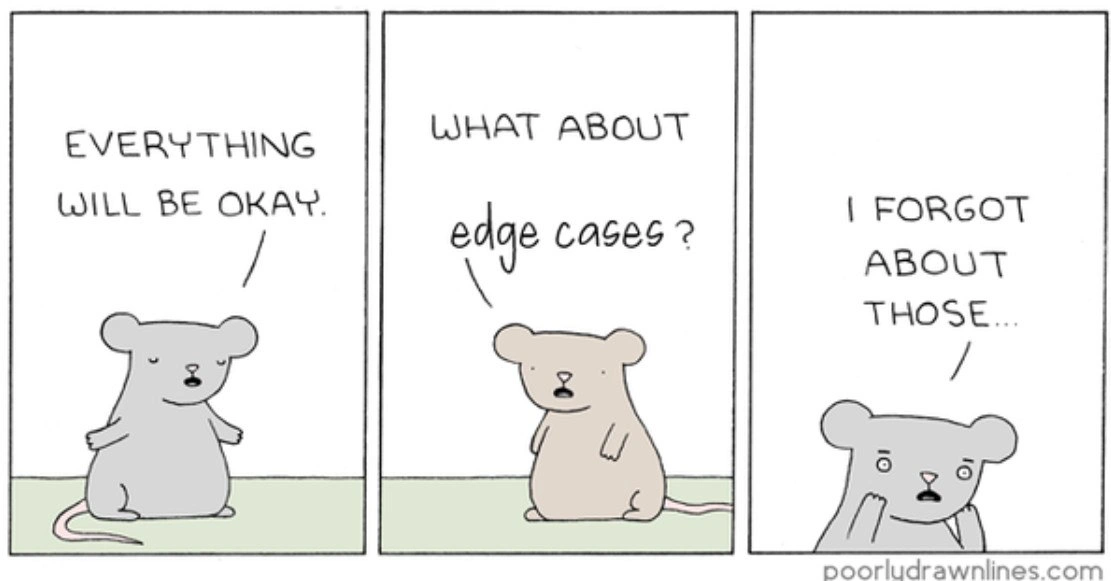
The three-panel comic hits uncomfortably close to home for seasoned developers. In the first panel, the grey mouse confidently proclaims “EVERYTHING WILL BE OKAY.” This is essentially the developer after writing code and running a few basic tests on the happy path – the standard, expected scenario where all inputs and conditions are normal. It’s that blissful moment of an optimistic release plan where we assume we’ve handled everything. But then comes the second panel: the lighter mouse asks “WHAT ABOUT edge cases?” Those two words are enough to send a chill down any programmer’s spine. Suddenly, in the third panel, the once-relaxed grey mouse is wide-eyed and sweating, admitting “I FORGOT ABOUT THOSE…” This transformation from Zen to panic is the punchline, and it’s funny because it’s true.

This meme perfectly captures edge_case_anxiety – the unique dread a developer feels upon realizing they didn’t consider some tricky scenario. It satirizes a classic scenario in software development: we feel confident that our code will run smoothly, until someone (often a sharp-eyed QA engineer or a cautious teammate) asks that dreaded question about edge cases. It’s the equivalent of a code review comment saying, “Hey, what if the input is empty or null?” and you feeling your stomach drop. The humor lands because every developer has been that grey mouse at some point, riding high on a batch of passing tests or a deployment green light, only to have their confidence come crashing down with a single question. The phrase “Everything will be okay” in the first panel might as well be famous last words in development – an almost superstitious jinx. In the real world, whenever someone declares “It’s all good, nothing can go wrong,” you can bet a concerned voice will chime in: “But did we handle X?” and then panic sets in as everyone scrambles to check. It’s a form of TestingHumor that resonates because it encapsulates a shared nightmare: discovering a bug minutes before (or worse, right after) shipping code because of a forgotten scenario.

The elements here highlight key patterns and anti-patterns in our field. The anti-pattern is forgetting edge cases – an oversight that often stems from focusing only on typical conditions. Developers sometimes get tunnel vision on the expected use cases (the main workflow, valid inputs, sunny-day scenarios) and assume that covers everything. This is especially tempting under tight deadlines or when you have a bit too much confidence in your change. The result is often a nasty surprise later. The meme’s second panel question, “What about edge cases?”, is basically the embodiment of a code review or QA feedback pointing out a blind spot. It’s a gentle reminder of a big issue: some forgotten validation or an unhandled condition that could crash the program or corrupt data. In the context of CodeQuality, not considering edge cases is a significant lapse. Good code isn’t just about making the happy path work; it’s about gracefully handling the weird, rare, and extreme situations too. The grey mouse’s shock in the final panel is the realization that a piece of that quality was missing.

Real-world tales of this scenario are endless in developer culture. Imagine a database migration script that worked on all test cases, except it forgot what happens if a table is empty — and of course in production one client’s table was empty, causing the whole migration to fail. Or consider a payment system that worked for most transactions, but nobody tried a transaction of $0 or a negative refund, and when that happened, the system blew up. These are bugs born from edge cases. A famous historical example is the Y2K bug: for decades, software printed years with two digits (“99” for 1999) and everyone assumed everything would be okay. But that was an optimistic assumption; come year 2000, those programs read “00” and interpreted it as 1900 or just crashed—pure edge-case chaos! It took massive efforts to fix that forgotten scenario before the deadline. In a less dramatic vein, every developer has a story like “the one time we didn’t account for emoji characters in usernames and it broke the notification system” or “we assumed no one would upload a 5GB file, until someone did and the server ran out of memory.” In each story, there was a calm before the storm – the code shipped under the belief that the team thought of everything – followed by the storm when reality proved otherwise. The panic depicted by the grey mouse is exactly how it feels at 3 AM getting an alert because some edge condition crashed production. It’s both horrifying and, in hindsight, darkly comedic.

Why do these oversights keep happening? Partly because handling edge cases is hard! By definition, edge cases are unusual; they lurk in the far corners of input ranges and system states, so they’re easy to miss during design and testing. Software systems today are complex, and the number of possible scenarios can be vast. Even with a battery of unit tests, integration tests, and code reviews, something can slip through – that one weird combination of inputs or an environment we didn’t simulate. There’s a saying among experienced engineers: “No code survives first contact with real users.” Real users find the craziest ways to break your assumptions. That’s why robust engineering processes encourage thinking about edge cases from the start (e.g., doing boundary value analysis in testing, where you actively test the extreme ends like 0, -1, max values, etc.). Teams that prioritize code quality will often have checklists or standards like “Did we handle empty inputs? Large inputs? Timeouts? Invalid data formats?” precisely to smoke out these things before the code goes live.

However, even in well-run projects, it’s impossible to predict every odd scenario — there’s a limit to human foresight. This is where the systemic challenge lies: product managers push for features quickly, developers are human and can overlook things, and sometimes everyone assumes someone else considered those weird cases. There’s also the phenomenon of confirmation bias in testing: we test to prove our code works, mostly using expected inputs, rather than trying to break it. The meme humorously underlines the importance of defensive programming – expecting the unexpected. The grey mouse forgot because maybe all the unit tests passed (but perhaps those tests didn’t include the nasty inputs). It’s highlighting a gap between best practices and real life: Best practice says “never assume anything, always validate and test thoroughly,” but in reality, corners get cut or blind spots happen, resulting in the all-too-familiar “I forgot about those…” moment.

On an organizational level, this comic could even be commenting on how sometimes projects have a false sense of security. Perhaps nobody wanted to be the “downer” in a meeting to ask “What about edge cases?” – much like the beige mouse does – because it often means more work or reconsidering the design. But that question is invaluable. The earlier someone asks it, the cheaper it is to address. If asked after deployment, well, then you’re scrambling with hotfixes and patches as users encounter those bugs. The meme’s frantic final panel is essentially a mini post-mortem: the team’s realization that they have to rush back to fix what they missed. If you’ve ever been in a deployment go/no-go meeting, there’s often that quiet pause where everyone mentally tries to think if any edge case was overlooked. And if someone finally speaks up with one, the mood in the room shifts exactly like it does for the grey mouse: from “We got this!” to “Oh no… did we account for that?!”

In terms of solutions, seasoned developers develop a healthy paranoia about edge cases. They know optimism in engineering should be balanced with skepticism: always assume there’s something you’ve overlooked. Teams might do dedicated edge case testing sessions or bring in QA specialists who are skilled at “thinking outside the box” (basically playing the role of the beige mouse, constantly asking, “What if X happens?”). There are even tools and techniques: for example, fuzz testing can automatically generate random or extreme inputs to throw at your program, effectively hunting for edge-case failures that no one thought of. It’s like unleashing a gremlin on your software to see where it breaks, so you can fix weaknesses proactively. High-quality code will also include a lot of checks and graceful handling: rather than assuming “this array will always have data” or “this number will never be zero,” a careful programmer will add code to verify those assumptions (and handle the scenario if the assumption is false). This might slightly complicate the logic, but it prevents those midnight crises.

Ultimately, the meme is a humorous reminder of a serious lesson: never declare victory too early in software development. The calm “Everything’s fine” mindset is a fragile illusion if you haven’t put in the work to consider the weird stuff that could happen. And as every battle-hardened coder knows, those weird stuff scenarios will happen eventually. The comedy lies in how quickly the reassuring mantra turns into a sweaty panic – a whiplash every programmer recognizes. It’s laughing at our own overconfidence. In a way, it’s a gentle PSA: Don’t forget the edge cases, or they’ll come back to bite you. The next time you find yourself about to say “ship it, looks good” – take a second and channel that beige mouse in your mind: “But what about…?” If a mental sweat drop forms like on the grey mouse, you know what you need to go back and add before all can truly be okay.

Description

This is a three-panel comic strip from 'poorlydrawnlines.com'. In the first panel, a calm, grey cartoon mouse confidently states, 'EVERYTHING WILL BE OKAY.'. In the second panel, another mouse appears and asks with a concerned expression, 'WHAT ABOUT edge cases?'. In the final panel, the first mouse is shown in a state of sudden, wide-eyed panic, holding its paws to its face and exclaiming, 'I FORGOT ABOUT THOSE...'. The comic humorously captures a quintessential moment in the software development lifecycle. It illustrates the developer's initial optimism after building the primary functionality (the 'happy path'), which is then abruptly shattered by the reminder of 'edge cases' - the numerous, less common, and often problematic scenarios that can cause bugs. For experienced engineers, this is a deeply relatable scenario that highlights the critical importance of thorough testing, quality assurance, and defensive programming to build robust, production-ready software. The panic is funny because it's a shared experience of realizing a seemingly complete project is actually full of potential holes
Comments

7
Anonymous ★ Top Pick The happy path gets your feature accepted in the sprint demo. The edge cases get you paged at 3 AM
  1. Anonymous ★ Top Pick

    The happy path gets your feature accepted in the sprint demo. The edge cases get you paged at 3 AM

  2. Anonymous

    Saying “we’re production-ready” is just the bat-signal for someone to ask, “Great - what happens at 03:14:07 UTC on 19-Jan-2038?” and suddenly you’re rewriting every datetime call you thought was bulletproof

  3. Anonymous

    After 20 years in the industry, you learn that 'everything will be okay' is just code for 'I've only tested the happy path and the edge cases will surface at 3am in production when the on-call engineer least expects it.'

  4. Anonymous

    The classic developer emotional arc: 'My code is bulletproof' → 'Wait, what if someone passes null?' → 'Oh god, what if they pass negative infinity wrapped in a string inside an array?' Edge cases are where optimism goes to die and where you realize your 'comprehensive' test suite tested exactly one happy path

  5. Anonymous

    Nothing torpedoes a two‑point story faster than someone whispering: “DST, retries, idempotency, and the p99 tail” - the edge‑case tax

  6. Anonymous

    Edge cases: the silent assassins turning your 'enterprise-grade' monolith into a 15-year tech debt bonfire

  7. Anonymous

    The happy path is always "okay" - until you define whether "okay" is inclusive or exclusive of Feb 29 in UTC‑12 when O’Connor uploads a 0‑byte file

Use J and K for navigation