Late-Night Code: Genius vs. Reality
Why is this CodeQuality meme funny?
Level 1: Magical Night, Scary Morning
Imagine you draw a picture really late at night when you’re super sleepy. In the dark and in your tired mind, you think it’s the most amazing drawing of your favorite cartoon character. You’re proud of it and go to bed happy. But when you wake up the next morning and look at that drawing in the daylight, uh-oh! It doesn’t look like you thought at all — the colors are wrong, the lines are all wobbly, and the character looks more like a funny monster than the nice picture you imagined. You might even laugh and wonder, “Was I the one who drew this? What was I thinking?!”
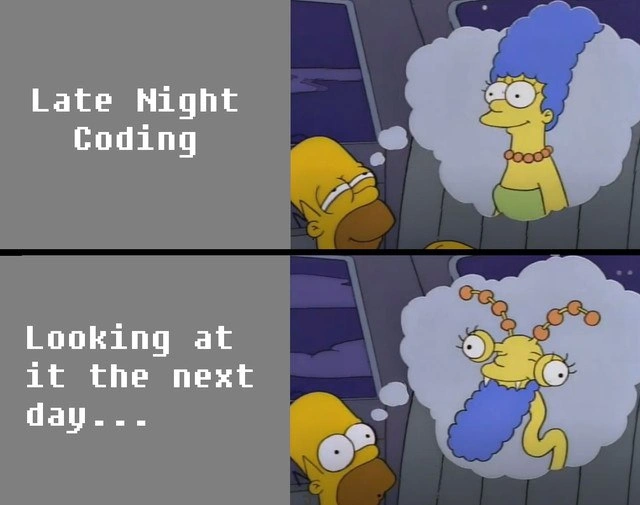
This meme is saying grown-up programmers sometimes feel the same way about the computer code they write when they’re very tired. Late at night, the code (which is like their drawing made of instructions) seemed perfect, just like your late-night drawing seemed awesome. That’s the “magical night” part — our tired brains trick us into seeing something great. But the next day, with fresh eyes, the code can look all wrong or messy — that’s the “scary morning” surprise, like seeing a monster where you thought there was a pretty picture. It’s a funny way to remind us that when we’re sleepy, we don’t always do our best work, and things can look very different (and much better or worse) once we’ve had some rest and sunlight. So, just like it’s often a good idea to draw or do homework when you’re not too sleepy, programmers learn it’s usually better to write or check their code when they’re fully awake. The meme uses Homer Simpson seeing normal Marge versus alien Marge to make us laugh about this common experience: sometimes, something we create at night can magically turn into a goofy monster by the next morning!
Level 2: Code Hangover
If you’ve ever pulled an all-nighter to finish an assignment or meet a project deadline, this meme probably feels too real. It’s depicting the classic “code hangover” — when you review the program you wrote late last night and find it’s not the suave masterpiece you imagined, but a confusing creature full of mistakes. In the first panel, labeled “Late Night Coding,” Homer is happily envisioning Marge Simpson looking normal. This represents how, at night, you’re sure your code is perfectly fine. Maybe you were in “the zone,” powered by adrenaline and LateNightCoding enthusiasm. By the second panel, morning arrives (“Looking at it the next day…”), and suddenly Homer sees Marge as a crazy alien version of herself. That’s you opening your file the next day, or walking into a morning_code_review, and realizing the code is actually pretty ugly (logic-wise, at least). It might have obvious Bugs (things that cause errors or incorrect behavior), or just be written in a strange, convoluted way that’s hard to understand.
Let’s break down why this happens in simpler terms. When you’re coding while super tired (SleepDeprivation), your brain isn’t firing on all cylinders. It’s like trying to solve a puzzle after being awake for 20 hours – you might force a piece to fit in a spot where it kind of works, even if it’s not the right piece. In coding, that translates to quick-and-dirty solutions. You might use a global variable as a shortcut, copy-paste some code from Stack Overflow without fully understanding it, or write a mega-sized function that does everything because it’s faster than breaking the problem into clean pieces. It works (whew!), so you feel great and go to sleep. But the next day, with a clear head, you see the puzzle more clearly and think, “Why did I do it like this?!” The solution that felt elegant at 2 AM now looks like a weird workaround, and maybe it even fails for cases you didn’t consider. This is a common CodingMistakes scenario for developers of any level, but junior developers experience it a lot as they’re still learning what good CodeQuality looks like.
CodeQuality basically means how well-written and maintainable your code is. High-quality code is organized, easy for others (and your future self) to read, and less likely to hide bugs. Low-quality code (the kind you often get from a bleary-eyed late night session) might run, but it’s like a messy room – everything’s scattered and only the person who made the mess (you, when tired) can barely navigate it. For example, maybe you named variables a, b, c instead of something meaningful, or you duplicated the same chunk of logic in five places because you were too exhausted to reorganize it. These choices make the code harder to understand and debug later. Debugging is the process of finding and fixing Bugs in your code. When your code is hard to read or overly complex, debugging becomes a nightmare. Have you ever tried to fix a bug in a rush and ended up adding another bug? That’s exactly the kind of frustration this meme is poking fun at. It’s a form of DeveloperFrustration many of us know: you’re frustrated at the bug, you stay up late to squash it, you end up writing something sloppy, and then you’re twice as frustrated in the morning when you discover the sloppiness.
The Simpsons imagery helps visualize this. Homer’s dreamy expression at night = a developer thinking “Finally, I fixed it, I’m a genius, time for bed.” Homer’s horrified face in daylight = the same developer the next morning going “What on Earth did I write? It’s hideous!” The “normal Marge” represents code as you hoped it was (correct and clean), and “mutant Marge” is what you actually have: code that’s sprouted unexpected problems (just like Marge suddenly sprouting extra eyes and weird tentacles). We’ve all had a moment where we open up the code we wrote yesterday and it feels like someone (or something) else wrote it. In group projects or professional settings, this is why you’ll often hear advice like “get some sleep and look at it with fresh eyes” or “let’s do a code review in the morning.” Our brains can trick us when we’re tired — we overlook mistakes or make risky compromises. Coming back after rest (or having a teammate review your code) is like shining a bright light on the monster under the bed, revealing issues you couldn’t see in the dark.
For a junior developer, it’s important to know this doesn’t mean you’re a bad coder — it’s just part of the learning (and working) process. Even experienced devs write questionable code when they’re in crunch mode or fatigued. The meme is a humorous reminder: take breaks, don’t trust your sleep-deprived judgment too much, and maybe avoid merging that 2 AM code until you’ve looked at it in the morning. Your future self will thank you! And if you do wake up to a “code monster,” don’t panic. Make a strong cup of coffee (like Homer’s equivalent of a reality check) and methodically start refactoring (cleaning it up) and testing. That wide-eyed Homer shock will quickly turn into a relieved chuckle once you’ve wrestled the monster code back into a decent shape. It’s all part of the developer journey.
Level 3: The 2 AM Delusion
At 2 AM, every exhausted developer becomes Homer Simpson gazing adoringly at a seemingly perfect piece of code. In the top panel of this meme, Homer's dreamy smile at normal Marge represents that LateNightCoding confidence: the code looks flawless in your bleary eyes. Fast-forward to the bottom panel — morning comes, Homer’s eyes bulge in alarm as Marge turns into a bug-eyed alien. That’s your “brilliant” midnight code revealed in daylight: a grotesque code monster you barely recognize. This joke hits on a universal truth in software development: code written under SleepDeprivation often mutates overnight from an elegant solution into a frightening mess of Bugs and poor CodeQuality.
Why does this happen? Think of all those times you’ve hacked away, fueled by caffeine and sheer willpower, convinced you’ve solved a tricky problem in a clever way. At 2 AM, your brain is running on empty; it will rationalize any hacky fix as genius. You might not notice that you created a dozen code smells (subtle hints of bad design) or left a trail of TODO comments. Without the sanity check of rest or reviews, you can introduce spaghetti code – logic so tangled it resembles a plate of noodles, impossible to follow. Ever woken up to find the “quick fix” you wrote is failing half the tests or, worse, took the entire app down? Nothing good happens after midnight in coding. The meme’s humor lies in that stark perception_vs_reality gap: your late-night code felt like a lovable Marge, but the next day it’s mutated into something from a Treehouse of Horror episode.
Seasoned developers know this transition all too well. They’ve stared at morning code diffs thinking, “Who wrote this monstrosity?!” — only to check git blame and gulp, it was them. It’s a mix of horror and dark comedy: you were the Dr. Frankenstein to last night’s code creature. :scream: The Debugging_Troubleshooting that follows is like battling a monster you unknowingly created. You spend the morning untangling that gnarly logic, renaming oddly-named variables (x, foo, temp2) into something sensible, and banishing those if/else creatures that “seemed like a good idea at 2 AM.” This is how technical debt is born: one late-night “just get it working” patch at a time, which you (or your teammates) must pay back later with heavy refactoring.
To paint a picture, imagine a snippet from a 2 AM commit:
# 2 AM quick fix:
data = fetch_data()
if data is None:
data = [] # just use an empty list if nothing's there (hacky shortcut)
process(data)
# Next morning: realize this hides failures - fetch_data() could have failed silently!
At night, setting data to an empty list avoided a crash and felt like victory. By morning, you’re facepalming at this bug-breeding hack: it masked the real error and made the program silently do the wrong thing. The meme perfectly captures that feeling — Homer's second-panel shock is basically you doing a double-take at your own code, thinking “Did an alien write this, or was it actually me?”
The senior take-away here is equal parts humorous and cautionary: sleep on big code changes. Our brains need downtime to reset. What looks like a solved problem at 2 AM may reveal itself as a mutant Marge mess when your mind is fresh. In real teams, this is why we do morning code reviews – a fresh pair of eyes (or just your own eyes after sleep) can spot the monstrosities hiding in that late-night commit. The meme uses a fun Simpsons reference to highlight a serious developer habit: always be wary of code crafted in the dead of night. It might compile. It might even work. But don’t be surprised if, come daylight, it makes you scream, “D’oh! What was I thinking?!”
Description
This is a two-panel meme using a scene from The Simpsons. Both panels feature Homer Simpson in profile with a thought bubble. In the top panel, labeled 'Late Night Coding', Homer is thinking of his wife Marge, who appears elegant and lovely in his thoughts. This represents a developer's perception of their own code while working late - it seems brilliant, elegant, and perfectly crafted. The bottom panel, labeled 'Looking at it the next day...', shows Homer with a more concerned expression. His thought bubble now contains a grotesque, alien-insect version of Marge. This hilariously captures the 'morning after' effect, where code written while tired and viewed with fresh eyes is revealed to be a confusing, monstrous mess. The meme is a timeless and deeply relatable joke for developers about the dangers of sleep-deprived coding, the creation of technical debt, and the stark difference between how clever code feels at 3 AM versus how maintainable it actually is
Comments
7Comment deleted
My git commit at 3 AM: 'feat: revolutionary new algorithm'. My git commit at 9 AM: 'refactor: remove whatever that was'
2 AM: “Behold, a single elegant reactive stream.” 9 AM: “Congrats, you’ve engineered a self-forking hydra that side-effects on every emission.”
The only thing worse than discovering your 3am 'elegant solution' is actually a distributed monolith with race conditions is realizing you committed it directly to main with the message 'fixed stuff' and the CI/CD pipeline already deployed it to production while you were sleeping
We've all been there - at 2 AM, that recursive lambda wrapped in a promise chain with side effects feels like architectural genius. Then morning coffee hits, you open the PR, and realize you've essentially built a distributed system to increment a counter. The real horror isn't the code itself; it's the commit message 'refactor: improved performance' that you'll have to explain in standup while your past self's hubris echoes through the codebase like a cautionary tale about the Ballmer Peak's evil twin
At 2am it’s “clean architecture”; at 9am it’s a temporal‑coupled micro‑monolith with hidden globals and three Managers - turns out daylight is the best linter
Legacy code is just someone else's late-night Marge, lurking to ambush the next dev's morning refactor
At 2am it looked like a clean functional abstraction; at 9am it's a temporally coupled singleton with hidden global state - caffeine performs implicit casts on architecture