Happy about the CI checks, until someone force-pushes straight to master
Why is this BuildSystems CICD meme funny?
Level 1: Rules vs. Shortcuts
Imagine you come up with a bunch of house rules to keep things tidy and safe – say, everyone must wipe their shoes, wash their hands, and ring the doorbell before coming in. You’re really happy because these rules will keep your home clean and secure. But then, your friend just climbs in through an open window without doing any of that. All your careful rules got skipped! You’d first be proud of your new house rules, and then you’d be shocked and upset when your friend ignores them. That’s exactly what’s happening in this meme: the developer made great “house rules” for code to keep it clean (through automated checks), and another person just found a shortcut and ignored all those rules. It’s funny in a frustrating way – we’re laughing because we know how it feels to have our hard work undone by someone who doesn’t follow the plan.
Level 2: Bypassing the Pipeline
This meme spotlights the clash between best practices and someone ignoring them. In modern software teams, it's common to use a CI/CD pipeline (Continuous Integration/Continuous Deployment pipeline) to automate quality checks on code. For example, when you open a pull request (PR) to merge new code into the main branch, a bunch of automated jobs might run: a linter will check your code style and find simple errors, a static analysis tool will inspect the code for deeper issues (like possible bugs or security vulnerabilities without actually executing the code), and a suite of tests will run to ensure nothing is broken. They might even enforce a test coverage percentage – meaning if your tests don’t cover, say, at least 80% of your new code, the PR can’t be merged. All these steps are about CodeQuality: they act as safety nets (often called quality gates) so that when code finally gets into the main codebase (usually the master branch), it’s clean and stable. In the top panel of the meme, the developer is super happy because they just added these checks to the PR pipeline. They’ve essentially upgraded their team’s workflow: now every time someone makes a PR, the code is automatically linted, analyzed, and tested. That’s a big win for any team’s BuildSystems_CICD process, and it feels good – it’s like having a robot assistant double-check everyone’s work! 🎉
But the bottom panel shows the nightmare scenario for that developer: someone bypasses the process entirely. Instead of creating a PR and letting the pipeline run, another developer pushes directly to the master branch. In Git (the version control system), pushing to master means you’re updating the main codebase immediately, without any review or checks. And doing a force-push (git push --force) is even more drastic – it means they forced their changes in, possibly overwriting others’ work or history on the remote repository. It’s generally considered a horrible idea to force-push to a shared main branch, because it can rewrite commit history and confuse everyone else who has the code checked out. Most teams avoid it except in emergency or very controlled situations.
So why is our initially happy developer now upset? Because all those wonderful CI checks on PRs don’t run when someone pushes directly to master without a PR. It’s like they set up an elaborate obstacle course to catch any bad code, and this other developer just walked around it entirely. None of the automated tests or linters ran on that direct commit before it merged. If there was a bug or a style issue, it went straight into the codebase. The static analysis that might have caught a mistake? Skipped. The test coverage requirement? Ignored. The result is that the code in master could now have undetected problems – exactly what the CI pipeline was supposed to prevent.
In practical terms, this is a violation of the usual workflow. Typically, teams enforce a rule: no direct commits to the main branch, only merges through PRs that pass all checks. Many repositories use branch protection settings to make this the rule: you physically can’t push to master; you must open a PR, and all CI checks must pass before you’re allowed to merge. This meme scenario suggests either those protections weren’t in place, or someone with the right permissions basically said “Nah, I’m gonna do it anyway.” (Maybe they were in a rush or felt their change was trivial – but it’s still dangerous.) In tag terms, this is a case of workflow_bypass: skipping the intended process (pr_pipeline) that ensures quality.
The humor here is very relatable in DeveloperHumor circles. The two-panel format (a happy-sad reaction meme) exaggerates the developer’s emotions: first, pride and happiness at improving the team’s process, then shock and disappointment when that process is disregarded. It’s essentially pointing out: “I did all this work to make our code safe and clean, and you just casually went around it!” For a junior developer or someone new to team projects, the lesson is clear: don't push straight to master, especially not with a force-push. It’s like driving on the shoulder to overtake traffic – sure, you get ahead quickly, but you’re breaking all the rules and everyone gasps in horror. The meme gets a laugh because many of us have either made this mistake once (and learned from the fallout), or we’ve seen it happen and caused a mini heart-attack for the team. In short, it’s a funny way to underscore why having a good process is important and why everyone needs to actually follow that process for it to work. The poor developer in the meme learned the hard way that even the best CI setup means nothing if people don’t play along by the rules of VersionControl workflow.
Level 3: All Checks, No Balance
At the highest level, this meme highlights a classic CI/CD pipeline facepalm scenario. The developer (the "me" in the caption) is initially elated because they fortified their pull-request workflow with every quality gate imaginable: a linter (automated code style checker), static analysis tools (to catch bugs and code smells before runtime), and test coverage thresholds (ensuring new code is well-tested). In other words, the works. Each new pull request triggers a pipeline that runs these checks, guaranteeing that only code passing all the scrutiny can be merged. It's a proud moment in any mature dev team: the build pipeline now automatically enforces code standards and catches issues early. The top panel’s grin represents that pipeline pride – the kind of joy a developer feels seeing all green checkmarks on their PR checks, confident that CodeQuality is under control.
Then reality comes crashing down in the second panel. Another developer bypasses the entire process by force-pushing straight to the master branch. Just like that, all those meticulous CI checks were circumvented. The same person who was beaming now has a look of shock and betrayal. Why? Because a direct push to master (especially a force-push) is basically a workflow bypass. It skips code review, skips the CI BuildPipeline on the PR, skips linting rules – it skips everything. None of the safeguards had a chance to run. The meme humor arises from this jarring contrast: the audacity of one git command undoing hours of careful pipeline engineering. It’s both funny and painfully true. Seasoned developers recognize this as the quintessential "we can build the perfect system, but we can’t make people use it properly" situation.
In a properly configured setup, the main branch (often named "master" or "main") is usually protected: direct pushes are disabled or restricted. That forces everyone to go through pull requests where all those checks run. If someone can still push to master (let alone git push --force rewrite history), it means either branch protection wasn’t in place or someone with special privileges decided to ignore it. This is the root of the joke: all the Continuous Integration machinery in the world won’t help if one renegade commit lands on master without review. It’s a breakdown of VersionControl discipline. The phrase "force-push to master" itself sends shivers down an experienced developer’s spine – it’s like hitting the big red eject button on all your safety protocols. You can imagine the on-call engineer’s face (exactly like the meme’s second panel) when they realize a colleague merged unvetted code directly into production’s doorstep.
This scenario is a textbook example of process vs. people. Technically, adding static analysis and tests to the PR pipeline is great – it’s supposed to catch bugs, enforce LintingRules, and maintain high standards automatically. But those checks are only as effective as the process around them. Here, the process was that changes must go through a PR (pr_pipeline), but someone decided to go cowboy and commit straight to master. It's VersionControlHumor because it pokes fun at a common team dysfunction: relying on tools instead of also instilling good practices (and perhaps forgetting to lock down important branches). The humor has a bit of dark truth: even the best devops setup can’t fully save you from a teammate clicking "push" on a Friday afternoon without a PR. Everyone in software has a war story about "that one time someone bypassed CI" – maybe it broke the build, maybe it caused a production incident, or maybe it triggered a frantic blame game. That shared trauma is what makes us laugh (and cringe) at this meme.
To visualize the contrast, consider the intended workflow versus what actually happened:
# ✅ Intended safe workflow with a feature branch and PR
git checkout -b feature/add-ci-checks
# ...make changes (add linter, tests, etc)...
git push origin feature/add-ci-checks
# Open a Pull Request -> triggers CI pipeline: lint, static analysis, tests run and must pass before merge
# 🚫 Actual bypass workflow: committing straight to master
git checkout master
# ...make some quick changes...
git commit -m "Hotfix: quick change"
git push origin master --force # Oh no, pushes directly to master, skipping PR and CI checks!
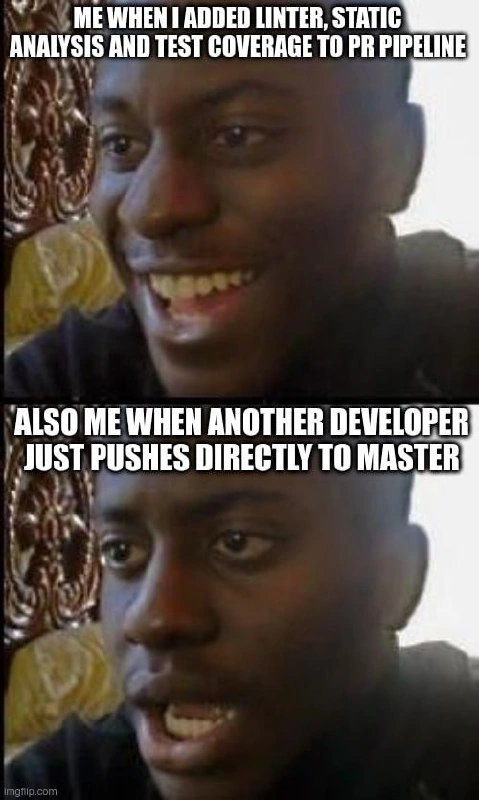
In the snippet above, the first part shows how code is supposed to flow through a PR pipeline (with all checks running before merge). The second part shows the rogue move: pushing directly to master with --force, which overrides any protections and lands changes on the main branch immediately. The result? The CI pipeline’s LintingRules, StaticAnalysis checks, and TestCoverage requirements were completely bypassed. The developer’s reaction in the meme says it all: first triumphant when the safety nets are in place, then horrified when someone walks right around those nets. The title text nails the two states: "ME WHEN I ADDED LINTER, STATIC ANALYSIS AND TEST COVERAGE TO PR PIPELINE" (pure joy at a clean PR process) versus "ALSO ME WHEN ANOTHER DEVELOPER JUST PUSHES DIRECTLY TO MASTER" (utter dismay at the chaos introduced). It’s a cheeky reminder that tools are only half the battle – team culture and enforcement are the other half. In summary, the meme’s humor lands because it captures a highly specific software engineering irony: celebrating a robust CI setup, then immediately having it rendered useless by one ill-timed git push. It’s the up-and-down rollercoaster of dev life in two simple images.
Description
Two-panel reaction meme featuring the well-known smiling then disappointed face. Panel 1 (top) shows the man beaming with joy; white impact font text at the very top reads: "ME WHEN I ADDED LINTER, STATIC ANALYSIS AND TEST COVERAGE TO PR PIPELINE". Panel 2 (bottom) shows the identical man now frowning in shock; the upper caption here says: "ALSO ME WHEN THE DEVELOPER JUST PUSHES TO MASTER". The meme humorously contrasts a developer’s pride in tightening a pull-request CI pipeline (linter, static analysis, coverage gates) with the frustration of a teammate bypassing the PR flow and committing directly to the main branch, undermining Build/CI discipline, version-control workflow, and code-quality safeguards
Comments
12Comment deleted
Weeks spent hardening the pipeline with linters and SAST, and then Dave types `git push --force origin master` - reminding us that our real attack surface is the org chart
Nothing says 'senior engineer' quite like spending weeks setting up pre-commit hooks, SonarQube integration, and 80% coverage requirements, only to discover your CTO has admin override and treats master like their personal development branch
Ah yes, the classic tragedy of modern software engineering: spending three sprints implementing a bulletproof CI/CD pipeline with linters, static analysis, and 80% test coverage requirements, only to watch a senior engineer with admin rights casually `git push --force origin master` at 4:47 PM on a Friday because 'the client needs it now.' It's the technical equivalent of installing a state-of-the-art security system on your front door while leaving the back door wide open with a welcome mat that says 'YOLO deploys welcome here.'
Bulletproof PR gates? Adorable - until 'git push origin master' turns your CI/CD moat into a kiddie pool
After wiring ESLint, static analysis, and coverage gates into PR checks, master still accepts direct pushes because "Require PR" and "Include administrators" were off - congrats on building the most sophisticated suggestion box CI
Static analysis in CI, but master’s unprotected - great quality gate, shame about the missing fence
Protected branch Comment deleted
better team Comment deleted
what if the same person Comment deleted
suicide Comment deleted
commit one and then push to main? Comment deleted
To master?) Comment deleted