Skip to content
DevMeme
4728 of 7435
When 'Work From Anywhere' Really Means Weekly Office Days In Belgium
RemoteWork Post #5182, on May 8, 2023 in TG

When 'Work From Anywhere' Really Means Weekly Office Days In Belgium

Why is this RemoteWork meme funny?

Level 1: Strings Attached

Imagine your teacher tells the class, "You can do a report on any country you like." You're excited because that sounds like total freedom, right? But then she adds, "Actually, you have to choose Belgium, and you'll need to come into school every Saturday to discuss it." In the end she still says, "See, I let you pick any country you wanted!" You would probably scratch your head or laugh because it's so obviously unfair. She didn't really let you choose freely at all. This meme is just like that: the company says you can work from anywhere, but then it makes you stay in one place and come in regularly. It's funny (and a little silly) because the promise of "do whatever you want" turned out to have a lot of strings attached — just like the teacher who only pretended to give you a free choice.

Level 2: Fine Print Freedom

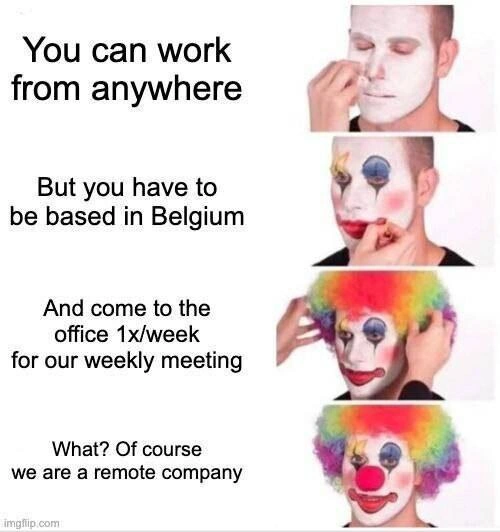
This meme breaks down a supposed remote job offer into its contradictory pieces, using a clown applying makeup to drive the point home. In the first panel, the company proudly says "You can work from anywhere." In an ideal world, that phrase means exactly what it sounds like: you could be coding from a beach, a mountain cabin, or your living room couch — as long as you get your work done. That's the essence of remote work: you aren't tied to a specific office location every day. Many tech companies boast about being remote-first, meaning they've set up their operations so that everything from meetings to project management is accessible to people working outside the office. It's an attractive promise, especially to a junior developer who might be dreaming of flexibility or even working while traveling.

But then the second panel drops the catch: "But you have to be based in Belgium." Suddenly, "anywhere" shrinks to a very specific somewhere. This is the meme's way of saying there's fine print on that grand promise. In real job postings, this might appear as a line in the requirements like "Candidates must reside in Belgium" or "Must have work authorization in Belgium." It turns the so-called global job into a local one. Why would a company do this? Often it's for practical reasons like time-zone alignment, tax laws, or hiring regulations — they might not be set up to employ people in every country. However, to someone reading "work from anywhere," this condition feels like a bait-and-switch. It’s the equivalent of a sale sign that gets you excited, only to find in tiny text that the sale applies only to one small shelf at the back. The humor here comes from that deflated expectation: the glorious anywhere was really just "anywhere... as long as it's in Belgium."

The third panel adds another requirement: "And come to the office 1x/week for our weekly meeting." Now the situation is even less like true remote work. If you have to physically be in the office every week, you obviously can't stray too far from that office. This is basically describing a hybrid work arrangement: a mix of remote and in-person. Many companies call themselves remote but still require team members to come in periodically (be it once a week, once a month, or for special events). Hybrid setups can be perfectly fine, but labeling a job like that as "work from anywhere" is misleading. As a new developer, you might think, "Wait, if I'm truly remote, why do I need to be there in person for a weekly meeting? Can't that be a Zoom call?" Exactly. A genuinely remote-first company would typically handle weekly meetings via video conference or other online tools so that nobody has to travel. By insisting on an in-person weekly meeting, this company is showing that it hasn't fully let go of the old office-centric habits. They're effectively saying: "You can work from home... most of the time... but we still need to see you regularly to believe you're working." It undercuts the freedom that remote work is supposed to give. If you were hoping to live in another country or far-away city, a weekly commute back to a Belgian office would be a deal-breaker. The meme highlights how this requirement turns the idea of freedom to work anywhere into something much more limited and inconvenient.

Finally, in the last panel, after piling on those caveats, the company still insists, "What? Of course we are a remote company." This is where the clown has fully transformed with the colorful wig — a visual sign of full-on ridiculousness. Here we see a prime example of misaligned expectations. The company thinks that having some work-from-home flexibility earns them the "remote" badge, while an employee or candidate would expect "remote" to mean no mandatory office time and no need to live in a particular spot. The humor (and frustration) comes from that disconnect. It's like the company is fooling itself — or trying to fool others — by clinging to the label despite not meeting the basic definition. In plainer terms, they're not practicing what they preach.

For a junior developer or anyone new to the industry, this meme is a lighthearted cautionary tale. It reminds you to always read the details of a job description. Terms like "remote-friendly" or "work from anywhere" can hide specifics: sometimes RemoteWork really means "you can work from home two days a week" or "you can work from anywhere within our city/state/country." The clown makeup meme format helps visualize how each additional rule makes the initial promise more laughable. Each panel's caption appears like a series of statements a naive company representative is making. As he adds white face paint, then goofy painted features, and finally the rainbow clown wig, the company's stance looks more and more silly. The clown symbolizes someone being foolish or not honest with themselves.

In summary, the meme spells out something important in a funny way: if a company truly is a remote company, it won't demand you live in one specific place or show up at the office for regular meetings. If it does, then it's using the word "remote" very loosely. For someone early in their career, it's a good reminder to clarify what a company means by remote work. Does "work from anywhere" literally mean any location, or is there a hidden "...in Belgium" attached? Are they remote-first in practice, or will you be pulled into weekly on-site meetings? This scenario resonates because it’s happened often enough to become a joke. The meme highlights the gap between a slick promise and the actual workplace reality you might face after signing the contract. And by using a clown to deliver the message, it lets us laugh at how absurd these mixed messages can be.


Level 3: The Remote Ruse

"You can work from anywhere," they proclaim, and every seasoned developer's eyebrow immediately arches in suspicion. In the first panel of this classic clown makeup meme, a hopeful line sets the stage for a utopian RemoteWork arrangement. But as each subsequent panel reveals more conditions, the bold promise turns into a farce. It's a well-choreographed piece of CorporateCulture satire: each new line of text arrives like a hidden clause in the fine print, and with it the character paints on another layer of clown makeup, symbolizing the company's growing foolishness (and our dwindling trust).

By the second panel, the too-good-to-be-true offer has its first catch: "But you have to be based in Belgium." Suddenly, "anywhere" doesn't quite mean anywhere. This is a classic bait-and-switch we've all seen in job listings. The company dangles global flexibility to lure talent, then reels it back with a geographic restriction. For an experienced dev, this is the moment you recognize a familiar pattern – the so-called remote job that's actually remote in name only. Sure, Belgium is a lovely place (chocolate and all), but requiring every "remote" worker to live there completely undermines the work from anywhere promise. It's like a cloud service that advertises 99.999% uptime and then says "only if you're in Western Europe." The contradiction would almost be funny if it weren't such a common frustration in real-world RemoteWorkCulture.

Then comes the third panel: "And come to the office 1x/week for our weekly meeting." Ah yes, the Meetings obligation – the final nail in the remote-first coffin. At this point, the clown has donned the rainbow wig, and the company has donned its full hybrid disguised as remote attire. The mandatory weekly office day is a telltale sign that they haven't truly embraced a RemoteFirstCulture. Any veteran developer recognizes this scenario: management insists on that one in-person meeting because they "value face time" or don't fully trust that Zoom can handle their oh-so-critical status updates. It's the hallmark of a half-hearted remote policy. You can almost hear the collective groan from employees: a weekly commute just to sit in a conference room and hear someone mutter, "This really could've been an email." The humor here is dark because it's painfully relatable. The company is effectively admitting: We don't actually know how to operate without hauling you into the office at least once a week. In an industry that managed entire product launches over video calls, clinging to a weekly physical meeting comes off as both absurd and archaic.

By the final panel, our clown-faced spokesperson declares, "What? Of course we are a remote company." This is pure CorporateHumor gold. The disconnect between the words and reality is glaring – and that's exactly why it’s funny. The clown makeup is now complete, representing the company’s full transformation into a parody of itself. They've checked all the buzzword boxes (remote-first! work from anywhere!) but nullified them with conditions, yet they still pat themselves on the back as if nothing’s wrong. This is the workplace reality many developers know: leadership proudly branding the company as progressive and flexible, while their policies are stuck in the past. It's a misaligned expectations circus, and the clown is the company, obliviously performing under the big top of denial. The seasoned tech crowd laughs (or maybe winces) because we’ve seen this show too many times. It's funny because it’s true – the humor comes from that shared exasperation of being promised one thing and getting another.

Behind the laughter, there's a genuine lesson about miscommunication and trust. Why do companies do this? Often it's a tug-of-war between HR and reality. HR wants to cast a wide net by advertising "work from anywhere," knowing it's a keyword that attracts top talent across the globe. But somewhere in the chain, a manager or legal department injects fine print: maybe for tax reasons, regulatory compliance, or plain old control-freak tendencies, they require employees to be local. Perhaps the company only has legal entities in Belgium, so technically you must live there for payroll – but instead of honestly saying "remote within Belgium," they go with a cheeky half-truth. And that weekly meeting? That's a cultural relic, a security blanket for old-school bosses who still equate seeing people at their desks with productivity. In an ideal RemoteWorkCulture, that meeting would either rotate virtually or be scrapped in favor of asynchronous updates on Slack. But change is hard. It's easier for a company to call itself remote than to actually be remote. The result is this clownish contradiction that the meme skewers so perfectly.

For those of us who have been in tech for a while, this meme triggers a mix of amusement and a sigh. It encapsulates an anti-pattern in modern work culture: calling something one thing while doing another. The term "remote-first" becomes a façade – a layer of makeup – that cracks under scrutiny. We've seen "Agile" teams that still follow a rigid waterfall; well, this is the remote-work equivalent. It's a company saying: We want the PR boost of being remote, but we also want the comfort of everyone within arm’s reach when we snap our fingers. The clown imagery is apt, because in the end, it's the company clowning itself. And as cynical veterans, we can't help but smirk at the irony: the only thing truly "remote" here is the company's grasp on what "work from anywhere" actually means.


Description

The meme uses the classic four - panel 'clown makeup' sequence: in each successive frame, a person applies more clown makeup and finally a rainbow wig, symbolizing increasing foolishness. At the left of each panel, bold black text states, top-to-bottom: "You can work from anywhere", "But you have to be based in Belgium", "And come to the office 1x/week for our weekly meeting", and "What? Of course we are a remote company". The background is plain white, and the clown’s wig is bright red, yellow, green, and blue, emphasizing the comedic tone. Technically, the joke highlights how some companies market themselves as remote-first while imposing geographic restrictions and mandatory in-person meetings, exposing contradictions in modern distributed-work policies familiar to software engineers evaluating job offers
Comments

9
Anonymous ★ Top Pick Their “remote-first architecture” turned out to be a distributed monolith: everyone’s sharded across Belgium, but we still hit the same single point of failure - meeting room 3B every Wednesday
  1. Anonymous ★ Top Pick

    Their “remote-first architecture” turned out to be a distributed monolith: everyone’s sharded across Belgium, but we still hit the same single point of failure - meeting room 3B every Wednesday

  2. Anonymous

    It's like deploying to production with 'git push --force' after claiming you follow GitFlow - technically possible, but everyone knows you're just making it up as you go along while pretending there's a coherent strategy

  3. Anonymous

    Ah yes, the classic 'remote-first' company where 'anywhere' is defined as 'within commuting distance of our Brussels office for mandatory Wednesday standups.' It's like saying your microservices are cloud-native but they all share a single MySQL instance running on a physical server in the basement that nobody's allowed to touch. The real kicker? They probably have a 'Remote Work Policy' document that's 47 pages long explaining why you need to be in Belgium for 'cultural alignment' while simultaneously bragging about their distributed architecture on the careers page

  4. Anonymous

    Their “work from anywhere” is a multi‑region org with a cron job that still SSHes into the single on‑prem box in Belgium every week

  5. Anonymous

    Like a 'cloud-native' monolith that demands weekly on-prem quorum for CAP theorem compliance

  6. Anonymous

    Our “remote” policy is data residency for humans: Belgium-only, with a weekly on-prem replication to keep culture strongly consistent

  7. @sylfn 3y

    the Earth of course

  8. @SomeWhereIBelong 3y

    Pain

  9. @estevanbs 3y

    Home

Use J and K for navigation