The Inevitable Regret of No Documentation
Why is this Documentation meme funny?
Level 1: Should’ve Written It Down
Imagine you built a really cool LEGO castle without keeping any instructions or notes because you thought, “I’ll remember how I did it.” You were so sure of yourself that you even told your friend, “I don’t need to write down how I built it – it’s obvious!” Now, half a year later, your little sibling accidentally breaks that castle. You decide to rebuild it, but when you look at the pile of LEGO pieces, you feel completely lost. You pick up strange pieces and have no idea where they go, even though you originally built it. You’re standing there scratching your head, maybe with a worried look like the man in the picture, realizing you have no clue how to put your own creation back together. You really wish you had written down the steps or drawn a simple diagram before. It’s a frustrating and funny feeling at the same time – funny because you were so confident back then, and frustrating because now you’re paying the price. The meme is just like that: it’s telling us in a goofy way that if you don’t leave yourself clues (write things down), you might end up bewildered by your own work later on. In simple terms, the lesson is: always leave a trail (like notes or instructions) for future-you, so you’re not stuck feeling like you’re reading a secret code that you yourself wrote!
Level 2: The Missing Manual
Stepping down to a junior developer’s perspective, let’s unpack the terms and scenario in simpler, clearer language. The meme is about documentation, or rather the lack of it. In software, documentation usually means any written text or illustrations that explain what the code does, how to use it, or why it was written a certain way. It can be as formal as a requirements document or as casual as comments in the code. Here we’re dealing with internal documentation: things like code comments, README files, or design notes that help developers (including future you) understand the codebase. Good documentation is part of CodeQuality and good Developer Experience (DX) because it makes life easier for anyone who works with the code later on.
The meme joke centers on the idea of “self-documenting code.” This is the notion that code can be written so cleanly and clearly that it essentially explains itself without needing separate docs or comments. For example, if you name variables and functions descriptively (totalPrice instead of tp, calculateInvoice() instead of calc1()), someone reading the code can guess what it’s supposed to do. Self-documenting code also involves structuring your logic in a straightforward way, so there’s no “mystery” for readers. Many programming guides encourage this – indeed writing clean, readable code is a great goal. However, this meme highlights the limit of that philosophy: no matter how clear you think your code is, time and complexity can still make it hard to understand later.
So what happened in the meme story? The developer (the “Me” in the caption) told their manager “we don’t need documentation” because they believed the code alone would be enough. Perhaps they said something like, “I’ll write the code so well that anyone can read it. Writing extra docs is just a waste of time.” They likely had confidence (maybe too much) in their memory and clarity of code. Fast forward six months (“6 months later…” as memes often dramatize), and now that same person – not a newcomer, but the original author – is looking at the code and feeling completely lost. The phrase “self-documenting code is hieroglyphics after half a year” uses hieroglyphics as a metaphor. Hieroglyphics are the ancient Egyptian writing system using symbols and pictures. To most people, hieroglyphs look like indecipherable drawings (gibberish), unless you’ve studied them. By comparing the code to hieroglyphics, the meme is saying the code has become impossible to read or understand without help, just like an ancient language that you don’t know.
The man’s confused, worried face in the image perfectly captures the “uh-oh” feeling. Junior devs might not have experienced this yet with their own code, but they probably know the feeling of being confused by code in general. Maybe you’ve looked at a piece of code from a previous class project or a snippet from an online tutorial after some time and thought, “What was this doing?” If there were no comments or notes, you might have struggled to recall the purpose. That’s exactly what’s going on here, except in a professional setting. The developer skipped writing any documentation (no comments, no guide, nothing) because they thought it wasn’t necessary. Now even they can’t remember the details, so the code seems foreign.
We should clarify some key terms that popped up:
- Technical Debt: This is a term you’ll hear often in development. It describes the idea that when you take shortcuts or do things the quick-and-dirty way in code, you incur a “debt” that you eventually have to pay back. Think of it like credit card debt: you can buy something now (save time by not writing docs or not refactoring messy code), but you “owe” that effort in the future with interest (later, it will cost extra time and hassle to fix or understand things). In this meme, skipping documentation was a shortcut – it saved time initially (no need to write stuff up) but it created a technical debt. The “interest” on that debt is the confusion and lost productivity the developer experiences six months later trying to figure out their own code. It’s an invisible debt because everything might have seemed fine for a while; nothing was obviously broken. But eventually, that choice catches up with them.
- Developer Experience (DX): This refers to the overall experience of developers when using certain tools, systems, or codebases. Good DX means it’s easy for developers to do their work – the code is readable, the environment is well-documented, things run smoothly. Bad DX, in contrast, means developers struggle with unclear error messages, poor documentation, confusing code, etc. In this scenario, not having documentation turns what could be a straightforward task (like updating a feature or fixing a bug) into a frustrating scavenger hunt through code. That’s a bad developer experience for the person who has to work on the code (even though that person is the one who wrote it!). This meme is tagged under DeveloperExperience_DX because it’s highlighting how a lack of docs can make a developer’s life harder down the line.
- Documentation Gap: You might not see this term every day, but it basically means the gap or discrepancy between what’s in the code and what’s understood by the team. A documentation gap happens when there’s missing information – things that aren’t written down anywhere. Here the gap is huge: the code’s logic and intent exist, but only in the code itself, and no one (not even the author) currently understands it fully because nothing was documented to bridge that gap in understanding.
- Legacy Code: Typically, this term refers to old code inherited from someone else or from the past, often without much documentation or tests. It’s the kind of code base where people are afraid to touch things because they don’t fully know how it works. In this meme’s twist, code became “legacy” to its own author in just six months. That’s pretty fast! But it underscores the idea: any code can become legacy code if you leave it alone long enough with no documentation or no updates. Suddenly, it feels like it was written by a stranger.
For a junior dev, this meme is a cautionary tale disguised as a joke. It’s DocumentationHumor because it humorously points out the downside of not documenting. As a newcomer, you might have heard mixed advice about comments and documentation. Some mentors or guides say “comment every line” (which can be overkill), while others say “if your code is good, you don’t need comments” (which can be too idealistic). The reality is usually in between: you want to write clean code and provide some documentation especially for complex parts or overall architecture. This meme’s scenario shows the extreme end of taking the “we don’t need docs” philosophy. It highlights a common DeveloperPainPoint: coming back to code that’s hard to decipher.
Think about the phrase: “convincing my manager that we don’t need documentation.” If you’ve just started in the industry, know that documentation is often a point of contention. Managers care about timelines and output; developers care about code maintainability and clarity. Sometimes writing docs is dropped to meet a deadline or because the team thinks it’s unnecessary bureaucracy. Early in your career, you might not be the one deciding this, but you could feel the effects. For instance, imagine joining a new project where there’s zero documentation. On your first day, they hand you a huge codebase and say “jump in!” How would you feel? Probably a bit like the confused guy in the meme, right? That’s why documentation (even simple README files or basic comments) is so important for onboarding and maintaining code.
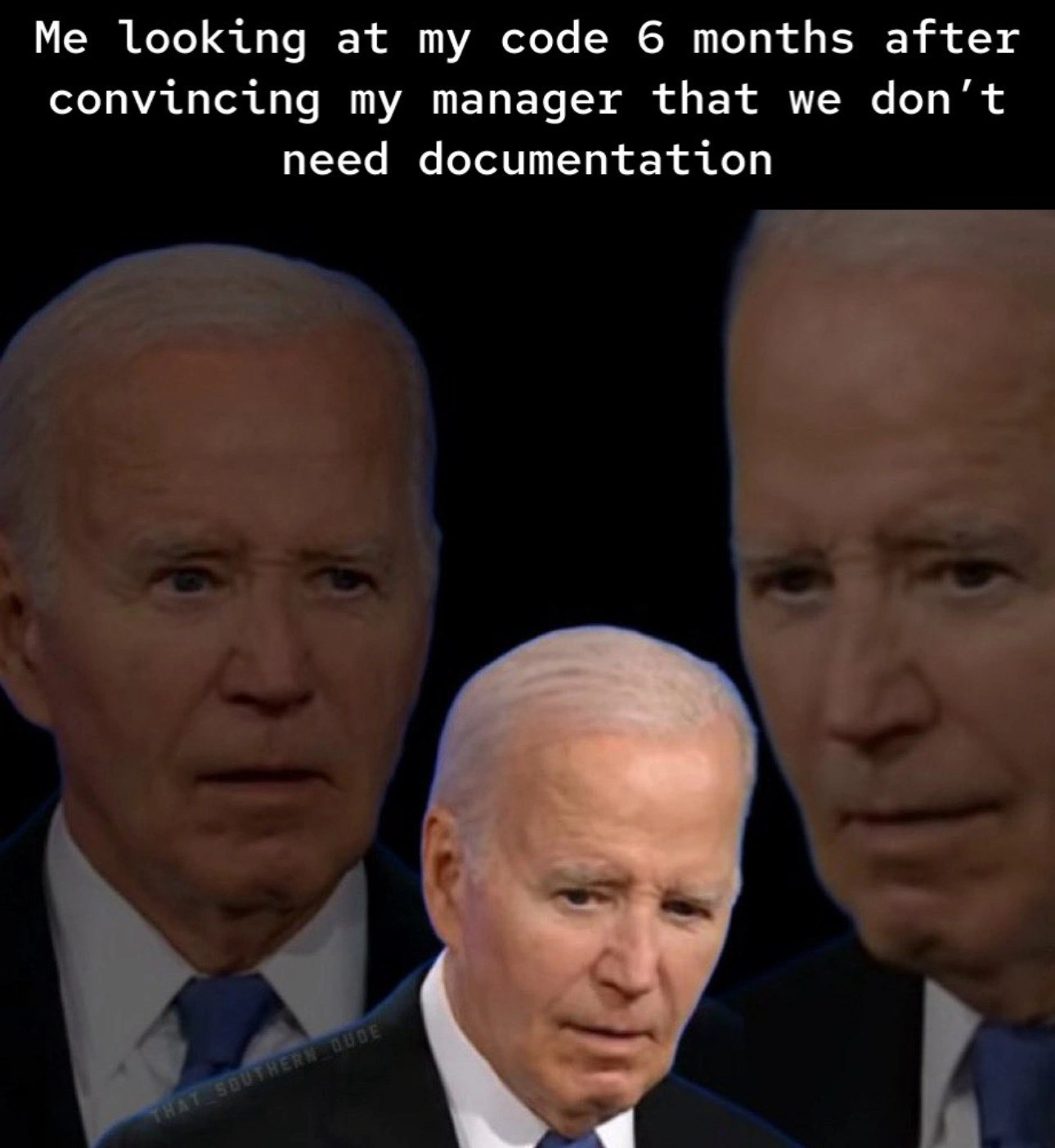
The image used (the confused older man) is actually a popular template for regret or realization. It’s often used to show someone coming to a shocking understanding that they messed up. Here it doubles as an “I did this to myself” face. The overlapping effect (multiple transparent layers of the same face looking stunned) emphasizes internal disarray – as if the person is thinking “Oh no... oh no... oh no...” on repeat. Even if you didn’t know who that man is or any deep meme lore, you can relate to his expression: he looks like someone who just realized a big mistake or is confronted with something baffling.
For a junior dev audience, the takeaway from this meme is: don’t underestimate the value of documentation. What seems obvious now may not be obvious later. We humans forget details over time, especially in the fast-paced world of tech where you might work on many different things in six months. Even the original coder can become a stranger to their code after enough time passes or if the code is particularly complex. This meme is basically a funny reminder that writing down a few notes or comments could save you from future confusion. It’s a way of laughing at our tendency to be shortsighted. RelatableHumor like this often carries a little lesson.
One more concept to clarify is the idea of “invisible” problems. When we say lack of documentation is invisible technical debt, we mean that at first, everything seems fine. The code runs, the feature works, so skipping docs appears to have no negative effect. Unlike a bug, which crashes your program or throws an error (very visible!), missing documentation doesn’t break anything immediately. The code still functions. So it’s easy to think, “See? We didn’t need those docs after all.” But the “debt” accumulates quietly: the real impact is only seen later when someone needs to understand or modify that code. Suddenly, what was an invisible problem becomes very visible and urgent. This delayed effect is why it catches people off guard – just like the meme shows the developer’s shock months later.
The term six_months_later from the context tags is actually a common trope in jokes and storytelling. It signifies that some time has passed and now things are different (often worse or ironic compared to before). In our context, it’s practically a mini-narrative: first scene, convincing the manager no docs are needed; second scene, six months later, oops. For a newbie, this is a good mental model: always consider what could happen down the road, not just the immediate moment. Today’s decision to skip writing that wiki page might be tomorrow’s confusion.
In summary, at Level 2 we break down the meme to real-world terms:
- Before (Decision Time): Developer thinks their code is clear enough, persuades manager that writing documentation is unnecessary. Perhaps they want to save time or they genuinely believe in code self-documentation.
- After (Consequence Time): Half a year later, the same developer is stuck and confused by their own code, having forgotten the finer points. The “self-documenting” code wasn’t as self-explanatory as hoped, at least not after memory faded. The lack of any written clues means they have to put on their detective hat and slog through the code to rediscover what it does.
- The Humor: Comes from that reversal – the confidence vs the reality – and the fact that the developer basically set a trap for themselves. It’s funny to others because we recognize the folly and maybe have done similar things. It’s a bit of “laughing with self-deprecating humor” because the joke-teller is the butt of the joke (the “Me” in the caption is admitting their own mistake).
After going through this explanation, even a relatively new developer can appreciate the meme. It underlines a common experience in a lighthearted way and teaches why things like documentation, which might seem boring, actually matter in the long run. Plus, the image of an utterly baffled person staring at something they themselves made is universally funny – it’s like a chef who forgot the recipe to their own dish. And in development, that scenario happens more than you’d think!
Level 3: The Hieroglyphic Hangover
At the senior engineer level, this meme hits painfully close to home. It lampoons the overconfidence in self-documenting code and the inevitable technical debt that comes due later. Six months after writing what we swore was crystal-clear logic, we’re squinting at our own code like it’s written in ancient hieroglyphics. The top caption admits: “Me looking at my code 6 months after convincing my manager that we don’t need documentation.” In other words, we once convinced the boss that writing docs was unnecessary overhead, and now we’re the ones paying the price – again. The joke lands because every experienced developer has lived this scenario: you skip writing things down, time passes, and suddenly even your own creation feels foreign.
This image brilliantly captures the face of regret. The meme uses a suited older man (yes, that’s President Joe Biden in a perplexed moment) layered three times with fading transparency. Those overlapping, confused expressions echo how you feel internally: shock, confusion, and a bit of “Oh no... not this again!” The repetition almost looks like a ghost of coding past haunting you – each faded face could represent a previous time you made the same mistake. It’s a visual metaphor for the mental fog and panic of trying to recall lost context. The black background and white text give it that classic developer humor meme format, but the content is an all-too-real DeveloperExperience_DX nightmare.
Why is this so funny (and painful) to seasoned devs? Because it satirizes the myth of self-documenting code. We boldly claim “the code is the documentation” and push back on writing proper docs or comments. Maybe we were up against a deadline or just feeling proud of our “clean code.” We assume our future self or any other programmer will instantly grasp the code’s intent from variable names and structure alone. It’s a nice theory that often crashes into reality. The reality is that institutional memory is volatile – after half a year (which in software time can feel like eons), the detailed reasoning we held in our head has been paged out of our mental RAM. Without external documentation to swap in, we experience a brutal cache miss of context. Suddenly, code that seemed straightforward is as cryptic as an untranslatable carving.
Seasoned developers recognize this as a form of invisible technical debt. Technical debt isn’t just messy code or quick hacks; it can also be the absence of things – like missing docs or tests. Skipping documentation is taking a shortcut: you save a bit of time now at the cost of spending much more later. The interest on that debt comes due when you (or your teammates) have to modify or debug the code months down the line. We’ve all had those “I am code archaeologist now” moments, where digging through commit history, cryptic variable names, and absent comments is like deciphering the Rosetta Stone. In fact, the hieroglyphics analogy is perfect: without a Rosetta Stone (i.e., some documentation or hint), decoding ancient Egyptian text was impossible. Likewise, without any docs, understanding your own six-month-old code can feel like an archaeological expedition. You examine artifacts (functions, weird flags, magic numbers) and try to infer what they mean. Why did we pass False and 7 into that function? What on earth is processDataLegacy() doing under the hood? With proper docs or even a decent comment, a quick look would refresh our memory. But lacking that, we’re left to reverse-engineer our past thinking from clues in the code. It’s detective work that DeveloperHumor turns into a shared joke because we’ve all been there.
This scenario is a textbook documentation gap. There’s a gap between how the code operates and our understanding of it after time passes. The meme text specifically says “after convincing my manager that we don’t need documentation.” So not only did we choose to skip writing docs, we actively sold that decision to management. Perhaps we argued that writing extensive docs was a waste of time, or that our code quality was so high that docs would be redundant. Maybe the manager was skeptical but we assured them with a straight face, “Don’t worry, I write self-documenting code. Anyone can read it like a book.” Fast-forward half a year, and now we are the ones who can’t read it. The humor has a self-deprecating flavor: the developer (the “me” in the caption) is essentially admitting they were wrong in a comedic way. It’s a relatable pain – a mix of embarrassment and “I really should know better by now.”
In practice, six months is long enough for pristine code to turn into legacy code, especially if no one has touched it in the interim. There’s a famous adage among programmers: “Any code you wrote more than 6 months ago might as well have been written by someone else.” In this case, you are “someone else” to your past self. You encounter your own code with fresh (and totally baffled) eyes. Every senior dev knows the spooky feeling of opening an old module and thinking, “Who wrote this nonsense?” only to git blame and discover your own name. 😅 The meme nails that shock – Joe Biden’s bewildered face says it all: “I have no idea what I’m looking at, and I’m the one who made it.” The DocumentationHumor here is that we always promise ourselves “Next time I’ll document things”, yet many of us slip back into the habit of trusting our memory or the code’s clarity. The title even adds “after half a year, again.” That “again” is doing a lot of work – it implies this isn’t the first time this happened. It’s a gentle roast of the coder’s own forgetfulness and overconfidence. Senior engineers chuckle (and maybe groan) at that because repeating this mistake is common. You’d think we’d learn after the first painful episode, but DeveloperPainPoints like this tend to repeat across projects and even careers.
Let’s talk about the broader pattern and relatable humor aspect. Why do developers often push back on documentation? Partly, there’s a culture in some teams that code should be self-explanatory if written well – comments and docs are seen as a sign of unclear code or just extra work that goes stale. There’s also the immediate reward structure: writing new features feels productive and gets praise, whereas writing docs feels like a chore with no immediate visible benefit. We might also have had experiences with out-of-date documentation that misled us, so we swing to the opposite extreme (“no docs at all”). So in that earlier meeting with the manager, perhaps the developer genuinely believed they were saving time and doing the right thing. The manager, not being deep in the code, might have relented, happy to skip what sounded like redundant work. This dynamic is common: short-term thinking wins because deadlines loom, and documentation is an easy item to cut. The true cost is hidden – until months later. By then, the context is gone and everybody, including the original author, is scratching their heads. The “invisible” nature of this TechDebt is key: it’s not like an immediate bug or a crashed server (something obviously broken); instead, it’s a slow ambush. Everything works fine… until someone has to maintain or extend the code. Then the DocumentationWoes hit hard.
The comedic irony is that writing a bit of documentation or even a few well-placed comments would have saved hours (or days) of frustration later. Now we might need a full-on code spelunking session to reconstruct what we were thinking. Senior devs know that dreadful feeling of opening a file and trying to load all those details back into their head. You scroll through lines of code, looking for any hint of what the trick was. If you left no breadcrumbs (no comments, no README, not even a helpful commit message), you’re basically debugging knowledge, not just code. It’s developer horror masked as humor: the caption could also read “Congratulations, you played yourself.”
Even more humor comes when you think of how the conversation with that manager might go now. Imagine walking into your boss’s office with that same confused Biden expression, admitting “Uh, so... remember how I said we didn’t need documentation? Well, I can’t decipher part of our system.” It’s a humbling and absurd situation. In a way, the meme is a gentle PSA in the form of RelatableHumor: document your code, or future-you will regret it. It resonates especially with senior devs because we’ve all cut a corner like this and then felt the sting later. The overlap of the man’s bewildered face is basically the senior engineer’s nightmare: confronting their own undocumented_code_blues.
To put it succinctly, this meme’s humor comes from truth. It exaggerates that “code turning into hieroglyphics” feeling, but only slightly. The longer you leave code without documentation or updates, the more it feels like some ancient script you have to decipher. The metaphor is clever: hieroglyphics were eventually decoded using the Rosetta Stone, a key that translated the unknown language into known ones. In our case, the equivalent of a Rosetta Stone would be documentation or comments that translate the code’s intent into plain language. But we don’t have one, so we’re left staring at the symbols (code) and guessing. As a result, the developer in the meme (i.e., us) is experiencing a heavy facepalm moment – equal parts regret and “here we go again” despair. And because this scenario is so relatable across the industry, it’s instant comedic gold in any thread about DocumentationWoes or DeveloperPainPoints.
We can even draw parallels to famous fails and cultural references. This situation is the software equivalent of not labeling your leftovers and six months later asking, “What is this science experiment in the fridge?” Or like convincing yourself you’ll remember all the important details of a project without writing anything down – only to get amnesia on the crucial bit. It’s tragicomic. The experienced folks laugh because we survive these snafus and know they’re partly self-inflicted. The young developers laugh (and maybe take mental notes) because it’s portrayed in a way that’s obvious and absurd – a cautionary tale wrapped in humor. The suited man’s worried look is basically saying, “I messed up, didn’t I?”
In summary, Level 3 analysis shows the rich context: Documentation is a first-class citizen of code quality, and ignoring it is a classic folly that turns around to bite us. The meme condenses a whole tech debt lecture into one image and one caption. It uses the well-worn meme format of an astonished face to drive home the “oh crap” realization. It’s funny because it’s true, and it’s self-deprecating humor because it’s the coder making fun of their own mistake. For a seasoned developer, this hits on multiple levels: the initial bravado (no docs needed!) contrasted with the later comeuppance (can’t understand my own code). It’s basically a cycle of hubris and humility that we know all too well in software development.
| 6 Months Ago (Writing Code) | Now (Reading Code) |
|---|---|
| “Docs are optional, the code speaks for itself.” | “What is this code even saying?!” |
| Confident memory of every detail. | Barely recall writing any of this. |
| Saved time by skipping documentation. | Wasting time deciphering everything. |
| Code looked elegant and clear. | Code reads like gibberish hieroglyphs. |
| “Anyone will understand this logic.” | “Not even I understand this logic.” |
The table above sums it up: what we thought at coding time versus the reality later on. It’s a relatable horror story in software: a missing_docs catastrophe that elicits laughter precisely because it’s so common and avoidable. The meme’s punchline is essentially that self-documenting code isn’t enough – without at least some written guidance, you’ll be as lost as an archaeologist in a tomb full of undeciphered symbols. And that wide-eyed, worried face in the meme? That’s every developer who’s realized their code documentation decisions have come back to haunt them. It’s funny, it’s sad, and it’s a free lesson: next time, maybe write some docs!
Description
A meme showing three overlapping, concerned-looking images of Joe Biden. The text at the top reads, "Me looking at my code 6 months after convincing my manager that we don't need documentation." This visual format, often used to convey confusion and self-reflection, perfectly captures the developer's dawning horror upon returning to a complex, undocumented project. The joke lands with senior developers who have experienced this exact scenario: the short-term win of skipping documentation leads to long-term pain, making code difficult to maintain, debug, or extend. It's a classic tale of hubris and its consequences, where "future you" pays the price for "past you's" shortcuts. The watermark "THAT_SOUTHERN_DUDE" is visible at the bottom left
Comments
23Comment deleted
The only thing more cryptic than undocumented legacy code is the commit message from six months ago that just says 'fixes'
Amazing how “the code is the documentation” expires exactly when your brain’s LRU cache evicts the whole module - apparently the TTL is six months
The three stages of grief when you realize that 'self-documenting code' is just technical debt with a marketing degree, and your past self was essentially running a Ponzi scheme against your future productivity
Ah yes, the classic 'self-documenting code' argument - where 'self-documenting' actually means 'I'll definitely remember why I wrote this Byzantine state machine with three nested ternaries when I'm context-switching back from the payment gateway rewrite.' Six months later, you're essentially doing archaeological excavation on your own tomb, except the hieroglyphics are variable names like `tmp2` and `handleStuff()`. The real kicker? You'll spend more time reverse-engineering your own clever abstractions than it would've taken to write a decent README and some inline comments explaining why you needed that cursed reflection hack to work around the framework's lifecycle. Future you sends their regards - and a Jira ticket
The real tech debt interest: compound confusion, turning 'self-documenting code' into an archaeological dig
We saved two hours by “not writing docs”; six months later, comprehension is O(months) and the only consumer of that undocumented API is future‑me - with no ADRs, no runbook, and a commit history that reads like Kafka
We saved two days by skipping docs; now every ticket starts with an unscheduled RFC - Reverse‑Engineering From Commits, with me as both author and archaeologist
Last time I had this I just felt like the code is shit, so I rewrote it from scratch, and now whenever I come to it again I just get a hang of it much faster Comment deleted
Of rewriting it again?💀 Comment deleted
yeeeeees agn! Comment deleted
just stop writing bad code, and you wont have this problem 😇 Comment deleted
It was good at the time you write it lol Comment deleted
absolutely not Comment deleted
Premature optimization is the root of all evil Comment deleted
the full quote is "We should forget about small efficiencies, say about 97% of the time: premature optimization is the root of all evil. Yet we should not pass up our opportunities in that critical 3%." btw Comment deleted
and that's why 97% of my code is a shit that never gets properly written the first time Comment deleted
I wasn't talking about optimization. The point is, that you should write a self-explanatory code and you will be fine. Comment deleted
I mean, it is like you add some intricate internal logic and naming things or following semantics becomes very hard Comment deleted
And you perhaps never implement O(logn) solution straight away if there's easy O(n) Comment deleted
I have deadlines to adhere, maintaining the code can be done later Comment deleted
Not to mention that you're not meant to write perfectly optimized and good code the first time around Comment deleted
You'll waste so much time thinking about it rather than doing it Comment deleted
how does this relevant to Biden? Comment deleted