Skip to content
DevMeme
5736 of 7435
Senior Dev Wisdom: Avoiding Needless Complexity
CodeQuality Post #6289, on Oct 2, 2024 in TG

Senior Dev Wisdom: Avoiding Needless Complexity

Why is this CodeQuality meme funny?

Level 1: Broom vs. Lightsaber

Imagine a kid is playing pretend heroes, and their friend has a super fancy lightsaber toy that lights up and makes cool sounds. But the kid’s grandpa hands them an old wooden broom to use as a sword. The friend says, “Haha, that’s like playing with my grandpa’s toys! Why don’t you get one of these new lightsabers with all the special effects?” The kid holds the broom confidently and says, “My grandpa told me this broom is all I need for a great adventure.”

In this simple story, the broom is plain and old-fashioned, and the lightsaber toy is shiny and complicated. It’s funny because you’d think the kid would want the fancy toy, but instead he trusts his grandpa’s old, simple broom. And guess what? He can still imagine it slicing through dragons! The heart of the joke is that sometimes the simple, old thing works just fine – you don’t always need the latest, flashiest gadget to have fun (or to solve a problem). The grandpa’s wisdom of “this is enough” makes us smile, because it reminds us that being creative and smart matters more than having the fanciest tool. The meme is saying the same thing for coding: a basic tool can win the day if you know how to use it well. It’s funny and sweet, like seeing someone choose a trusty old broom over a high-tech lightsaber and still win the pretend battle.

Level 2: Keep It Simple

Let’s break down the joke in more straightforward terms. This meme is poking fun at a situation many developers have seen or experienced, especially in backend development and system design. On one side, we have a developer (the purple-haired character with the broom) who writes code using just basic building blocks: plain functions, simple objects, and maybe one straightforward HTTP API call in their whole system. On the other side, we have someone bewildered by this simplicity, essentially asking, “Why aren’t you using more complex stuff? Isn’t our job supposed to be fancy?”

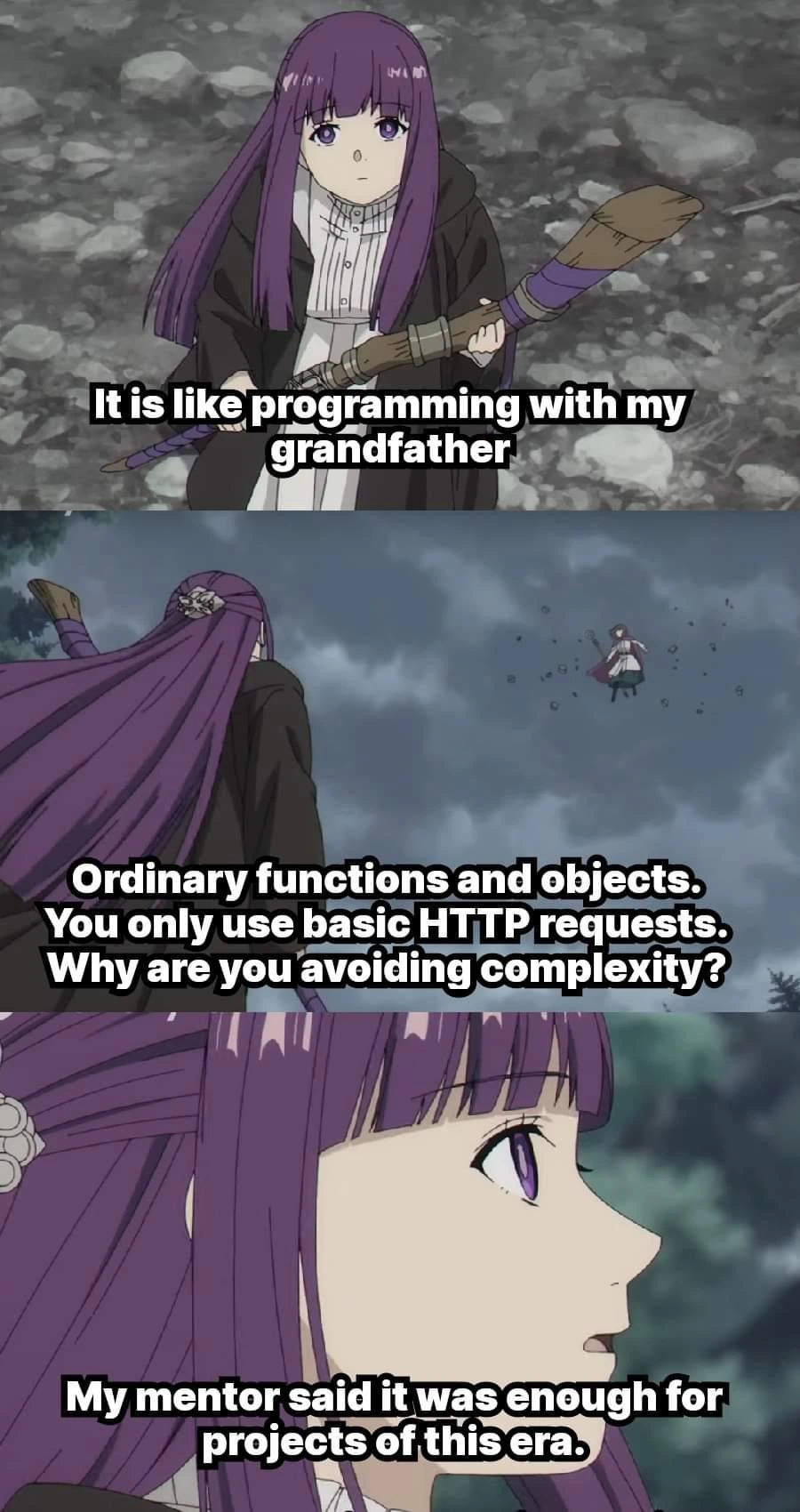
The first panel’s caption, “It is like programming with my grandfather,” suggests that using such a simple approach feels old-fashioned – like something an earlier generation of programmers would do. In tech culture, referencing a “grandfather” or “legacy” approach often means it’s considered outdated by younger folks. So, the meme sets up a contrast between old-school simplicity and today’s tendency to adopt cutting-edge frameworks and multi-layer architectures. The imagery of a medieval-looking broom used as a sword emphasizes this mismatch: a broom is a common, simple tool (no sharp blades, no high-tech features) being used in a dramatic battle. It’s funny because you’d expect a warrior to have a complex, magical sword – just as you might expect a modern developer to arm themselves with elaborate architecture diagrams, dozens of microservices, or the latest shiny framework. Instead, the character just grips a broom, confidently.

When the second panel asks, “Ordinary functions and objects. You only use basic HTTP requests. Why are you avoiding complexity?” it highlights specific simple things:

  • Ordinary functions and objects: This means writing straightforward code. A function is just a piece of code that does something (like calculateTax() or sendEmail()), and an object is a basic programming concept to bundle data and behavior. “Ordinary” implies there’s no special trick or pattern; it’s just the normal way you’d write it in a language like Python, Java, or JavaScript. No magic, no metaprogramming, no elaborate inheritance diagrams – just plain code that you can read and understand.
  • Basic HTTP requests: In web development, an HTTP request is how clients talk to servers (for example, your browser sending a GET request to fetch a web page, or your app sending a POST request to an API). A “basic HTTP request” might be something like a simple GET to retrieve data or a POST to send data, using common tools or libraries. The meme is implying this developer isn’t using advanced communication protocols like gRPC, GraphQL, message queues, or asynchronous event buses – just the standard web requests that have been around forever.
  • Avoiding complexity: Complexity here refers to all those fancy architecture patterns and tools that can make a system more complicated: e.g., microservices (splitting an application into many small services), complex design patterns (like Abstract Factories, multi-layer dependency injection frameworks), or trendy new technologies that promise to solve problems (often while introducing new ones).

So why would someone stick to only these simple things? The final panel gives the answer: “My mentor said it was enough for projects of this era.” In simpler words, a mentor (an experienced senior developer or teacher) advised that for modern projects, you often don’t need more than this basic setup. This is reflecting a real principle often taught to new programmers: don’t add complexity unless you need to. There are even acronyms and principles about this – one famous one is KISS: Keep It Simple, Stupid (the slightly silly phrasing just means “really, keep it simple”). Another is YAGNI: You Aren’t Gonna Need It, which warns developers not to build features or systems just in case they need them later – instead, build what you know you need now, and add more when it’s necessary.

For a junior developer or someone new to architecture, this can actually be a bit surprising. When you’re learning, you hear about all these cool tools: container orchestration (like Kubernetes), microservices, design patterns, enterprise frameworks, etc. It’s easy to think that a “professional” system must use a bunch of these to be “correct” or scalable. But experienced devs often emphasize starting with the simplest thing that could possibly work. Overengineering is a term used to describe when someone designs a system that's far more complex than it needs to be for the task at hand – like building a rocket-powered cleaning machine when a broom would do the job. Overengineering can lead to wasted time, harder maintenance, and more bugs, especially if the project is small or moderate in size. The meme’s mentor character is basically saying: in today’s era, computing power is huge and our basic tools are pretty good. A single well-built service using ordinary code and one API call can handle a surprisingly large workload. You don’t have to split everything into ten different microservices or apply every design pattern you read about in textbooks.

Let’s clarify some of these key terms in a junior-friendly way:

  • Microservice: This is a style of architecture where an application is divided into many small, independent services that communicate over a network (often via HTTP requests or messaging). Each microservice handles a specific piece of functionality. This can make large systems more modular and scalable, but it also introduces complexity because now you have many moving parts that talk to each other. In contrast, a monolith is one big application that contains all the functionality in one place (maybe one codebase, one deployable unit). The meme’s hero is basically running a monolith with a minimal API, while the critic expects a microservice-like approach with lots of endpoints or services.
  • Framework magic: Frameworks (like Angular for front-end, Spring Boot for Java, Django for Python, etc.) often provide a lot of helpful features out of the box. However, sometimes they hide details under the hood – this is colloquially called “magic” because things happen seemingly automatically (e.g., just by naming a method a certain way, or adding an annotation, something special happens). “Plain functions over framework magic” means our broom-wielding developer prefers to write straightforward code they fully understand, instead of relying on a heavy framework that does many things behind the scenes. It’s not that frameworks are bad, but using them can add complexity, especially if the developer doesn’t need all those extra features.
  • Basic HTTP requests: The bread-and-butter of web APIs. For example, using fetch in JavaScript or requests in Python to call http://myapp.com/data and get some JSON response is a basic HTTP interaction. If a system is “just one REST call”, it might mean the whole app basically exposes one primary API endpoint or uses one external API. It’s minimalistic. Nowadays, some projects have dozens of interconnected APIs (like a microservice for users, one for orders, one for notifications, etc., all calling each other). The mentor here suggests one is enough – implying the project can be built around a single cohesive API rather than many.
  • Overengineering vs Simplicity: Think of a simple calculator app. A simple design would be one program that takes input, adds numbers, and shows output. An overengineered design might split this into separate services (one service for the “add” operation, one for formatting results, one for logging usage stats, and they all communicate over a network). Unless you are Google handling billions of calculations a second, the overkill version just adds complexity without real benefit. The meme humorously positions the young voice as almost disappointed that the senior isn’t using more complex techniques – which is the opposite of the usual scenario where seniors beg juniors not to introduce needless complexity!

To a junior developer, the message is: you don’t need to use every cool technology in every project. If using ordinary functions and a simple REST API solves the problem, that’s likely the best route. Make it work, make it clear, and only then, if you hit a limitation, consider adding more complexity. The visual of an anime character confidently facing a foe with just a broom in hand drives home that confidence: I know this looks plain, but I also know it’s enough. In real dev terms, it’s like saying “Yes, our app is basically just a well-written Express.js server (a simple web server) and it talks to one database. And that’s fine! It handles thousands of users, it’s easy to understand, and it didn’t take us ages to build.” There’s a quiet confidence and even humor in sticking to the basics when everyone else is swinging around ultra-complicated setups.

And importantly, keeping things simple often improves code quality. Fewer moving parts means fewer places for bugs to hide. It’s easier to test a single function than an entire mesh of services. It’s easier to refactor (improve the code design) when everything’s in one place, versus touching multiple repositories and APIs. This is likely why the mentor advised sticking to simplicity – they care about long-term maintainability and developer sanity, not just impressing people with a complex diagram.

In summary, at this level we see the meme as a lighthearted lesson: use the right tool for the job, and don’t be ashamed if that tool is “just” a broom. Sometimes a broom can outperform a whole high-tech cleaning crew if the task is straightforward!

Level 3: Occam’s Broom

At the highest level, this meme satirizes the eternal architecture trade-off between minimalism and complexity in backend systems. An anime heroine wielding a lowly broom as a sword symbolizes a developer armed with nothing but ordinary functions, simple objects, and a single REST API call – facing off against the industry’s hype-driven foes wielding far flashier tech. It’s a comical juxtaposition: the mundane tool vs. the extravagant arsenal, much like a monolithic app versus a constellation of microservices. The caption “It is like programming with my grandfather.” is a tongue-in-cheek jab at how old-school simplicity can look quaint or outdated to those caught up in the latest trends. Yet the punchline, “My mentor said it was enough for projects of this era,” lands with a confident, almost zen-like calm. It channels the wisdom of a sage senior developer: Keep it simple. This hints at the classic KISS principle (“Keep It Simple, Stupid”), a guiding mantra in software engineering since the days of “grandfather’s code.”

Behind the humor lies a serious commentary on overengineering. In modern backend development, it’s all too common to see teams unsheathing an arsenal of microservices, message queues, and convoluted design patterns for problems a single well-written service could handle. The meme captures a senior-vs-junior architecture debate: the junior (or simply trend-chasing dev) asks incredulously, “Why are you avoiding complexity?” as if complexity is a virtue in itself. The purple-haired dev stands firm, embodying YAGNI philosophy (“You Aren’t Gonna Need It”) – resisting the pull of needless abstractions and framework magic. We’ve all seen it: a simple feature that ballooned into a labyrinthine system with dozens of moving parts, each piece a potential point of failure. Senior engineers often carry the battle scars from such systems – late-night incidents where an overzealous microservice network became a distributed monolith nightmare, or a fancy new framework introduced more bugs than benefits. No wonder the protagonist in the meme holds onto the humble broom (the straightforward solution) like a trusted old weapon.

This also touches on code quality and maintainability. Every additional layer of complexity – an extra service, a clever design pattern, an indirection – is like adding another fancy attachment to your sword: it might make an impressive demo, but it can weigh you down in a real fight. By “keeping the architecture at ordinary functions + one REST call,” the developer ensures each part of the codebase is understandable, testable, and traceable. There’s a hidden senior flex here: truly experienced devs know that plain code can be more powerful than an over-architected contraption. They favor explicit function calls over magical framework injections, and a simple HTTP interface over a web of synchronous API calls and callbacks. The humor hits home because it flips the script – the veteran engineer isn’t the one complicating things; it’s the younger or trend-driven engineers asking why everything isn’t more fancy and complex!

In practical terms, this scenario could be referencing a team discussion where one developer proposes a straightforward design: perhaps a single RESTful API service using basic CRUD operations and in-process function calls for logic. Another developer, enamored with the latest architecture fad, might scoff, “That’s it? No microservice mesh? No event-driven pipeline? It’s like coding in the stone age!” The mentor’s advice – “it was enough for projects of this era” – reflects historical perspective. Decades of computing have shown that you should scale complexity only as needed. A well-known adage among seasoned architects is that architecture is about trade-offs: each shiny new layer (be it a caching tier, an async messaging system, etc.) brings benefits and costs. If you don’t need the extra complexity to meet requirements (throughput, scalability, team autonomy), then adding it preemptively is just tech fashion. This meme cleverly packages that hard-earned wisdom into an anime confrontation. The broom might be rustic, but it can still sweep away problems effectively – just as a basic design often suffices for a project’s success, especially in an era where simple RESTful APIs remain the workhorse of the web.

To illustrate the absurdity of needless complexity, consider a trivial example in code: one could either call a function directly or architect an entire HTTP service call for the same task. The difference in overhead speaks volumes:

# 🚀 Overengineered approach: using an HTTP call for a simple operation
import requests

# Imagine we deploy a separate microservice just to add two numbers...
response = requests.post("http://analytics.internal/add", json={"x": 2, "y": 3})
total = response.json().get("result")
print(f"Received result from service: {total}")

# 🧹 Simple approach: a direct function call in the same application
def add(x, y):
    return x + y

total_simple = add(2, 3)
print(f"Computed result locally: {total_simple}")

In the overengineered version above, we unnecessarily send data over HTTP to analytics.internal just to compute a sum, introducing network latency, error handling, and deployment complexity – effectively trading a quick function call for a distributed system. The simple version just calls add(2, 3) directly. The broom-wielding dev in the meme is championing the second approach: why summon a fleet of servers for what a single function can do within milliseconds in your process? The humor resonates with senior developers because they’ve seen real-life analogues of the HTTP sum calculator – systems where a basic HTTP request or local call would suffice, but someone insisted on an entire service-oriented architecture for it. It’s the “use a sledgehammer to crack a nut” scenario we joke about in architecture discussions.

In the end, “ordinary functions + one REST call” is a rallying cry for pragmatic design. It’s not saying all complexity is evil – just that it should be justified. Much like an anime hero trusting a plain broom to win a duel, a seasoned coder trusts simple, solid code and minimal APIs to carry a project. The comedic contrast in the meme highlights a truth: sometimes the flashiest, most “modern” solution is overkill, and a grounded, old-school solution can be not only enough but actually better for “projects of this era.” It’s a celebration of focus and restraint in an age of endless nerd-sniping shiny tools.

Description

A three-panel meme using screencaps from the anime 'Frieren: Beyond Journey's End'. In the first panel, a young magician with purple hair says, 'It is like programming with my grandfather.' In the second panel, she looks towards a figure flying away in the distance and continues, 'Ordinary functions and objects. You only use basic HTTP requests. Why are you avoiding complexity?' The final panel is a close-up of her face as she reflects, 'My mentor said it was enough for projects of this era.' The meme humorously captures the generational and experiential gap in programming philosophy. It contrasts a junior developer's fascination with complex, modern architectures and tools with a senior developer's pragmatic preference for simple, proven solutions that are sufficient to solve the problem at hand, a core tenet of the 'Keep It Simple, Stupid' (KISS) principle


Comments

20
Anonymous ★ Top Pick The hardest part of modern software engineering is explaining to a junior dev that their five-microservice, event-driven, serverless solution for a blog could have just been a single script
  1. Anonymous ★ Top Pick

    The hardest part of modern software engineering is explaining to a junior dev that their five-microservice, event-driven, serverless solution for a blog could have just been a single script

  2. Anonymous

    Every time someone replaces a straightforward handler with a gRPC-Kafka-CQRS pipeline, a senior engineer quietly rewrites it as a single function and goes back to sleep

  3. Anonymous

    After 20 years in the industry, you realize the junior's 'grandfather programming' with simple REST endpoints will outlive your beautifully orchestrated GraphQL federation with event sourcing - and require 90% less maintenance budget when the next CTO arrives with their own architectural vision

  4. Anonymous

    When your senior architect suggests 'just use REST and PostgreSQL' for your microservices mesh proposal, and you realize they've been shipping production systems longer than your favorite framework has existed - sometimes the broom that sweeps is more reliable than the autonomous cleaning robot that needs three services, two message queues, and a distributed tracing system just to know which room it's in

  5. Anonymous

    Uptime improved and the cloud bill halved when we replaced CQRS + event‑sourced GraphQL microservices behind a service mesh with a single REST handler and plain objects - my favorite optimization is deleting architecture

  6. Anonymous

    Every time I replace a network hop with a function call, p99 drops and someone opens a ticket to ‘modernize’ it back into twelve services and a sidecar

  7. Anonymous

    Grandpa's cURL: zero schema drift, infinite uptime. Your GraphQL? Weekly versioning purgatory

  8. dev_meme 1y

    bs

  9. @mpolovnev 1y

    Please note that Fern is using a spell invented by a daemon!

  10. @MMageGangsta 1y

    sauce?

    1. @ffngs 1y

      Frieren

  11. @kandiesky 1y

    Only bad developers admire complexity. Good devs appreciate simplicity.

    1. @purplesyringa 1y

      PSA: please don't use this adage to protect simple-yet-not-generally-correct code

      1. @kandiesky 1y

        That has nothing to do with defending incorrect code tho Also, complexity has it's place, but most things do not need it

        1. @purplesyringa 1y

          I've seen many, many people provide a simple solution to a complex problem and try to assure me it'll work just fine, citing that maxim

          1. @purplesyringa 1y

            e.g. We don't need a database, a JSON file will work just fine or We don't need a specially designed sandbox, a Docker container will work just fine

            1. @kandiesky 1y

              I see. I undestand where this is coming from, but these look like POs/Architects not doing their jobs at explaining requirements Yet, I agree that simplicity should not be an excuse

            2. @SamsonovAnton 1y

              We don't need a relational database, a NoSQL will work just fine. 🤡

              1. @Broken_Cloud_1 1y

                https://news.ycombinator.com/item?id=3597891

  12. @GLXBX 1y

    True

Use J and K for navigation