The Data Science hype train skips the math station
Why is this DataScience meme funny?
Level 1: Wants Trophy, Hates Training
Imagine a kids’ soccer team at practice. The coach asks, “Who wants to win the big championship trophy?” Every kid jumps up, cheering “Me! Me!” because winning the trophy is exciting and fun. Then the coach asks, “Okay, who wants to come to early morning practice every day and do a bunch of tough drills?” Now the kids get quiet, looking at their shoes, and maybe only one or two murmurs a reluctant “I will…” because doing hard practice doesn’t sound fun at all. Finally, the coach smiles and asks, “Who wants to grow up to be a superstar soccer player?” and suddenly all the kids are enthusiastic again, hands in the air, because they all love the idea of the cool end result (being a star). This is just like the meme’s joke: everyone eagerly wants the reward (the trophy or the cool job title of “data scientist”), and they’re happy to do the easy or fun part (playing with the ball, which is like learning a bit of Python coding). But very few are excited about the hard work and basics (the daily training, which is like learning the math theory). It’s funny because we all recognize this feeling – wanting the great outcome but not the boring stuff that comes before it. The cartoon simply shows that in a tech context: lots of excitement for the fun bits, not so much for the hard foundation, even though you need both to succeed.
Level 2: From Code to Calculus
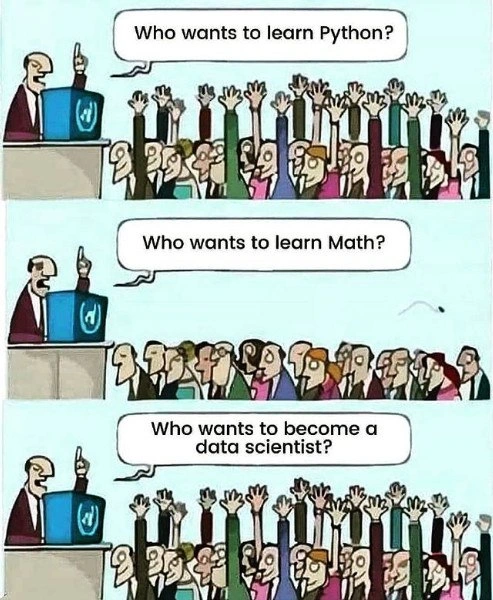
Let’s break down what’s happening in this meme in simpler terms. In the first panel, a lecturer at a podium asks, “Who wants to learn Python?” and almost everyone in the audience excitedly raises their hand. Why such an enthusiastic response? Python is a very popular programming language, especially among beginners and in the field of data science. It’s known for being easy to read (its syntax looks a bit like English) and easy to learn. Many people start their LearningToCodeJourney with Python because you can do a lot with just a little code – whether it’s automating a simple task, analyzing some data, or even making a small game. Python is also hyped as the language to learn if you want a job in tech, especially in hot areas like web development or machine learning. So in the meme’s first question, of course everyone wants to learn Python – it’s seen as fun, accessible, and directly useful for careers. The crowd is all smiles and raised hands, which represents how newcomers flock to popular coding classes.
Now, the second panel: the same lecturer asks, “Who wants to learn Math?” This time the reaction is completely different – the once excited audience now mostly looks away or slumps in their seats. Only one or two people have a half-hearted hand raised. You can almost hear the awkward silence or maybe a cricket chirping in the background. This dramatic change happens because “math” has a reputation for being difficult or boring to many people. Math (in the context of data science) can include things like algebra, statistics (which means learning about data, probabilities, averages, etc.), linear algebra (working with matrices and vectors, basically large sets of numbers in grids), and calculus (studying how changing one thing affects another, using concepts like derivatives and integrals). These subjects are essential for understanding how data science algorithms work. But a lot of learners, especially those drawn in by the excitement of coding, feel intimidated by these topics. Perhaps in school they found math too abstract or had a bad experience with it, so the word “math” triggers a bit of fear or at least a groan. In the meme, this is shown by the audience’s body language: enthusiasm has drained out. Most people are not raising their hands because learning math sounds like hard work and not as immediately rewarding as jumping into writing code. This panel illustrates a common scenario in education: many students eagerly sign up for something trendy and practical like a programming course, but when they realize it involves serious math study, their excitement fades. The term math_aversion is often used to describe how folks tend to avoid mathematics if they can.
Finally, the third panel brings the punchline. The lecturer asks, “Who wants to become a data scientist?” – and suddenly every hand in the room is up again, as high as possible! A data scientist is someone who uses programming, math, and domain knowledge to extract insights from data; it’s often described as a mix of a programmer and a statistician. In recent years, being a data scientist became incredibly desirable because it pays well and sounds very cutting-edge. Companies across all industries have been hiring data scientists to help them make sense of big data and to build machine learning models (which are programs that learn from examples). There’s a huge data_science_demand – lots of job openings – and you’ll see articles calling it one of the best jobs out there. So, naturally, when the lecturer asks who wants that cool job title and career, everyone is excited again. It’s like asking a group of kids if they want to be astronauts or rock stars – of course they’ll say yes. In the cartoon, all the hands are back up, showing that people are very eager for the outcome (being a data scientist) because of the prestige and opportunities.
Now, the humor and message of the meme come from putting these three panels together. It paints a little story:
- Learning Python? “Yes, absolutely!” – because Python is fun and seen as an easy entry point into tech. It’s like saying “Who wants to play with this cool new gadget?” and everyone’s onboard.
- Learning Math? “Umm, not really…” – because that sounds like schoolwork, theory, and potentially a lot of effort. Here the “cool factor” suddenly disappears. Many people treat math as something they’d rather skip, even though it’s important.
- Becoming a Data Scientist? “Yes, definitely!” – because that’s the exciting goal with all the rewards (great career, interesting work, good salary).
The meme highlights a gap or skill_gap in how people approach learning. Everybody wants the reward, but not everybody is willing to do the challenging preparation required for that reward. In the context of data science, the reward is the cool job and using Python to play with data, and the challenging preparation is learning the mathematics that makes those data science techniques possible.
For a junior developer or someone early in their learning journey, this meme might even feel a bit personal (and that’s why it’s funny!). You might recall times when you were excited to try a new programming library or follow a tutorial to make a machine learning model, but then you hit a chapter full of formulas and your enthusiasm took a hit. For example, imagine you’re following along a machine learning course: at first you use pandas (a Python library) to manipulate a dataset and scikit-learn (another library) to create a simple prediction model. That part feels pretty straightforward – it’s mostly coding and using library functions. But then the course starts explaining how the model works under the hood, introducing something like the equation of a line or a cost function with sigma notation (∑) and suddenly it feels like you’re back in math class. A lot of beginners at this point think, “Do I really need to know this?” The meme is capturing exactly that sentiment.
It’s worth noting that in reality, both Python and math are key ingredients to becoming a good data scientist. Python is the tool you use to actually apply ideas to real data – for example, writing a script to clean data, or using a library to train a model and make predictions. Math is the underlying knowledge that tells you which tool to use and how to use it correctly. MachineLearning algorithms, for instance, are built on mathematical principles. If you know the math, you can understand why a decision tree might be overfitting (getting too specific to the training data) or why increasing the learning rate in training a neural network might cause it not to converge (because of the calculus behind gradient descent). If you don’t know the math, you might still get results by trial and error or by following recipes, but it’s harder to troubleshoot or improve on them.
However, for someone just starting out, it’s common to focus on the coding part first because it’s more tangible. Writing a program gives you immediate feedback – you see it run, you see the output. Math, on the other hand, can feel abstract; you might not immediately see how an equation translates to something visible. This difference in the learning curve makes coding feel more approachable initially, and math feel steep or dry. The meme is poking fun at that: people spiritually say “yay!” to coding and “ugh…” to math, despite wanting the end result that actually requires both.
Another angle is the career_expectations aspect: Many people are drawn to data science by hearing success stories or seeing LinkedIn posts about cool projects (like someone built an AI that can detect cancer or predict stock prices). These stories often highlight the programming and the outcome, but they rarely mention the grunt work – which is often a lot of studying math and also doing mundane data cleaning. So a newcomer might expect that learning Python and maybe a few high-level concepts is enough to land them in those exciting scenarios. When reality hits – that they need to dig into equations, learn about things like linear regression formulas, probability distributions (like the Normal distribution), or matrix multiplication – it can be a shock. The meme simplifies that realization into a funny visual: everyone cheers for the flashy parts (Python, the job title) and goes quiet for the foundational part (math).
In summary, this cartoon uses a simple classroom Q&A setup to reflect a real-world learning paradox:
- Python symbolizes the fun, high-level skill that people are eager to pick up because it’s programming (creative and practical).
- Math symbolizes the foundational knowledge that is tougher and less glamorous, so fewer people are eager to tackle it.
- “Become a data scientist” symbolizes the end goal or dream job that everyone wants.
The joke is that you can’t reach that end goal with Python alone; you need the math too. But the way people’s enthusiasm fluctuates in the meme implies many are trying to somehow jump from Python straight to Data Scientist, skipping over the math – which in reality is not possible (or at least not wise). It’s a bit like saying everyone wants to build a fancy treehouse (data_science_demand is high), everyone loves using a hammer and nails (Python, the fun tool), but nobody wants to read the engineering manual on how to make sure the treehouse doesn’t collapse (math, the boring but necessary planning).
This meme definitely falls into DataScienceHumor. It’s poking fun at the hype around data science and how people approach learning it. If you’re a junior developer or student, you might even feel called out (in a lighthearted way!). The message isn’t to scare you off, but to say: “Hey, if you’re super excited about data science, remember that there’s some tough stuff (math) you’ll need to learn too – don’t ignore it.” And if you’re someone who already went through this learning process, you’re probably nodding and laughing, remembering how you or your classmates reacted when the coursework got more mathematical. It’s funny because it’s true – and it’s also a gentle reminder of the learning curve we all go through in mastering a complex field.
Level 3: Equation Aversion
Zooming out to a senior developer or data scientist’s perspective, this meme is a wink at a very familiar scenario in the tech community. It highlights an all-too-common gap between career hype and the reality of the skills required. We’ve all seen the pattern: a new programming course or bootcamp advertises “Learn Python – no experience needed!” and the class is packed with eager learners. Python’s popularity in the LearningToCodeJourney is huge, partly because it’s an accessible language with simple syntax and immediate results. Everyone is excited to raise their hand for Python, as shown in panel 1, because they’ve heard it’s fun, powerful, and a gateway to lucrative fields like DataScience and MachineLearning. Python tends to be love at first sight for new coders – it’s interactive, you can plot graphs in a few lines, and you feel productive quickly. It’s no wonder the lecturer’s question “Who wants to learn Python?” gets a full sea of hands. This represents the hype and optimism around learning to code, especially with Python as the poster child language for beginners and aspiring data scientists.
Now comes panel 2: “Who wants to learn Math?” – and crickets. Most of that enthusiastic crowd suddenly avoids eye contact. A few timid hands half-rise (perhaps the ones who always kind of liked math or know its value), but the majority slouch down as if the teacher just offered them extra homework on a Friday. This comedic drop in participation rings true to any instructor or senior engineer who’s mentored juniors. There’s a strong math_aversion among many would-be programmers and analysts. It often stems from past experiences – math is perceived as abstract, difficult, or just not as “cool” as coding up an app. We can practically feel the collective groan that follows the mention of mathematics. It’s a classic example of equation aversion: the moment you put a formula on the whiteboard, a chunk of the audience mentally checks out. The meme artist captured this perfectly with almost everyone putting their hands down in panel 2. We’re left with an image any speaker or teacher recognizes: a room that was buzzing now deflated by the mention of something hard.
The kicker is panel 3: “Who wants to become a data scientist?” and suddenly all those hands are right back up, sky-high. This is where the humor really crystallizes. Data scientist has been touted as “the sexiest job of the 21st century” (as a famous Harvard Business Review article proclaimed), and it’s associated with prestige, high salaries, and cool projects. It’s the buzzword on everyone’s resume. So naturally, when asked who wants that title, everyone is enthusiastic again. The joke is that becoming a real data scientist absolutely requires the very math that so many people were shunning in panel 2! The audience in the meme wants the end result (the glamorous job, the cool career, the chance to call themselves a data scientist) but not the means to get there (doing the tough math and theory). This comedic mismatch between career_expectations and willingness to do the groundwork makes developers and data professionals smirk knowingly. We’ve seen junior colleagues excitedly enroll in “AI/ML” courses because they love playing with Python notebooks, only to flinch or drop out when the coursework dives into linear algebra or statistical theory. It’s hype-versus-reality in cartoon form.
This pattern is something industry veterans recognize from real life:
- Bootcamp boom and bust: Many coding bootcamps popped up to feed the demand for data scientists. They attract crowds with promises of easy career switches via Python programming and maybe a dash of pandas and TensorFlow. But when the curriculum inevitably reaches probability theory or the derivation of a cost function, suddenly some students lose steam. The meme’s second panel is basically that moment in every data science course where half the class gets a deer-in-headlights look during the math lecture.
- On the job surprises: Hiring managers in tech have anecdotal tales like “We interviewed a candidate who could talk about using a random forest library, but when we asked them how a random forest works or what a standard deviation is, they struggled.” This is the skill_gap in action. Lots of people can drive the car (use the software), but fewer can fix the engine (understand the science). As a result, teams sometimes find that a self-proclaimed data scientist might not grasp why their model is behaving poorly, because the fix lies in mathematical reasoning (like recognizing multicollinearity or tuning a regularization parameter).
- “It’s just using libraries” mindset: There’s a recurring joke in developer circles that many data science projects are just stacking libraries on top of each other. For example: someone uses Python with scikit-learn or TensorFlow to train a model, and they can follow a tutorial to do it. But ask them to explain the choice of algorithm or to interpret the results statistically, and it gets tricky. The meme nails this phenomenon: the willingness to “learn Python” is high because it implies using these convenient building blocks, whereas “learn Math” implies understanding or deriving what those blocks do from first principles – which is less immediately gratifying.
From a senior perspective, the meme is funny but also a little bittersweet, because it reflects a real challenge in the field of DataScience education. In an ideal world, learners would be just as eager to build solid foundations (math, algorithms) as they are to jump into trendy tools. But human nature – especially in fast-paced career-oriented fields – often leads to career_hype chasing. Everyone wants to quickly grab that shiny title “Data Scientist” (or get the high-paying job) without slogging through what might feel like academic drudgery. It’s the same reason phrases like “it’s not rocket science” are used – people acknowledge math-heavy subjects are tough and often shy away unless absolutely necessary.
However, experienced data scientists will tell you: learning math and theoretical concepts is absolutely necessary if you want to excel (or sometimes even just not screw up) in data work. Without understanding math, one might misuse models (leading to false insights) or be unable to troubleshoot when things go wrong. For instance, if you don’t understand distributions and someone asks you to validate if an experiment’s results are significant, you might be stuck. Or if a model is making mistakes, without knowing the math you can only treat it as a black box. That’s risky in critical applications. So there’s a serious undercurrent to the joke: under-prepared “data scientists” can cause real issues, like incorrect business decisions, because they didn’t understand the statistics of their analysis.
The cultural context adds another layer: data_science_demand in the job market is enormous. Every company wants to be “data-driven” now, and there’s a shortage of qualified people, so lots of folks are rushing into the field. This rush breeds a lot of career switchers and fresh grads eagerly taking short courses to get in on the action. It’s common to meet someone who says, “I took an online course in data science; I know Python and some MachineLearning libraries.” But if you probe their knowledge of, say, how gradient boosting works or what conditions might violate a model’s assumptions, they might get uncomfortable. The meme captures that collective discomfort with the “boring” foundational stuff. It’s comedic exaggeration – of course not literally everyone avoids math – but it’s grounded in truth that resonates widely.
In essence, developer humor often points out contradictions we see daily. Here it’s the image of a room full of aspiring data experts who are all-in for the cool tools and fancy job title, but almost empty when it’s time to talk theory and equations. It pokes fun at the python_vs_math tension. The lecturer’s questions in the meme could be rephrased in an experienced mentor’s mind as: “Who wants the glamour of data science?” vs “Who wants to do the unglamorous study that actually makes you a data scientist?” We laugh because we’ve probably been that person at some point – excited by the idea of something (like AI, or building an app, or becoming a senior engineer) and then sobered by the realization of what we have to learn to get there (maybe complex math, low-level debugging, or countless hours of practice). The meme strikes a chord, especially in the data science community, because it’s so relatable: it’s much easier to get people interested in a high-level skill or career than to maintain their enthusiasm through the grind of prerequisite learning.
So, the senior-perspective takeaway: math is to data science what basic training is to an elite sport – absolutely essential, often tough, and not nearly as celebrated as the end victory. The meme humorously shines a light on that disconnect. It reminds the seasoned folks of all the times they’ve had to explain to newcomers, “Yes, you do need to understand these formulas, not just call the function.” And it perhaps gently nudges the newcomers who see it to chuckle at themselves and (hopefully) hit the math books with a bit more willingness. After all, if every hand is up for becoming a data scientist, a few more hands need to stay up for learning math – otherwise the career_expectations won’t match reality. The cartoon simplifies a whole educational and cultural issue into three panels, making even those of us who struggled through university math laugh at how true it rings.
Level 4: Gradient Descent of Enthusiasm
At the deepest technical level, this meme exposes the mathematical backbone of data science that often scares away newcomers. Under the hood, data science and machine learning aren’t just about writing Python code – they’re about solving complex math problems. The hilarious contrast in the meme is rooted in the fact that becoming a data scientist requires mastering advanced concepts like linear algebra, statistics, and calculus, not just learning the print() function in Python. In other words, all those excited learners in the first panel may not realize that data science is essentially applied math with a fancy name.
To illustrate, training a simple machine learning model often boils down to mathematical equations. For example, fitting a linear regression (a basic predictive model) isn’t just writing model.fit(X, y) – behind the scenes it’s solving something like the Normal Equation:
$$
\hat{\beta} = (X^T X)^{-1} X^T y
$$
This formula is telling us how to compute the best-fit parameters β (beta) by inverting a matrix ($X^T X$) and multiplying by $X^T y$. It’s pure linear algebra. Many enthusiastic Python learners might find an equation like this intimidating – it’s packed with matrices, transposes, and inverses, the kind of scary notation that draws blank stares. Yet, this is what libraries like scikit-learn are doing internally when you call a simple .fit() on a LinearRegression object.
Similarly, the algorithms behind neural networks rely on calculus. Training a neural network often uses gradient descent, which involves taking derivatives (slopes of curves) to adjust weights and minimize error. The core update rule looks like: $w := w - \eta \nabla L(w)$ (which means “adjust each weight $w$ by subtracting a learning rate $\eta$ times the gradient of the loss function $\nabla L(w)$”). That’s calculus sneaking in to fine-tune the model. Those Greek letters and ∇ symbols are enough to make many coders’ eyes glaze over – yet they’re the secret sauce that makes machine learning work. If the phrase “partial derivative” triggers flashbacks of calculus class, you’re not alone – and that’s exactly why so many hands go down in panel 2 of the cartoon.
In fact, the second panel of the meme (where almost no one wants to learn math) is like applying a heavy dropout layer to the classroom: the crowd’s enthusiasm “drops out” when the lecturer mentions equations. 🤓 Dropout in deep learning deliberately turns off random neurons to make a network robust, and here our lecturer accidentally turned off almost the entire audience by uttering the word “Math”! It’s a cheeky parallel that data science veterans can chuckle about. The meme’s humor comes from this very real math aversion. We see it often: eager students flock to learn the trendiest tools, but vanish faster than you can type import math when confronted with an honest-to-goodness formula.
Why does this happen? Partly because modern tools like Python (with its “batteries-included” libraries) create an illusion that you can do complex things easily. Python’s scientific stack – NumPy, pandas, SciPy, scikit-learn, and so on – are incredibly powerful. They encapsulate decades of research (linear algebra routines from Fortran, statistical methods from R, optimizations from C++) behind simple Python interfaces. This enables newcomers to run a machine learning model with a few lines of code, without ever seeing the math. It’s wonderful for accessibility, but it also means many learners treat these libraries like magic black boxes. The moment the magic is explained with equations, eyes glaze over. Everyone wants the data_science_demand-driven career payoff, but few want to peek under the hood at the hard theory.
Yet the foundations remain: data science was born from statistics and computational mathematics. Long before “data scientist” was the sexiest job title, statisticians and analysts were crunching numbers with formulas and probability theory. Python is just the latest friendly interface on this long-running engine of math. The meme cleverly points out a truth that senior folks know well: you can’t have the machine learning hype without the math, just as you can’t build a sturdy house without understanding the beams holding it up. The excited crowd in panel 1 and 3 wants the shiny outcome (cool Python tricks, sexy job), but the near-empty response in panel 2 reveals the skill_gap – the rigorous learning curve of mathematics that underlies that outcome.
For seasoned data professionals, this meme elicits a knowing grin. We’ve read the papers, derived the formulas, and perhaps even debugged an algorithm by going back to the math. We know that things like overfitting, regularization, or a poorly tuned model all circle back to mathematical principles. It’s simultaneously amusing and a bit painfully true: many aspiring data scientists don’t realize that learning math is not an optional side quest – it’s the main quest that powers everything else. The meme holds up a mirror to the industry’s hype: behind every neat Python one-liner model.predict(), there’s a mountain of theory. To truly master data science (and not just use it by rote), one has to embrace that mountain rather than run from it. In short, the cartoon’s joke lands because it captures a real “python_vs_math” phenomenon: coding feels like an easy win, but mathematics is the steep price of admission that too many try to dodge. The gradient descent of enthusiasm from panel 1 to panel 2 is a playful reminder that, in data science, you can’t have the thrill of the summit without climbing the hill of math.
Description
A three-panel comic strip depicting a speaker at a podium addressing a large crowd. In the first panel, the speaker asks, 'Who wants to learn Python?'. The entire crowd enthusiastically raises their hands. In the second panel, the speaker asks, 'Who wants to learn Math?'. The crowd falls silent, arms down, with only a single cricket visible in the air, signifying crickets chirping in an empty room. In the final panel, the speaker asks, 'Who wants to become a data scientist?', and the crowd once again raises their hands with enthusiasm. This meme satirizes the disconnect in the tech industry, particularly in the field of data science, where many are drawn to the trendy job title and popular tools like Python but are unwilling to put in the effort to learn the foundational mathematics (statistics, calculus, linear algebra) that are critical for a deep understanding of the subject. It's a commentary on the shallow, hype-driven approach to learning, which senior engineers often observe in less experienced candidates

Comments
10Comment deleted
Many think data science is just `model.fit(X, y)`. The math is what you need when the model fits a little too well on Monday and then spectacularly fails on Tuesday's data
The data-science funnel in three slides: 1) “import pandas as pd” - standing room only, 2) “derive the softmax gradient” - polite coughing in the back, 3) “now ship it to prod on a 128 MB Lambda” - just me, rewriting the whole thing in Go
Everyone wants to be a 'data scientist' until they realize that behind every .fit() and .predict() lies a decade of linear algebra papers, statistical proofs, and the haunting realization that you actually need to understand why gradient descent works, not just import it from sklearn
This perfectly captures the 'I want to be a data scientist but skip the math' phenomenon - like wanting to be a surgeon but refusing to learn anatomy. The reality is that Python is just the scalpel; linear algebra, calculus, and statistics are the years of medical school. You can't just import numpy and expect to understand why your gradient descent is diverging or why your model is overfitting. The math isn't optional; it's literally the science in data science
That lone math hand? It's the principal engineer deriving your gradients while the Python crowd ships 'vibes-based' models
Everyone wants scikit-learn until you say “assume IID,” and suddenly the only thing converging is the attendance
Everyone wants the data-scientist badge - until math is declared a hard runtime dependency and you ask for a derivation of cross-entropy from maximum likelihood
this is the fourth time I'm seeing this on telegram, and it's not getting funnier. Comment deleted
maybe fifth time will be funnier) Comment deleted
When you make memes while you are stressed you'll start loosing your memory Comment deleted