Skip to content
DevMeme
3304 of 7435
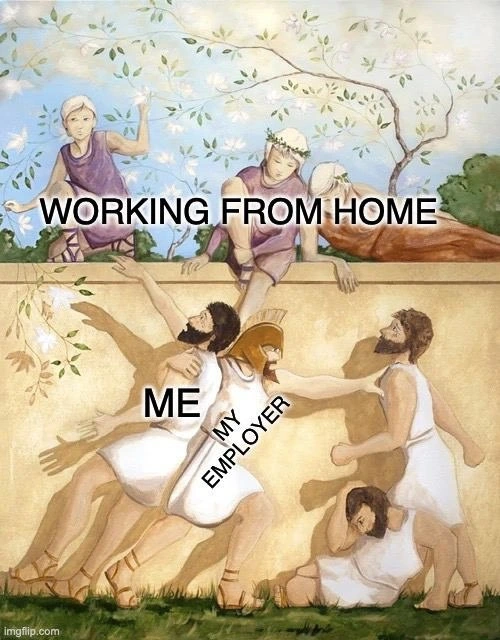
The serene dream vs. the chaotic reality of remote work
RemoteWork Post #3628, on Sep 1, 2021 in TG

The serene dream vs. the chaotic reality of remote work

Why is this RemoteWork meme funny?

Level 1: Tug-of-War Over Playtime

Imagine you’re playing happily in your favorite playground, and it feels like the best place ever – sunny, fun, and free. You see some friends hanging out on a big comfy treehouse (that’s the remote work paradise in the meme – the happy place). You want to join them because it looks so nice up there. You even start climbing the ladder to get into that treehouse. But then, picture a strict school teacher or parent (that’s “My Employer”) suddenly grabbing you by the waist and pulling you back down to the ground. They’re saying, “Nope, playtime is over, you have to come back inside.” Sounds unfair, right? You were so close to enjoying that wonderful play spot with your friends, and now you’re being dragged away.

That’s exactly the feeling this funny picture shows. You (the worker) just want to keep working in your cozy spot at home – like staying in that fun playground – but your boss (like the strict adult) insists you return to the office, which is like going back inside for class or chores. The reason it’s humorous is because we can all relate to that disappointment. It’s a big silly tug-of-war: one side is you reaching for something you love (playing or working comfortably at home) and the other side is the authority figure pulling you back to what they want (going back to the office or the classroom). In real life, grown-up workers felt this way when their companies told them to stop working from home and return to the office. It’s a bit like ending recess just when it was getting really good – and the picture makes us laugh because we’ve all felt that “aww, do I have to?” moment when someone in charge ends the fun.

Level 2: Climbing the WFH Wall

Let’s break down what’s happening for those newer to the tech world. The image uses a climbing_wall_analogy to represent an engineer trying to enjoy WorkFromHome (WFH) life. “WFH” simply means doing your job remotely, usually from home, instead of at the office. In the picture, the top of the wall – blooming flowers, blue skies – symbolizes the comfort and RemoteWorkCulture many developers came to love: think waking up and working in pajamas, no commute (that daily trek to the office), and easy access to your own coffee maker. The figures relaxing on top labeled “WORKING FROM HOME” are basically showing how great it is up there in remote-work paradise. They’re the embodiment of content developers coding from a cozy home office with a cat on the lap and maybe a nice big external monitor set up – zero boss interference.

Now, the figure labeled “ME” at the wall is the developer who wants to stay in that comfy remote world. They’ve had a taste of it and are literally reaching for it, like “Please let me keep working from home!” But the other figure grabbing “ME” around the waist is labeled “MY EMPLOYER.” That’s the company or the boss. This strong-looking boss-character is pulling the developer off the wall, dragging them back down. This visualizes a return_to_office_mandate – a policy where the company says, “Alright everyone, time to come back to the office now. Vacation’s over.” In 2021, a lot of developers were getting these messages from management after months of remote work. Companies often claim it’s for better teamwork or company culture (the famous water-cooler chats and in-person meetings). But to the employee, it often feels like being yanked away from something wonderful.

The CorporateCulture clash here is central: developers discovered they could be just as productive remotely (sometimes even more so, without random interruptions or loud open-office noise). Many junior devs experienced their first jobs entirely from home, deploying code via git and collaborating on Slack or Zoom calls. It became normal to fix bugs from your dining table or do stand-up meetings with your team via video chat. So going back to a physical office can feel like a downgrade – trading flexibility and focus for fluorescent lights and a rented desk. The meme format itself – using a Greek fresco painting style – is common in DeveloperHumor. Meme creators often slap modern captions on classical art; here it exaggerates the situation as a grand ancient struggle. It’s like saying, “Look, this battle between me and my employer over remote work is epic, it belongs in a museum!”

Thus, for a junior engineer: the meme is a funny, slightly hyperbolic summary of what a lot of people went through. You might not have lived through a return to office demand yet, but it’s basically when the company insists you show up in person after you’ve been happily working from home. The “garden wall” is the barrier between the two worlds – remote work on one side (peaceful, ideal) and traditional office life on the other (where your employer is in control). The characters at the bottom who look upset or are helping the boss can represent either other managers enforcing the policy or coworkers who have reluctantly given up on climbing to that paradise. It’s a comedic way to explain a real frustration: employees (like developers) wanting one thing (WFH freedom) and employers enforcing another (office attendance). The humor comes from how accurately this simple image captures that feeling of almost having work-life nirvana, only to be pulled back by forces beyond your control (the company’s rules).

Level 3: Paradise Lost to RTO Mandates

The meme’s humor hits seasoned developers right in the post-pandemic reality. It dramatizes the tug-of-war between blissful RemoteWork and stiff CorporateCulture using an ancient fresco scene. In this tableau, working from home is depicted as a literal paradise atop a garden wall – idyllic, serene, everything a dev could want – while the return_to_office_mandate is the brute force yanking “ME” (the developer) back down. The contrast is hilariously apt: after 2020, many engineers experienced unprecedented productivity and comfort coding from their couches (our “remote work paradise”). Yet by mid-2021, numerous companies started insisting on a return to office. This meme captures that employee_vs_employer_conflict with epic flair.

For a senior engineer, it’s a painfully familiar pattern. We spent years perfecting cloud-based dev environments, VPN setups, and asynchronous workflows – proving we can push to production from a coffee table. ManagementHumor aside, the DeveloperFrustration is real: code deployments didn’t fail just because we traded business casual for sweatpants. If anything, many of us squashed more bugs without the open-office distractions. But here comes “MY EMPLOYER,” clinging to old notions that in-person presence equals productivity. In the meme, the bearded boss figure snatches the dev mid-climb, much like corporate policies snatching away newfound freedom. It’s a satirical nod to how some companies act like Greek gods, capriciously plucking mortals from Eden for their own convenience.

The classical greek_fresco_meme_format adds ironic weight: it’s as if returning to the office is a tragic myth or a biblical fall from grace. (We’re basically seeing a modern Paradise Lost, but with Zoom calls and JIRA tickets.) Senior devs chuckle darkly because we recognize the anti-pattern: trust earned during remote months evaporated the second corner offices felt lonely. There’s history here too – even pre-COVID, giants like Yahoo! and IBM yo-yoed on remote-work policy, citing “culture” or “collaboration” while baffled engineers rolled their eyes. This meme says what every burned-out on-call veteran was thinking: “We tasted the WorkFromHome elysium, and of course, management can’t let us have nice things.” It’s funny because it’s tragically too real. We all know at least one teammate who revels atop that wall (maybe they joined a fully remote-friendly company), while we’re left getting tugged back into commute traffic. The humor lands with a thud of recognition – the classical struggle between modern developers seeking flexibility and conservative employers invoking bygone office glory is nothing short of mythic in scope. And like any good Greek tragedy, everyone knows the outcome is messy: morale drops, attrition spikes, and the cycle of DeveloperHumor (and cynicism) continues. After all, why fix a system that allows for both a good laugh and a good cry?

Description

A two-panel meme using classical art to contrast the expectations and reality of working from home. The top panel depicts a serene, idyllic scene of figures in classical attire lounging peacefully under a flowering tree, with the text 'WORKING FROM HOME' overlaid. It represents the peaceful, productive environment many hope for. The bottom panel shows a starkly different scene of violent struggle, with figures in a chaotic brawl. One figure, labeled 'ME', is being forcefully dragged by another labeled 'MY EMPLOYER'. This meme humorously captures the conflict many tech professionals feel between the promise of autonomous, calm remote work and the reality of employer oversight, constant demands, and the pressure to be constantly available, turning a peaceful sanctuary into a battleground
Comments

15
Anonymous ★ Top Pick The top panel is you successfully running all services locally with Docker. The bottom panel is your employer trying to drag you into a meeting to discuss why the staging environment is down... again
  1. Anonymous ★ Top Pick

    The top panel is you successfully running all services locally with Docker. The bottom panel is your employer trying to drag you into a meeting to discuss why the staging environment is down... again

  2. Anonymous

    Being dragged back to the office after three years of flawless remote releases feels like decommissioning a perfectly tuned distributed system because the C-suite misses hallway cache coherence

  3. Anonymous

    The only distributed system harder to debug than eventual consistency across multiple data centers is maintaining the illusion of productivity while your employer's monitoring software tracks your every keystroke, mouse movement, and the 47 Slack channels you're pretending to actively participate in

  4. Anonymous

    Ah yes, the classic distributed systems problem: your employer thinks they're running a lightweight microservice in the cloud, but you're actually a monolithic on-premises server handling all the load with zero horizontal scaling options and a single point of failure - yourself

  5. Anonymous

    WFH as distributed systems nirvana - boss enforces CAP's 'C' for office Consistency, ignoring remote Availability's sweet scaling

  6. Anonymous

    Amazing that our distributed systems reach cross‑region consensus, but leadership says collaboration only works once the badge readers hit quorum

  7. Anonymous

    RTO is a latency-injection attack on throughput - commute RTT and open‑office interrupts burn the error budget while leadership celebrates ‘presence metrics.’

  8. @kitbot256 4y

    As if. When you work from home, you are ALWAYS at work. That's crazy.

    1. @chupasaurus 4y

      3 easy things to prevent it: Have a dedicated workplace Hours when employers have to be active are defined Everyone else at home should be ready for GTFOs in response during hours above

      1. @kitbot256 4y

        Defined hours can go suck ducks (quack!). What if I suddenly need to go to the grocery shop at 1PM?

        1. @chupasaurus 4y

          Do you not have phones?©

          1. @kitbot256 4y

            Sure I do. But if you think of something at 9pm at home, usually it means that it has to wait til' tomorrow. If you WFH, you usually think of "let's go implement it" and your evening becomes a mixture of vscode, jenkins and/or other tools of your preference.

            1. @chupasaurus 4y

              Write a note and call it a day, it's that simple.

              1. @kitbot256 4y

                That's way too hard!

  9. Deleted Account 4y

    Just leave this company and get another job, let this boomers to sit in their empty offices. Never will get back to office. Remote is a best thing, happened to industry.

Use J and K for navigation