Pokémon TCG Gets AI Agents
Why is this AI ML meme funny?
Level 1: Robot Card Battles
This is funny because a game about colorful cards is being turned into a contest for computer players. It is like inviting robots to a school card tournament and then realizing the robots have to learn bluffing, planning, luck, and all the tiny rules printed on every card.
Level 2: Cards as State Space
An AI agent is a program that observes a situation, chooses actions, and tries to achieve a goal. In this case, the goal is to play the Pokemon Trading Card Game well enough to beat other agents. Machine learning can help such agents learn patterns from games, evaluate board states, or choose actions based on past experience.
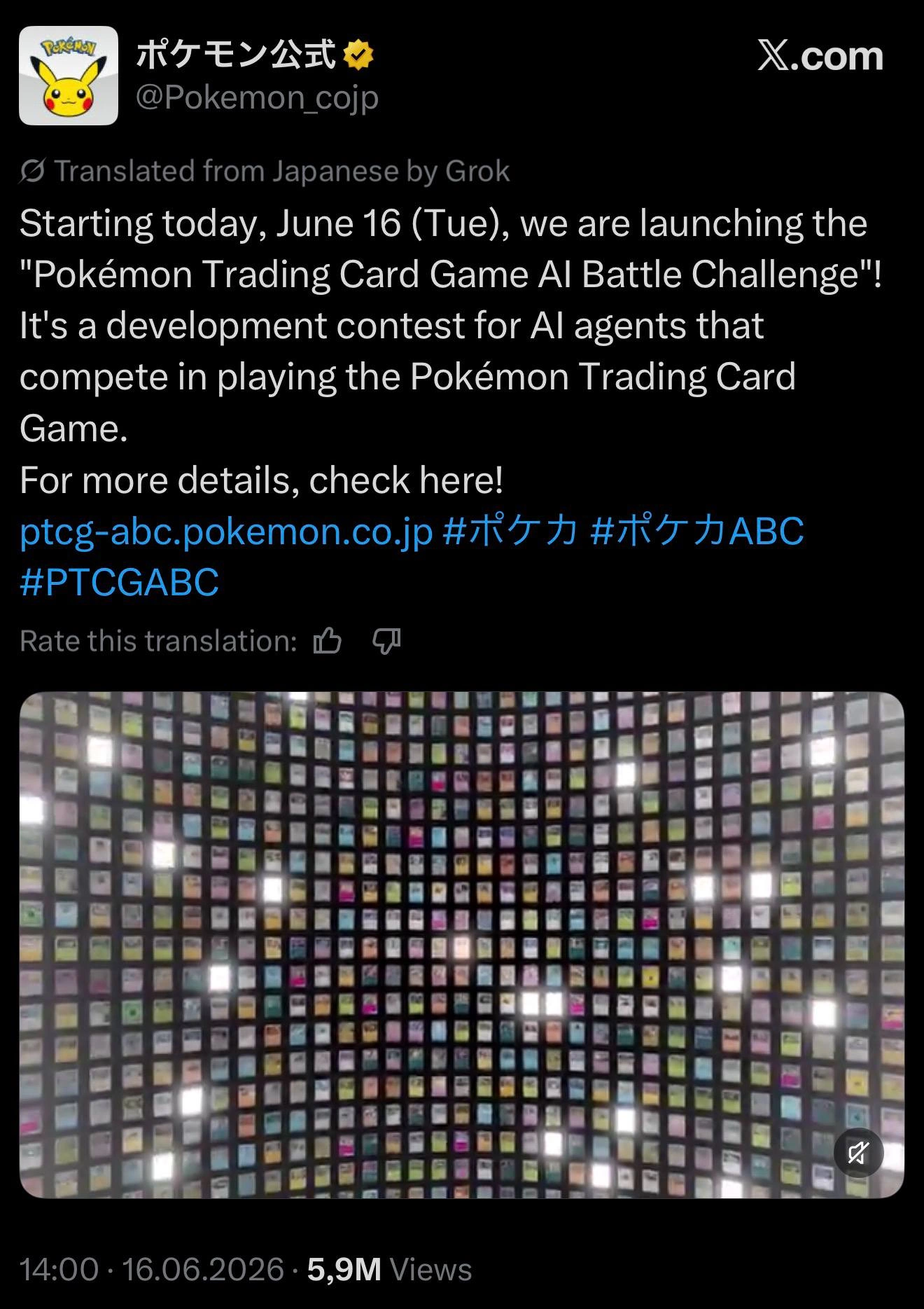
A trading card game gives the agent many things to track. It must know which cards are in play, which cards are in hand, what has already been used, what might be drawn next, and what the opponent could be planning. It also has to understand the rules: attacks, energy, evolution, knockouts, turn order, and special card text. The big card-wall preview in the image visually sells that complexity. There are a lot of little rectangles, and each little rectangle can change the problem.
This is why the announcement is interesting to developers. It is not just "make a bot click buttons." It is closer to building a player that can plan under uncertainty, follow a complicated rulebook, and adapt to a changing game environment. That is the kind of problem that makes AI engineers reach for experiments, benchmarks, and eventually coffee.
Level 3: The Meta Evolves
The meme's surrounding reaction, 1. What, is doing exactly what many developers would do on seeing an official Pokemon account announce an AI-agent battle contest. The premise is not "AI plays a game" anymore; that part has decades of history. The surprise is seeing a mainstream collectible card game presented as a formal development challenge, complete with translated launch language, official branding, and a video preview that looks like someone turned a card shop binder into a benchmark suite.
The humor comes from the collision of two cultures. Pokemon TCG is built around collecting, deck construction, local play, competitive metas, favorite cards, and the very human joy of arguing over whether a line was brilliant or lucky. AI competitions turn that into agents, evaluation loops, simulations, leaderboards, and optimization pressure. Suddenly "good deck advice" becomes feature engineering, and "the meta" means both the competitive card environment and the thing your model is about to overfit.
There is also a broader AI industry trends joke here. Any sufficiently structured hobby now looks like a benchmark waiting to happen. Card games are especially tempting because they offer discrete rules, clear win conditions, hidden information, and huge tactical variation. For developers, the funny part is imagining all the familiar machine-learning failure modes entering a cheerful branded card game: brittle agents, reward hacking, bad state representations, model hallucinations about legal moves, and leaderboard strategies that win because they found the weirdest corner of the simulator.
Level 4: Partially Observable Pikachu
The translated official post says:
Starting today, June 16 (Tue), we are launching the "Pokemon Trading Card Game AI Battle Challenge"!
It's a development contest for AI agents that compete in playing the Pokemon Trading Card Game.
That sounds cute until you model the problem. A trading card game is not a clean perfect-information board game like chess. It is closer to an imperfect-information stochastic planning problem: each agent sees the public board, its own hand, and some history, but it does not know the opponent's hand, exact prize cards, future draws, or sometimes the opponent's full deck list. The agent is constantly acting under uncertainty while the state space branches through card choices, search actions, shuffling, damage math, switching, energy attachment, evolution timing, and matchups against entire metagames.
In AI terms, this is a nasty blend of belief-state tracking, long-horizon planning, and policy evaluation. The agent cannot simply pick the move with the best immediate damage. It has to reason about future turns, deck thinning, probability of drawing outs, whether to conserve resources, when to reveal information, and whether a line that looks weak now creates a stronger board later. A serious contest needs a rules engine, legal action enumeration, simulation, state encoding, and evaluation metrics that do not accidentally reward agents for exploiting harness bugs instead of playing well. Ah, the classic research milestone: your model has achieved superhuman performance against the test harness.
The wall of tiny card images in the preview quietly reinforces the scale problem. Each card is a possible rule fragment, combo piece, constraint, or exception. TCGs are made of composable mechanics, and every expansion adds more interactions. That makes them attractive for AI research because they pressure-test planning systems in a domain that is structured but messy, strategic but randomized, and rule-bound but constantly evolving.
Description
A dark-mode X.com screenshot shows the verified Japanese Pokémon official account, "ポケモン公式" (@Pokemon_cojp), with the note "Translated from Japanese by Grok." The translated post reads: "Starting today, June 16 (Tue), we are launching the \"Pokémon Trading Card Game AI Battle Challenge\"! It's a development contest for AI agents that compete in playing the Pokémon Trading Card Game. For more details, check here! ptcg-abc.pokemon.co.jp #ポケカ #ポケカABC #PTCGABC," followed by "Rate this translation" with thumbs icons. Below the post text is a video preview showing a curved wall of many Pokémon cards, and the footer shows "14:00 · 16.06.2026 · 5,9M Views." The technical relevance is that a mainstream card game is being framed as an AI-agent competition, with game-state uncertainty, deck construction, planning, and strategy evaluation becoming benchmark material rather than just entertainment.
Comments
5Comment deleted
The new meta is no longer netdecking from the forums; it is overfitting Pikachu until your ELO converges.
yeah, you throw your Agent out of the pokeball and it plays pokemon TGC for you Comment deleted
I think Sony called dibs first on that https://gamerant.com/sony-auto-play-game-mode-patent/ Comment deleted
I guess they just want to improve their battle system against the CPU to make battles more challenging Comment deleted
what a waste of resources Comment deleted