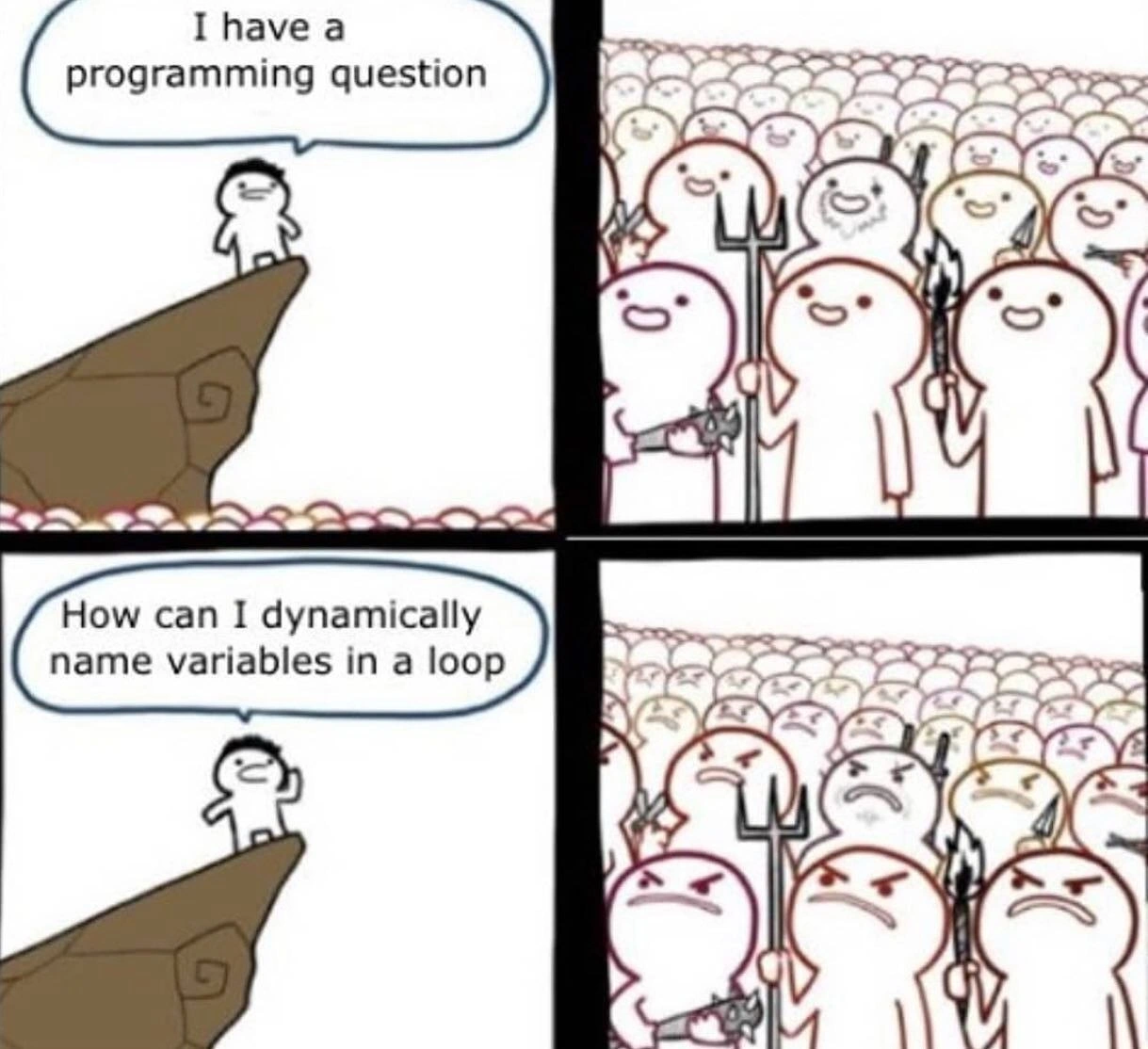
Asking about dynamic variable names instantly enrages the once-cheerful dev crowd
Why is this Languages meme funny?
Level 1: Friendly to Furious
Imagine a group of friendly car mechanics at a workshop. A person walks in and says, “I have a question about my car,” and all the mechanics smile, ready to help. Then the person asks, “Is it okay if I pour water into my car’s gas tank to save on gas?” In an instant, all those friendly faces turn angry 😠. The mechanics start shouting “No, no, no! Never do that!” They were happy to answer any normal question, but this particular idea was so bad it made them upset right away. The meme is just like that, but for programmers: someone asks a question that shows a big misunderstanding, and the once-cheerful crowd of experts suddenly looks furious. It’s funny because the change in their reaction is so extreme and sudden. The person’s suggestion (naming variables on the fly, or pouring water in a gas tank) is silly to the experts, so the crowd goes from helpful to outraged in a split second – an exaggerated, cartoonish way to show how a really bad idea can flip people’s moods instantly.
Level 2: Use a List Instead
Let’s break down what’s happening in this meme in simpler terms. In the first panel, a little stick figure programmer says, “I have a programming question,” and a big crowd of other developers is smiling and eager to help. In the next panel, the programmer asks: “How can I dynamically name variables in a loop?” Suddenly, in the final panel, that same friendly crowd looks angry and threatening (they’re holding pitchforks like an angry mob!). This dramatic change is played for laughs, but it highlights a real coding issue and how developer communities often react to it.
The question being asked is: “How can I dynamically name variables in a loop?” What does that mean? It means the person wants to create new variable names on the fly as a program runs, especially inside a loop. For example, imagine someone wants to have player1, player2, player3, ... playerN as separate variables and they think, “I’ll just generate those names in my code automatically.” This idea of dynamic variable naming is basically trying to create new, uniquely named variables during execution, rather than defining each one in advance.
Why would someone ask this? Usually, it’s because they need to handle a bunch of similar data items (like a list of players or values) and they haven’t learned a better way yet. In programming, the idiomatic (and much easier) way to handle lots of related values is to use a data structure like a list (or array) or a dictionary (also called a map or hash in some languages). These are like containers that hold multiple values under one variable name. You don’t need a new variable name for each item; instead, you use an index or key to distinguish them. For example, instead of having score1, score2, score3 as separate variables, you can have one list scores where scores[0] is the first score, scores[1] is the second, and so on.
The developer crowd in the meme gets upset because dynamically creating variable names is considered a bad approach – in fact, it’s a well-known anti-pattern. An anti-pattern is like a common solution people think of that actually leads to problems. It’s something experienced coders have seen many times and learned to avoid. In this case, if you try to generate new variable names during a loop, you usually end up with code that is hard to read and maintain. It’s also unnecessary because programming languages provide better tools for the job (like lists or dictionaries).
Think about it: if you had 100 pieces of data, would you really want to manually create 100 different variable names? That would be a nightmare to keep track of! Instead, you could put those 100 pieces of data in one array or list and just loop through that. The code becomes much simpler and cleaner. Here’s a quick illustration in Python-like pseudocode of the wrong versus right way to do this:
# ❌ A bad approach: trying to dynamically create variable names (not recommended)
for i in range(3):
exec(f"value_{i} = {i}") # This line magically creates variables value_0, value_1, value_2
print(value_0, value_1, value_2) # It prints "0 1 2", but this method is confusing and risky.
In the above snippet, exec is used to execute a string as code (imagine constructing code textually). It actually creates value_0, value_1, and value_2 variables. While it “works” in this simple case, it’s generally a terrible idea. If you saw code like this, you might worry: “What else is it doing behind the scenes? How do I know what variables exist?” It’s very easy to make mistakes or introduce bugs this way.
Now compare that with a better approach:
# ✅ A good approach: use a list to store values
values = [] # one list to hold many values
for i in range(3):
values.append(i) # add the value to the list
print(values[0], values[1], values[2]) # prints "0 1 2", using list indices 0,1,2 to access items
Here, we use a single list values to hold all the data. We don’t need to create new variable names; the list takes care of grouping the items. values[0] acts like what we wanted value_0 to be, but without inventing a brand-new variable in the code for it. This is how modern programming is taught and practiced across most languages: use collections (lists, arrays, dictionaries) instead of a bunch of standalone variables.
So why did the crowd of developers in the meme react with such anger? It’s because they’ve likely seen what happens when someone actually tries the dynamic-naming trick. It often leads to confusing code or runtime errors. Moreover, questions about this come up a lot on sites like Stack Overflow, so much that regular contributors get tired of explaining the same thing: “Don’t do that, use a list!” There’s even a bit of developer humor and lore around it. For instance, it’s common to see responses that bluntly say “Don’t reinvent the wheel” or “That’s a code smell – use a proper data structure.” A code smell is a term for something in code that’s not technically an error, but it signals a deeper problem – kind of like a bad smell hints something is rotten. If someone is asking to dynamically name variables, the “smell” is that they haven’t learned about arrays/lists or proper data management yet.
The meme uses the crowd’s extreme change (from friendly to hostile) as a joke. It exaggerates reality to make a point. In real life, if you ask this question in a programming forum, you won’t literally get people with torches at your door 😅. But you might get some short-tempered answers, downvotes, or snarky comments. The StackOverflow community in particular is known to close or downvote such questions because they consider it either duplicate (asked many times before) or an indication the asker needs to read a basics tutorial on data structures. Naming things (like coming up with good variable names) is indeed a hard part of programming, but trying to avoid the issue by auto-generating variable names is going about it the wrong way. Experienced devs prefer you use meaningful names for variables and appropriate structures for collections of items.
In summary, the meme is funny to developers because it captures a common scenario: a beginner innocently asks about an AntiPattern – generating variable names on the fly – and the veteran programmers collectively freak out. It’s a lighthearted take on how strongly people feel about code quality and doing things “the right way.” The advice underneath the humor is solid: use lists or other collection types when you have lots of related data, rather than trying to invent new variable names for each piece of data.
Level 3: Dynamic Variables, Static Rage
In the top panels of this meme, a lone coder stands on a cliff proclaiming “I have a programming question.” A massive dev crowd below is all smiles, ready to help. But in the next breath the question comes: “How can I dynamically name variables in a loop?” Instantly, that friendly crowd’s demeanor turns into an angry mob brandishing pitchforks and torches. This dramatic shift is poking fun at a well-known anti-pattern in programming and the fierce reaction it triggers in developer communities (especially on Q&A forums like Stack Overflow). The meme exaggerates how a once-cheerful dev community can become enraged by the mere mention of dynamic variable naming. It’s an inside joke about code quality and shared frustration: the question reveals a code smell that experienced programmers have seen too many times.
Why does this seemingly innocent question unleash coding frustration? Because dynamically naming variables at runtime is almost universally considered a bad practice. It’s like walking into a room of battle-hardened engineers and shouting a forbidden spell: everyone recognizes it, and they know it leads to chaos. In many programming languages, variable names are meant to be static labels you choose when writing the code. If you find yourself wanting to generate new variable names on the fly (e.g., user1, user2, user3 … up to userN in a loop), it usually means you’re approaching the problem the wrong way. Seasoned devs insist that instead of conjuring new variables for each item, you should use a proper data structure (like a list, array, or dictionary) to hold those values. So when someone asks “How do I create variables on the fly with changing names?”, experienced developers hear “I don’t know about arrays/lists and I might do something dangerous like use eval.” 😱
This strong reaction is partly because such questions pop up frequently on forums, and the community has answered them ad nauseam. It’s a running joke that asking about dynamic variable names is like stepping on a landmine of dev ire. The crowd’s transformation in the comic (from 😊 to 😡) is the meme’s humorous way to say: “Uh oh, you just asked that question — prepare for downvotes and lectures!” In Stack Overflow lore, the top answer to “How can I dynamically create variables?” is often simply: “Don’t. Use a list (or map) instead.” The meme’s angry pitchfork-wielding horde represents all those senior engineers who have seen this anti-pattern wreak havoc in codebases. It touches a nerve because dynamic variables make code harder to maintain, debug, and review. Imagine trying to figure out what went wrong in a program where variable names are generated unpredictably — it’s a nightmare scenario for anyone concerned with CodeQuality.
From a technical standpoint, dynamically creating variable identifiers breaks assumptions that both humans and tools rely on. Most languages store variable references in a structured way (like a symbol table or memory addresses). Manually injecting new variable names at runtime via hacks (like Python’s exec or globals() dictionary, or PHP’s $$ variable variables) is like playing tricks on the language interpreter. It tends to confuse code editors, linters, and anyone reading the code later. Experienced devs know that “just because you can doesn’t mean you should.” In fact, some compiled languages won’t even allow it — you literally can’t create new variable names dynamically once the program is compiled. And in dynamic languages that do allow it, it’s often through dangerous workarounds. For example, consider this horror-show in Python:
# Anti-pattern: creating variables dynamically using exec (very bad!)
for i in range(3):
exec(f"var{i} = {i}") # This will create variables var0, var1, var2 at runtime. Yikes!
print(var0, var1, var2) # It "works" (prints 0 1 2), but oh boy, what a code smell.
Here the code uses exec to execute a string as Python code, effectively doing var0 = 0, var1 = 1, etc., in a loop. It does create separate variables, but any senior developer seeing this would cringe. Why? Because it’s hard to reason about, it’s prone to errors (imagine debugging 100 such variables!), and it’s unnecessary when a cleaner solution exists. Instead, the time-tested advice is to use a list or dictionary:
# Proper approach: use a list to store values instead of separate variables
values = []
for i in range(3):
values.append(i)
print(values[0], values[1], values[2]) # Prints 0 1 2, using one list to hold all values.
This second snippet achieves the same output (0 1 2) but with a single variable values that contains all the items. It’s cleaner, safer, and scalable. The contrast between these two approaches is exactly why the coding crowd in the meme reacts so strongly. The first approach is a classic CodeSmell that signals “newbie mistake” or “maintainability nightmare,” whereas the second is a standard pattern taught in any intro to programming class. In short, the meme humorously encapsulates a common interaction in DevCommunities: a novice asks about a known anti-pattern (dynamic variable naming), and the veterans collectively facepalm (or in this case, rage with pitchforks). The only thing dynamic here is the community’s mood turning from helpful to hostile! It’s a funny exaggeration of how protective developers are about naming things properly and using the right abstractions. After all, there’s a famous joke: “There are only two hard things in Computer Science: cache invalidation, naming things, and off-by-one errors.” The crowd isn’t really mad at the person — they’re mad at the idea of code that’s harder to manage. The meme gets its punchline from that shared understanding: we’ve all seen this question before, and we all know the answer.
Description
Four-panel comic with minimalist stick figures. Top-left: a lone figure stands on a brown cliff, saying in a blue-outlined speech bubble, "I have a programming question." Top-right: a large crowd of smiling stick figures holding tridents and torches looks back supportively. Bottom-left: the cliff figure asks, "How can I dynamically name variables in a loop" in another blue bubble. Bottom-right: the same crowd now scowls angrily, gripping their pitchforks menacingly. The joke highlights how developer communities (e.g., Stack Overflow) react negatively to the anti-pattern of generating variable names at runtime, favoring proper data structures instead and equating the practice with poor code quality
Comments
6Comment deleted
If your loop is minting variable names, congrats - you just reinvented a hash map and summoned the code-review inquisition in O(1) time
Twenty years in, and I still feel that primal urge to explain why they want a dictionary, followed immediately by the sobering realization that I'll need to explain what a dictionary is first
Asking how to dynamically name variables in a loop is the programming equivalent of asking a Michelin-star chef how to microwave a steak - technically possible with eval() or globals(), but it reveals such a fundamental misunderstanding of the craft that the entire community collectively sighs. Senior engineers know this question immediately signals someone trying to use variable names as a poor man's hash map, when they should be reaching for dictionaries, arrays, or objects. It's the canary in the coal mine that indicates a developer hasn't yet internalized that variable names are compile-time constructs for humans, not runtime data structures for programs
Dynamic loop vars: because arrays are for amateurs, and your future self deserves the debugging hell
“How can I dynamically name variables in a loop?” Translation: I want the symbol table to be my key‑value store and eval to be my ORM
If your loop needs to mint variable names, congrats - you’ve reinvented a hash table without the benefits and with all the PR blame