Programmer Dress Code Fork
Why is this DevCommunities meme funny?
Level 1: Picking A Costume
This is like a kid choosing between dressing like a fancy grown-up or wearing something weird and comfortable from home. The funny part is that programmers are shown as if they must choose one dramatic path, when the real answer is often just whatever clothes they found before sitting down at the computer.
Level 2: Culture In Clothes
Developer culture includes the habits, jokes, clothing, tools, values, and stereotypes shared by programmers. Some of those stereotypes are old: hoodies, caffeine, messy desks, late nights, and not caring much about office fashion. Others come from online communities where programmers use playful clothing or aesthetics as part of identity and humor.
Corporate culture often expects people to dress in ways that signal reliability and professionalism. A suit can help in client-facing roles, management, sales engineering, finance, consulting, or any environment where appearances affect trust. That does not mean the person is better at programming. It means the room has expectations.
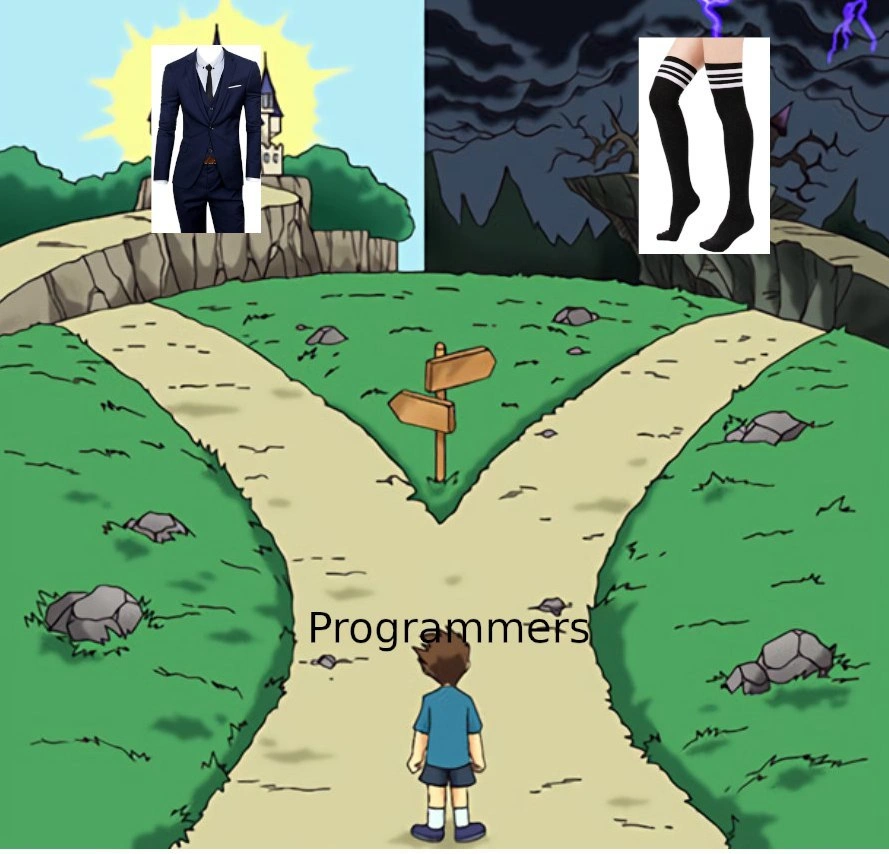
The image contrasts those worlds with two extreme symbols. The suit says "I can talk to executives." The socks say "I live on the internet and my code still passes." The caption's third road points at the most realistic option: many programmers simply wear whatever is clean, comfortable, and available.
For early-career developers, the useful lesson is that clothing is context. A job interview, a startup office, a remote standup, a conference booth, and a production incident may all have different norms. The code matters most, but people still make social judgments around it because humans stubbornly continue to attend meetings.
Level 3: Dress Code Branching
The image puts a small figure labeled:
Programmers
at a fork in the road. The bright left path leads toward a formal navy suit. The dark, stormy right path leads toward black thigh-high socks. The post caption adds that a third road exists when programmers have "just one pants or something." That last line is doing a lot of unpaid cultural analysis.
The joke is about developer identity splitting between professional presentation and internet-native subculture. On one side is the suit: enterprise consulting, client meetings, promotion packets, conference keynotes, and the old idea that serious technical labor should look like corporate authority. On the other side is the meme-coded programmer aesthetic: informal, online, playful, sometimes gender-nonconforming, and very aware that the compiler does not care about your blazer.
Experienced engineers know both paths are costumes in different contexts. A suit can be useful armor in rooms where nontechnical stakeholders judge competence through polish before substance. The socks represent the opposite fantasy: the work is digital, the output is code, and the body at the keyboard can reject corporate costume rules entirely. Then remote work arrived and quietly introduced the real production standard: acceptable shirt on camera, mystery situation below the desk.
The deeper workplace-culture joke is that software has always had a strange relationship with professionalism. Companies want creativity, intensity, and hacker problem-solving, but also predictable availability, brand-safe communication, and a person who can explain a race condition without looking like they slept under the build server. Developers respond by building microcultures where hoodies, socks, conference swag, startup T-shirts, and "I own one pair of pants" all become signals.
The fork format exaggerates the choice as moral destiny: sunny castle for formal respectability, lightning swamp for chaotic authenticity. Real careers are less clean. The same person may wear a suit for a bank integration meeting, pajama pants for a late-night incident, and a ridiculous conference shirt while reviewing code that moves real money. The meme is funny because the wardrobe debate is silly, but the identity negotiation behind it is real.
Description
A cartoon crossroads scene shows a child labeled "Programmers" standing at a fork in the road. The left path leads toward a bright, sunny castle-like area and is marked by an image of a formal navy suit; the right path leads toward a dark, stormy landscape and is marked by an image of black thigh-high socks. The sibling caption jokes, "The third road exists too when programmers have just one pants or something." The meme plays on developer-culture fashion stereotypes, contrasting corporate presentation with internet-native programmer subculture and the practical chaos of actual wardrobe habits.
Comments
25Comment deleted
The real senior move is choosing the outfit that passes code review and the standup webcam crop.
OnlyPants :) Comment deleted
Same BTW Comment deleted
"just one pants" - wat Comment deleted
Like one scissors Comment deleted
Pants is not plural Comment deleted
that was my guess but even then I still do not get the joke Comment deleted
I'm fullstack. I run out of motivation and moral after coding CSS for more than 30 minutes, so I didn't get too. My road is none of them, but backwards Comment deleted
Dont say "I coded CSS" you will geht a shitstorm xD Comment deleted
"Turing complete" CSS defenders more terrifying than others Comment deleted
CSS is turing-complete, soooo.... Comment deleted
Stop saying this word. The only CSS I wanna see is Counter-Strike Source, not this shit Comment deleted
Okay, I never used CSS in depth, so i thought it was just like the name says a "stylesheet" 🤦♀ Comment deleted
It has conditionals, variables and calculations Comment deleted
it doesn't have proper control flow. All events you can react to are from the html or input changing, so you can't create events you can react to. Furthermore, besides simple arithmatic, there's no instruction order either, mostly because there's barely any instructions, only property definitions. variables are also just different constants depending on certain events. There are no input values except "is it x or not", like hover or focus. It's at best a programming language that can define constants and react to external events in predefined ways. In my opinion though, it's a design language that's accidently technically turing-complete. Comment deleted
I have one faded out pair of sport pants and one pair of jeans I still fit in lol Comment deleted
I see, you're from 🏳⚧russia Comment deleted
It's a trap Comment deleted
Russia has a new flag, eh? Comment deleted
https://emojipedia.org/transgender-flag/ (sorry if I am to spoil a joke) Comment deleted
yeah, I know this one, but why Russia? Comment deleted
Not just Russia. I even dare say I know the exact city. It is in bio. Comment deleted
tell me the right one isn't male ... Comment deleted
ofcourse not, it's a trans woman😁 Comment deleted
what's that meaning? Comment deleted