Steve Jobs rejects liver transplant, keeps Apple’s no-third-party policy intact
Why is this Apple meme funny?
Level 1: No Outside Toys
Imagine you have a friend who only ever wants to play with his own toys. He’s built a special little castle out of his favorite blocks. One day, a part of his castle breaks and you offer him one of your blocks to fix it. But he crosses his arms and says, “No, only my blocks are allowed!” He’d rather see the castle fall apart than use someone else’s piece. Sounds silly, right? That’s basically the joke here. Steve Jobs was so set in his “only my stuff” rule (just like that friend who won’t use others’ toys) that when Tim Cook tried to give him a piece to save his life – in this case, a piece of his liver – Steve said no. It’s funny in a kind of ironic way: he was super stubborn about keeping things in his world all-original, even when it really mattered. The meme makes us laugh because it’s like saying, “He stayed true to his rule of no outsiders allowed, even when an outside thing could have helped him.”
Level 2: Walled Garden 101
If you’re newer to the tech world, here’s the scoop: Apple is famous for keeping a tight grip on its products and services – often referred to as a “walled garden.” In a garden with high walls, only the plants Apple chooses can grow inside; outside plants (third-party stuff) are kept out unless Apple lets them in. This means Apple controls what hardware works with your device and what software you can install. Ever notice how you can’t easily replace an iPhone battery yourself or how MacBooks have memory soldered on the motherboard? That’s on purpose. Apple doesn’t want just any third-party component entering their devices without oversight. They prefer you use official Apple parts and accessories (or Apple-certified ones). This strategy is called vendor lock-in – once you’re in Apple’s world, you kind of have to stay with Apple for upgrades, repairs, and add-ons, because alternatives either won’t work or will trigger warnings. For example, using an off-brand charging cable might pop up a “unsupported accessory” alert.
Now, third-party integration in general means adding something from an outside source. In software, it could be using a library or service made by another company. In hardware, it might be plugging in a device or part from another manufacturer. Many tech ecosystems welcome third-party integrations to foster flexibility and innovation. But Apple? Apple has a reputation for being very choosy. They run the App Store with strict rules – if an app uses private (non-public) APIs or tries to do something Apple doesn’t allow (like overly integrate with system features or circumvent security), Apple will reject it. On the hardware side, think about connecting gadgets: Apple often has unique ports and connectors (like the old 30-pin dock, then Lightning, now possibly only USB-C but with authentication). If you try to use a gadget Apple hasn’t approved, you might hit a compatibility wall. Apple’s philosophy under Steve Jobs was to create a seamless, high-quality user experience by gatekeeping outside influences. That closed ecosystem policy can frustrate developers and hardware tinkerers, but Apple believes it keeps things consistent and secure.
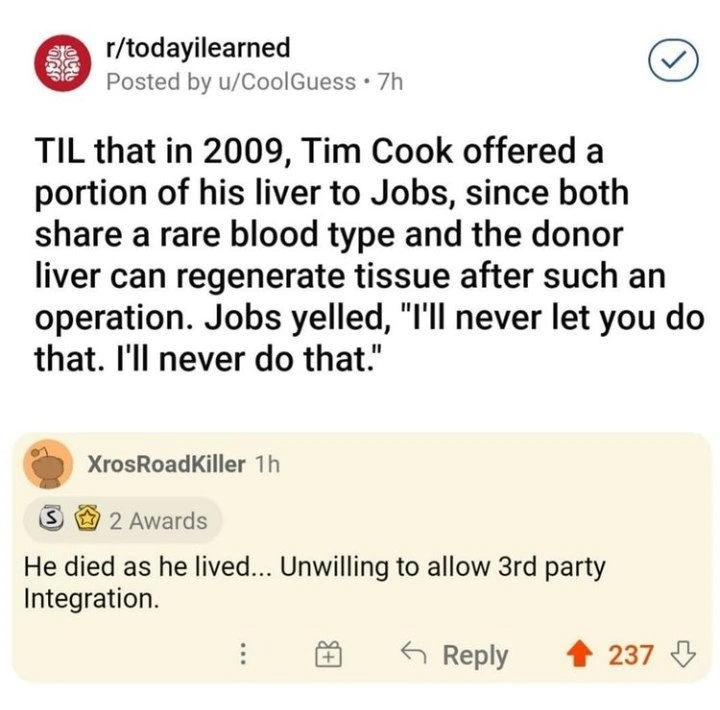
So what’s this meme about? It takes a real story from 2009: Steve Jobs was very sick, and Tim Cook (who is now Apple’s CEO, and was a top executive then) offered a part of his liver to help save Jobs. It was possible because livers can regenerate and, luck would have it, they shared a rare blood type. But Steve Jobs refused the offer emphatically, saying “I’ll never let you do that.” This Reddit meme screenshot shows someone posted that fact (on the subreddit r/todayilearned). The golden comment below – the one with 237 upvotes and a couple of awards – makes a joke connecting that refusal to Apple’s no-third-party mindset. The commenter XrosRoadKiller quips: “He died as he lived... Unwilling to allow 3rd party Integration.”
Why is that funny to tech folks? Because it’s comparing Steve Jobs to an Apple device. Essentially, the joke is saying: Steve treated Tim’s liver like it was an unofficial iPhone part — he wouldn’t let it be installed. It’s a play on Apple’s habit of disallowing unapproved integrations. If you’ve ever tried to fix an Apple gadget with non-Apple parts, or install an app that Apple didn’t sanction, you know the struggle – Apple often blocks it or at least makes it hard. So the idea here is that Steve Jobs stuck to Apple’s philosophy so hard that even when his life was on the line, he acted like his body had an Apple-style “no third-party components” rule. It’s an IndustryIrony and definitely DeveloperHumor because it pokes fun at the very thing developers often gripe about: Apple’s gatekeeping. The humor has a bit of a dark edge (we’re talking about a real person’s death), but it’s mainly directed at highlighting Apple’s consistent closed approach. In short, the meme uses an Apple anecdote to lampoon the company’s vendor lock-in culture in a way that techies find clever. It’s saying, “Steve Jobs wouldn’t even accept a third-party liver, just like Apple products won’t accept third-party anything!” – a hyperbolic way to underscore how Apple’s gatekeeping is almost a matter of principle or pride.
Level 3: Non‑User‑Serviceable Parts
Apple’s ecosystem has long been a walled garden – beautifully designed, tightly controlled, but notoriously closed to outsiders. The meme riffs on Apple’s closed ecosystem policy by equating Steve Jobs’s refusal of a liver transplant to rejecting an unauthorized hardware upgrade. It’s a darkly funny case of life imitating product philosophy. The punchline comment – “He died as he lived... Unwilling to allow 3rd party Integration.” – lands because it weaves together Apple’s corporate culture and a literal life-and-death decision in one grim joke. Everyone in tech knows Apple’s stance on third-party integration is legendarily strict. From the App Store’s stringent rules to Mac hardware’s soldered components, Apple has a “my way or the highway” approach.
This strict control is often termed vendor lock-in: Apple designs the hardware, the software (iOS/macOS), the cables, even the screws (proprietary pentalobe screws in iPhones!), making it hard for any non-Apple part or software to integrate without Apple’s blessing. It’s as if Apple products have a built-in checklist: if a component or app isn’t Apple-certified, it’s not welcome. In developer terms, third-party APIs or unauthorized apps get gatekept out of the ecosystem. Engineers who have tried to use unapproved accessories or libraries with Apple devices have often hit the same wall: “Integration not allowed.”
Now, picture Steve Jobs – who personified Apple’s philosophy of end-to-end control – faced with Tim Cook’s generous offer of a partial liver transplant. By 2009, Jobs was seriously ill, and Tim Cook, sharing a rare blood type with him, offered part of his own liver to save Steve’s life. Jobs vehemently refused: “I’ll never let you do that.” To a seasoned developer, this true story instantly conjures an analogy: Steve treating Tim’s liver like an uncertified third-party part, declining it just as Apple might reject a non-approved iPhone battery. It’s morbid humor with a tech twist. The Redditor’s comment gained 237 upvotes and a couple of awards because it resonated with an industry truth – Apple’s infamous unwillingness to allow outside integration, taken to absurd heights.
Why do engineers chuckle (or groan) at this? Because we’ve all wrestled with Apple’s gatekeeping at some point. Maybe you tried to use a third-party charging cable only to see the “This accessory may not be supported” warning. Or you wanted to integrate an app with a system feature, but Apple’s private APIs said “nope.” Apple’s tight grip ensures quality and security (no random organ transplants without approval!), but it also creates friction for developers and tinkerers. The IndustryIrony here is palpable: a company preaching innovation while disallowing outside innovation in its garden. Apple’s policy has always been: if it’s not built in-house or officially sanctioned, it doesn’t get in. This meme exaggerates that policy to a personal extreme – implying Jobs’ body itself had a “No Third-Party Components” sticker.
For veteran developers, it’s a head-nodding moment of “yep, that’s Apple for you.” They recall decades of Apple’s vendor lock-in: from the original Macintosh (closed case, “no user-serviceable parts inside”) to the lightning cables (chips inside to verify authenticity). Apple has always been about vertical integration, controlling the whole widget. Even as far back as the 1980s, Jobs insisted on proprietary everything – hardware, operating system, peripherals – eschewing the open IBM PC clone approach. This ethos continued with the iPod, iPhone, and beyond. So when Jobs declines a liver that isn’t “Apple-approved,” it’s a perfect satirical metaphor. It humorously suggests that Steve Jobs remained fiercely loyal to Apple’s closed ecosystem policy to the very end. It’s tech humor with a pinch of darkness, poking fun at Apple’s corporate culture of control. The meme works because it’s absurd yet fitting: Apple’s gatekeeping is so strong that even a lifesaving organ from a colleague was politely declined, just like an unsolicited app on the App Store.
Description
Image is a Reddit screenshot from r/todayilearned, posted by u/CoolGuess 7 hours ago. The post text reads: “TIL that in 2009, Tim Cook offered a portion of his liver to Jobs, since both share a rare blood type and the donor liver can regenerate tissue after such an operation. Jobs yelled, 'I'll never let you do that. I'll never do that.'” Below, commenter XrosRoadKiller (with two award icons) writes: “He died as he lived... Unwilling to allow 3rd party Integration.” The comment shows an orange up-arrow with 237 votes and a grey reply icon. Visually it uses Reddit’s beige comment box and default fonts. Technically, the punchline satirizes Apple’s historically strict control over hardware and software ecosystems - equating an organ transplant to unauthorized peripheral integration, a joke that resonates with engineers who’ve wrestled with Apple’s closed APIs and vendor lock-in
Comments
7Comment deleted
Somewhere in Cupertino, the MDM policy still flags foreign biological peripherals as “unsigned hardware.”
Just like how Apple still charges a 30% commission on organ donations through the App Store - some things never change, even in the afterlife. At least the liver would've been compatible without a dongle
Rejecting a fully compatible donor with regenerative capacity - the man deprecated his own high-availability failover on principle
Jobs maintained his commitment to vertical integration right to the end - refusing to accept external components even when his own system was failing. A true architect who would rather deprecate the entire platform than compromise on his design principles by accepting a third-party organ transplant. The ultimate 'not invented here' syndrome
PR to add TimCookLiver.dylib was rejected: no notarization, uses private hepatocyteRegenerate(), and violates entitlements - runtime doesn’t load unsigned third‑party modules
Jobs' final architecture review: Tim's liver pull request denied - no third-party deps in the iBody
Apple's integration policy in one line: unless the donor organ ships with signed entitlements and an MFi certificate, the host runtime rejects it as a private API