Skip to content
DevMeme
1478 of 7435
The Road to Unmaintainable Code is Paved with Good Intentions
Documentation Post #1654, on Jun 2, 2020 in TG

The Road to Unmaintainable Code is Paved with Good Intentions

Why is this Documentation meme funny?

Level 1: Hide-and-Seek with Yourself

Imagine you decided to play a trick on yourself. You hide a toy or a treat somewhere in your house and think, “I won’t forget where I put it, I’m the one who hid it after all!” You don’t leave any notes or clues because you feel so sure you’ll remember. Now fast forward a few weeks: it’s time to find that hidden object, but you have absolutely no idea where it is. You search high and low, scratching your head in confusion. You feel pretty silly, right? You basically played hide-and-seek with yourself and lost.

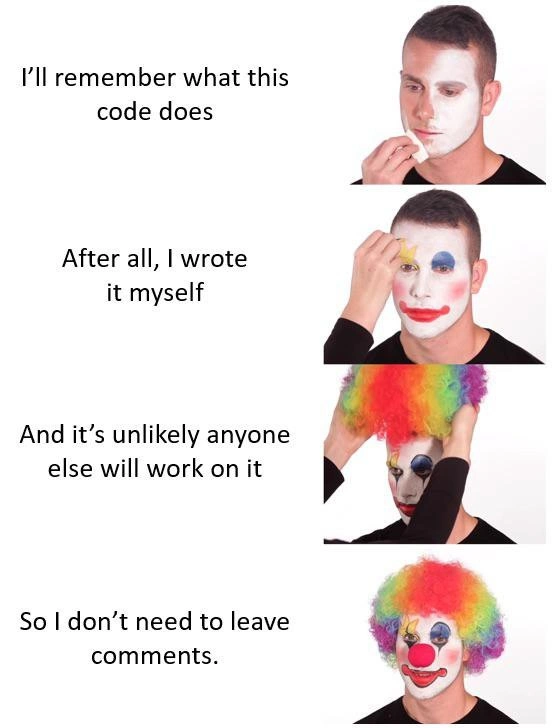
That’s exactly the feeling this meme is talking about. The person thought they didn’t need to leave any hints (like comments in code) for later, because they were confident they’d remember everything. But later on, they become completely confused by their own actions, just like forgetting where you hid something. The picture of the clown is a funny way of showing how the person ended up fooling themselves. It’s like saying, “I was so sure I didn’t need help remembering, and now I realize I was wrong – what a clown move!” In everyday terms: writing down a little note for yourself (or in coding, leaving a comment) can prevent you from feeling goofy later when your memory lets you down.

Level 2: Comment or Regret

Let’s break down what’s happening in this meme in simpler terms. A developer decides not to write any code comments, coming up with a series of justifications while we see them progressively turning into a clown. Each panel’s caption is basically the developer’s inner voice rationalizing a bad habit:

  1. “I’ll remember what this code does.” – In the first panel, the programmer assumes their memory is so good that they’ll recall exactly how this piece of code works, even months later. At the moment of writing, it’s easy to believe because the code is fresh in their mind. But as time passes, details get fuzzy. We’ve all had that experience of looking at something we wrote a while ago and thinking, “Wait, what did I do here?” If there are no comments or notes, figuring it out again can be as hard as reading someone else’s code.

  2. “After all, I wrote it myself.” – Next, the developer doubles down on the confidence. The logic is: “Since I’m the author, I have special insight that won’t fade.” This is a common overconfidence in one’s own familiarity with the code. Yes, you wrote it, but our brains don’t permanently store every detail of every program we touch – especially not the tricky parts or the little hacks we added. Without reminders, even the original author can become a stranger to their own code. Writing it doesn’t guarantee remembering it, much like writing a diary entry doesn’t mean you memorize it word-for-word.

  3. “And it’s unlikely anyone else will work on it.” – Here the developer assumes the code is a personal island. Maybe they think it’s a small script or a private project that no other developer will ever see or need to modify. This is a risky assumption in terms of CodeMaintainability. In team environments, code often gets shared or handed off. Even in solo projects, there’s a saying: “Future you is another developer.” In other words, when you come back to this code in the future, you’ll be almost like a new person on the project. Also, things change – you might switch teams, someone else might take over your work, or the code could be repurposed in a new project. If no one else ever works on it, great, but you can’t be 100% sure of that. It’s safer to assume that someone (either a colleague or your future self) will read this code with fresh eyes at some point.

  4. “So I don’t need to leave comments.” – In the final panel, all the flawed reasoning culminates in the decision to write no comments. The developer concludes that documentation is unnecessary. This is presented as the logical result of the previous points, but it’s actually a mistake. CodeComments exist to make code easier to understand later. Skipping them might feel fine now, but it often leads to DeveloperRegret. Without comments, the code has less CodeReadability – meaning other programmers (or you, later on) will have a harder time figuring out what it does and why. It’s at this moment the meme shows the developer fully dressed as a clown, symbolizing that they’ve fooled themselves.

In simpler terms, the meme is saying: “Skipping comments because you think you won’t need them later is a silly move.” The clown imagery is a humorous way to illustrate someone making a fool of themselves. Each excuse the developer makes (“I’ll remember, I wrote it, nobody else will see it”) is like another step of putting on clown makeup. By the end, the person has effectively clowned themselves by leaving their code undocumented.

Let’s connect this to real programming practices. Code comments are bits of text in the source code that are not executed by the computer. They’re written for humans to read. For example, in Python you might see a line starting with # or in JavaScript/C++ a //. Anything after those symbols on that line is a comment. The computer skips over it, but a developer reading the code will see a helpful note. Comments can explain what a block of code is for, or why something is done a certain way. This is especially useful for tricky sections or clever tricks that aren't obvious just by reading the code itself.

Documentation in general (which includes comments, as well as external docs or README files) is considered a key part of CodeQuality. Good documentation can make the difference between a program that is easy to maintain versus one that’s a nightmare. CodeMaintainability means how easy it is to modify or fix the code later on. If the original author wrote clear comments explaining their thinking, the next person (or future them) can pick it up and understand it without guesswork. CodeReadability is about how easy it is to read and follow the code. Things like clear variable names, proper formatting, and yes, comments, all improve readability. When code is readable and well-documented, it’s less likely to have bugs linger and it’s easier to extend with new features.

The context tags mention self_documenting_code_myth. This refers to the idea that “well-written code is self-documenting,” implying you shouldn’t need comments if your code is super clean. While it’s true that we should write code as clearly as possible (for example, using descriptive variable and function names), the meme is poking fun at taking that idea too far. Assuming your code alone will always be clear is a myth – sometimes even the clearest code can benefit from a short comment about the intent or a weird edge case it handles. And if your code isn’t that clear (maybe because a problem was really hard and required a complex solution), comments are even more important.

Another context tag is future_self_is_other_programmer, which gets at a famous piece of advice: “Always program as if the person who ends up maintaining your code is a complete stranger.” In fact, that stranger might be you, after you’ve forgotten the details. The meme’s joke aligns perfectly with this concept. The developer thought no one else would work on the code, but future-them is effectively "someone else." When they return to that uncommented code later, it won’t be obvious anymore, and they’ll have to puzzle it out like a new programmer would. That’s when they’ll wish Past-them had been a bit more considerate and left some helpful comments – or as the meme suggests, that’s when they realize they were kind of a clown for not doing so.

In short, for a junior developer (or any developer really), the lesson from this meme is: Don’t skip writing comments out of overconfidence. It’s a gentle ribbing but carries real wisdom. Taking a few extra minutes to write a comment now can save you or your teammates hours of headache later. No one has a perfect memory, and code without explanation can confuse even its creator down the line. The meme humorously shows the consequence – you only make a fool of yourself by assuming you’re an exception to this rule.

Level 3: Self-Documenting Delusions

This meme captures a classic CodeQuality blunder that makes seasoned developers cringe and chuckle at the same time. The four panels are basically a play-by-play of a developer donning the clown makeup of overconfidence:

  • "I'll remember what this code does." At the moment of writing, everything is fresh and crystal clear. The logic is in your head, and you think your memory is as reliable as git version control. Spoiler: it’s not. Human memory has cache eviction policies of its own – a few weeks or a complex context switch later, and those details will get swapped out. That one-liner function with the clever bitwise hack you wrote might as well be an obfuscated puzzle when you see it again in six months. Without any CodeComments to refresh your memory, you’re already setting the stage for confusion.

  • "After all, I wrote it myself." Ah yes, the developer ego speaking. There’s a kernel of pride here – the code was your ingenious creation, so of course you believe it will remain forever familiar. Experienced engineers know this is false confidence. Just because you authored the code doesn’t grant you an eidetic memory of its every quirk. Code is not a personal diary entry; it’s a complex set of instructions. Time and changing projects will erode that intimate knowledge. To a future-you, that code might as well have been written by a stranger. In fact, there's a saying: "Write code as if the guy who ends up maintaining it will be a violent psychopath who knows where you live." It’s grim humor, but drives home the point – never assume the next person reading your code (even if it’s you) will know what you know now.

  • "And it's unlikely anyone else will work on it." Here comes the flawed bus factor assumption (bus factor = how many people can get hit by a bus before knowledge on a project is lost, and a bus factor of 1 is bad). The developer believes they’re the sole owner of this code forever, so why bother explaining anything? In reality, no code is an island. Maybe your teammate will need to debug it, or you’ll hand the project off when you go on vacation, or the code gets reused in a different app. Even if none of that happens, future-self is effectively another programmer because in a few months you won’t remember the intricacies. Seasoned devs have seen "my private script" turn into mission-critical production code more times than they can count. The moment you say nobody else will touch it is usually exactly when someone will. Murphy’s Law of code maintainability.

  • "So I don't need to leave comments." And with that, the transformation to 🤡 is complete. This final panel is the punchline: defying every best practice in Documentation and CodeMaintainability by leaving zero comments. It’s the embodiment of the self_documenting_code_myth — the false idea that “the code itself is the documentation.” Sure, well-written code with good naming is extremely important, but even then, code only tells you how it works, not necessarily why. When you skip comments, you create a DocumentationGap that will come back to haunt you. The humor here is that we all know how the story ends: the same developer (now with metaphorical clown wig and nose) will be staring at this code later, utterly baffled, perhaps muttering "what idiot wrote this?!" only to realize, that idiot was me.

From a senior engineer’s perspective, this meme is painfully on-point. It highlights how CodeReadability and maintainability suffer under the weight of unchecked confidence and laziness. We’ve all been there: a 3 AM on-call emergency, digging through your own spaghetti logic from last year, desperately wishing Past You had left a breadcrumb trail of comments. The clown makeup in the meme is exaggerated visual satire for that “I played myself” moment. It’s a shared industry joke that even brilliant developers can be fools if they assume memory alone will suffice. In real projects, the cost of missing comments is measured in hours of lost productivity, bugs, and DeveloperRegret.

Consider a snippet of mysterious code without context:

# Mysterious code with a "clever" hack and zero comments
flags = 0b10001010  
result = compute_magic_value(data, flags)

Looking at this, future-you has no clue what 0b10001010 means or why those particular bits are set. Is it enabling some special modes? Disabling a feature? Now compare it to a commented version:

# 0b10001010 sets mode X and Y, and disables Z (bitmask for features)
flags = 0b10001010  
result = compute_magic_value(data, flags)

A one-line comment instantly reveals the intent behind that cryptic binary literal. The code itself might not tell you that bit 3 turning off feature Z is a workaround for a legacy bug – but a comment can. This is the kind of vital context a developer loses when they skip writing comments. Without such hints, even clean code can become a minefield of misunderstood “magic numbers” and unexplained logic.

In summary, the meme humorously exposes a code maintenance trap: skipping documentation under the assumption that things will always be as clear as they are on day one. Seasoned devs recognize this as a form of technical debt – you save a few minutes now by not writing comments, but you incur a hefty interest later when you (or someone else) waste hours deciphering the code. The clown costume is a perfect metaphor: you may think you’re being pragmatic or quick today, but down the road you’re just clowning yourself.

Description

A four-panel meme, known as 'Putting on Clown Makeup', which illustrates a developer's flawed logic for not documenting their code. Each panel on the right shows a man progressively applying more clown makeup, symbolizing his increasingly foolish reasoning, which is stated in text on the left. First panel: The man applies white face paint with the thought, 'I'll remember what this code does'. Second panel: He adds colorful makeup around his eyes and a red smile, thinking, 'After all, I wrote it myself'. Third panel: He puts on a rainbow-colored wig, rationalizing, 'And it's unlikely anyone else will work on it'. Final panel: Now a fully-dressed clown, he concludes with the disastrous thought, 'So I don't need to leave comments.'. The meme is a sharp critique of a common developer pitfall: overconfidence in one's own memory and underestimation of future collaboration, leading to unmaintainable code that makes a clown out of the original author
Comments

7
Anonymous ★ Top Pick There are only two hard things in computer science: cache invalidation, naming things, and remembering what the hell your uncommented code from six months ago does
  1. Anonymous ★ Top Pick

    There are only two hard things in computer science: cache invalidation, naming things, and remembering what the hell your uncommented code from six months ago does

  2. Anonymous

    “Skipping comments because ‘git blame will explain it’ is just past-you leaving a zero-day vulnerability for future-you - except the exploit is every 3 AM Sev-1 page.”

  3. Anonymous

    The four stages of grief when you're debugging your own undocumented code from six months ago: denial ('I'll remember'), bargaining ('I wrote it myself'), anger ('why would anyone else need to understand this?'), and acceptance (you're now the clown trying to reverse-engineer your own clever one-liner that seemed so obvious at 2 AM)

  4. Anonymous

    Every senior engineer has been both sides of this meme: the clown who wrote 'self-documenting' code at 2 AM, and the archaeologist six months later staring at `processData(x, true, false, 7)` wondering if the original author was having a stroke or a stroke of genius. The real punchline? That original author was you, and no, you absolutely do not remember why that magic number 7 is critical to production

  5. Anonymous

    “I’ll remember what this does” is an optimistic cache with 100% eviction at 3am - also known as Bus Factor = 1

  6. Anonymous

    Using memory as documentation is a stateful service with zero replicas - one reorg or 3am page and your RPO is infinite

  7. Anonymous

    Future you: the most unreliable maintainer, with zero context and a looming deadline

Use J and K for navigation