Skip to content
DevMeme
821 of 7435
The Network Engineer's Christmas Gift
Networking Post #928, on Dec 22, 2019 in TG

The Network Engineer's Christmas Gift

Why is this Networking meme funny?

Level 1: Not That Kind of Switch

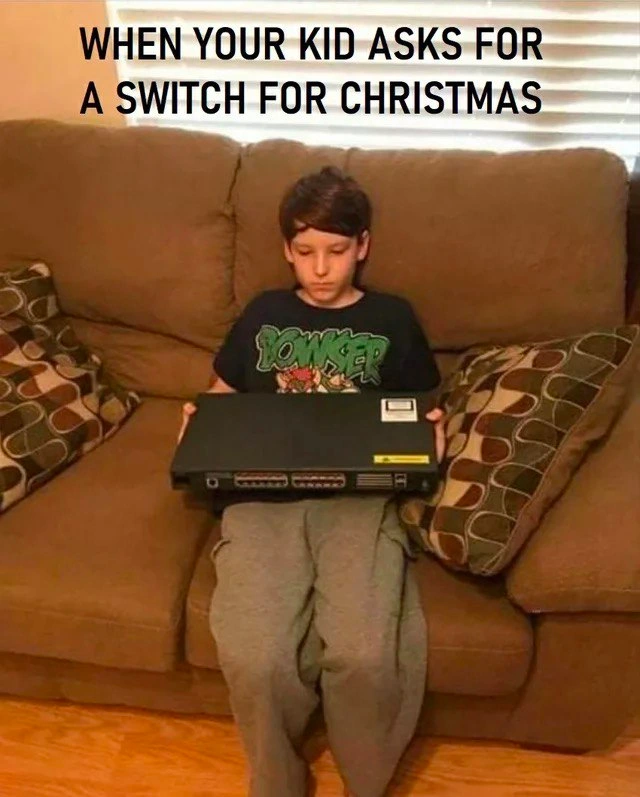
Imagine you ask for a really cool toy but get a boring gadget that just shares the same name. That’s what’s happening here, and it’s why it’s so funny (and a little sad for the kid). It’s like telling your parents you want an Xbox (the video game console) and instead they give you a cardboard box with a big “X” drawn on it. You’d be confused and disappointed, right? In this meme, the kid wanted a Nintendo Switch, which is a fun handheld video game machine. But his parent gave him an electric network switch, which is basically a box used to connect computers with cables – something you’d find in an office or behind the scenes of the internet, not in a toy store. The poor kid is sitting there on the couch with this heavy metal box on his lap, looking baffled. He was expecting games and excitement, but got a piece of tech equipment that doesn’t do anything fun on its own. The joke is all about a simple mix-up: the word “Switch” meant one thing to the kid and something totally different to his parent. It’s a bit like if you asked for a bass (thinking of a guitar) and someone handed you a bass (a big fish). Sometimes, words can be tricky, and saying exactly what you mean is important – otherwise you might end up with a Christmas surprise that’s more plug-and-play than pick-up-and-play!

Level 2: Two Kinds of Switches

Let’s break down what exactly is happening in this meme for those not deeply into tech. The joke revolves around the word "Switch", which has two very different meanings in this context:

  • Nintendo Switch – a popular video game console made by Nintendo (released in 2017). It’s a hybrid console that you can play handheld or connect to a TV (hence the name “Switch,” because it can switch between modes). Kids ask for this so they can play games like Mario Kart, The Legend of Zelda, and Super Smash Bros. It’s lightweight, portable, colorful, and designed for fun. It has controllers called Joy-Cons, and you insert game cartridges or download games to play. In short, a Nintendo Switch is entertainment hardware for gaming.

  • Network Switch – a piece of networking equipment used to connect multiple devices (computers, consoles, smart TVs, etc.) in a wired network. This is a metal box with 24 Ethernet ports (in the image) where you plug in RJ-45 cables. A network switch’s job is to direct data traffic: it receives data packets from one device and forwards them to the correct destination device, all within a local network (this is called packet switching at the Ethernet level). It’s usually used by IT professionals in offices or by enthusiasts in their home lab setups. Think of it as a smart data splitter that lets many devices talk to each other efficiently. It often has status lights, a power supply, and sometimes makes a humming noise. This kind of switch is all about infrastructure – it’s not something you play games on, it’s something that makes networks run behind the scenes.

To a young kid, the word "switch" unequivocally means that cool Nintendo gaming device. But to an IT parent (or any network engineer), "switch" might first bring to mind the trusty network switch sitting in a server rack. The meme’s humor comes from this mix-up: the child expected a fun gaming console, but the parent deliberately (or accidentally) provided a serious tech gadget with the same name. It’s a classic case of one word, two meanings. In software or IT terms, this is akin to a misunderstanding where someone uses a general term and gets a very literal, unintended result. It’s as if the kid filed a bug report saying “I want a Switch,” and the parent resolved it by delivering hardware from the wiring closet instead of a trip to GameStop.

We can imagine the conversation that led to this:

Kid: “I really hope I get a Switch for Christmas!”
Parent (with a mischievous grin): “Roger that, I know just the thing.”

The parent might even have thought this was an educational opportunity: “Hey, if my kid is into Nintendo’s Switch, wait till he learns about networking switches!” – a bit of homelab parenting humor. The front of the device on his lap clearly shows multiple Ethernet ports (those rectangular jacks), which are used to plug in network cables. Notice the kid isn’t exactly jumping with joy. For most people (especially children), an enterprise-grade network switch is a boring utilitarian device – it doesn’t have a screen, you can’t play Fortnite on it, and it won’t show cartoons unless you use it to wire up the internet. The child was expecting the excitement of a new game console, something that runs Mario or Pokemon, but instead got something that an IT department would prize for setting up a LAN. It’s the difference between getting a toy and getting a tool.

To put it in perspective, here’s a comparison between the two “switches”:

Nintendo Switch 🎮 Network Switch 🖧
What it is Gaming console by Nintendo Networking device (Ethernet switch)
Purpose Play video games for fun Connect multiple devices in a network
Used by Kids, gamers, families IT pros, network engineers, techies
Interfaces Controllers (Joy-Cons), HDMI to TV, game cards RJ-45 Ethernet ports for cable plug-ins
Size/Weight Small, portable (handheld device) Large, heavy (rack-mount metal box)
Produces Graphics, sound, interactive gameplay Blinking lights, data traffic, maybe fan noise
Why called "Switch" Because it switches between handheld and dock/TV mode Because it switches data between multiple network ports (Layer-2 switching)
Fun factor ★★★★★ (High – it’s a toy!) ★☆☆☆☆ (Low – unless you’re a networking geek)

In the image, the boy’s face says it all: he’s realizing “Not that kind of switch...”. This mix-up highlights why clear communication is important. In technology (and parenting!), being specific can save you from some big surprises. The kid will probably remember to say "Nintendo Switch console" next time, just like a junior developer learns to ask, "Do you mean the game console or the network device?" when a senior says, "Hand me the switch." It’s a funny and slightly painful lesson in how a single word in tech can mean drastically different things.

Level 3: The Old Switcheroo

At first glance, this meme looks like a straightforward spec misunderstanding that any battle-hardened engineer can relate to. A child asks for a "Switch" and ends up with a 24-port network switch perched on his lap instead of the Nintendo Switch gaming console he actually wanted. This is the classic literal requirements misinterpretation in action: the stakeholder (kid) used an ambiguous term, and the implementer (parent, in full nerd mode) delivered exactly the wrong switch. Every senior developer has seen this play out in production – it's like when a client ambiguously requests a feature toggle and someone hands them a physical light switch on their desk as a joke. Here the parent took the request word-for-word, resulting in a gift that technically satisfies the phrasing but completely misses the intended outcome.

From a networking perspective, what the kid got is a serious piece of hardware: a rack-mountable Layer-2 network switch. This means it operates at the Data Link layer (Layer 2 of the OSI model), forwarding Ethernet frames between devices. In practical terms, it’s a heavy metal box filled with switching silicon, MAC address tables, and possibly a loud fan — not exactly what you’d put on a wish list next to Pokémon Sword/Shield. The front panel is lined with RJ-45 Ethernet ports, 24 of them, ready to connect a small office worth of devices (or maybe all the gaming consoles in the neighborhood, if the kid had any!). If this were an enterprise-grade switch, it might boast features like VLAN support, Spanning Tree Protocol to prevent network loops, and a CLI that only a network admin would love. In contrast, a Nintendo Switch operates at the fun layer: running games at 60 FPS, not packets at gigabit speeds. One deals in frames of video, the other in frames of data — same word, totally different meaning. The poor kid probably has no idea that the term "switch" has such divergent interpretations in tech.

The humor here also plays on the parent-as-Engineer trope: the adult in this situation is likely a tech-savvy homelabber or sysadmin who found the perfect geeky way to troll their child. It's the kind of dad joke only a network engineer would execute; they hear "Switch" and immediately think of Cisco IOS configs and blinking link/activity LEDs, not Super Mario or Zelda. It's a safe bet the parent knew exactly what the kid meant but couldn’t resist the opportunity for a punny lesson in specificity. This scenario is basically a live demo of the advice: "Always clarify requirements before you deliver." In a software project, failing to clarify could mean weeks of building the wrong feature — here it meant one very confused and disappointed kid on Christmas morning. The child’s black T-shirt even says "BOWSER" (the notorious Nintendo villain), which is hilariously fitting: to the kid, the parent just became the final boss who guarded the treasure but gave him a tech puzzle instead of a console. The kid’s blank, unamused expression in the meme is every end-user’s face when they open a deliverable and think, "This isn’t what I asked for... or is it?". It’s a perfect encapsulation of that painful-yet-funny gap between what was requested and what was actually delivered.

Description

A meme showing a young boy sitting on a brown couch with a look of profound disappointment on his face. He is wearing a black t-shirt with the video game character 'Bowser' on it. On his lap, he is holding a large, black, rack-mountable network switch, the kind used in data centers or server rooms. White text at the top of the image reads: 'WHEN YOUR KID ASKS FOR A SWITCH FOR CHRISTMAS'. The humor is a pun based on the double meaning of 'switch'. The child clearly wanted a Nintendo Switch, a popular gaming console, but his parent, presumably a network engineer or IT professional, has literally given him a network switch. The joke lies in the parent's nerdy, literal interpretation of the request and the child's utter failure to appreciate his new enterprise-grade hardware
Comments

7
Anonymous ★ Top Pick The dad probably told him it has 48 ports, so all his friends can connect at once. He just left out the part about needing a patch panel and a solid understanding of spanning tree protocol
  1. Anonymous ★ Top Pick

    The dad probably told him it has 48 ports, so all his friends can connect at once. He just left out the part about needing a patch panel and a solid understanding of spanning tree protocol

  2. Anonymous

    Stakeholder asked for “a Switch”; delivery shipped 48 Gbps of VLAN-ready bandwidth and exactly zero Joy-Cons - requirements ambiguity strikes again

  3. Anonymous

    At least it's managed - unlike the emotional damage from explaining why daddy's homelab budget exceeds the college fund

  4. Anonymous

    The real tragedy here isn't the gift mix-up - it's that the kid now has to explain to his friends why his Christmas present requires a console cable and TFTP server to configure, has a CLI but no GUI, and the only games it runs are spanning-tree convergence simulations. At least it has better uptime than a Nintendo Switch, and when it crashes, you can actually read the stack trace in the syslog

  5. Anonymous

    The only Switch where 'Joy-Con drift' means bad crimps, not firmware fails - and it scales to production traffic

  6. Anonymous

    Classic requirements ambiguity: the backlog said "Switch", so engineering shipped a 24‑port Layer‑2 with STP; UAT failed when acceptance tests involved Mario Kart instead of MAC tables

  7. Anonymous

    This is what happens when the user story says 'deliver a Switch by Christmas' - engineering ships a 24-port, wire-speed L2 with STP and 802.1Q; great throughput, zero Joy-Con support

Use J and K for navigation