Skip to content
DevMeme
822 of 7435
The True Source of a Developer's Pain: JavaScript
Languages Post #930, on Dec 24, 2019 in TG

The True Source of a Developer's Pain: JavaScript

Why is this Languages meme funny?

Level 1: Crying Over Code

Imagine you have a really hard puzzle or a tricky game that you’ve been trying to figure out all day. It keeps changing the rules on you. You thought you solved it one way, but then suddenly the pieces mean something different and your solution doesn’t work anymore. You’d feel super frustrated, right? You might even get so upset that you cry a little because it’s just not making sense. Now, your dad comes by and sees your red, teary eyes. He might think it’s because something simple like you got dust in your eyes or you’re sad about a TV show. But actually, you’re upset because that puzzle (let’s say it’s a really confusing coding problem) was so hard and confusing that it made you cry. This meme is joking that coding in JavaScript is like that really tricky puzzle. It’s saying the kid’s eyes are red not from doing something naughty or painful like getting smoke in them, but because JavaScript coding made him so frustrated he cried. In other words, sometimes working with JavaScript can be so confusing and difficult that it feels as if it hurts. The joke is funny because the dad guesses the unexpected truth: that writing code (supposedly a nerdy, logical activity) can be even more tear-inducing than something obvious like getting smoke in your eyes. It’s a silly way to show just how maddening coding problems can be — so much so that even a parent would understand why their kid might end up in tears over it, just like they might over a tough homework problem.

Level 2: JavaScript Landmines

Let’s break down why JavaScript can make developers so upset. JavaScript is the primary programming language for the web’s front-end — it runs in your browser to make pages interactive. It's a dynamically typed language, meaning variables don’t have fixed types. This flexibility is great for quick scripting, but it also leads to language quirks that feel like stepping on landmines for developers. A big source of trouble is type coercion. Type coercion is when the language automatically converts a value from one type to another. JavaScript does this in the background with loose equality (written as ==). The idea was to be helpful: "5" (a string) and 5 (a number) are different types, but == will coerce and consider them equal in value. Unfortunately, the rules for these conversions can be quite convoluted, leading to type_coercion_gotchas. For example, "" (empty string), 0, false, null, and undefined are all "falsy" values, but they aren’t all treated the same under the hood. Compare:

  • Using ==: undefined == null is true (JavaScript considers them loosely equal in value).
  • Using ===: undefined === null is false (because with strict equality, no type conversion happens and an undefined is not the same type as null).

Because of surprises like that, a best practice is to use strict equality (===), which checks for both value and type, to avoid unintended coercion. New developers (and even veterans on a bad day) often get tripped up by something like 0 == [] evaluating to true, or "0" being loosely equal to false. These are classic JavaScript quirks.

Now, why would this drive someone to tears? Imagine spending hours debugging, only to find out the bug was because == was used instead of === somewhere, causing a subtle logic error. It's frustrating! Undefined vs null is another headache: undefined typically means "a variable has been declared but not given a value," whereas null is an intentional "no value" assignment. They are different things, but because undefined == null returns true, developers sometimes mistakenly treat them as interchangeable. This can cause all sorts of confusion in code, and hence debates on how to use them properly (some teams even ban one or the other to simplify their codebase).

Beyond type issues, frontend development has other pain points that the meme hints at. The mention of crying while coding could also relate to async bugs — say you wrote some JavaScript that calls a server or waits for a timer. If you don’t handle the asynchronous nature correctly (like using callbacks, Promises, or the async/await pattern), you might get unexpected results or errors (undefined is not a function at runtime can be a real tear-jerker). Debugging asynchronous code can be really tough for a newcomer, because the code execution order might not be the order it appears in the file.

And then there’s the ecosystem churn in JavaScript. Ecosystem churn means the tools and frameworks around JavaScript change rapidly. In the last decade, frontend developers saw jQuery, then AngularJS, then React, then Vue, then Angular (again, a new version), then things like Svelte — it feels like a new “must-use” framework or build tool (hi Webpack, Babel, now Vite and so on) comes out every few months. Keeping up can be exhausting. A developer might just get comfortable with one technology, only to be told that it’s now “legacy” and they need to learn something entirely new. This constant learning curve can absolutely contribute to developer pain points and burnout. It’s a running joke that JavaScript fatigue (being overwhelmed by the pace of change) can leave you crying at your desk.

So the meme’s scenario is that the son claims a trivial reason for his red eyes (smoke from weed, which is a humorous misdirection), but the dad immediately suspects the real, nerdier reason: coding in JavaScript. It’s funny because it swaps a typical parent-child conflict (like scolding about drugs) with an inside joke about programming. The dad essentially says, "Don’t lie to me, I know those tears are from debugging and JavaScript frustration." To get it, you need to know that coding, especially in JavaScript, can indeed be frustrating enough to make you cry. Many of us have sat in front of the screen with watery eyes after hours of chasing a weird bug or dealing with a package that suddenly broke our app. This shared experience is central to developer humor on forums and sites like CodeHub (note the small "Code hub" logo on the meme image). The categories here—Languages, Frontend, DeveloperExperience_DX—all hint that this is about the developer experience with a programming language (JavaScript on the front-end) and how it sometimes feels like an emotional rollercoaster.

In short, the meme highlights JavaScript’s landmines: tricky parts of the language (like type coercion and other odd behaviors) and the challenging aspects of the frontend developer’s life (like constant changes and nasty async bugs). These are things that junior developers quickly learn about (often the hard way) and that senior developers love to commiserate and joke about. If you’ve ever seen the joke "It’s not a bug, it’s a feature!", a lot of JavaScript’s weirdness can feel like that. And if you’ve spent a long night trying to figure out why your code isn’t working only to realize it’s because JavaScript automatically did something silly, well, you might end up a bit teary-eyed too. The Dad in the meme knows this, and any programmer who’s dealt with JS can relate.

Level 3: Type Coercion Trauma

At the highest level, this meme hits on JavaScript's notorious language quirks that can reduce even seasoned engineers to tears. The dad's punchline about coding in JavaScript causing red eyes is a darkly humorous nod to how developer frustration with JS is very real. Why would a programmer cry over a language? Because JavaScript's type coercion can feel like a betrayal by the interpreter itself. In JavaScript, loose equality (==) will coerce types in often bewildering ways, leading to gotchas that every veteran dev knows too well. For example, consider these WAT-worthy cases:

console.log(false == "0");   // true  — both sides coerce to 0 (yes, seriously)
console.log(false === "0");  // false — different types, no coercion this time
console.log("5" + 3);        // "53"  — string concatenation (coerced number to string)
console.log("5" - 3);        // 2     — subtraction forces numeric conversion
console.log(undefined == null); // true  — special case: loosely equal, yet...
console.log(undefined === null); // false — ...strictly, different types (of course)

These bizarre results are not bugs per se; they’re dictated by the ECMAScript specification. But that doesn’t stop them from feeling like booby traps. A senior developer reading this meme recalls hours lost debugging why a value was NaN or why [] == 0 returned true. The Dad in the meme clearly has the battle scars of many a JS project — he immediately recognizes those bloodshot, I've-been-debugging-JS eyes. The joke exaggerates that coding in JavaScript is more tear-inducing than any illicit substance. It’s a playful exaggeration, yet it lands because of shared pain: undefined vs null confusion, async race conditions that only show up in production at 3 AM, and the endless churn of the front-end ecosystem that leaves developers feeling burned out (ecosystem_burnout, indeed).

This is a classic piece of developer humor. It resonates with experienced engineers who know that “just JavaScript things” can be maddening. The dad/son scenario underscores an inside joke: even a parent (perhaps also an engineer) knows that the real culprit for a programmer’s despair isn’t typical teenage mischief but rather the torment of dealing with yet another inexplicable JavaScript behavior. In a world where new front-end frameworks pop up weekly and where one misused this context or stray = can ruin your day, the meme wryly suggests that coding in JavaScript is a hardship that eclipses more ordinary troubles. Frontend development often promises dynamic, interactive webpages, but behind the scenes it sometimes delivers late-night frontend_rage and actual JavaScript tears. This shared understanding — that the struggle is real — is what makes the meme so funny and cathartic to the in-crowd of devs. We laugh because we’ve all been that red-eyed coder at some point, wondering why we chose this career path as yet another DeveloperExperience_DX nightmare unfolds on our screen.

Description

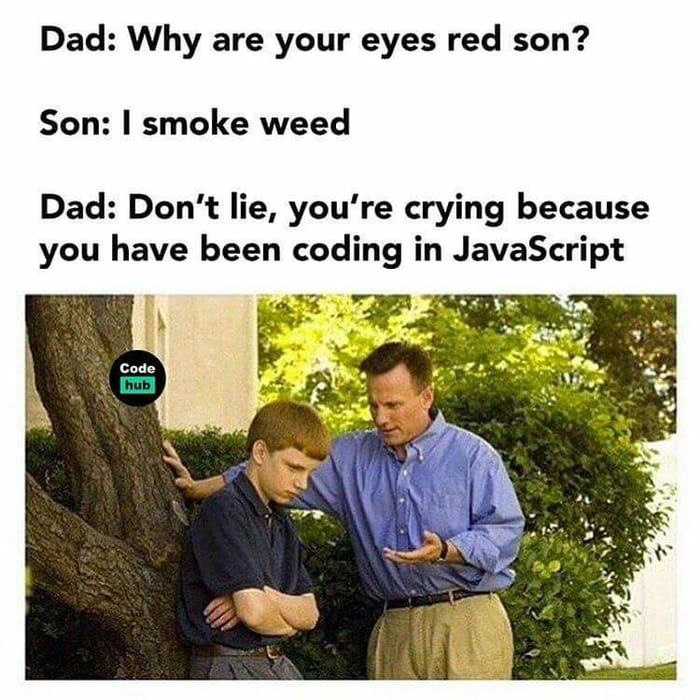
A meme featuring a stock image of a father consoling his visibly upset teenage son, who is leaning against a tree with his arms crossed. The scene is captioned with a three-line dialogue. First line: 'Dad: Why are your eyes red son?'. Second line: 'Son: I smoke weed'. Third line: 'Dad: Don't lie, you're crying because you have been coding in JavaScript'. A small circular logo for 'Code hub' is visible on the tree trunk. The humor is derived from the father's immediate dismissal of a common teenage excuse, instead identifying a more 'realistic' source of distress for a developer: the frustrations of programming in JavaScript. This plays on the language's reputation for having confusing behaviors, complex asynchronous patterns, and other quirks that can lead to long, painful debugging sessions. The joke resonates with any developer who has felt the unique despair that comes from wrestling with JavaScript's eccentricities
Comments

7
Anonymous ★ Top Pick The kid probably just tried to explain the 'this' keyword to his dad. Both of them ended up crying
  1. Anonymous ★ Top Pick

    The kid probably just tried to explain the 'this' keyword to his dad. Both of them ended up crying

  2. Anonymous

    JavaScript: the only language where '[] + []' equals '' and your emotional outage budget hits zero in production

  3. Anonymous

    Dad's been through enough JavaScript migrations to know that '[] + [] === ""' is just the beginning of your suffering, and that your tears probably started when you discovered your perfectly working code broke because a dependency's dependency updated a patch version

  4. Anonymous

    The real tragedy isn't the red eyes - it's that he's probably crying over whether to use `==` or `===`, why `this` isn't what he thinks it is, and the fact that his `node_modules` folder is now larger than the entire codebase. At least with weed, the high eventually ends; with JavaScript, the confusion is a permanent state of being

  5. Anonymous

    Those aren’t tears; it’s when == turns '0' into false while the microtask queue outruns setTimeout - no linter prepares you for that

  6. Anonymous

    Nothing reddens eyes faster than debugging a promise chain where == quietly coerces a branch, await inside forEach doesn’t, and npm installs half a rainforest to render a button

  7. Anonymous

    In JavaScript, even NaN !== NaN, but your deadlines are always strictly equal to yesterday

Use J and K for navigation