Skip to content
DevMeme
3152 of 7435
The Project Manager's Orchestra Problem
ProjectManagement Post #3472, on Jul 29, 2021 in TG

The Project Manager's Orchestra Problem

Why is this ProjectManagement meme funny?

Level 1: Time Doesn’t Work That Way

Think about watching your favorite TV show or a movie. Imagine a cartoon that runs for 40 minutes. If you watch it alone or with a bunch of friends, it’s still going to take 40 minutes to finish – watching it with more people doesn’t make the cartoon go faster, right? The idea in the meme is just like that: Beethoven’s Ninth Symphony is a piece of music that takes a certain amount of time to play from beginning to end. If an orchestra plays it, it might last about 40 minutes. Now, if only half the number of musicians play it, does the music suddenly last twice as long (80 minutes)? Of course not! The song is the song – it has a fixed length. More players or fewer players don’t change the actual running time of the music, just like more people watching a show doesn’t change how long the show is. The joke here is that someone treated this like a math puzzle and assumed a really silly thing: as if you could stretch out time just by having fewer musicians. That’s not how time works! We all intuitively know that if a big group can perform a piece in 40 minutes, a smaller group playing the same piece isn’t going to magically create a longer version of the piece.

So why is it funny? Because it’s obvious to us that the question is nonsense – it’s like asking, “If one cook bakes a cake in 1 hour, how long would it take half a cook to do it?” Huh?! It makes no sense. The meme is poking fun at that kind of nonsense logic. It’s basically saying: Some things just take a fixed amount of time, no matter how many people are involved, and thinking otherwise is pretty laughable. Even a kid listening to a bedtime story knows that two storytellers reading alternate words would just make a mess, not a faster ending. In simple terms, the meme is funny because it’s a goofy misunderstanding of reality – and we’re laughing at the idea that anyone would seriously come up with such a question. It’s a gentle way of reminding us: you can’t just split or double the length of a song (or any task) by fiddling with the number of people – life doesn’t work like a math equation!

Level 2: Linear Scaling Fallacy

For a less experienced developer or someone new to CS fundamentals, let’s break down the key ideas. This meme addresses what we call the linear scaling fallacy – the mistaken belief that work done is just a simple product of the number of people and the time they spend (often measured in “man-hours” or similar). In that flawed view, if 120 players take 40 minutes, one might think 60 players would need double the time (80 minutes) to do the same job, because 120×40 and 60×80 both equal 4800 player-minutes. This corresponds to treating “work” like a constant that can be split up any which way among people and time. You might write a quick calculation like:

players = 120
time_minutes = 40
total_work = players * time_minutes  # total "player-minutes" of effort
new_players = 60
new_time = total_work / new_players
print(f"With {new_players} players: estimated {new_time} minutes")
# Output: With 60 players: estimated 80.0 minutes

However, this computation only makes sense if the task is perfectly divisible and parallelizable. Many tasks in real life and tech don’t work that way! Scalability is the idea of how well a process can handle more or fewer resources. If something scales linearly, doubling the workers would halve the time (or vice versa). But here’s the catch: playing a symphony or developing software isn’t like filling sandbags where 10 people can fill 10 bags in the same time 5 people fill 5 bags. A symphony performance has a fixed duration because it’s essentially one big sequential task – the music flows from start to finish. All 120 musicians in Beethoven’s 9th are not doing separate independent 30-second mini-tasks; they’re playing together, following one continuous score for 40 minutes. Even if you cut down to 60 musicians, those 60 still have to play the entire 40-minute piece. They might each cover more parts or the music might suffer in quality, but the time to play all movements from the first note to the final chord stays at ~40 minutes. It’s not twice as slow; it’s the same length with fewer people contributing.

In computer terms, imagine a program that processes a list of tasks, but certain steps must happen one after the other. You could add more threads or more servers, but if, say, the program has to wait for one database response that takes 2 seconds, you can’t get that below 2 seconds by adding more threads – that’s a sequential bottleneck. Similarly, some coding tasks (like designing an architecture or debugging a tricky issue) can’t be split among many people without them interfering or needing to stop and sync up. A new junior engineer often learns this the hard way when a team project doesn’t go faster just because more people joined – sometimes it even slows down initially due to ramp-up and coordination.

The Mythical Man-Month is a famous book from the 1970s by Fred Brooks that introduced these ideas to software project management. Brooks explained that the concept of a “man-month” (one person working for one month) can be mythical because people aren’t interchangeable and tasks don’t always partition neatly. He gave that memorable example: one woman takes 9 months to make one baby, but 9 women can’t make a baby in 1 month. It sounds obvious when you say it like that, right? That’s essentially the same logic as this Beethoven puzzle. It’s highlighting an expectations vs. reality gap. On paper, someone clueless might treat the orchestra like a bucket of labor that can be halved or doubled, but in reality certain jobs have a fixed timeline. The worksheet-style format of the meme (it literally looks like question 5 on a test or homework) is baiting you to apply a formula for inverse proportionality. If you did, you’d answer “80 minutes” – which is the trap and the joke. The expected sensible answer is that it still takes 40 minutes, because that’s how long the symphony lasts. The humor comes from recognizing that the question is fundamentally flawed, and only someone with no understanding of music (or by analogy, no understanding of software project dynamics) would even attempt to solve it with rote math.

In performance engineering, we also talk about diminishing returns: for example, adding more CPU cores speeds up a task less and less once the remaining work can’t be parallelized. In team projects, adding more people yields diminishing returns (or worse) once communication and coordination become significant. These are core performance trade-offs to understand. The orchestra example is a friendly real-world analogy to drive the point home: Some processes are like a single long song – you can’t chop it in half and play both halves at the same time with two groups; it has to be played from start to finish. When tasks have to be done in order or require everyone in sync, more people don’t linearly translate to less time. Recognizing this helps junior developers understand why sometimes “more hands on deck” doesn’t fix a late project, and why smart planning involves looking at dependencies, not just headcount. This meme wraps that lesson in a funny, slightly absurd question about Beethoven – making the learning a bit more memorable (and meme-able!).

Level 3: Half Team, Double Delay

Every seasoned engineer immediately recognizes the humor as a riff on The Mythical Man-Month and the classic Brooks’s Law: “adding manpower to a late software project makes it later.” This level of the joke targets management humor and the folly of misaligned expectations in project planning. The scenario of halving the orchestra and naively expecting the performance to simply take twice as long perfectly mirrors a certain corporate absurdity. It’s the same flawed logic behind a project manager saying, “We lost half our devs on this feature, so it’ll just take twice as long, right?” – as if building software were as linearly scalable as stacking bricks. Tech humor often draws from such real-world management misconceptions. In reality, complex projects (like symphonies) don’t scale that neatly. Reducing a team (or orchestra) can actually wreak havoc: critical roles go unfilled, coordination overhead for those remaining skyrockets, and sometimes the project (or performance) can’t even be completed properly with too few hands.

This meme is essentially pointing out a ScalabilityIssue in human terms. In software engineering, we’ve all seen how throwing more developers at a problem doesn’t always proportionally speed things up – in fact, beyond a point it can slow things down. Why? Because as team size changes, communication costs and coordination efforts change non-linearly. With more people, the number of communication channels grows roughly as n(n-1)/2. With fewer people, individuals have to multitask and cover broader responsibilities, which can introduce delays and mistakes. There’s a famous tongue-in-cheek analogy from the Mythical Man-Month: “Nine women can’t have a baby in one month.” It’s absurd because some tasks just can’t be parallelized or compressed; they have natural timelines and dependency chains. The Beethoven puzzle is a similarly absurd real-world analogy: you can’t just speed up or slow down a fixed-length piece of music by altering headcount, just like you can’t arbitrarily compress a software schedule by adding or removing developers without consequences.

In practice, senior engineers have war stories where a higher-up treated developer time as simple units of exchange. For example, a manager might think if 120 engineer-hours produce a feature, then 60 engineer-hours should produce half a feature or take double time for the whole feature. They assume work = people × time, a dangerously simplistic formula. This meme’s question #5 reads exactly like a snarky exam for pointy-haired bosses, catching those who apply that linear formula blindly. The correct answer to “How long would 60 players take?” is of course still 40 minutes – because the Ninth Symphony’s score dictates the timeline, just as certain project tasks have fixed durations (or minimum times) regardless of team size. When an experienced dev hears a manager ask something equivalent to this question, it elicits a knowing chuckle (or maybe a twitch). It’s engineering humor that underscores a painful reality: misaligned expectations between how managers wish scalability would work and how it actually works.

Consider a real software scenario: Suppose a critical code module takes one senior dev about 2 weeks to implement because it requires deep understanding (a largely sequential mental task). Hiring an extra developer in the last week won’t cut that remaining week to 3.5 days – in fact, onboarding the new dev might consume the whole week and delay completion. Similarly, if you removed half the team from a tightly scheduled 40-minute release deployment, it’s not like the deployment will just linearly stretch to 80 minutes; more likely, critical steps would be missed or someone would simply have to do the same tasks, maybe a bit slower or serially, but the overall process flow remains the same length or gets riskier. The performance tradeoff of team resizing isn’t linear time change; it involves overhead, risk, and sometimes a hard floor on time.

The Beethoven analogy is perfect because it’s so obviously misleading if interpreted with raw math. Even a non-musician knows a famous symphony has a set length – you can’t arbitrarily change it by cutting players. That absurdity is exactly how devs feel when higher-ups treat tasks as perfectly scalable man-hours. It’s simultaneously funny and frustrating – funny because of how ridiculous the math is, and frustrating because it reflects real conversations we’ve had in sprint planning or post-mortems. This meme falls under Management_PMs humor because it satirizes a management-style mistake. Developers share these jokes as a gentle way to say, “Scaling people isn’t like scaling servers – you can’t expect double the output with double the people, or vice versa, without considering complex dependencies.” In short, the humor is a nod to every engineer who’s had to explain to a non-technical lead that software development isn’t a simple linear equation. The next time someone suggests halving the team “might just double the timeline,” you can point to this meme and remind them: Beethoven’s Ninth still lasts 40 minutes, no matter what.

Level 4: Amdahl's Orchestra

At the most theoretical level, this meme is a clever illustration of parallelism limits and Amdahl's Law disguised in musical form. In computing, Amdahl’s Law tells us that the maximum speed-up of a task from adding more resources is limited by the portion of the task that must happen sequentially. Beethoven’s 9th Symphony has an intrinsic sequential nature: it’s a fixed composition that unfolds over time. Even though an orchestra plays many notes in parallel (different instruments concurrently), the performance still has to progress measure by measure from start to end. There’s no way to parallelize the timeline of the symphony itself. This is analogous to a program with a large serial component – adding more threads (or musicians) won’t reduce the total runtime below the duration of that sequential part. In fact, Beethoven’s score already uses full parallelism (120 players all playing together), so reducing to 60 players doesn’t make it slower; it just means some musicians would cover multiple parts or sections might sound thinner, but the tempo and overall length remain the same. The linear scaling fallacy here is treating “total work” as a simple product of people and time (e.g., 120 players × 40 minutes = 4800 player-minutes of work) and assuming that product stays constant. Real systems violate this assumption because work isn’t a homogenous lump that can be arbitrarily split. In formal terms, if none of Beethoven’s symphony can be accelerated by extra players (i.e. 0% parallelizable beyond a certain point), then according to Amdahl’s Law the speedup from 120 to 60 players is essentially 1.0 (no change in time).

This highlights a fundamental CS_fundamental of performance: some processes have an invariant execution time determined by sequential dependencies or unbreakable steps. It’s like a hard lower bound – for Beethoven’s 9th, the lower bound is ~40 minutes at the intended tempo, no matter how many or how few players. In computing, similarly, if a portion of code must run in series (say initialization or final aggregation), doubling CPUs or team members won’t fully halve the runtime. In fact, under Brooks’s Law (the software project analog from The Mythical Man-Month), adding people can increase the sequential overhead (like extra coordination and communication), making things even slower. The humorous question in the meme subverts any naive attempt at a formula like T2 = (P1/P2) * T1 by showing that such math doesn’t apply when work cannot be partitioned infinitely. It’s a playful wink to those who understand that in both music and multi-threaded programs, throughput isn’t a linear function of resources when a bottleneck is in play. The orchestra is essentially operating at the parallelism maximum needed to perform the piece correctly – taking away players doesn’t stretch the time, it just reduces richness (and if you took away too many, the task fails completely, since one person can’t play all parts at once, akin to a single thread trying to simulate an entire concurrent process). The absurdity of expecting half an orchestra to double the performance time is a near-perfect analog to expecting two CPUs to execute a non-parallelizable algorithm in half the time, or half the dev team to require double the schedule on a project that isn’t purely divisible. In summary, this meme encodes a bit of computing theory: it’s scalability turned on its head, demonstrating that scalability issues arise when an implicit assumption of perfect parallelization meets the reality of sequential constraints. It’s a symphony of performance tradeoffs and theoretical limits packaged as a joke.

Description

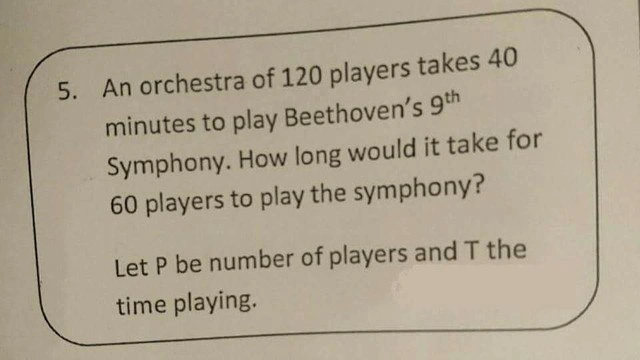
The image is a close-up photograph of a printed math or logic problem, labeled as question number 5. The text inside a rounded rectangle reads: 'An orchestra of 120 players takes 40 minutes to play Beethoven's 9th Symphony. How long would it take for 60 players to play the symphony? Let P be number of players and T the time playing.' This is a classic trick question designed to bait the reader into a simple mathematical calculation (halving the players = doubling the time), while the logical answer is that the duration of the symphony remains the same regardless of the number of performers. For senior software engineers, this is a perfect and succinct analogy for Brooks's Law and the 'Mythical Man-Month.' It humorously illustrates the fallacy that development tasks are always parallelizable, mocking the non-technical management perspective that one can simply add or remove developers to proportionally affect a project's timeline, ignoring dependencies, communication overhead, and the inherent sequential nature of much of the work

Comments

25
Anonymous ★ Top Pick A project manager tried this logic on me. I asked him if nine women could have a baby in one month. The baby is now our new legacy system
  1. Anonymous ★ Top Pick

    A project manager tried this logic on me. I asked him if nine women could have a baby in one month. The baby is now our new legacy system

  2. Anonymous

    Beethoven’s Ninth still ends at 40 minutes; halving the orchestra just demonstrates to management that Amdahl’s law comes with violas instead of mutexes

  3. Anonymous

    Just tried explaining to our new VP why we can't deliver the project twice as fast with double the developers. Should have just shown them this orchestra problem and watched them try to calculate how long it takes 240 musicians to play the same symphony in 20 minutes

  4. Anonymous

    This is basically the musical equivalent of 'Nine women can't make a baby in one month' - a perfect analog to Brooks's Law. The problem assumes perfect parallelization with linear scaling, completely ignoring that some tasks have inherent sequential dependencies and coordination overhead. Just like you can't halve your sprint time by doubling your team size, you can't speed up a symphony by reducing the orchestra. The symphony's duration is architecturally fixed by the composition itself, much like how certain algorithms have irreducible time complexity regardless of how many cores you throw at them. This math problem inadvertently teaches us more about the fallacy of naive resource scaling than it does about proportional relationships

  5. Anonymous

    120 cores: 40s runtime. 60 cores: 40s. Amdahl's Law auditions for the orchestra

  6. Anonymous

    Still 40 minutes - you can’t shard a symphony. Amdahl nods; Brooks mutters, "with onboarding, call it 45."

  7. Anonymous

    You can’t multithread a symphony; it’s all latency and zero parallelizable fraction - Amdahl nods, Brooks smirks

  8. @TERASKULL 4y

    those damn project managers and their unrealistic expectations

  9. @alhimik45 4y

    from entrance test for effective manager position?

  10. @VladislavSmolyanoy 4y

    A woman needs 9 months to birth a child. How many months would it take to birth a child if 5 women got pregnant at the same time?

    1. @boingo00 4y

      From same man or from different?

      1. @VladislavSmolyanoy 4y

        Same man

        1. @tyranron 4y

          geo distributed or single dc?

    2. @vdobrovolskii 4y

      After nine months you’ll get five babies, so the average birthing speed is 5/9 = 0.56 babies per month Compared to one woman — GREAT SUCCESS

      1. @VladislavSmolyanoy 4y

        yes. with only one woman we have 0.11 babies per month, thus to increase our monthy output, we’ll have to impregnate more women. easy

  11. @dontmindmehere 4y

    obviously this would take 80 minutes instead. ez. gimme an offer

  12. @pavloalpha 4y

    Ебать клоун(such a good man)

  13. @saidov 4y

    It’s me understanding asynchronous programming:

  14. @Truth_0000 4y

    (60×40)÷ 120

    1. @thisisluxion 4y

      I can't tell if you're joking or not

  15. @mainfme 4y

    Still 40

  16. @misesOnWheels 4y

    about tree fiddy

  17. @azizhakberdiev 4y

    Isn't "Tests for PM" name of the book

  18. @BreadCrumberWay 4y

    That’s not how any of this works

  19. @BreadCrumberWay 4y

    😂😂

Use J and K for navigation