Skip to content
DevMeme
4453 of 7435
Reddit perfectly explains why brilliant engineers sometimes sound dumb in meetings
Communication Post #4880, on Sep 30, 2022 in TG

Reddit perfectly explains why brilliant engineers sometimes sound dumb in meetings

Why is this Communication meme funny?

Level 1: Big Brain, Stuck Tongue

Imagine you have a friend who is super smart – like they can solve a really hard puzzle or build the tallest LEGO tower without instructions – but when you ask them “Wow, how did you do that?” they get all nervous and the explanation comes out all jumbled and confusing. They might start talking, but maybe they use words that don’t quite make sense or they keep circling around the point without clearly saying it. You know your friend is brilliant (because hey, the LEGO tower is amazing!), but listening to them explain it, you might tilt your head and think, “Huh? I don’t get it.” It’s not that your friend isn’t smart – they’re just not so good at telling people what they’re thinking.

This meme is laughing about that exact situation, but with engineers (people who design and build things, like computer programs). It basically says: lots of engineers are exactly like that friend. They have big brains full of ideas, but sometimes a stuck tongue when they try to share those ideas with words. It’s funny in a friendly way because it’s true enough that many of us have seen it happen. Think of it like a genius kid in class who knows the answer to a tough math problem, but when the teacher asks them to explain how they got it, the kid freezes up or speaks so quietly/awkwardly that no one can understand. The meme’s joke answer “Have you met engineers?” is like saying, “Yup, smart people who can’t explain things well exist – just look at engineers. There are lots of them!”

In simple terms: Being really smart doesn’t always mean you’re good at talking. And that mismatch can be pretty funny when you notice it – like watching a powerful race car that has a little trouble starting up. The humor here isn’t mean-spirited; it’s more like a gentle tease. People in the tech world (engineers, developers, etc.) are kinda poking fun at themselves with this meme, admitting “Haha, yes, sometimes we’re geniuses with computers but sound a bit dumb when we open our mouths in meetings.” So the meme makes us laugh because it’s a truth we recognize in everyday life, told in a short and clever way.

Level 2: Great at Code, Not at Words

This meme comes from a RedditThreads screenshot and highlights a joke within the developer community about communication troubles. Let’s break down what’s happening in simpler terms:

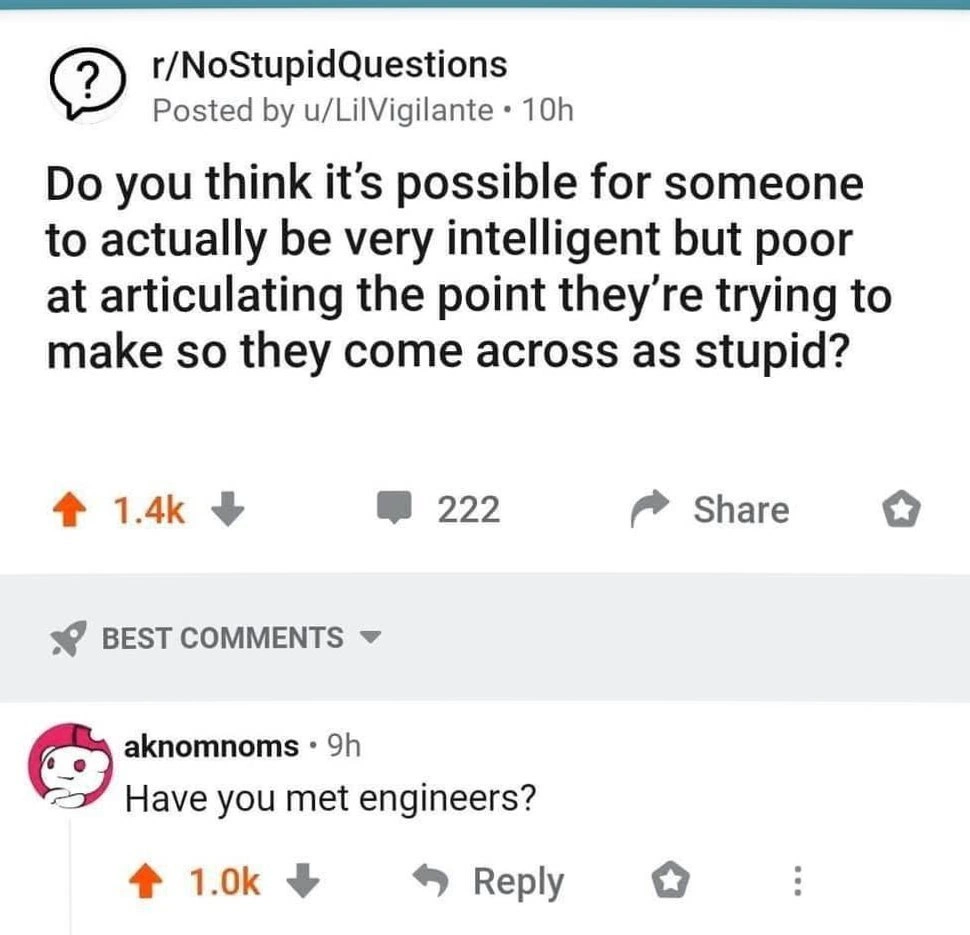
  • The image is a post on the subreddit r/NoStupidQuestions. On Reddit (a popular online forum platform), a subreddit is like a specific topic channel. NoStupidQuestions is a community where people can ask any question without feeling judged – even questions that might seem obvious. In the screenshot, someone asks: “Do you think it’s possible for someone to actually be very intelligent but poor at articulating the point they’re trying to make so they come across as stupid?” In plain words, they’re asking: Can a person be really smart but speak so poorly that people think they’re dumb?

  • The top answer beneath that post is by a user named aknomnoms, and their reply is a short quip: “Have you met engineers?” This comment got about 1.0k upvotes (Reddit’s way of people saying “I agree” or “I like this”). That’s a lot of upvotes, meaning many readers found the answer funny or true. Essentially, the commenter is saying, “Yes, it’s definitely possible – just look at engineers!” It implies that engineers are a prime example of very smart people who sometimes aren’t great at expressing themselves clearly.

  • This is a form of TechHumor and a common DeveloperStereotypes joke. The stereotype here is that developers/engineers (especially software engineers) are extremely intelligent when it comes to technical stuff, but many aren’t the best at everyday communication or social_skills_in_tech. So, they might explain something in a meeting or conversation and end up confusing everyone, even though they are actually correct or have a great idea. Because they articulate poorly, others might mistakenly think the idea (or the person) isn’t smart. The meme is basically saying “This isn’t just a wild idea, it happens all the time in the tech world!”

  • CommunicationGap is a key term here: it means there’s a gap between what one person is trying to say and what the other person understands. In developer teams, a communication gap can occur when someone uses a lot of technical jargon, speaks in a very convoluted (twisted or overly complex) way, or just isn’t comfortable explaining things in simple terms. New developers (or anyone listening) might feel lost. For example, an engineer might say something highly technical like, “We need to refactor the recursive algorithm to improve the time complexity,” and a non-engineer in the meeting might blink, having no idea what that means. The engineer did have a smart thought, but the way they said it wasn’t accessible to everyone.

  • The context_tags like engineer_stereotype and poor_articulation point out exactly the themes: there’s a well-known stereotype that engineers aren’t great at talking understandably, and “poor articulation” means not expressing ideas clearly. The meme plays on this by essentially answering the question with a tongue-in-cheek example: engineers.

Now, why do people in tech find this so relatable and funny? Let’s think of common scenarios in a developer’s work life where this happens:

  • Daily stand-up meetings: These are short, daily team meetings (often part of Agile/Scrum processes) where each developer says what they did yesterday, what they’ll do today, and if they have any blockers. They’re supposed to be quick and clear. But some engineers either give way too much detail (“Yesterday I optimized the Frobnicator in our code by 0.01% by adjusting the bitwise operations...”), leaving everyone’s eyes glazed over, or they give too little detail (“Worked on some stuff, it’s fine.”) because they aren’t sure how to explain it succinctly. In both cases, the team might be thinking, “Huh? What did we just hear?” This is a mini example of sounding less competent than you are, just because of how you delivered the update.

  • Code reviews: A code review is when peers examine someone’s code changes to catch issues or improve the solution. In a code review meeting or discussion, the author might need to explain why they wrote the code a certain way. A brilliant engineer might have a very good reason, but perhaps they struggle to articulate it. For instance, they might mumble, “I did it like that ’cause, you know, memory... thing... it’s just better trust me,” which doesn’t sound convincing, even if their code is actually excellent. Colleagues might misunderstand and think the code has no solid reasoning behind it.

  • Architecture or design discussions: These are meetings where developers plan out how to build a system or feature. It involves explaining abstract ideas. Here, an especially smart engineer might propose something complex (say, a new microservices design or a fancy algorithm for scaling), but they describe it in such a high-level, theoretical way, or dive into the weeds of technical details, that others in the room can’t follow. Someone might be drawing boxes and arrows on a whiteboard and using acronyms like ACID, API, CPA (maybe meaning CAP theorem but mixing it up), and at the end of the monologue, others are quietly wondering, “So... is that good or bad? What’s the actual proposal?” Everyone leaves confused, even though the person had a brilliant plan in mind. If that engineer can’t articulate it, the team might not adopt their idea, not because it was bad, but because it wasn’t communicated clearly.

When the Reddit commenter says, “Have you met engineers?” they’re specifically poking fun at these kinds of situations. It’s a rhetorical question – they don’t literally mean if you’ve met an engineer; they mean “Engineers are a perfect example of what you’re talking about.” It’s like if someone asked, “Do very tall people have trouble fitting in small cars?” and someone else replied, “Have you met basketball players?” It’s a humorous way of saying “Yes, and here’s a group known for that issue.”

The meme visually being a reddit_meme_format screenshot also signals a certain style of humor: Reddit is known for witty, concise responses. The straightforward nature of “Have you met engineers?” as the top-voted answer is a big part of why it’s funny. It’s so short and direct, almost like the punchline of a joke. Many people scrolling through a developer meme page might chuckle because they immediately get the reference without needing any more explanation – it’s an inside joke for those in tech.

For those new to tech or just starting out, it’s helpful to understand that this is a light-hearted stereotype – not every engineer is a bad communicator, of course, but it’s common enough that we joke about it. In fact, in many DevCommunities (from company teams to online forums), folks share stories or memes about the socially awkward programmer or the times they themselves struggled to explain something simple. It’s part of CommunityAndCulture bonding; we laugh at ourselves and our peers a bit. One common saying is, “Developers speak in code,” meaning sometimes they talk in a way that might as well be a computer language because outsiders can’t grasp it.

Let’s also clarify the term engineer in this context. Here, it primarily refers to software engineers or programmers (though it can apply to other types like electrical or mechanical engineers too). In tech circles on Reddit or Twitter, “engineer” often shorthand for people who write code or build technical systems. And the stereotype involved – being highly logical and intelligent but not very articulate – is mostly aimed at that crowd.

So summarizing in simpler words: This meme jokes that yes, someone can be really smart but sound dumb if they can’t explain themselves. And engineers are given as a prime example of this. It’s funny to developers because it’s a kind of self-jab at a known quirk in the tech world. The categories “Communication” and “DevCommunities” listed for the meme are exactly about this – it’s addressing communication issues within developer communities. Many junior devs quickly notice that understanding code is one thing, but explaining code to others is a whole different skill. If you’ve ever felt nervous or stumbled over your words explaining your work in a meeting, you’re definitely not alone – even the brilliant folks do it.

The key takeaway is that the humor comes from contrast: extreme intelligence vs. shaky communication. The meme exaggerates a bit for effect (not every engineer is like this), but it hits close enough to reality that it resonates. If you keep hanging around developers or working in tech teams, you’ll likely encounter scenarios where someone incredibly smart says something in a meeting and it just doesn’t land well. It might even become a fond, funny memory later. This meme captures that whole idea in one quick Reddit Q&A snapshot.

Level 3: High IQ, Low Bandwidth

This meme nails a classic engineer_stereotype: the CommunicationGap between a brilliant developer’s mind and their mouth. The Reddit screenshot shows a question on r/NoStupidQuestions asking if someone can be “very intelligent but poor at articulating the point they’re trying to make so they come across as stupid.” The top reply: “Have you met engineers?” – a five-word mic drop that garnered 1.0k upvotes. Why is this so uproariously on-point in DeveloperHumor circles? Because anyone who’s survived a few dev team meetings or code reviews in DevCommunities has met that engineer (or been them): the person with a 150 IQ and a poor_articulation skill dump stat.

In everyday DeveloperCulture, it’s practically a running joke that many engineers have a higher affinity for optimizing algorithms than for optimizing sentences. This meme’s humor comes from a shared recognition: we’ve seen geniuses go tongue-tied trying to explain their own code. The Q&A format in the screenshot (a hallmark of reddit_meme_format in RedditThreads) sets up a serious question only to zap it with a zinger of an answer. It’s funny because it’s true: the answer doesn’t bother with nuance – it just points to engineers as Exhibit A of “smart person who sounds dumb in meetings.” The developer community upvoting that reply is basically saying “Yep, we feel seen.”

So why do brilliant engineers sometimes sound borderline incoherent in meetings? Part of it is the social_skills_in_tech conundrum. Many developers spend years honing computational thinking and deep technical expertise, often at the expense of honing human-to-human communication protocols. Think of an engineer’s brain as a high-speed multi-core processor – extremely powerful, capable of complex reasoning – but the output device (aka their speech) runs on an older, laggy interface. The result: ideas that are crystal-clear in their mind come out as fragmented jargon, half-finished sentences, or overly detailed rambles. In technical terms, they’re compute-bound internally but bandwidth-limited when trying to express those computations in plain English. It’s a Brain-to-Mouth bottleneck.

CommunityAndCulture dynamics in tech can unintentionally reinforce this. Often, the culture tacitly accepts that poor articulation is the price of brilliance. In a fast-paced startup or an academic research lab, you might hear, “Oh, that’s just Alice – she’s a wizard at code but don’t ask her to explain it.” People nod along as if Communication were an optional module. Over time, some engineers lean into it, communicating just enough to get by (maybe with a flurry of slides, or a barrage of acronyms) and relying on sympathetic colleagues or managers to translate for them.

Real-world war stories abound: the DevCommunities veteran recollects the 3 AM outage call where the database wizard’s explanation of the fix was so convoluted that the on-call team just said “uh, okay” and hoped for the best. Or that architecture review where a senior dev described their proposal as “basically O(n) with an optimized recursive mutex lock-in, you know, standard stuff” – and everyone else in the room exchanged helpless glances. These scenarios are hilarious in hindsight (and in TechHumor memes like this) because they’re painfully relatable. There’s an unwritten rule in many teams: if Bob the backend guru starts using five-dollar words and trailing off mid-sentence, someone will gently ask, “So... can you dumb it down a bit for us?” Bob isn’t dumb – far from it – but his explanation might as well have been encrypted in ROT13. It’s CommunicationGap comedy gold.

Underneath the humor lies a grain of truth that senior devs understand well: being able to solve a problem doesn’t automatically mean you can explain the solution. Software engineering isn’t just about writing code; it’s also about conveying ideas – to colleagues, to documentation, to other systems. When that second part is lacking, weird things happen. Miscommunication in stand-ups can lead to team members working with wrong assumptions for days. Poorly explained code decisions in a PR (pull request) can sow doubt about the code’s quality (“If they can’t explain it, did they even know what they were doing?”). Architectural discussions might derail because the brightest person in the room can’t get their point across clearly, so the team defaults to a less elegant plan pitched by someone more eloquent. The CommunicationGap becomes a productivity gap, and it’s all too real.

Historically, the archetype of the awkward, mumbling tech genius has been around forever – think of the cliched DeveloperStereotypes in movies: the shy computer whiz who talks in technobabble. In real tech history, many early computing legends were known more for their code than their charisma. It’s not that social_skills_in_tech were never valued; it’s that during the rise of Silicon Valley and open-source movements, one could contribute massively through code alone, with minimal human interaction. The culture lionized coding prowess over communication. You wrote an amazing Linux kernel patch? No one cared if you stuttered through explaining it on a mailing list. But as software eats the world and teams become more interdisciplinary, the need to articulate clearly has grown. Still, culture shifts slowly. Many companies now gently nudge engineers to improve “soft skills,” but the meme highlights that the old norm – brilliant but inarticulate – is alive and well, as any trip to an engineering all-hands meeting will confirm.

One reason this joke lands so well is because of how blunt the comment is: “Have you met engineers?” is phrased like a snappy comeback. It implies DeveloperCulture collectively knows the answer – “Yes, this is absolutely possible; in fact, it’s practically commonplace – just look at engineers.” There’s a hint of self-deprecation from the tech community in there too. A lot of the people upvoting that comment are engineers or work with them. We’re laughing at our own expense, in a way. It’s a communal in-joke: engineers, as amazing as they are with machines, often act like machines that haven’t had the communication firmware update. The meme is essentially poking fun at that archetype we’ve all encountered: the colleague who gives an impromptu 10-minute discourse on pointer arithmetic when asked a yes-or-no question, or the genius coder who, during the monthly all-hands, introduces themselves with an incoherent mumble that no one really catches.

The mention of “so they come across as stupid” in the question is key. The tragicomic reality is that extremely intelligent engineers sometimes do get misunderstood or underestimated because they presented their thoughts in a confusing way. A cynical veteran dev might dryly joke: “If I had a dollar for every time a brilliant idea died in committee because its champion couldn’t string together a clear sentence, I’d refactor that memory leak in my bank account.” It’s funny, but it points to a real challenge in our field: good ideas need good communication to thrive.

In practice, teams often develop coping mechanisms around these communication gaps. Maybe the project manager learns to interpret “uhh, I mean, like, the thing’s not synchronous, it’s, you know, eventual” as “the service uses an asynchronous, eventually consistent architecture.” Maybe another dev politely rephrases what the quiet genius tried to say, acting as a human compiler from engineer-speak to plain English. It’s all part of working in DevCommunities – you adjust to each other’s strengths and quirks. The humor of this meme is that it lays this dynamic bare in a single, savage line. It’s the kind of truth-hammer you normally only drop after a frustrating meeting, but seeing it on Reddit with upvotes is cathartic.

So yes, to answer the Redditor’s question: not only is it possible for a person to be very intelligent but bad at articulating (thus seeming stupid), it’s practically a running gag in the tech world. The meme’s punchline “Have you met engineers?” wryly suggests that brilliant-but-inarticulate individuals are so common in tech that they’re the rule, not the exception. It’s a mix of pride and self-own – we’re proud of our brainy colleagues and ourselves, but we also collectively groan at the memory of all those meetings that could’ve been emails (if only because the in-person explanation was a word salad).

In summary, this meme resonates because it speaks to a well-known pattern in software development culture. It’s TechHumor drawn straight from real life: an acknowledgment that even a Developer with rock-star coding skills might need a bit of help when it comes time to articulate those brainy thoughts. We laugh, knowingly, because we’ve all been there – either on the speaking end or the listening end of an “umm, well, so the thing is… trails off” monologue. It’s both a light-hearted roast and a gentle reminder: intelligence isn’t just about what’s in your head, but also how well you can share it. And if you’ve ever been in a meeting full of engineers, you know exactly how hilariously true that is.

Description

Image is a mobile screenshot of a Reddit thread from r/NoStupidQuestions. The original post reads, “Do you think it’s possible for someone to actually be very intelligent but poor at articulating the point they’re trying to make so they come across as stupid?” It shows 1.4k up-votes, 222 comments, and standard Reddit action icons. Below, the top comment by user “aknomnoms” simply says, “Have you met engineers?” with 1.0k up-votes. Visually it uses Reddit’s white background, orange up-vote arrows, and grey interface icons. Technically, the meme highlights a common engineering stereotype - high cognitive ability paired with weak communication - and pokes fun at how this manifests in developer stand-ups, code reviews, and architectural discussions

Comments

6
Anonymous ★ Top Pick My brain processes in nanoseconds, but my mouth has millisecond P99 - so in meetings I look like a flaky microservice with half my ideas stuck in the retry queue
  1. Anonymous ★ Top Pick

    My brain processes in nanoseconds, but my mouth has millisecond P99 - so in meetings I look like a flaky microservice with half my ideas stuck in the retry queue

  2. Anonymous

    The same engineer who can architect a distributed system handling millions of requests per second will spend 20 minutes explaining why the coffee machine is broken using CAP theorem and eventually consistent state

  3. Anonymous

    This perfectly encapsulates the eternal struggle of the senior engineer who can architect a distributed system handling millions of transactions per second, optimize database queries down to microseconds, and debug race conditions in their sleep - but when asked to explain why we need to refactor the monolith to stakeholders, somehow produces a 47-slide deck about CAP theorem that leaves everyone more confused than when they started. It's not that we're bad at communication; we're just optimizing for precision over comprehension, which is totally different... right?

  4. Anonymous

    Yes - every time I explain the CAP theorem, someone asks if we can just buy the third option from AWS

  5. Anonymous

    Engineers: O(1) lookup for solutions, infinite loops on stakeholder syncs

  6. Anonymous

    Seen it: 10Gbps brain, 9600-baud mouth - without a PM as serializer, ideas hit stakeholders like protobuf to a REST client; decode error, perceived as dumb

Use J and K for navigation