Skip to content
DevMeme
4454 of 7435
Rate vs Budget Standoff: Freelance Dev Negotiations Escalate Kaiju-Level Firefight
Stakeholders Clients Post #4881, on Sep 30, 2022 in TG

Rate vs Budget Standoff: Freelance Dev Negotiations Escalate Kaiju-Level Firefight

Why is this Stakeholders Clients meme funny?

Level 1: No, You Go First

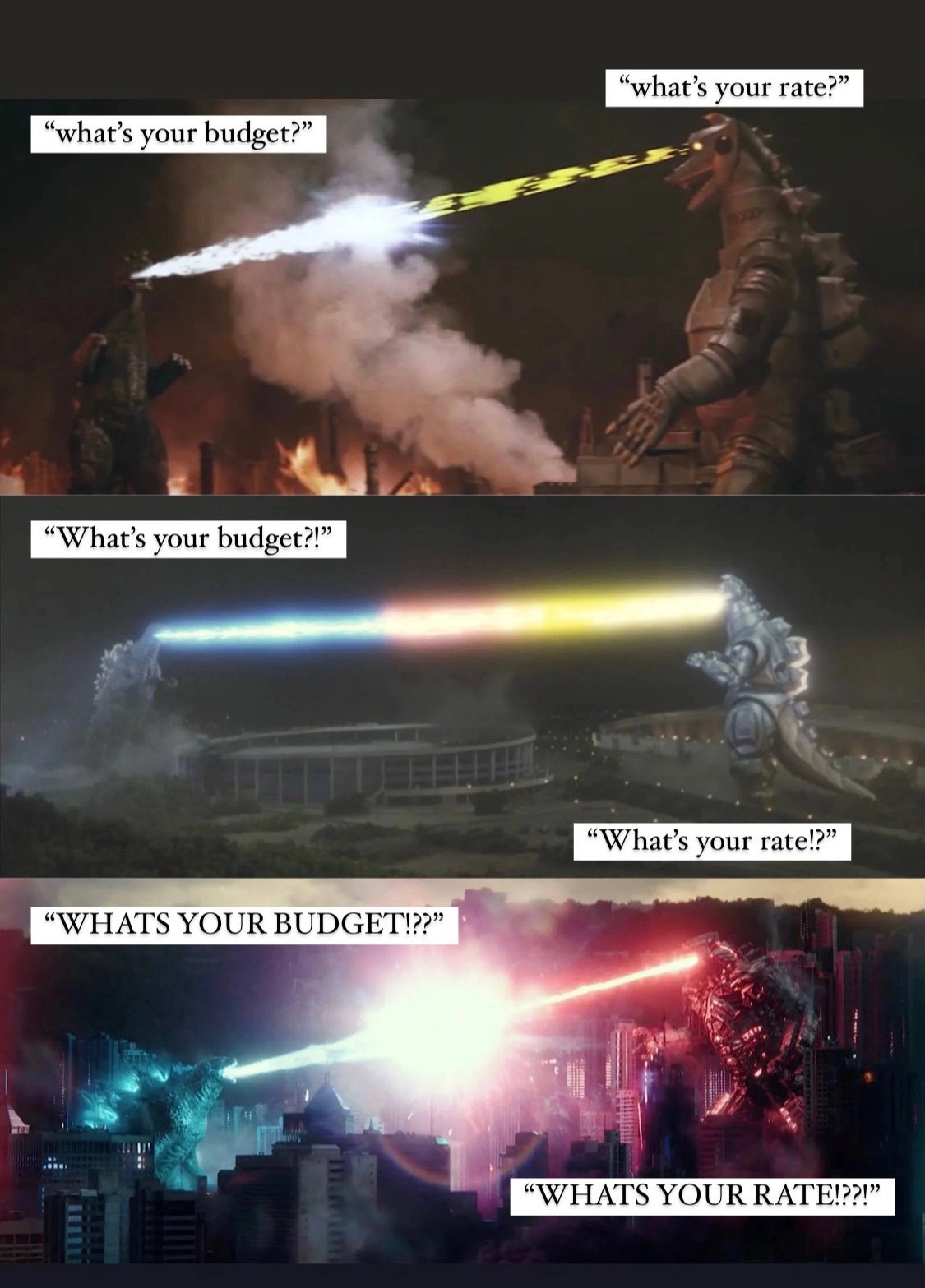
Imagine two kids on a playground who both want to play a game, but each insists the other kid goes first. One says, “You go first!” and the other snaps back, “No, YOU go first!”. They start yelling this back and forth, getting louder and angrier, and nobody actually starts the game. The whole thing becomes a big shouting match over who should speak up first. In this meme, that’s exactly what’s happening – but instead of kids, it’s a developer and a client arguing about money. Each one is basically saying, “You tell me your number first!” and neither wants to give in. It’s funny because it’s a silly stalemate: like two stubborn people both refusing to take the first step, so nothing gets done except a lot of noise. Even though in the picture it looks like two giant monsters fighting with colorful beams, the feeling is the same as those two kids arguing – lots of fuss, and no progress, all because nobody wants to be the first to budge.

Level 2: Rate vs Budget Tug-of-War

At its core, this meme highlights a tug-of-war in freelance consulting: the developer versus the client, each pulling for control over the pricing conversation. Let’s break down the roles and terms in this showdown:

  • Freelance Developer (Godzilla): An independent programmer for hire, not a full-time employee. Freelancers live on project fees or hourly pay – this means discussing money upfront is critical for them. In the meme, Godzilla’s question “What’s your budget?” represents the developer’s stance. The budget is the total amount of money the client has set aside (or is willing to spend) for the project. By asking for the budget, the dev wants to gauge the project’s scope and the client’s spending limit. It’s a way to avoid proposing something out of range. Also, if the budget is very low, an experienced dev might know not to engage further (to avoid being underpaid or stretching themselves too thin). Essentially, the developer is thinking: “Don’t make me name a price blindly. Tell me your limit so I can tailor my proposal (or bail out if it’s too low).”

  • Client or Stakeholder (Mechagodzilla): The person or company who needs the software built and will pay for it. A stakeholder is anyone with a stake (interest, investment) in the project’s outcome – here it’s specifically the paying client. Mechagodzilla’s retort “What’s your rate?” stands for the client’s perspective. The rate usually means the developer’s hourly rate or a fixed project quote. The client is effectively asking, “How much do you charge for your work?” Often, clients prefer to hear the developer’s rate first to see if it fits their budget constraints. They might also worry that if they reveal a high budget, a freelancer will simply charge that full amount. By getting a rate upfront, the client hopes to compare developers and control costs. In their mind: “Don’t make me reveal my wallet. Tell me your price so I can see if I can afford you (and ensure I’m not overpaying).”

Now, why is this a communication standoff? Because each side is only repeating their question instead of answering the other’s. The meme exaggerates it as literal fire-breathing monsters locked in battle, but it reflects a real communication issue: neither side is willing to give the information first. This is essentially a loop (the meme even visually shows repeated frames with the same dialogue intensified). If you’ve ever seen two people each insist the other “go first”, you know it can loop forever. Here we have a classic rate vs budget loop:

Developer: “What’s your budget for this project?”
Client: “What’s your hourly rate?”
Developer: “(Seriously) what’s the budget you’re looking at?”
Client: “(I said) tell me your rate.”
(and so on, with growing frustration...)

Each side has a valid concern, but by not answering, they create a stalemate. For a junior developer or someone new to freelancing, this situation can be confusing and daunting. You might wonder, “Why won’t the client just tell me how much they can spend?” or “Should I just throw out a number first?” It feels like a high-pressure chess match where any move could lose the deal. Indeed, it’s a known problem in FreelanceLife and consulting: a mistrust or caution that leads to neither side sharing information.

Let’s clarify a few key terms and why they matter here:

  • Budget Constraints: This refers to the limitations on how much money can be spent. Clients often have a maximum figure in mind (even if they don’t say it). It affects what features or how many hours of work are affordable. If a project has a tight budget constraint, the developer might need to adjust the plan (fewer features, or use cheaper tech solutions). In our context, the client’s refusal to state budget leaves the developer guessing the size and ambition of the project. It’s like trying to plan a road trip without knowing how much gas you can buy – will it be a short ride or a long journey? The developer is prodding for this very info.

  • Hourly Rate vs. Fixed Price: Developers can charge in different ways. An hourly rate is how much money per hour of work (e.g., $50/hour). A fixed price is one total sum for the whole project (e.g., $5,000 for the project, regardless of hours). When the client asks “What’s your rate?”, they are typically fishing for hourly cost to estimate total expense, or they want a quote. If the dev responds with a high hourly rate, the client might panic thinking the total will blow past their budget. If the rate is low, the client might doubt the developer’s experience or happily try to lock that cheap price in. The developer knows this, so they are cautious.

  • Client Expectations vs. Reality: Often there’s a gap. A client (especially a non-technical one) might expect that a project is easy or cheap (“Can’t you just whip up an app in a week or two?”). They might have, say, $1,000 in mind for something that realistically costs $10,000. That mismatch in expectations is why developers ask about budget early – to see if the project is even feasible. Conversely, a client might expect a developer to have a neat price card or rate sheet ready to go, as if buying a product off a shelf, which isn’t how custom software development works. This misunderstanding can lead to frustration on both sides.

  • Communication Breakdown: This phrase means the failure to communicate effectively. In the meme, instead of a productive dialogue (like discussing project requirements, scope, and then talking cost), both parties are talking past each other. It’s a breakdown because each question goes unanswered. The fiery beam collision is a dramatization of arguments intensifying when neither side listens. In real life, this could translate to tense emails, awkward pauses on calls, or deals falling apart. Good communication would involve each side sharing some information or finding a compromise (for example, the client giving a budget range and the dev giving a ballpark quote). But here, that ideal breaks down spectacularly.

Picture a junior developer in their first client meeting: The client asks, “So, what’s your rate?” The dev, nervous about scaring them off, replies, “Well, what kind of budget were you thinking for this?” If the client insists “I need your rate first,” and the dev still deflects “Maybe give me a ballpark budget,” the conversation can quickly feel like an awkward loop. The meme uses the Godzilla vs Mechagodzilla visual to say “Yep, it often feels exactly like this volatile beam-fight.” It’s simultaneously funny and a bit painful because it’s true – a lot of freelance and consultant negotiations devolve into this back-and-forth.

By showing Godzilla (the dev) and Mechagodzilla (the client) blasting each other with questions-as-lasers, the meme highlights the absurdity. In a sane scenario, one of them would stop and say, “Alright, let’s actually talk numbers or scope rationally.” But in the meme’s scenario (and all-too-often in reality), pride or fear wins out, and they just keep firing. The result can be stakeholder pressure on the dev (“Why won’t you just tell me your cost!?”) and equal pressure back on the stakeholder (“How am I supposed to quote without any clue of budget?!”). It underscores a common career humor point: technical work isn’t the only hard part of being a developer – navigating client conversations and expectations is its own challenge.

In short, this meme is showing a freelance negotiation gone wild. Both the consultant and the client are stuck in a loop of one-upmanship: “Tell me your number!” “No, you tell me yours!” The escalating Godzilla imagery exaggerates how combative and fiery it feels, while the actual text (“what’s your budget?” vs “what’s your rate?”) grounds it in a very real, very relatable developer-client interaction. It’s a reminder (especially to newer devs) that discussing money in projects can become a heated battle if you’re not careful – almost comically so. And for those who’ve been there, it’s a chance to laugh at the memory of their own monstrous rate vs budget stand-offs.

Level 3: Mutually Assured Deadlock

The meme humorously depicts a deadlocked negotiation with the subtlety of a kaiju battle. On the left, Godzilla (analogous to the freelance developer) unleashes an atomic “What’s your budget?” breath. On the right, Mechagodzilla (standing in for the client or stakeholder) counters with a laser-bright “What’s your rate?”. Neither side yields. This escalating back-and-forth is the unstoppable force meeting the immovable object – a stakeholder vs. consultant standoff that many experienced freelancers know all too well. The joke lands because it exaggerates a routine freelance negotiation into a city-leveling Kaiju clash: a simple pricing discussion turns into an absurdly destructive duel. The communication breakdown is total – each party repeats their demand louder (just like the movie beams getting bigger), and nothing else gets through.

In real software projects, this scenario is a perfect recipe for mutually assured destruction of trust (and timelines). The client wants to pin the developer to a cheap hourly rate, the dev wants assurance there’s a sane budget to fund the work – but both are locked in a prideful dance. It’s a classic game of chicken: whoever blinks first (by revealing their number) fears losing the upper hand. This is essentially a negotiation deadlock. In concurrency terms, each process is waiting on a resource the other refuses to give – a bit like two threads locking different mutexes and neither releasing. The result? Total stall. We can almost code it:

let budgetDeclared = false;
let rateDeclared = false;
while (!budgetDeclared && !rateDeclared) {
  console.log("Client: What's your rate?");
  console.log("Dev: What's your budget?");
  // war intensifies... both sides waiting for the other to answer
}
// Outcome: Deadlock. City (project) goes up in flames.

Everyone in the industry recognizes this loop. The FreelanceLife veterans smirk because they’ve battled through these pricing discussions before. It’s funny in a dark way – like an inside joke about how hard simple communication can be when ClientExpectations and developer realities clash. The meme’s three panels even span decades of Godzilla films (from cheesy 1970s suitmation to modern CGI), implying this rate-vs-budget duel is an ageless monster. Technology evolved, special effects got flashier, but clients and devs still beam-fight over money. Each panel’s caption grows from polite lowercase to caps-lock fury (“What’s your budget?!”“WHATS YOUR BUDGET!?!”), symbolizing how a polite inquiry can erupt into an exasperated shouting match.

This absurd stakeholder negotiation highlights several painful truths in consulting and corporate culture:

  • Opaque budgeting: Many clients have tight BudgetConstraints but won’t reveal them, fearing a developer will just soak up the entire amount. This lack of transparency is a pain point in cost management – it’s hard to plan features or time when the funding is a mystery.
  • Pricing paranoia: Developers, on the other side, hesitate to state their rate too early. If they aim too high, the client might balk; too low, they undercut themselves. There’s an unwritten rule in freelance consulting: whoever quotes a number first, loses. That’s why both sides volley the question back – each hopes the other will set the pricing anchor.
  • Loss of trust: Instead of cooperative planning, it becomes adversarial. The stakeholder perceives the dev as pricey by default, and the dev suspects the client of having unreasonable expectations. The negotiation turns into a beam-firing contest of wills. The project hasn’t even started and already StakeholderPressure and developer defensiveness are blowing holes in the skyline.

The giant-monster metaphor captures how disproportionate and destructive this standoff can feel. Rather than calmly discussing scope and finding a compromise, both parties dig in with nuclear options (“Give me your number or there’s no deal!”). In the end, just like a Godzilla film, there are no real winners — the city (the project timeline, scope, and good will) lies in smoldering ruins while Godzilla and Mechagodzilla simply exhaust their fire. Communication is the biggest casualty. Seasoned engineers chuckle (or groan) at this meme because it’s a hyperbolic reminder of every freelance negotiation gone wrong, every meeting where a simple question about money turned into a tense showdown. It underscores a core irony of tech Career life: even building cutting-edge software can be easier than answering, “So, what will this cost?”

Description

The meme is a vertical triptych of Godzilla-versus-Mechagodzilla movie stills, each more modern and destructive than the last. Panel 1 (1970s suitmation style): Godzilla on the left fires a white atomic breath while Mechagodzilla on the right shoots a jagged yellow laser; overlaid text reads “what’s your budget?” above Godzilla and “what’s your rate?” above Mechagodzilla. Panel 2 (early-2000s CGI): the monsters trade longer, brighter beams across a stadium ruin; captions intensify to “What’s your budget?!” and “What’s your rate!?”. Panel 3 (2021 blockbuster): blue and red energy blasts collide above a skyscraper skyline; captions scream “WHATS YOUR BUDGET!?!” opposite “WHATS YOUR RATE!?!”. The escalating beam war satirizes the circular stand-off between freelance engineers and clients - developers refuse to quote without knowing budget, while stakeholders demand an hourly rate first - highlighting communication breakdowns and cost-management pain points in software projects
Comments

6
Anonymous ★ Top Pick Rate-vs-budget “conversations” are basically distributed livelock - procurement keeps blasting RATE? packets, I reply with BUDGET? packets, and the RFC for “actual requirements” stays forever in draft
  1. Anonymous ★ Top Pick

    Rate-vs-budget “conversations” are basically distributed livelock - procurement keeps blasting RATE? packets, I reply with BUDGET? packets, and the RFC for “actual requirements” stays forever in draft

  2. Anonymous

    The same negotiation dance I've been having since Y2K consulting, except now it's about Kubernetes clusters instead of COBOL migrations, and somehow the budget uncertainty has only gotten worse despite two decades of "data-driven decision making."

  3. Anonymous

    This perfectly captures the recursive deadlock of freelance negotiations: Client.getBudget() blocks on Consultant.getRate(), while Consultant.getRate() blocks on Client.getBudget(). Eventually both threads timeout and the entire city - er, project - gets destroyed. The real solution? Implement a circuit breaker pattern and just name a number first, but where's the fun in that when you can have a Godzilla-scale atomic breath standoff instead?

  4. Anonymous

    Client: 'What's your rate?' Architect: *quotes microservices refactor on their monolith* - kaiju-level runway vaporization incoming

  5. Anonymous

    Consulting negotiation is a distributed deadlock: procurement keeps blasting GET /rate, we fire back GET /budget, retries ramp up, SLOs melt down, and the only thing that scales is the blast radius

  6. Anonymous

    Classic RFP boss fight: you say “what’s your budget,” they say “what’s your rate,” and procurement ultimates with fixed‑bid, net‑90, unlimited scope - GG T&M

Use J and K for navigation