Skip to content
DevMeme
3669 of 7435
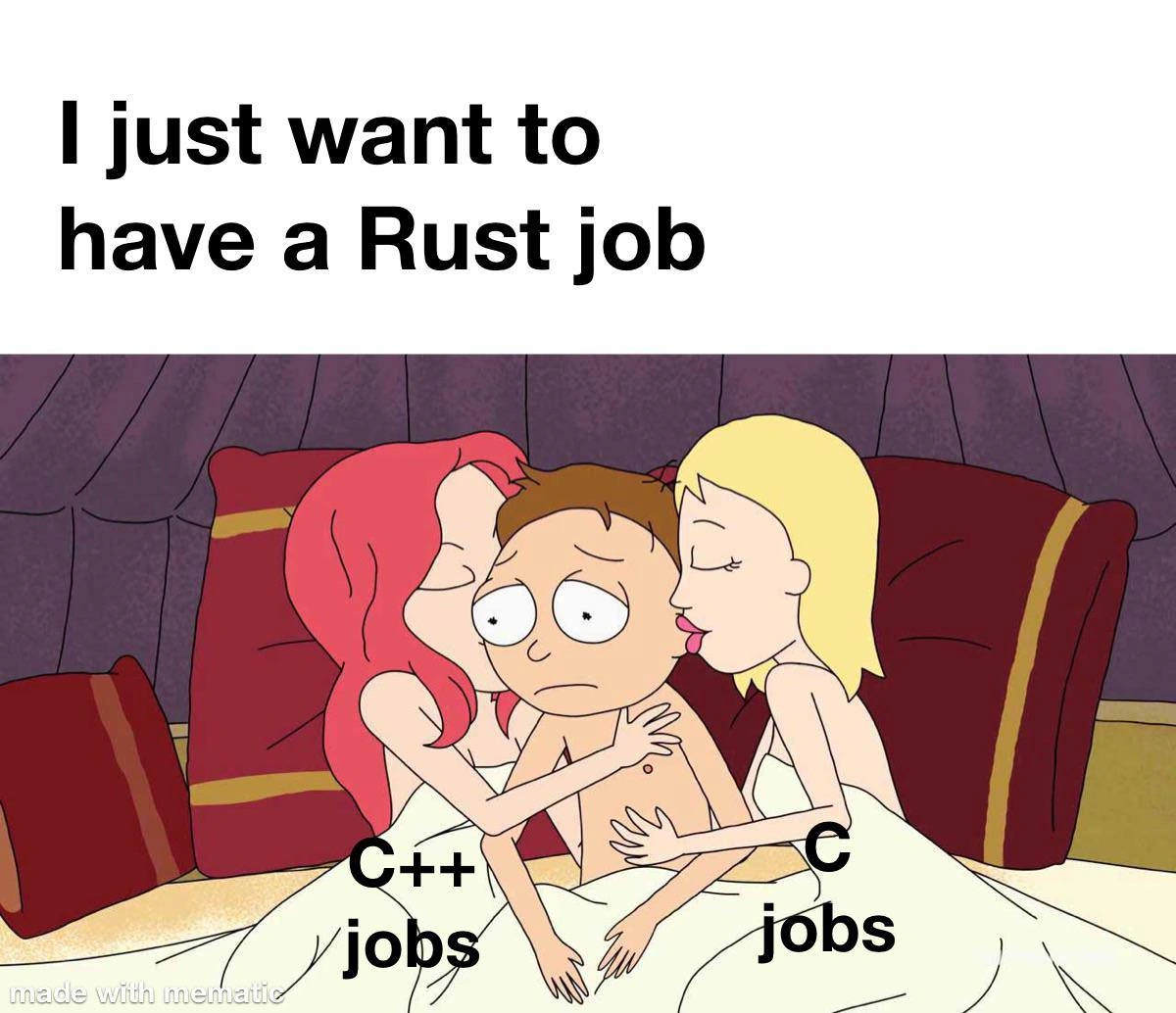
Friend helps programmer replace self-loathing with deeper rage by showing them C++ code
Languages Post #4008, on Dec 7, 2021 in TG

Friend helps programmer replace self-loathing with deeper rage by showing them C++ code

Why is this Languages meme funny?

Level 1: A New Distraction

Imagine you’re feeling really sad about yourself, like you think you’re bad at everything. Now, a friend comes along and instead of just saying “cheer up,” they give you a super hard riddle or puzzle to solve. At first you might think, “Huh, how is this supposed to help?” But then you start trying to solve the puzzle. It’s so tricky and annoying that pretty soon you’re not thinking about being sad anymore – you’re too busy saying “Grr, this puzzle is so frustrating, I hate it!” In a funny way, that helps, because now you’re mad at the puzzle instead of being mad at yourself.

That’s exactly what’s happening in the comic. The little blob person is saying “I hate myself” because they feel down. The friend blob has a clever (and a bit silly) idea: they show them some C++ code on the computer. C++ code is like a really hard puzzle in programming – it’s famous for being super complicated and frustrating. When the small blob sees this, they forget about feeling bad about themselves. Instead, they start to frown at the code and say “Wow! I hate this more.” Now they’re not sad about themselves anymore because they’ve found something else to be upset with. It’s like distracting someone with a bigger problem so the first problem doesn’t feel so bad. The humor here is a bit like if you had a splinter that hurt, and your friend made you focus on a big math problem – suddenly you’re not thinking about the splinter because the math problem is so annoying. In real life, maybe not the best way to handle sadness, but in this little comic world it’s a goofy way of cheering someone up: by trading a personal pain for a puzzle pain. And since a lot of programmers know how headache-inducing C++ can be, it makes them chuckle to think “Yep, that would definitely distract me alright!”

Level 2: From Self-Loathing to Segfaults

Let’s break down what’s happening here in simpler terms, especially for those newer to programming or not super familiar with C++. The comic shows a little character who’s very down on themselves (“I hate myself,” they say). A bigger friend character comes along and basically says, “Hey, let me show you something.” What they show is a computer with “C++” on the screen – implying some C++ code or just the concept of coding in C++. After looking at it, the once-sad character’s mood shifts from self-hate to hating that code instead (“Wow! I hate this more.”). The joke is that C++ code is so notoriously frustrating and complex that it can make you forget your personal angst by giving you an even worse problem to be angry about. It’s like, “Who has time for self-loathing when this code is driving me absolutely bonkers?”

But why is C++ singled out as hate-worthy? Here’s some context:

  • What is C++? It’s a programming language, an extension of the C language (hence the name C “plus plus”). It’s been around for decades and is used to build all sorts of high-performance software – operating systems, game engines, browsers, you name it. C++ is known for being very powerful and very complicated. It gives programmers a lot of control over the computer, but with great power comes great responsibility (and lots of ways to mess up).
  • Manual Memory Management: Unlike some modern languages (like Python, Java, or JavaScript) that have automated memory management (garbage collectors that clean up for you), C++ often requires you to manage memory by hand. This means when you create an object or some data using new (which grabs memory), you’re expected to later free that memory with delete. Forgetting to do this causes a memory leak (where the program keeps using more memory over time). Freeing or deleting something twice or using memory after you’ve freed it leads to even worse problems, often crashes (the dreaded segfault, short for segmentation fault, which is basically the operating system saying “you touched memory you shouldn’t have”). Newcomers are often scared of manual memory management – and rightly so. It’s easy to make mistakes that are hard to find. Imagine having to keep track of every toy you take out to play and remembering to put each one back exactly in its place, or else the house might explode randomly later – that’s what C++ memory management can feel like! 🧨
  • Pointers and Dereferencing: In C++ you use pointers (variables that hold memory addresses) to manipulate memory directly. If a pointer doesn’t point to a valid thing (say it’s nullptr (nothing) or it points to memory that’s already gone), and you try to use it, boom – you get undefined behavior or a crash. For example:
    int* p = nullptr;
    std::cout << *p;  // Dereferencing a null pointer – this will crash (segfault)!
    
    This one-liner illustrates how a tiny mistake can bring your whole program down. A beginner might not even know what went wrong without a lot of debugging. That’s manual_memory_management_fear in action.
  • Complex Syntax and Templates: C++ has a feature called templates which lets you write code that works with any data type (sort of like generics in other languages). Powerful, yes, but the error messages when you get things wrong with templates are famously terrible. They often spit out pages of cryptic text because the compiler tries to tell you, in its robotic way, all the places things failed. This is what we mean by template_error_trauma. Picture writing a short essay and getting back a 5-page document of corrections written in a language that looks like English but might as well be gibberish – that’s what reading a C++ template error feels like.
  • Language Quirks and Edge Cases: Because C++ is so old and has been continuously updated (C++98, C++11, C++14, C++17, C++20 and so on), it has a lot of legacy behavior and odd rules to keep things compatible. For instance, the way it handles multiple inheritance (a class inheriting from two classes) can lead to something called the “dreaded diamond problem” (naming conflict and ambiguity which the language addresses in peculiar ways). Or how about the fact that C++ will let you convert between unrelated types with a cast, even if it’s unsafe – that’s a footgun waiting to fire. These LanguageQuirks mean that even if you’ve programmed in other languages, C++ will surprise (or frustrate) you with its special cases.
  • Poor Developer Experience (DX) at times: All the above factors contribute to what we call DeveloperExperience_DX – basically, how enjoyable or painful it is to develop in a language. Modern C++ has gotten better with tools and smart libraries, but it still has a reputation for being rough on the developer. Setting up a C++ project can involve dealing with compilers, linkers, weird error messages, and long compile times. A simple typo might lead to dozens of errors because one mistake cascades into many during compilation.

Now, the DeveloperEmotions at play: The little guy in the comic initially hates themselves, which could be a reference to how programmers often feel when stuck on a tough bug or when they feel unproductive. It’s common in tech circles to cope with stress through DeveloperHumor and DeveloperSelfDeprecation – like saying “ugh, I’m such an idiot, I can’t believe I wrote that bug.” But here the friend intervenes in a funny way: by essentially saying “buddy, it’s not you, it’s the code!” They literally refocus the frustration outward, onto the C++ code. And because C++ is objectively hard to deal with, the sad programmer quickly goes “Oh wow, yeah this is awful stuff – I officially hate this code more than I hate myself.” It’s a tongue-in-cheek take on how sometimes externalizing the frustration can make a developer feel a bit better. Misery with company (commiserating over awful code) can be less lonely than misery directed inward.

For a junior developer or someone not deeply familiar with C++, think of it this way: have you ever been upset about something personal, and then tried to do a really hard puzzle or math problem? While you’re wrestling with that hard task, you kind of stop thinking about your troubles because the task is consuming all your focus. And if the task is especially frustrating, you might even start cursing at the puzzle (“Ugh, this puzzle is impossible!”) instead of thinking negative thoughts about yourself. That’s exactly what’s happening here, except in a software context. C++ provides that “really hard puzzle” – except it’s not just a fun crossword, it’s a programming language that pros famously joke about. In fact, LanguageWars (playful debates about which programming language is best or worst) often have C++ brought up as the big, scary, complicated one that everyone respects and fears a little. So showing a downtrodden coder some C++ is like saying, “If anything can distract you and give you a new target for your anger, it’s this.” And the punchline is, it works – the coder is now grouchily happy to have something external to vent about.

Summed up: this meme is portraying a scenario of language_ergonomics_failure so severe (C++ being hard to use) that it becomes a form of twisted comfort. The friend is leveraging a programmer in-joke – that C++ can be infuriating – to cheer up their buddy. It’s a bit like an anti-depression life hack for developers: “feeling down? Open some C++ code and bask in the fury it induces; you’ll feel alive again through pure annoyance!” Of course, it’s all in jest. In reality, if someone’s feeling low, dumping a tough coding problem on them might not be the gentlest approach 😅. But within the coding community, this dark humor gets a sympathetic laugh because we’ve all been there, feeling strangely relieved to know that sometimes the code sucks, not us.

Level 3: Hate-Driven Development

The seasoned coder’s perspective on this meme starts with a knowing groan: ugh, C++ – that’ll do it. The humor is painfully relatable to anyone who has spent late nights wrestling with Cpp quirks. The small blob person says “I hate myself,” a feeling not unknown among developers coping with imposter syndrome or a DeveloperExperience_DX so bad it wears down your self-esteem. Along comes the friend – the comforting_friend_format figure – who doesn’t say “No, don’t hate yourself” (that would be too straightforward). Instead, this friend offers a devilish solution: “Here, look at some C++ code.” Instantly, the despairing developer’s attention is yanked from self-loathing to a deeper rage: “Wow! I hate this more.” Cue a bittersweet chuckle from the audience of programmers. We’ve all been that person banging our head against a C++ problem so frustrating that it drowns out whatever personal demons were nibbling at us. In a way, it’s a form of hate-driven development – using raw annoyance as fuel to power through coding. It’s obviously not a recommended mental health practice 😂, but the meme plays on the dark humor that sometimes focusing your rage on the code is a twisted relief compared to beating yourself up.

Why C++ specifically? Because C++ is legendary for inducing DeveloperFrustration and DeveloperPainPoints. This language has a reputation: it’s like the final boss in the video game of programming. Think about the LanguageComplexity: you have to manage memory manually (no garbage collector to save you), decipher inscrutable template errors that look like eldritch incantations, juggle multiple inheritance and virtual method pitfalls, worry about object lifetimes, and remember which of the dozens of gotchas might be causing your bug. For example, a single misplaced * or & (pointer and reference symbols) can introduce a subtle bug that takes days of debugging. Seasoned devs swap war stories of template metaprogramming gone wrong or manual_memory_management_fear realized: “I called delete twice on the same pointer and everything segfaulted randomly in production.” 😱 The template_error_trauma is real, too – ever seen a template error message that’s hundreds of lines long? It’s like the compiler throws the entire instantiation stacktrace at you, listing every template parameter substitution until your eyes cross. Sorting out those messages can make even a confident programmer feel absolutely brain-dead.

So when the friend in the comic shows a monitor with "C++" on it, every developer reading this instantly fills in the blanks with their own language_ergonomics_failure nightmares. Maybe it’s that one cryptic linker error about missing vtables, or the time you tried to follow the rules of the STL (Standard Template Library) only to get an error that seemed to be in Klingon. The friend doesn’t even need actual code on the screen – just the C++ logo or text is enough to invoke a Pavlovian cringe. It’s shorthand for “remember that thing you hate? Here it is.” And sure enough, the next panel has the once-despairing programmer at the keyboard, smiling albeit wryly, saying “Wow! I hate this more.” The transformation is complete: self-hate has been replaced by burning coder rage at whatever fresh nonsense the C++ code is spewing. It’s a classic developer coping mechanism wrapped in humor: misery loves company, and what better company for your misery than the most cantankerous programming language you know?

This joke hits on a form of DeveloperHumor that is both self-deprecating and communal. On one hand, it’s laughing at our tendency to be overly hard on ourselves (DeveloperSelfDeprecation is practically a meme genre of its own). On the other hand, it’s validating that hey, you’re not the problem – this code is. It taps into the shared understanding that no matter how much you doubt yourself, there’s always that one hated codebase or language that everyone struggles with. It’s almost comforting: “Don’t worry pal, it’s not that you’re dumb or inadequate – C++ really is that exasperating. Hate it, not yourself.” In the daily slog of programming, especially in LanguageWars discussions or project post-mortems, developers often jokingly blame the tools or languages (like the perennial “I guess it’s time to blame C++”). Here the friend is doing exactly that in comic form – redirecting the blame/hate to where it can do less psychological damage.

The Languages category is front and center. C++ is the star, infamous for its steep learning curve and abundance of “features” that double as pitfalls. Other languages have their own pain points, of course, but C++ occupies a special place. It’s powerful and fast, used in everything from game engines to high-frequency trading, but those same qualities mean it leaves a lot of rope for you to hang yourself. There’s even a popular Stack Overflow question, “Why is C++ so fast?”, with a top answer basically saying, because it leaves practically everything up to the programmer, including shooting yourself in the foot. That’s why a struggling programmer can look at C++ code and go “ugh, it’s not me, it’s this darn language!” – a moment of relief through shared hatred. The meme format (the larger friend consoling the smaller one) is perfect: it’s a gentle parody of a friend’s therapy session, except the “therapist” is basically saying, “Let me show you something truly horrible to take your mind off things.” It’s an absurd strategy, but in the DeveloperEmotions context it rings true. We often partake in communal complaining (ever read developer Twitter rants or those comic sites like xkcd or Dilbert?) as a way to bond and cope. If you’re feeling down about your abilities, a veteran might quip, “Have a look at this messy C++ code I wrote in ’98 – you’ll feel better about yourself when you see how bad it is.” Self-loathing gets a timeout while we unite against a common enemy: code that deserves the hate.

In real-life developer culture, you could imagine this scenario: A programmer is burning out or stuck in imposter syndrome, saying “I must be the worst coder ever, I can’t get this to work.” A good friend or mentor might respond tongue-in-cheek, “You think you’re bad? Let’s do some C++ template metaprogramming, that’ll recalibrate your pain scale.” It’s half joke, half genuine tactic. After an hour of debugging linker errors or mysterious memory corruption in C++, that person is likely to exclaim “I hate this language!” instead of “I hate myself.” And paradoxically, that’s progress! They might even laugh, realizing everyone struggles with this beast. The meme captures that ironic eureka moment: the smaller blob’s slight smile in the last panel isn’t joy exactly – it’s the satisfaction of having a new outlet for their negative feelings. It’s like discovering a pressure valve for your DeveloperFrustration. The daily grind of coding has plenty of aggravations, and often devs use humor to cope: “At least if I’m cursing out the code, I’m not cursing out myself.” This dark twist on comfort is the heart of the joke, and why it resonates widely in the programming community. We all know a deeper rage at code that can momentarily eclipse any doubt about our self-worth.

Level 4: Turing-Complete Templates

At the deepest technical layer, this comic nods to the arcane complexity of C++ – a language so powerful and convoluted that it's practically a computer science case study. C++ isn’t just a programming language; it’s an accretion of decades of paradigms and features layered on top of an old C core. Its template system is Turing-complete, meaning you can (ab)use templates to perform arbitrary computations at compile time. This was never the primary goal – templates were meant for generic programming – but their design unintentionally created a compile-time metaprogramming sublanguage. In other words, C++ can make the compiler itself do ridiculously complex things, from generating exhaustive code via templates to evaluating constants through constexpr logic. The result? If you push the language hard enough, you can end up solving puzzles and producing errors of mind-bending complexity before your program even runs. It’s as if the language ambushed itself with theoretical computer science – the halting problem lurks in template recursion (hence compilers impose recursion depth limits), and SFINAE (“Substitution Failure Is Not An Error”) turns template overload resolution into a Byzantine logic puzzle.

All this theoretical horsepower gives C++ its notorious LanguageComplexity. It’s a low-level systems language with high-level abstractions; a combination that sets the stage for language_ergonomics_failure. Every feature aims for zero-cost abstractions – you shouldn’t pay a performance penalty for fancy code patterns – but achieving that often shifts the burden onto the programmer’s brain. For example, manual memory management exists because garbage collection might cost CPU cycles; instead, you get pointers and new/delete, which offer maximum control at the price of maximum risk. The C++ memory model leaves room for undefined behavior, which is a deliberate trade-off: rather than performing runtime checks for errors, the language assumes you know what you’re doing. If you violate those assumptions (say by dereferencing a wild pointer or reading uninitialized memory), all bets are off – the program might crash immediately, corrupt data subtly, or even seem to work fine until it spectacularly doesn’t. This “UB” is a sort of Heisenberg realm of bugs: its consequences are non-deterministic and can vary by compiler, optimization level, or the phase of the moon. Seasoned C++ devs half-jokingly refer to invoking undefined behavior as summoning daemons from the bowels of the compiler – once freed, those daemons (bugs) are out of your control.

The meme’s core joke – replacing self-loathing with loathing of C++ code – resonates so well because grappling with C++’s intricate machinery devours all of your mental bandwidth. There’s a finite amount of cognitive energy and emotional CPU cycles one has in a day. C++, with its template_error_trauma and manual memory pitfalls, can max out that CPU quickly. After spending hours deciphering a 50-line template error message or chasing a memory leak through a thicket of std::shared_ptr and std::weak_ptr references, a developer literally has no processing power left to indulge in self-hate – every neuron is now devoted to untangling the code. The friend in the comic is effectively performing a psychological hack: by presenting something so intellectually and emotionally consuming (C++ code!), they overwrite the smaller program of personal negativity running in the background. It’s an extreme form of context switching – from the inward-focused spiral of imposter syndrome to an outward battle with the monolithic beast of a programming language. And hilariously, it works, because in the hierarchy of frustration, C++ outranks one’s existential dread (at least temporarily).

Even from a tech-historian angle, C++ is a perfect scapegoat for this joke. Born in the 1980s, C++ grew by accruing features (like multiple inheritance, exception handling, template metaprogramming, lately concepts and modules) while maintaining backwards compatibility. This evolution created countless edge cases and gotchas – fertile ground for LanguageQuirks humor. Entire books and research papers exist just to specify and tame the complexity (e.g., the C++ ISO standard itself is hundreds of pages long and reads like rocket science). The language’s design echoes the classic “there ain’t no such thing as a free lunch” principle: you want high performance and fine control, you’ll pay with your time and sanity. Historically, developers have coined wry sayings like “C makes it easy to shoot yourself in the foot; C++ makes it harder, but when you do, it blows away your whole leg.” This comic simply takes that collective truth – that C++ can be infuriatingly complicated – and uses it as a form of dark therapy. The subtext is almost philosophical: by wrestling with the primal forces of your machine (through C++ code), your DeveloperFrustration at the external problem eclipses any DeveloperSelfDeprecation you started with. It’s like an existential hierarchy of pain, written in curly braces and angle brackets.

Description

Four black-and-white comic panels depict two simple blob characters. Panel 1 shows the smaller blob sitting, hugging its knees, with the caption “I hate myself.” Panel 2 shows a larger blob approaching and placing a reassuring hand on the smaller one’s shoulder. Panel 3 zooms out to reveal a computer monitor displaying the text “C++” while the larger blob points toward the screen. Panel 4 shows the smaller blob now at the keyboard, smiling slightly, with the caption “Wow! I hate this more.” The meme humorously suggests that wrestling with C++’s notorious complexity and edge-case ridden syntax can eclipse even one’s own self-criticism, a feeling many seasoned developers can relate to when dealing with templates, manual memory management, and compiler errors

Comments

15
Anonymous ★ Top Pick C++ therapy: trade “why am I like this?” for “which template instantiation triggered this 10-page linker error?” - at least one of those has a reproducible test case
  1. Anonymous ★ Top Pick

    C++ therapy: trade “why am I like this?” for “which template instantiation triggered this 10-page linker error?” - at least one of those has a reproducible test case

  2. Anonymous

    After 20 years in the industry, I've learned that C++ doesn't just give you enough rope to hang yourself - it provides a template metaprogramming framework to generate infinite variations of that rope at compile time, each with its own unique undefined behavior

  3. Anonymous

    C++: the only therapy where transferring your self-loathing onto a segfault counts as RAII for emotions

  4. Anonymous

    The progression from general self-loathing to C++-specific despair perfectly captures the moment a senior engineer realizes that debugging a template metaprogramming error with 500 lines of compiler output is somehow worse than the existential dread they started with. At least depression doesn't give you undefined behavior and memory leaks - though both can make you question your life choices at 3 AM

  5. Anonymous

    Only C++ can refactor 'I hate myself' into a multi-hour ODR-violation hunt during link time

  6. Anonymous

    Hugged my imposter syndrome over that legacy hack - then peeked at the logs, now we both despise the load-bearing if-statement

  7. Anonymous

    Nothing cures self‑loathing like C++: five minutes into chasing an ODR violation, an ABI mismatch, and a dangling reference from a templated container, AddressSanitizer hates you far more efficiently than you ever could

  8. Deleted Account 4y

    'Unix' C Programmers be like

  9. @s2504s 4y

    It's life (жизааа!!!!)😂

  10. @cybercrusader 4y

    Салаги)

    1. @sylfn 4y

      Please use English in this chat as main language --- either explain meaning of your message's text or add English translation.

      1. @cybercrusader 4y

        Don't know how to explain it in English)

        1. @affirvega 4y

          I think "Noobs" will work?

          1. @cybercrusader 4y

            Oh, exactly))

  11. @cybercrusader 4y

    Maybe 'silly' the best translation

Use J and K for navigation