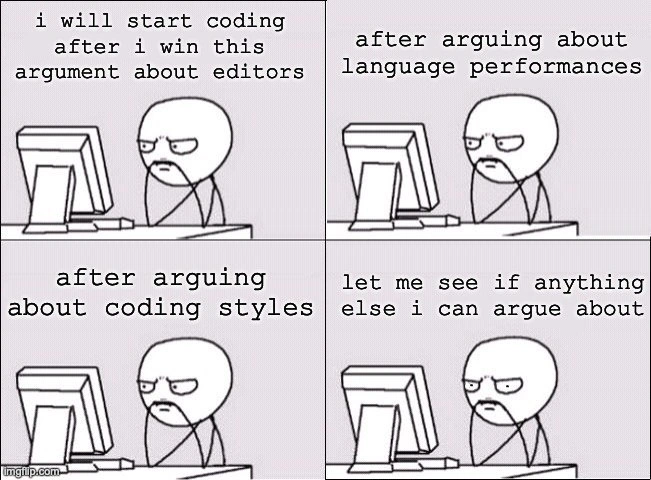
The seven deadly coding sins: tabs, spaces, IDE wars, and array doom
Why is this CodeQuality meme funny?
Level 1: Baking Blunder
Imagine two chefs in a kitchen who are supposed to be making a cake together. One chef insists, “Adding sugar is a culinary sin – cakes should only be sweetened with honey!” The other chef fires back, “Using honey is wrong – the only proper way is with sugar!” They’re both so adamant about their method that they start a big argument in the middle of baking. While they’re busy bickering over which sweetener to use, they completely lose track of the oven. The timer was set for 30 minutes, but nobody’s paying attention, and the cake ends up burning.
In this little story, the chefs’ fight over sugar vs honey is like programmers arguing about tabs vs spaces or which IDE to use – it’s a heated debate over preferences. The burned cake is like the “overrun array” bug – the real mistake that actually ruins the result. The chefs were so distracted arguing about a minor detail that they committed a major blunder: they left the cake in too long and destroyed it.
The meme is funny for the same reason. It shows people arguing about small things in programming (like code formatting or tool choices) as if they were deadly serious “sins,” and then reminds us of a truly serious error (going past the end of an array) that can break everything. It’s saying: sometimes we get so caught up in little debates (sugar vs honey, tabs vs spaces) that we forget the big important thing – like not burning the cake, or in coding, not introducing a real bug. Anyone can understand that feeling: it’s like focusing on the wrong detail and messing up the thing that really matters. That contrast is why it’s humorous, and it’s also a small lesson in keeping our priorities straight.
Level 2: Flame Wars 101
This meme lists what it calls the “7 deadly sins of programming,” but it’s clearly done tongue-in-cheek. Let’s break down what each of those points actually means in everyday coding:
1 & 2. Tabs vs Spaces: The first two “sins” are exact opposites – one says using spaces instead of tabs is wrong, the next says using tabs instead of spaces is wrong. This refers to the age-old tabs vs spaces debate in code indentation. When programmers write code, they indent lines to show structure (like inside loops or functions). You can indent by pressing the Tab key, which inserts a special tab character, or by pressing the spacebar multiple times to insert spaces. Different programmers and style guides have different preferences. For example, Python’s style guide (PEP8) insists on spaces, while some other teams insist on tabs for consistency. It’s a minor stylistic choice – it doesn’t change the program’s behavior at all – but developers can get surprisingly passionate about it. The meme jokes that whichever one you choose, someone will tell you you’re “doing it wrong.” In reality, what matters is picking one style and sticking with it, because mixing tabs and spaces can cause confusion (and even errors in a language like Python). Many companies resolve this by standardizing on one or the other to improve team consistency and CodeQuality.
3. Not using auto-formatting: This point says it’s a sin if you don’t use auto-formatting. Auto-formatting is when you use a tool or IDE feature that automatically tidies up your code’s layout (indentation, spacing, bracket placement) according to a set style. Tools like prettier for JavaScript or clang-format for C++ will re-indent and reformat your code at the press of a button (or on file save). The idea is to avoid arguments over tabs vs spaces or brace placement by letting the tool enforce a uniform style for everyone. The meme is basically saying, “What’s wrong with you? Just auto-format your code so we don’t have to look at your weird spacing.” For a junior developer, this highlights a common piece of advice: use linters or formatters to keep your code neat and consistent. It’s funny here because it contradicts the first two points – first the meme pretended that using tabs or using spaces were sins, and now it’s implying you should just let the computer handle it. This exaggeration is poking fun at how zealously some people push auto-formatting as the cure for code style debates.
4 & 5. Using IDEs vs Not using IDEs: The next contradictory pair of sins is about IDEs vs text editors. An IDE (Integrated Development Environment) is an application like IntelliJ, Eclipse, or Visual Studio that provides a whole suite of tools for programming. IDEs typically have a code editor with syntax highlighting, auto-completion, build and run buttons, interactive debuggers, and other convenient features built-in. In contrast, some developers use more minimalist text editors like Vim (vi) or Emacs. Vim and Emacs run in a terminal or have simple interfaces, and they require some learning of keyboard commands (for example, Vim has modes for inserting text or issuing commands, and Emacs uses special key combinations, often involving the Ctrl or Alt keys and sequences of letters – these can sometimes look like alien code to newcomers!). There’s a long-standing light-hearted feud in programming: “vi vs Emacs” is a classic rivalry, and more generally “simple text editors vs full-featured IDEs” is a debated choice.
Point 4 says using IDEs is a sin. This mimics the argument from old-school or minimalist programmers who might say that relying on an IDE’s fancy features (like those nicely-colored buttons and auto-generated code) makes you a lazier or less skilled coder. They might claim “true” programmers stick to basic editors and command-line tools for the sake of simplicity and deeper knowledge. That’s why the meme jokingly talks about ensuring “purity” by writing code in vi or Emacs (both of which are seen as classic, powerful editors that run in a text-only interface).
Point 5 says not using IDEs is a sin, which is the exact opposite perspective. This one echoes what you’ll hear from proponents of modern IDEs and productivity tools: if you stubbornly avoid IDEs, you’ll waste a lot of time doing things manually. Why manually scroll and search code or remember arcane key combos when you could click a button or use an IDE’s search, refactor, and auto-complete features? This perspective values efficiency and leveraging tools to write code faster and with fewer errors. The reference to “ridiculous key combination invoked using LISP” is specifically mocking Emacs – Emacs is highly customizable and uses a built-in language called Lisp for a lot of its extensions, and it’s famous (or infamous) for certain multi-key shortcuts that can be hard to remember (like Ctrl+Alt+Shift plus some letter, etc.). It’s basically saying, “Why would you subject yourself to that, when an IDE could do it easier?”
For a new developer, the takeaway is: there are different ways to write code. Some people work in streamlined text editors (possibly with plugins), others in heavyweight IDEs. Both approaches have merits, and you’ll encounter strong opinions on both sides. The meme exaggerates by implying both choosing an IDE and not choosing an IDE are “sins,” which simply highlights that this is a controversial topic in the dev community. In reality, you’re not a bad programmer for choosing either; it depends on what works best for you and the task at hand. It’s just a funny aspect of DeveloperExperience culture that these debates exist at all.
6 & 7. C/C++ vs Java (language wars): Now the meme moves on to programming languages. Point 6 says it’s a sin if you fail to learn C and C++, and point 7 says it’s a sin if you do learn C/C++ instead of using something like Java. This is referencing the ongoing language wars and generational differences in advice.
C and C++ are programming languages that have been around for decades (C since the 1970s, C++ since the 1980s). They are considered lower-level than Java, meaning they give the programmer more direct control over the computer’s memory and processor. They’re very powerful and are used for things like operating systems (Windows, Linux are largely in C), game engines, embedded systems (like the software in appliances or cars), and high-performance applications. However, with that power comes complexity. In C/C++, the programmer has to manage memory manually (allocate and free memory, ensure you only use memory that belongs to you, etc.). Mistakes can lead to crashes or security issues. These languages also have a steep learning curve due to complex features (especially modern C++ which is huge). Despite that, many experienced engineers recommend learning C/C++ at some point because it teaches you how things work under the hood and can make you a more well-rounded coder.
Java, on the other hand, came about in the mid-1990s with a philosophy of “write once, run anywhere.” It runs on a virtual machine (the JVM), which means Java programs are not compiled to raw machine code directly but to bytecode that the JVM interprets or JIT-compiles. Java manages memory for you using a garbage collector (so you typically don’t manually free memory; the system cleans up unused objects for you). It also has built-in checks – for example, if you try to access an array index that’s out of bounds in Java, the runtime will throw an
ArrayIndexOutOfBoundsExceptionerror and stop that operation. This prevents you from accidentally corrupting memory. Java is used a lot in enterprise applications, Android apps, and many other areas. It’s considered “safer” and easier for large teams because it removes some pitfalls of C/C++ at the cost of a bit less control over low-level details.
Now, about the meme’s points:
Point 6 (failing to learn C/C++) suggests that it’s a huge mistake not to learn those “essential” languages. You might hear this from a mentor or senior dev who started with C early in their career – they might feel that understanding pointers and memory and how a computer really works is crucial. From their perspective, if you only know higher-level languages, you might be missing core knowledge.
Point 7 says learning C/C++ instead of something modern like Java is a sin – this is the opposite view. Some folks will tell you that spending time on C/C++ is unnecessary for many jobs and that you should focus on modern, higher-level languages that allow you to build things more quickly. They’ll point out that projects in C++ can become very complex, and if your goal can be achieved with a simpler language like Java (or even Python or JavaScript nowadays), you should use those. The meme specifically jabs that schedules involving C or C++ overrun by five years – an exaggeration, but it hints that developing in those languages can be slow due to debugging tricky issues. The line about Java not allowing certain flaws is referring to things like the aforementioned array bounds checking or automatic memory management – basically saying Java protects you from some mistakes that C/C++ would happily let you make (and suffer the consequences).
For a junior programmer, this is a bit confusing because it’s completely opposite advice from two camps. And that’s exactly the point of the joke: no matter what language you start with, someone will claim you made the wrong choice! The reality is both paths have value. If you learn C or C++, you gain insight into low-level workings and performance, which can be very useful. If you learn Java (or a modern high-level language), you might build skills that let you create applications faster and with fewer chances to shoot yourself in the foot. Every language has pros and cons, and what you “should” learn depends on your goals and the project’s requirements. The meme humorously calls both choices a “sin” to highlight how opinionated developers can be about language choice.
8. Overrunning the end of an array: The final point is different from the rest – it’s not about preferences or tools, it’s about a genuine programming error. An array is a data structure that holds a fixed number of elements in order. For example, you might have an array of 10 numbers indexed from 0 to 9. Overrunning an array means you try to access index 10 (the 11th element) or some index beyond the last valid element. This is also known as going “out of bounds.” Doing this is a bug. In some languages like C or C++, the system will not automatically stop you from looking beyond the array – instead, you’ll be reading or writing into memory that doesn’t belong to that array. This can lead to very unpredictable and bad outcomes: it might overwrite some other important data or code in memory, causing your program to misbehave or crash. This type of bug is famously one of the causes of serious security vulnerabilities (a lot of hacks exploit buffer overflows, which are a form of writing past the end of a buffer/array). In safer languages like Java, C#, or Python, the runtime will detect that you’re accessing an illegal index and will throw an error/exception to prevent damage.
What’s clever in the meme is that it promised 7 deadly sins, but then it listed an 8th one – overrunning an array. If you count, that’s one more than expected, almost like the list itself “overflowed” its limit. This is likely intentional: it’s a little meta-joke referencing an off-by-one error, which is exactly the kind of mistake that can cause you to overshoot an array by one. An “off-by-one” error is when a loop or index goes one too far (or one short) because of a small miscount – a very common logic mistake, especially when you’re starting out programming. The meme writer is winking at us saying, “Oops, I listed one too many – I just did an off-by-one!” This bit of humor might fly over the head of a brand-new coder, but once you’ve encountered your first off-by-one bug, you’ll get the joke.
In essence, this meme is introducing you to some of the classic developer culture debates (tabs vs spaces, editor/IDE choice, language choice) in a joking way. It shows that for almost every rule someone tells you (“always do X”), there’s another experienced person who will say the exact opposite (“never do X, do Y instead!”). If you’re a junior developer, it can feel contradictory and confusing – and that’s exactly why this is funny. It’s exaggerating how dogmatic people can be. The final point about the array is a lighthearted reminder that, at the end of the day, arguing over spaces or tabs doesn’t matter as much as avoiding real mistakes that could crash your program. The meme teaches an implicit lesson: don’t take every “never do this” rule at face value (context matters), and always keep an eye out for actual bugs that everyone agrees are bad news!
Level 3: Debates vs Defects
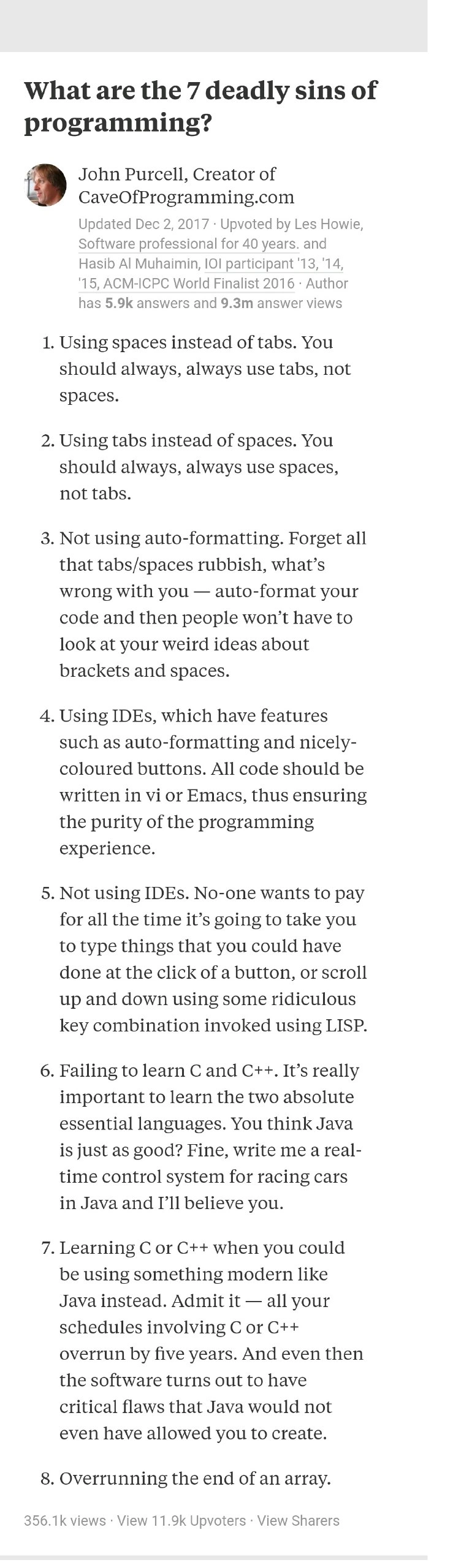
The meme is poking fun at the perennial flame wars of programming by listing “7 deadly sins” that are ironically contradictory pairs of advice. It’s styled as if it were a serious Q&A response on a forum (the screenshot mimics a Quora post complete with an expert author’s credentials), which gives the declamatory list of sins an extra layer of dry humor. The heading asks “What are the 7 deadly sins of programming?”, and the answerer – a veteran programmer – delivers a seemingly authoritative list that’s actually full of tongue-in-cheek contradictions. This resonates with any senior developer who’s seen these holy wars play out repeatedly in code reviews and online forums. The humor comes from how dogmatic best practices often conflict depending on who you ask – and how fervently programmers will declare something a sin one week, while the exact opposite is a sin the next.
Take the first two "sins": Using spaces instead of tabs vs Using tabs instead of spaces. It’s the classic tabs-vs-spaces debate taken to absurdity – no matter which you choose, some camp insists you’re committing a cardinal offense against code formatting. Experienced devs have watched entire teams split over indentation style as if it were a matter of religious doctrine. The meme exaggerates this by literally making both choices “always, always” wrong. It’s a nod to the endless formatting wars where everyone claims their style is the One True Way to achieve good CodeQuality. Seniors chuckle because they know the real answer is “just be consistent and maybe use an auto-formatter so we can get back to actual coding” – yet here consistency itself becomes its own sin in the next point.
Indeed, item 3 – “Not using auto-formatting.” – scolds those who don’t use tools to enforce a uniform style. This is a jab at the auto-formatting evangelism in developer culture: some folks act like failing to run Prettier or clang-format on save is practically a mortal sin. It directly conflicts with points 1 and 2, highlighting the paradox: we fight over manually aligning code with tabs or spaces, then someone else lambasts us for not letting the IDE format everything automatically. The senior perspective here recognizes the satire in these contradictory best practices. We’ve all seen the pendulum swing – one codebase where any stray space is vilified, and another where touching the indent manually is forbidden because “the tool knows best.” By combining these mutually exclusive stances back-to-back, the meme reminds us how opinionated and fickle DeveloperExperience guidelines can be. What one team treats as gospel, another treats as heresy.
Next, the meme shifts to the eternal editor war: Using IDEs (sin #4) versus Not using IDEs (sin #5). This is a playful take on both sides of the IDEs vs Text Editors feud. On one hand, purists insist that relying on a fancy IDE with auto-completion, GUI debuggers, and nicely-coloured buttons makes you a lesser programmer – “true artisans code in a plain text editor like vi or Emacs.” This is the voice of the old-school hacker who equates using minimalist tools with purity of programming. The meme mocks that stance by calling “Using IDEs” a deadly sin that supposedly corrupts the "purity of the programming experience." Any veteran developer recognizes this tongue-in-cheek nod to the vi vs Emacs era – a legendary rivalry in which each side claimed moral high ground for decades.
Then immediately, sin #5 flips the script: “Not using IDEs” is also wrong, now from the perspective of the productivity pragmatist. This side argues that refusing an IDE is just inefficient – why waste time memorizing obscure Emacs key combos (invoked with LISP snippets, no less) or manually typing boilerplate that an IDE could generate with a click? The meme exaggerates it: no one wants to pay for all the extra time it takes you when you could hit a button instead. This mirrors real office conversations: one colleague side-eyes the terminal-only dev and says, “you know, you could do that in half the time with an IDE,” while the other retorts, “my lightweight setup makes me faster in the long run.” Senior devs grin because they’ve seen both extremes. By listing both using and not using an IDE as sins, the meme highlights that in programming culture you can get shamed either way. It’s a no-win scenario every experienced programmer recognizes – you will always violate someone’s idea of best practices, no matter what you do.
The next pair of contradictions involves programming languages and underscores a classic LanguageWars tug-of-war between low-level and high-level camps. Sin #6 declares “Failing to learn C and C++” as unforgivable. This channels the sentiment of seasoned systems programmers who insist that every serious developer must know these foundational, high-performance languages. It’s a common gatekeeping refrain: “If you don’t understand pointers, memory management, and how the machine really works from coding in C/C++, you’re not a real engineer.” The meme parodies this absolutism by having a grizzled guru voice say, essentially, “Prove Java is as good by doing something hardcore (like a real-time racing car control system) in it. Bet you can’t!” Many veterans have heard that kind of challenge, implying Java or higher-level languages are for the weak, and only C/C++ grant you true control and efficiency.
And yet, sin #7 immediately chastises the opposite: “Learning C or C++ when you could be using something modern like Java.” Now the perspective shifts to the camp that views C/C++ as dangerous legacy choices except where absolutely necessary. They’ll point out (with a smirk) how projects written in C or C++ often blow past deadlines and end up riddled with bugs—whereas languages like Java (or C#, or Python in more recent debates) let you build faster and help prevent entire classes of errors. The mention that “all your schedules involving C or C++ overrun by five years” lampoons the reputation C++ projects have for complexity and delays. The kicker that Java “would not even have allowed you to create” those critical flaws is referencing memory safety. For example, a buffer overflow (writing past the end of an array) that might slip by in C++ would in Java immediately throw an exception and halt before causing havoc. Seasoned devs appreciate this irony – they’ve witnessed endless debates where one colleague swears by C++ for its performance and control, while another rolls their eyes and advocates for managed languages to avoid C++’s sharp edges. By including both stances as “deadly sins,” the meme emphasizes how subjective and context-dependent these so-called rules are. It’s essentially saying: whichever path you take – low-level or high-level – someone will claim you’ve sinned and chosen poorly.
Finally, we get to the punchline eighth sin: “Overrunning the end of an array.” This one breaks the pattern in two brilliant ways. First, it’s not a matter of opinion or preference at all – it’s a plain programming error, a serious bug that every programmer agrees is bad news. In languages like C or C++, overrunning an array’s bounds (also called an array out-of-bounds error) can lead to memory corruption, security vulnerabilities, and nasty crashes. It’s truly a “deadly” sin in the sense that it has caused real-world software disasters. By including this as a sin, the meme starkly contrasts it with the petty squabbles above. It’s as if the author is saying: “While you’re busy waging war over spaces vs tabs and editor choices, don’t forget the one sin that will actually send your program to segfault hell.” In other words, don’t lose sight of actual code correctness while obsessing over style. This punchline resonates with experienced devs who’ve seen teams bikeshedding on trivialities while a fatal bug lurked unnoticed in the codebase.
The second clever twist is that this is the eighth item in a list that was supposed to have only seven sins. That extra item is itself an overrun – a subtle meta-joke referencing the very error it describes. Off-by-one errors (counting one too many or too few) are a notorious cause of array overruns. So the meme cheekily commits an off-by-one mistake by listing 8 sins instead of 7, as if the list itself overflowed its bounds. It’s the kind of Easter egg that makes a senior engineer snicker: the content about a bug includes a little instance of the bug in its form (going “one over” the expected count). It shows that the author is intimately familiar with developer humor and intentionally layered the joke.
In summary, a veteran programmer sees this meme as a tongue-in-cheek reflection of our industry’s most heated trivial disputes – the endless TabsVsSpacesDebate, the editor/IDE holy wars, the language superiority fights – all contrasted with a reminder of what real programming sins look like. It’s funny because it’s spot on: you could follow every style rule or win every argument about tabs and braces, and still get bitten by a devastating bug like an array overrun. The meme’s contradictory rules and final serious goof illustrate that there’s no way to please everyone’s subjective rules, but there are definitely ways to screw up that everyone agrees on. Seasoned engineers laugh (perhaps a bit self-critically) at this list, recalling times they too got caught up in petty developer culture battles, only to be humbled by a real bug. The meme cleverly reminds us that in programming, real hell isn’t using spaces or an IDE – it’s debugging memory corruption at 3 AM.
Description
Vertical screenshot of a Quora-style post with a white background and black serif text. Heading reads, “What are the 7 deadly sins of programming?”. Beneath a small circular avatar, the author line shows “John Purcell, Creator of CaveOfProgramming.com” with update and view stats. The numbered list is intentionally contradictory: 1) Using spaces instead of tabs, 2) Using tabs instead of spaces, 3) Not using auto-formatting, 4) Using IDEs, 5) Not using IDEs, 6) Failing to learn C and C++, 7) Learning C or C++ instead of Java, followed by an eighth point “Overrunning the end of an array.” The humor pokes fun at perennial developer flame-wars over editor choice, formatting style, language superiority, and classic off-by-one bugs, illustrating how dogmatic rules can conflict and lead to real defects like buffer overruns
Comments
36Comment deleted
After two weeks debating tabs vs spaces, IDE purity, and whether C++ is a moral failing, the array overrun from bullet #8 quietly got root in prod - good thing the attacker kept our .editorconfig intact
The real eighth deadly sin? Writing a list of seven deadly sins but including eight items because you forgot to bounds-check your own enumeration - proving that even when mocking buffer overflows, we're all just one off-by-one error away from becoming the very thing we satirize
A list of 7 sins with 8 entries - the author didn't just describe sin #8, he committed it, and in production no less
This post brilliantly captures the essence of senior developer discourse: we've spent decades arguing about tabs vs spaces and IDEs vs vim, only to realize the real deadly sin was the friends we made buffer overflow along the way. The author's masterstroke is listing contradictory positions as separate sins - a perfect metaphor for how every architectural decision is simultaneously the right choice and a career-limiting move, depending on which Slack channel you're in. The punchline about C++ schedules overrunning by five years hits different when you've actually been on those projects and watched Java rewrites take six
console.log to 'proper logging': Exchanging 2s prototypes for 2w ELK ceremonies - DX purgatory
Everything before #8 is theology; #8 is the SEV‑1 that wakes your SRE at 3am and resets your SLO
Funny how the first seven are perfectly load‑balanced bikesheds; the only thing that actually pages you is #8 - undefined behavior is gloriously editor‑agnostic
this is golden Comment deleted
kinda bipolar Comment deleted
"I hate bipolar disorder. This is awesome!" Comment deleted
I think my bipolar friends would laugh and cry at that Comment deleted
I follow these rules since my childhood and have no psychical disorder. Comment deleted
Great Comment deleted
Just what I expected Comment deleted
Damn this culture, instead of using word ' sarcasm ' they blame bipolar disorder. Comment deleted
👍 Comment deleted
4. myself Comment deleted
5. C++ Comment deleted
10. base-6 counting system Comment deleted
But why? Comment deleted
if you are a programmer then you are committing a deadly sin Comment deleted
Maybe not, if you are using ternary computers - those with trits instead of bits. That is, with unbalanced ternary system, the number 6<base10> becomes a round number 20<base3>. Comment deleted
not round, but ok Comment deleted
Are these contradicting or am I out of my mind? Comment deleted
Very much yes Comment deleted
Which question are you saying yes to? Comment deleted
They are contradicting Comment deleted
Noice Comment deleted
what is bipolar disorder? Comment deleted
where ppl go from extremely happy to extremely sad in very little time Comment deleted
Manic and depressive respectively. While the manic states may manifest as cheerful-seeming hyperactivity and depression as sadness, that's far from the only way those can look like. And yes, they are usually fairly long periods. There are different personality disorders that have the stereotypical rapid mood swings as a symptom but bipolar is not it. Comment deleted
aight then Comment deleted
oops thats me Comment deleted
yes, that's also a variant Comment deleted
what is it standing for? Laugh my great tough fucking ass off for you? Comment deleted
oh thanks Comment deleted