The Bugfix Emotional Loop
Why is this Debugging Troubleshooting meme funny?
Level 1: Fixing A Wobbly Chair
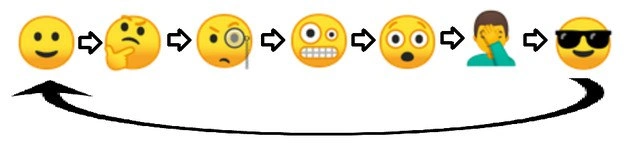
This is like trying to fix a wobbly chair. First you think it will be easy, then you look closely, then you get annoyed, then you realize another leg is loose too, then you smack your forehead, then you finally fix it and feel proud. But the arrow says the next chair is already waiting, so the same feelings start again.
Level 2: Debugging Feelings
Bug fixing means finding why software behaves incorrectly and changing it so the problem stops happening. Debugging is the investigation part: reading error messages, checking logs, stepping through code, writing small tests, and comparing what the program does against what you expected it to do.
Each emoji in the image represents a common stage. The smile is the first optimistic “this should be easy.” The thinking face is the first theory. The monocle-like inspection face is code review and log reading. The clenched teeth and shocked face are what happens when the bug touches more files than expected. The facepalm is the moment you discover the cause was either embarrassingly simple or deeply cursed. The sunglasses face is the victory lap after a patch.
The arrow looping back means the process repeats. A new bug appears, or the old bug returns in a slightly different form. For junior developers, this can be frustrating because it feels like failure. In reality, iteration is normal. Good debugging is not magic; it is learning enough about the system to make the next guess better.
Level 3: The Recurring Fix
The post caption, “Bugfix process,” turns the image’s emoji chain into a developer lifecycle diagram. Visually, it starts with a calm smile, moves through thinking, inspection, clenched-teeth anxiety, wide-eyed panic, facepalm despair, and finally sunglasses confidence. The thick curved arrow then loops from that final “fixed it” feeling right back to the beginning. That return arrow is the whole indictment.
The senior-developer pain here is that debugging rarely ends at the first fix. The emotional sequence maps cleanly onto real troubleshooting: reproduce the issue, form a theory, inspect the suspicious code, discover the theory was incomplete, realize the bug is deeper than expected, regret every design choice involved, patch something, and briefly feel like a genius. Then a failing test, production edge case, or user report sends you back to the smiley starting state because the “fix” was only the first layer.
This is why the loop format lands harder than a straight timeline. A bugfix is not a clean march from confusion to victory; it is a feedback system. You change code, observe behavior, update your mental model, and repeat. In healthy engineering cultures, tests, logs, traces, and small deploys shorten that loop. In less healthy ones, the loop includes vague tickets, stale documentation, unowned services, and a comment from 2017 that says // temporary workaround.
The image also captures the false confidence phase. The sunglasses face is not wrong; sometimes the bug really is fixed. But experienced developers know that confidence arrives before the next weird input, race condition, timezone boundary, cache invalidation surprise, or “works locally” report. The meme is funny because it compresses hours of technical investigation and emotional whiplash into a tiny repeatable conveyor belt. Debugging is science, yes, but it is science performed while the build pipeline quietly judges you.
Description
A simple white-background diagram shows a horizontal sequence of emojis connected by black arrows: smiling, thinking, inspecting with a monocle, gritting teeth, wide-eyed panic, facepalm, and finally sunglasses confidence. A thick curved black arrow loops from the confident final emoji back to the first smiley, implying the cycle repeats. There is no overlaid text in the image; the associated caption reads "Bugfix process," framing the emoji progression as the emotional state machine of investigating and fixing software defects.
Comments
5Comment deleted
Bugfixing is just a finite state machine where the accepting state immediately transitions back to denial.
You forgot about these stages: Comment deleted
and the disassociation when you've spent 6 hours staring at one function Comment deleted
your combo is weak Comment deleted
Bug fixed Comment deleted