Skip to content
DevMeme
2032 of 7435
Wishing life had GitHub rollback to revert to last stable version
VersionControl Post #2265, on Nov 8, 2020 in TG

Wishing life had GitHub rollback to revert to last stable version

Why is this VersionControl meme funny?

Level 1: Back in Time Wish

Imagine you’re playing a video game and you reach a level that’s just not going well at all. In most games, you could hit a reset or load your last save point to try again. This meme is a funny way of saying “I wish I could do that in real life.” The person is a programmer, so they phrased it in a programmer’s way: they wish life was like a project on GitHub (a place where people store code) so that they could revert to an earlier point in time, the last time everything was okay. In simple terms, they want an undo button for life.

Why is that funny? Well, because we all know you can’t actually rewind real life. If you make a mistake or something bad happens, you can’t just click “undo” and magically go back. But developers — people who write software — have a tool that almost feels like a magic undo for code. It’s called version control. It saves past versions of their work. If they mess up the code, they can roll it back (which means go back) to an earlier version that worked. It’s like having multiple save points in a game or multiple copies of an essay at different stages. So the joke is comparing life to a coding project: “My life is a bit messed up right now, I wish I could restore it to how it was before, just like I do with my code when a change goes wrong.”

Anyone who’s ever said “I wish I could go back to yesterday and do things differently” can relate to that feeling. The tweet just expresses it in a geeky, playful manner. Instead of saying “I want to go back in time,” the person says “I want to revert to my last stable version.” In everyday language, stable version means “the last time everything felt okay and stable for me.” It might make you smile because it’s basically a high-tech way of sighing “Oops, life got complicated. Can I take a mulligan?” (like asking for a do-over).

The heart of the humor is a mix of wishful thinking and nerdy reference. You don’t need to be a programmer to get the wishful thinking part – who wouldn’t love a do-over for their mistakes or a chance to relive a better time? But the nerdy part is what makes it uniquely funny to developers: they deal with GitHub and version control every day, so they’re imagining using a work tool on something as personal and non-technical as one’s life story. It’s like saying “I fixed my code with a button, why can’t I fix my life with a button?” in code-speak.

In summary, this meme is a coder’s daydream: if life had an undo function like code does, wouldn’t that be great? It tickles the funny bone because it’s a big contrast – life is unpredictable and permanent, whereas code (to a developer) feels controllable and easy to change back. The tweet wraps a common human feeling (wishing for a second chance) in a fun tech metaphor. Even if you’re not a techie, you can understand the longing behind it. And if you are a techie, you’re probably grinning thinking, “Ha, if only I could type some command and undo that awkward thing I said last week.” It’s a lighthearted way to commiserate that, unlike our programs, our lives don’t come with a revert button.

Level 2: No Ctrl-Z IRL

Let’s break down the technical references in this tweet for newer developers or the uninitiated. The author wishes their life was a GitHub repository. GitHub is a popular web-based platform where developers store their code and use Git for version control. A repository (repo for short) on GitHub is like a project folder that tracks every change made to the files within. With Git, every change you save creates a commit, which is like a snapshot in time of your project. You can go back to older commits if needed, almost like a time machine for code.

When they say “roll back to my last stable version,” they’re using software terminology. “Rolling back” means undoing recent changes. If an update causes problems, developers roll back the software to a previous stable state – essentially reverting to when it last worked correctly. In Git, you might use commands like git revert (which undoes a specific commit by creating a new commit that negates it) or git reset (which moves the project’s state back to a previous commit, as if subsequent changes never happened). The last stable version refers to the most recent version of the software (or life, in the joke) that was free of major bugs or issues. In software teams, you’ll hear things like “Version 2.3.1 was stable, but 2.4.0 introduced a crash; we had to roll back to 2.3.1.” Here, the person humorously implies that their personal life has gone through a “release” that is full of bugs, and they yearn to revert to a prior, stable state (maybe before a bad decision or incident). It’s a metaphor: life events are being treated like versions of an app, some stable, some not.

The tweet itself is formatted with hashtags: #github and #repository. On Twitter, people use hashtags to tag keywords, making the tweet discoverable to others interested in those topics. In this case, it signals to other developers or tech-savvy folks that this tweet involves GitHub and repositories. It’s like saying “attention dev crowd, you’ll get this joke.” The tone and wording are firmly in DeveloperHumor territory – if you know what GitHub and a rollback are, you immediately understand the wish. If you don’t, it just looks like gibberish (or an odd desire to time-travel).

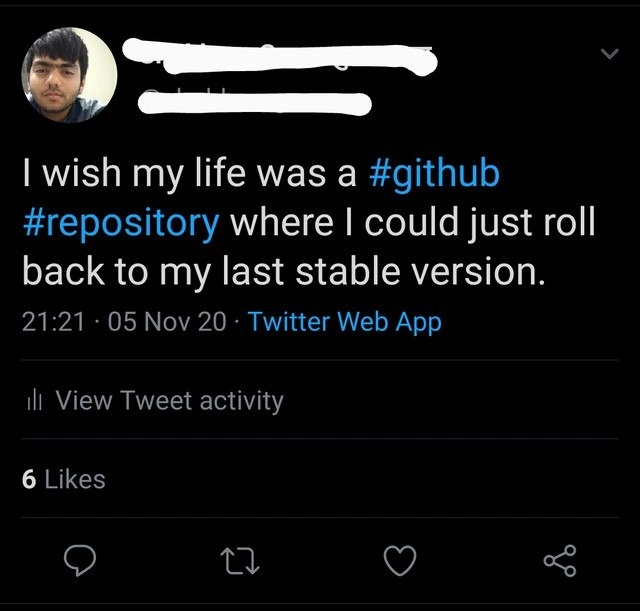
Now, consider the Twitter dark-mode UI shown in the image. Twitter allows users to switch to a dark theme (light text on dark background). Developers are famously fond of dark mode (many IDEs, code editors, and apps have dark themes, and we joke about dark mode being better for our eyes or just our aesthetic). The fact the screenshot is in dark mode subtly adds to the “dev ambiance” of the meme. It’s a small visual cue that resonates with the target audience – much like seeing a code editor in dark theme.

The content of the tweet resonates on a human level too, especially about mental health and stress. When life gets overwhelming or something goes wrong, it’s common to wish one could simply undo it. That’s basically what a rollback in code does: undo the troublesome changes. The tweet’s author likely had a rough day or year (and indeed by November 2020, a lot of people did) and expressed that frustration through a coding analogy. For a junior developer or someone new to coding, imagine the first time you broke something in your code. You might think, “I wish I could just go back to when it was working!” With Git, you can do that with your code. But with life... not so much. So this tweet is a playful way of saying “I wish life had an undo button.” It’s relatable to anyone, though the choice of words is a wink to those in the know about Git and VersionControlHumor.

Let’s define a few terms more clearly in case you’re just learning them:

  • GitHub: A website/service for hosting Git repositories. It’s like a social coding platform – you can store code, track issues, and collaborate. Think of it as a remote backup and collaboration hub for your code, with a nice interface.
  • Git: The underlying version control system. It runs locally on your machine to track changes. GitHub is built on Git, adding collaboration features.
  • Repository: A project tracked by Git. It contains all your files and the entire history of changes (commits). It’s what you “clone” from GitHub to get a copy of the project on your computer.
  • Commit: A saved change or set of changes in the repository. Commits are often thought of as snapshots or versions. Each commit has a message (like “Fixed login bug”) and an ID.
  • Stable version: A version of software that is known to work well. Often teams tag a commit as a release (e.g., v1.0) which has been tested. That’s considered stable if it has no major issues. An unstable version might be a development build that’s still being tested or has new features (and new bugs).
  • Roll back (or revert): To go back to an earlier commit/version because the latest changes aren’t good. For example, if commit 50 introduced a bug, you might revert to commit 49, effectively “undoing” commit 50’s changes. In life terms, it’s like saying “I wish I could undo that thing I did yesterday.”

Knowing these, the tweet becomes crystal clear. It’s essentially: “I messed something up in my life (or it’s become chaotic). If life were like my code, I’d simply use GitHub to rewind to when things were good.” It’s both relatable humor and a comforting thought for a developer: our developer tools make us feel powerful at work, so it’s tempting to imagine wielding that power in our personal ups and downs. And as any programmer who’s been stuck on a problem knows, sometimes you really do fantasize about hitting Ctrl+Z (the universal “undo” shortcut) on life events. There’s no Ctrl-Z in real life (IRL), but thinking about life as a repository is a funny geeky way to vent that feeling.

Finally, notice the small details: the tweet timestamp and likes. It’s a real slice-of-life tweet (not a polished meme image or comic, but a screenshot of a tweet). Only 6 likes – which actually makes it more authentic as a personal musing rather than a viral joke. Many developers share these little thoughts on Twitter with modest audiences. It’s part of developer culture to hop on Twitter and drop a quirky one-liner mixing tech and life. The fact that it’s a Twitter Web App user means they posted it from a browser (perhaps during a late-night coding session procrastination?). All these pieces paint the picture: a developer feeling a bit down or whimsical, expresses it in code-speak, a few fellow devs nod in agreement (hitting the Like button), and voila – we have a meme-worthy relatable post.

Level 3: Rollback Reality

At first glance, this meme draws a laugh from any experienced developer who’s had to undo a bad deployment. It conflates real life with a version-controlled codebase on GitHub – a clever mashup of mindsets. In the programming world, when a new release is unstable or introduces bugs, we often roll back to the last stable version. That means quickly reverting the code to a prior state that we know worked. It’s a staple of VersionControl and a lifesaver in production at 3 AM. So when a developer jokes “I wish my life was a GitHub repository where I could just roll back to my last stable version,” they’re comparing life’s messy moments to a buggy software release.

For seasoned devs, the humor works on multiple levels. First, there’s the absurd wish for a personal git revert. In code, git revert creates a new commit that undoes a previous commit, effectively a time machine for mistakes. We’ve all had that deployment where we frantically git revert or roll back the release because something broke. Now imagine applying that to life: had a bad day or made a poor decision? Just hit “undo” and go back to yesterday when things were working! It’s funny because we all know life offers no such easy fixes. This roll_back_metaphor tickles the programmer brain: if only human existence had a commit history we could checkout.

There’s also an undercurrent of developer self-deprecation and mental health reflection. Referring to one’s “last stable version” of life suggests the current state is unstable – perhaps full of bugs (problems, stress, regrets). It’s a tongue-in-cheek way to say “I’m not okay right now, things have been better before.” In coding, we label a software build as “stable” when it’s been tested and doesn’t crash. By joking that an earlier time in life was a stable release, the author implies things have since spiraled like a bad update. It’s relatable: everyone has chapters of life that felt better (or at least less broken) than the present. Developers often cope with these feelings using humor, slipping into RelatableDevExperience mode – “lol, my life is in production and the latest deploy is full of bugs.” This kind of DeveloperHumor wraps genuine stress in a nerdy analogy that fellow coders immediately get.

The choice of GitHub (not just “Git”) in the tweet is deliberate. GitHub is the popular platform for hosting Git repositories – basically the hub of collaborative coding. By saying life is a GitHub repository, the implication is that life’s timeline would be neatly versioned, maybe even open to collaboration or forking (imagine branching your life into alternate paths!). It also evokes the conveniences GitHub gives: a nice UI, issue tracker, perhaps even those green contribution squares tracking your activity. It’s adding a layer of tech familiarity to the fantasy. A senior dev might chuckle at the thought: What if you could open a pull request to fix your past? Would your future self approve it? There’s an entire genre of jokes where devs describe real-world phenomena in tech terms, and this fits right in.

Digging deeper, this meme hints at the contrast between coding and life. In software development, we have powerful tools to mitigate failure: version control, backups, tests, continuous integration. If a change goes wrong, we can revert, redeploy, or hotfix – it’s not the end of the world. This safety net encourages experimentation and quick fixes in code. Life, on the other hand, has no true staging environment or rollback command. You can’t spin up a second “life server” to test a risky choice, nor issue a quick git reset after an argument with your boss. As the joke implies, life is always running in production. This is a well-known saying in tech circles: “Don’t test in production – except you kinda have to, in life.” The meme captures that ironic truth. An older, battle-scarred engineer would agree: if only our personal mistakes were as easily fixable as our code commits. Instead, we endure the equivalent of pagers blowing up—except it’s our own stress and consequences calling.

It’s worth noting the time and context: this tweet was posted in late 2020, a year that many would indeed love to revert. 😅 A senior developer reading it in November 2020 might smirk and think of the myriad “bugs” introduced that year (global pandemic, anyone?) and how nice it’d be to time-travel to a pre-2020 stable version of the world. The MentalHealth tag here is real: this humorous wish reflects a bit of burnout or anxiety, common in our industry. Under the joke, there’s a subtle sigh of **“Things were better before; I’m overwhelmed now.”* Tech folks often use these metaphors as a both a comedic outlet and a gentle way to acknowledge stress. It’s easier to say “roll back my life” with a grin than to directly say “I’m struggling right now.”

Lastly, let’s appreciate the tweet format itself. It’s presented as a screenshot in Twitter’s dark mode UI – of course it is, because what self-respecting coder doesn’t use dark mode? The black background with white text is the same aesthetic as an IDE in dark theme. It subconsciously screams “developer vibes.” Even the fact it got only 6 likes gives it a kind of authenticity as a niche dev joke rather than corporate viral marketing. It’s like an inside joke among coders on a coffee break. The hashtags #github and #repository are used to flag the topic (and perhaps to catch fellow programmers’ attention). This kind of meme (well, a tweet in this case) lives at the intersection of DeveloperProductivity culture and everyday life woes. It’s saying: We spend our days controlling software with precision, yet our own lives feel out of control. Wouldn’t it be nice if the tools that make us productive in code could save us in life too? That mix of powerlessness and geeky imagination is what makes the joke land so well with an experienced audience.

To illustrate the concept in pure dev terms, imagine if you really had a Git repository for your life timeline. You might see something like this:

$ git log --oneline -2
abcd1234 (HEAD -> master) Update life: tried something new, broke everything
1234abcd (tag: stable-life) Previous version: things were working fine

# Time to roll back to the last stable commit:
$ git revert HEAD
Opened new pull request: "Revert to stable-life version" ✔️

In reality, no such commands exist for life’s mistakes. But hey, one can dream! This meme perfectly captures that dream in one relatable, humorous line.

Description

Screenshot of a tweet displayed in Twitter dark-mode UI. The user’s avatar is blurred and their name and handle are white-out bars. Tweet text reads: “I wish my life was a #github #repository where I could just roll back to my last stable version.” Below it shows the timestamp “21:21 · 05 Nov 20 · Twitter Web App,” a muted analytics icon, and “6 Likes.” Standard reply, retweet, like, and share icons sit along the bottom. The humor compares personal life to a Git/GitHub repository, invoking the developer concept of rolling back to a prior commit when the current state is unstable - an analogy that resonates with version-control workflows, releases, and the desire for an easy ‘git revert’ when things go wrong

Comments

12
Anonymous ★ Top Pick Forget rollback - just give me a `git bisect` for life so I can pinpoint the exact commit where I said “sure, I’ll own the legacy Perl cron job,” then `git revert --no-edit` my entire career trajectory
  1. Anonymous ★ Top Pick

    Forget rollback - just give me a `git bisect` for life so I can pinpoint the exact commit where I said “sure, I’ll own the legacy Perl cron job,” then `git revert --no-edit` my entire career trajectory

  2. Anonymous

    After 20 years in tech, I've mastered git rebase -i, can cherry-pick through merge conflicts blindfolded, and maintain a pristine commit history... yet somehow my life's main branch is still full of unresolved conflicts and the CI/CD pipeline to happiness keeps failing on the 'work-life balance' integration tests

  3. Anonymous

    The real tragedy is realizing life doesn't support `git revert` - only `git commit --amend` with increasingly desperate messages, no CI/CD pipeline to catch breaking changes before production, and absolutely zero rollback strategy when you merge that 'seemed like a good idea at the time' decision into main. At least with code, you can blame the previous developer; in life, that's just you with worse judgment and better hair

  4. Anonymous

    Life as a GitHub repo? Rollback sounds nice until you remember it's not stateless - there's a production DB called "consequences," no migrations, and you forgot to tag the last good commit

  5. Anonymous

    Life is prod; the only safe rollback is a compensating migration - no git reset --hard origin/youth without failing the compliance audit

  6. Anonymous

    Life's the ultimate unrebased feature branch: full of half-baked changes you can't squash without rewriting history

  7. @AmindaEU 5y

    and make the same mistakes again or make different mistakes as rolling back would probably erase the memories?

  8. @yanisalwayslies 5y

    very deep

  9. @iksunen 5y

    I wish I could run the tests before I start making any decisions in life

  10. Ievgen 5y

    REBASE

  11. Ievgen 5y

    Also guys keep messing git vcs vs github

  12. @LionElJonson 5y

    git GIT GIIIIT

Use J and K for navigation