Skip to content
DevMeme
4819 of 7435
From two-hour task to multi-sprint saga: the banner of broken estimates
Deadlines Post #5279, on Jun 29, 2023 in TG

From two-hour task to multi-sprint saga: the banner of broken estimates

Why is this Deadlines meme funny?

Level 1: Not as Easy as It Looks

Imagine you have a homework assignment that you think will take you just 10 minutes. You tell your parents, “I’ll be done really fast, it’s easy!” and you start working on it. But then, as you do it, you realize the task is much bigger than you thought. For example, say you’re asked to clean your room and you figure, “No problem, I only need to pick up a few toys.” Once you begin, you find toys under the bed, then you notice your clothes are all over the floor, and then you remember you also spilled some juice in the corner that needs cleaning. Now you have to do a lot more work: pick up toys, put away clothes, wipe up the spill, maybe even vacuum. Your whole room was messier than it looked at first! Suddenly that “quick 10-minute job” turns into an hour-long deep clean. You feel surprised and a bit frustrated because you truly thought it would be easy, and that’s the only reason you started it so casually. In the end, you can laugh and say, “Wow, I didn’t expect it to be that hard!” That’s exactly what this big red banner is joking about – sometimes we start things thinking they’ll be simple, and only later do we realize they’re not easy at all. It’s funny in a friendly way, because we’ve all been there: we underestimate a job and then discover it’s a big task. The banner’s message is basically the grown-up, software version of “Oops, this turned out to be a lot more work than I thought!”

Level 2: Scope Creep Strikes Again

Let’s break down what’s going on here in simpler terms. The meme shows a banner stating: “We do this not because it is easy, but because we thought it would be easy.” This is poking fun at a common situation in software teams where everyone underestimates how hard a task will be. In planning, a new feature or bug fix often starts as “Oh, that should only take a couple of hours, no problem.” With that confidence, the team jumps in and commits to doing it by a certain deadline (say by the end of the week). In software development (especially using Agile methods), work is planned in short cycles called sprints (often 1 or 2 weeks long). The team might allocate this “two-hour” task to the current sprint, expecting it to be a quick win.

However, as soon as the developer starts working on it, reality intervenes. Scope creep is the term for when a project’s scope (the amount of work or features) grows beyond what was originally planned. It “creeps” in gradually. For example, imagine the task is to add a simple profile picture upload for users on a website. Sounds easy: just add an upload button and save the picture, right? But here’s how scope creep strikes in real life:

  • New Requirements Emerge: As you start, someone says, “If we’re letting users upload pictures, we should also let them crop and resize them.” Now you have to add an image cropping feature too.
  • Hidden Dependencies: You discover that to save the images, you need to update the database to store a file path or binary data. The current database might be outdated or not configured for large file storage, so you have to migrate the database schema (which is a bigger task on its own).
  • Technical Debt Surfaces: While integrating this, you find an old piece of code (legacy TechDebt) that handles user profiles. It’s poorly written and not compatible with the new image uploads. To avoid the whole system breaking, you now have to refactor (rewrite) that module. This is an unexpected chunk of work caused by earlier shortcuts in the code.
  • Bugs and Edge Cases: With new code in place, suddenly some edge cases appear. For instance, uploading certain image formats causes an error, or very large images make the app run out of memory. Now you must fix those bugs, add image size validation, maybe even integrate an image compression library.
  • Testing & Integration: As you finish coding, the QA tests reveal that the new feature conflicts with something else – say the mobile app version has problems with the new profile picture API. Now you need to coordinate with another team or update the mobile app as well.
  • “Since you’re in there…”: Meanwhile, stakeholders or product managers might slip in a request like, “Since you’re touching the profile section, can we also enable editing the username on that screen?” It wasn’t part of the original plan, but it often happens. This is classic scope creep, adding more to the plate.

By the end of this, the “small” task has turned into a mini-project. What was thought to be a few hours of work can easily stretch over multiple days or weeks. The phrase “multi-sprint saga” from the title is exactly this scenario: something expected to fit in one sprint ends up taking two or three sprints. A sprint in Agile is like a fixed time box for work (commonly two weeks). So if a task spills into multiple sprints, it means it’s taken much longer than planned and likely delayed other scheduled work.

Several key concepts are at play here:

  • Time Estimation: Developers and project managers try to estimate how long tasks will take. This meme highlights how those estimates can be wildly incorrect. Saying “two hours” for something that ends up taking two months is a huge estimation error, but it happens a lot. Estimating software tasks is tricky because every task can hide unexpected challenges. Even experienced engineers struggle with this, which is why this is a big ProjectManagementHumor point.
  • Deadlines and Pressure: When a team underestimates and commits to a tight deadline, they often face DeadlinePressure. For instance, if the boss promised a client this feature would be done this week, everyone will feel pressure to rush. This can lead to long nights, cutting corners, or just stress when things inevitably take longer. It’s a recipe for MisalignedExpectations – management expects one thing, reality delivers another.
  • Agile and Adaptability: Agile processes are supposed to accommodate change. In Agile, you normally review progress in daily stand-up meetings and sprint reviews. When a “quick task” blows up, the Agile approach is to be transparent about it and adjust plans. Maybe you drop other tasks to finish this one, or move it to the next sprint. It’s still frustrating though, and the sprint demo might have less to show than hoped because this one item ate up all the time. In the meme’s scenario, what started as a tiny item in the sprint backlog became the main story of the sprint (or multiple sprints).
  • Technical Debt: This is crucial in understanding why something thought easy becomes hard. TechDebt refers to the idea that shortcuts or outdated code in the past become “debt” that you eventually have to pay back with extra work. It’s like if you do a rushed job now, you (or someone else) will spend more time fixing it later. In our example, encountering legacy code that doesn’t support images is tech debt coming due. The developers thought it would be easy because they weren’t fully aware of the lurking technical debt. Once they started, the debt had to be paid (by refactoring, debugging, etc.), expanding the scope of the task significantly.
  • Scope Creep: As defined, it’s the expansion of a project’s goals or tasks beyond what was originally agreed. It’s one of the main reasons projects overshoot their schedules. In many cases, scope creep isn’t malicious or even intentional – it often happens naturally as people realize “Oh, we need this too!” or “Wouldn’t it be nicer if…?” during the development process. Good project management tries to control scope creep (for example, by saying “let’s save that extra request for later”), but sometimes even necessary things (like fixing discovered bugs, handling edge cases) effectively increase the scope.

The banner in the image is funny to developers because it’s a precise reflection of their lived experience. The statement “we thought it would be easy” is almost an inside joke – practically every programmer has said or thought those words, only to eat them later. It’s a form of DeveloperHumor where you laugh to keep from crying. Teams might even hang something like this on their wall as a reminder. It’s simultaneously a joke and a warning: Don’t trust rosy estimates! Always assume there’s some complexity hiding beneath the surface.

So, to sum up this level: The meme is about RequirementsVsReality. The requirement sounded simple; the reality was far more complicated. It highlights the disconnect that can happen between initial expectations and the actual outcome in software projects. A task that seemed easy blew up due to unknown challenges, additional requirements, and technical pitfalls. For a junior developer or someone new to project planning, it’s a relatable lesson: be cautious with time estimation, and remember that “simple” things can become anything but simple once you start digging in. It’s not that anyone is dumb for getting it wrong – it’s that software is inherently complex and full of surprises. This meme just captures that lesson in one hilariously blunt banner.

Level 3: Famous Last Words

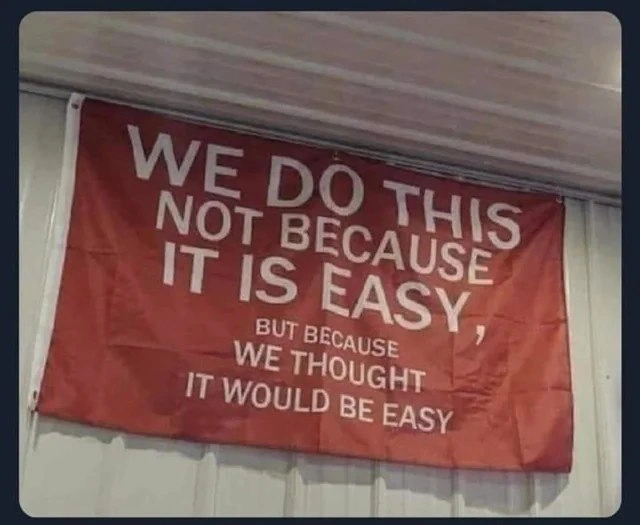
"WE DO THIS NOT BECAUSE IT IS EASY, BUT BECAUSE WE THOUGHT IT WOULD BE EASY."
This giant red banner is basically the coat of arms for every dev team that’s been burned by overly optimistic estimates. It’s a tongue-in-cheek twist on JFK’s famous moonshot quote – originally about doing hard things on purpose – now repurposed to admit: “We only took on this project because we misjudged how hard it would be.” The humor hits home for senior engineers because it satirizes the chronic software estimation fallacy: our tendency to boldly claim a task is “no big deal” only to watch it balloon into a multi-sprint saga. In project planning meetings, these rosy estimates are almost famous last words – a rallying cry before reality smacks us in the face. The meme’s engineering irony is that the banner reads like motivational wall art, but the message is pure sarcasm about MisalignedExpectations and RequirementsVsReality. It’s essentially the banner of broken estimates, proudly hanging in the dusty warehouse of software project failures. Seasoned devs smirk at this because they’ve lived through the “quick win” that went terribly wrong, turning a simple two-hour ticket into a two-month fire-fight.

In real-life Agile shops, this scenario is painfully common. A team commits to a feature thinking it’s a quick win – a straightforward addition promised to the client by Friday. The initial task seems easy on the surface (maybe a few lines of code or a minor UI tweak). But once you dig in, you uncover a rabbit hole of unknown dependencies and hidden complexity. The database schema needs a change, the outdated third-party API suddenly breaks, the TechDebt from two years ago rears its head, and new scope creep sneaks in as stakeholders say, “Since you’re in there, could you also add this other thing?” Each discovery adds more work, and soon the “quick fix” spirals far beyond the original requirements. The team scrambles, the deadline slips, and the DeadlinePressure mounts. By Sprint’s end, that two-hour task has devoured two entire sprints (or more), and everyone in the retrospective is facepalming and laughing darkly at how ProjectManagement optimism met reality.

This meme resonates because it pokes fun at the perpetual gap between plans and production. It’s developer humor (DeveloperHumor) drawn from lived experience: the ProjectManagementHumor of every Gantt chart and sprint plan blown to bits by real-world complications. The banner’s message might as well be framed as the Agile team’s unofficial motto. It encapsulates TimeEstimation hubris: no matter how many times we say “Let’s pad the estimate”, we still get blindsided by the unknown unknowns. In fact, this is a textbook example of the planning fallacy in action – a cognitive bias where we consistently underestimate how long tasks will take, even when we’ve been burned before. Experienced devs know to be wary of any sentence that includes “just” or “should be easy”. Saying “It’s just a small change” is practically scope-creep summoning magic. We’ve all seen that one-liner change request turn into a full system overhaul. There’s even a jokey rule: any task labeled “easy” will automatically become high risk. 🤦‍♂️

Historically, this underestimation problem has been around as long as software engineering itself. The meme nods to classics like The Mythical Man-Month – Fred Brooks’ 1975 book on why software projects always take longer. Brooks famously stated: “Adding manpower to a late software project makes it later.” This is Brook’s Law, and it’s part of the lore that when an Agile team realizes a “quick task” is way behind, throwing more developers at it (or splitting it across sprints) often backfires. New engineers have to get up to speed (slowing everyone down), communication overhead increases, and the complexity just multiplies. In our two-hour-turned-two-month saga, a panicked manager might say, “Let’s put two more devs on it so we can still meet the deadline.” The cynical veteran knows this usually just adds coordination chaos, introducing even more bugs and inconsistencies. It’s the mythical_man_month_reference in action: the false belief that work scales linearly with people or initial optimism. In reality, tasks have essential complexity that defies brute-force compressing. The banner’s proclamation captures that absurd truth: we embark on these doomed “easy” tasks out of blissful ignorance. If we knew how hard it would be, we might never have started… but by the time we know, we’re already knee-deep in the mess!

To seasoned engineers, the meme is both cathartic and cautionary. It’s cathartic because it says out loud what everyone feels after yet another quick_win_gone_wrong: “Welp, we really thought this would be simple. Oops.” It’s a shared joke that eases the pain – a bit of gallows humor hung like a banner in the tech debt boiler room. And it’s cautionary because it reminds us (with a smirk) to approach TimeEstimation with humility. The next time someone cheerfully suggests a risky refactor two days before release, you can just point at the banner. We do these things not because they’re easy, but because we falsely believed they would be easy – a modern dev team’s version of famous last words. After living through a few such debacles, you better believe this phrase gets ingrained in the collective memory. Teams might even ban the phrase “it’s easy” from planning meetings entirely. In some offices, that red banner (or a printed sign of the quote) actually hangs on the wall as a perpetual inside joke. It’s like a battle scar from past project wars, reminding everyone: Estimate at your own peril.

Description

The image shows a large red fabric banner hanging inside what looks like an industrial warehouse or garage with corrugated metal walls and ceiling panels. In bold white uppercase letters it reads: "WE DO THIS NOT BECAUSE IT IS EASY, BUT BECAUSE WE THOUGHT IT WOULD BE EASY" - the last clause humorously undercutting the inspirational tone. The scene evokes every software team that green-lights a feature thinking it’s a quick win only to discover hidden complexity, unknown dependencies, and cascading scope creep. For seasoned engineers, the banner is a tongue-in-cheek nod to chronic under-estimation, mythical man-month miscalculations, and the perpetual gap between planning spreadsheets and production reality

Comments

6
Anonymous ★ Top Pick It started as a ‘small refactor’ - now the Jira ticket has more descendants than a Git rebase gone rogue
  1. Anonymous ★ Top Pick

    It started as a ‘small refactor’ - now the Jira ticket has more descendants than a Git rebase gone rogue

  2. Anonymous

    The same confidence that made us estimate "just a simple REST API" at 2 sprints is what convinced us Kubernetes would simplify our deployment pipeline

  3. Anonymous

    This banner perfectly captures that magical moment in sprint planning when you confidently estimate 3 story points for what will inevitably become a 6-month architectural refactor involving three legacy systems, two deprecated APIs, and a database migration that nobody documented. The real kicker? You'll still defend that original estimate in the retrospective because 'how were we supposed to know the authentication service was written in COBOL and maintained by a contractor who retired in 2003?'

  4. Anonymous

    PM: 'Just swap the DB driver', and six weeks later we're running dual-write CDC, backfilled 2TB, and learned what write skew means

  5. Anonymous

    In planning it was a one-line change; in production it required a schema migration, nine service contracts, a backfill job, and a postmortem on why “easy” remains our most fragile dependency

  6. Anonymous

    Architects pitch 'simple refactor' at kickoff; ops sighs 'monolith migration incoming' 18 months later

Use J and K for navigation