Linux Enters The Privacy Debate
Why is this DataPrivacy meme funny?
Level 1: Who Is Peeking?
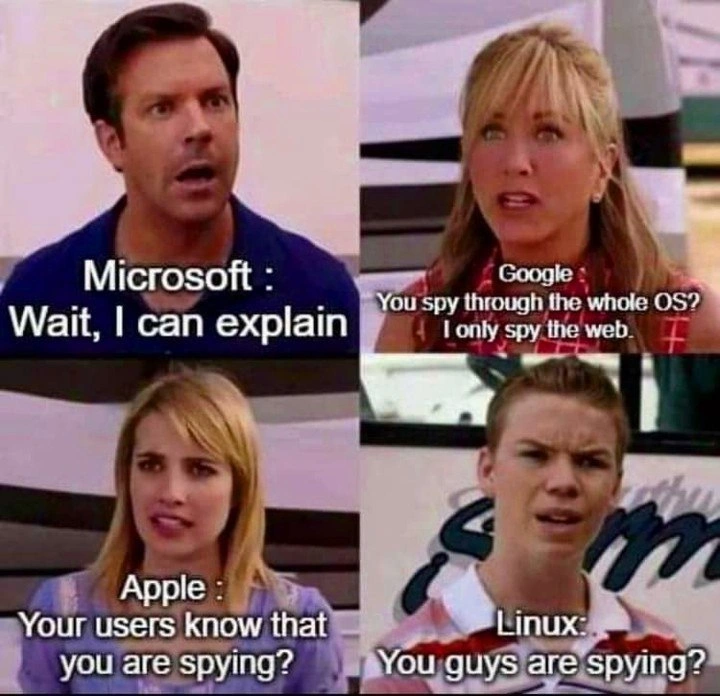
This is like four shops talking about watching customers. One shop says it can explain, another says it only watches people online, another asks whether customers even know, and the last shop is confused because it thought nobody was supposed to watch. It is funny because Linux is shown as the person who did not realize everyone else was being nosy.
Level 2: Who Watches What
Telemetry means software sending information about usage, errors, performance, or behavior back to a vendor or maintainer. It can be useful when it helps developers fix crashes and understand real-world failures. It becomes a privacy concern when users do not understand what is collected, cannot meaningfully opt out, or when the data supports advertising, profiling, or lock-in.
Microsoft, Google, and Apple in the image stand for big commercial platforms. They build operating systems, browsers, cloud services, app stores, identity systems, and analytics pipelines. Those products often need some data to function, but users and developers argue about how much is necessary and how much is extraction wearing a friendly settings page.
Linux is different because it is not one company-owned desktop product. The Linux kernel is open source, and Linux distributions combine it with many other components. In practice, that means privacy depends on the distribution, desktop environment, installed applications, defaults, and user choices. The meme simplifies that into Linux: You guys are spying? because Linux users often see themselves as choosing control over convenience.
For a newer developer, the key lesson is that privacy is not just a checkbox. It is architecture, defaults, incentives, documentation, and trust. A system can collect data for good reasons, but users should know what is happening and have realistic control over it.
Level 3: Telemetry Meets Tribe
Microsoft : Wait, I can explain
Google You spy through the whole OS? I only spy the web.
Apple : Your users know that you are spying?
Linux: You guys are spying?
The meme stages a platform privacy argument as escalating disbelief. Microsoft is caught first, Google judges from the web-advertising corner, Apple implies that the real trick is making surveillance feel consensual or invisible, and Linux enters as the open-source innocent asking why everyone is collecting data at all. The joke is not a precise technical audit of each company; it is a compressed cultural map of how developers talk about privacy, operating systems, and business models.
The Microsoft panel lands because Windows is the most visible desktop OS associated with account integration, diagnostics, cloud tie-ins, and settings screens where privacy choices can feel more like archaeology than consent. The Google panel works because Google's core reputation is web-scale data collection: search, ads, analytics, browser sync, Android services, and identity. The Apple panel twists the knife by pointing at branding. Apple sells privacy as product differentiation, so the meme jokes that the important question is not whether data exists but whether users notice the trade.
Then Linux gets the punchline. In developer culture, Linux represents inspectability, user control, and the possibility of running an operating system without a single vendor monetizing the whole experience. Because much of the ecosystem is open source, unwanted telemetry is more likely to be argued about in public, patched out, disabled by downstream distributions, or forked around by sufficiently stubborn people with mailing-list stamina. That is the idealized version, and the meme knows it.
The post message says, "Just don't think too much about Canonical, etc" and then "Linux is Linux," which is the necessary footnote. Linux is a kernel, not one uniform consumer product. Ubuntu, Fedora, Arch, Debian, Android, ChromeOS-derived systems, enterprise distributions, desktop environments, package managers, and vendor builds all make different choices. Some Linux-adjacent products have added analytics, search integrations, crash reporting, or commercial services. The meme's Linux panel is funny because it expresses the community's preferred self-image, while the caption quietly admits reality has package dependencies.
The deeper industry satire is that telemetry is always sold as helpful: crash reports improve stability, usage metrics guide product decisions, sync features reduce friction, security signals detect abuse. Some of that is legitimate. The failure mode is when collection becomes default, opaque, hard to disable, or entangled with advertising and account lock-in. Developers laugh because they have heard the phrase "improve your experience" enough times to know it can mean anything from useful diagnostics to "we found another column for the data warehouse."
Description
A four-panel reaction meme shows characters reacting with escalating disbelief, each labeled as a major technology platform. The top-left panel says "Microsoft : Wait, I can explain," the top-right says "Google You spy through the whole OS? I only spy the web," the bottom-left says "Apple : Your users know that you are spying?" and the bottom-right says "Linux: You guys are spying?" The joke frames Microsoft, Google, and Apple as surveillance-heavy ecosystems while Linux appears confused by the idea of built-in user tracking. It is a broad operating-system and platform-privacy satire rather than a specific exploit or implementation bug.
Comments
11Comment deleted
Linux telemetry is mostly a forum thread where someone asks why you enabled telemetry.
I don't use Arch btw Comment deleted
💀😂 Comment deleted
Google is also spying through OS Comment deleted
And with the one that's the most popular in the world xd Comment deleted
Pls edit it to be real: Google uses GMS (Google Mobile Services or formerly known as Google Play Services) to have a whole place to store your activity and stuff that got spied about you. The problem is it uses apis that allow apps that volunteer to communicate with gms and leaks data out of the app’s sandbox (work even on AOSP) because this inter-app connection is based on both apps voluntary implemented feature. Now you think that no app would volunteer for such a data leak. Guess what, to use basic things that work on google play services like redirecting to store or checking for purchased licenses or voice to text transcription, auto correct or whatever else, you must add a library to your app that bloats it and makes it voluntarily connect and expose data to the gms main app. Even better if you disallowed microphones or file access for the app sandbox it still can get stuff passed from gms to the app or the other way around (if you disallow that for gms it will bypass it with any app that has file access and passes the stuff over from that sandbox). So google technically can even spy you on the OS level even if your os is open source and debloated and has no OS level backdoors. Google play servuces got you covered Comment deleted
Make sure that all this text is visible in the meme /s Comment deleted
Linux is the kernel, Canonical is company who maintains one specific distro 🤓🤓🤓 Comment deleted
linux is the genre, canonical is the band and ubuntu is the song Comment deleted
Still using Arch btw Comment deleted
The spy're in the hardware lol Comment deleted