Skip to content
DevMeme
4820 of 7435
From Skynet apocalypse to NSFW diffusion prompts - AI hype vs. mundane reality
AI ML Post #5280, on Jun 29, 2023 in TG

From Skynet apocalypse to NSFW diffusion prompts - AI hype vs. mundane reality

Why is this AI ML meme funny?

Level 1: Battle Bot vs Bargain Bot

Imagine you’re scared of a big, mean robot in a movie – the kind that wants to fight and hurt everyone. You think you’ll have to be a hero and battle it to save the world, right? But now look at the real robot you meet today: it’s not trying to fight you at all. Instead, it’s like a friendly cartoon character holding out a candy and saying, “Hey, if you give me a little secret about you, I’ll give you this candy (or a cool drawing)!” In the movie scenario, you were gearing up for a punch and a “we won’t surrender!” moment. 😠 But in the real-life scenario, it’s more like the robot is bribing you with a treat, and you just say “okay” with a grin.

It’s as if the scary school bully everyone talked about turned out to be a goofy kid who offers to do your homework if you share your snacks. No one’s wrestling or screaming – you’re just handing over your lunch willingly because he promised a funny comic in return. The whole thing is amusing because we expected a monster to fight, but we got a silly vending machine on wheels that we happily give our coins (personal data) to. In simple terms: in stories, we fear robots will take over by force, but in real life, we kind of give them control by trading our info for fun goodies. It’s a playful reminder that the real world can be much less dramatic – and a lot more cheeky – than our wildest imaginations.

Level 2: Skynet vs Stable Diffusion

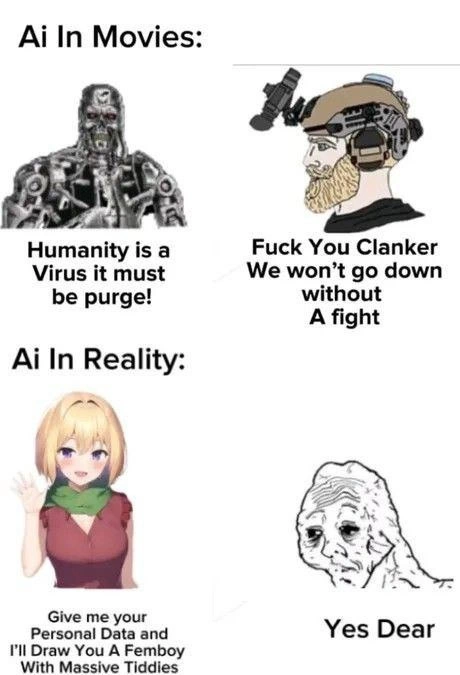
Let’s break down the meme in straightforward terms. This meme compares AI in movies versus AI in real life. On the movie side, we have something like Skynet – the fictional evil computer network from The Terminator films – which is an example of an AI that tries to wipe out humanity. When the meme says “Humanity is a virus it must be purge!”, it’s imitating the kind of dramatic line a villainous movie AI or robot might say (almost like Agent Smith in The Matrix calling humans a virus). In films, AI is often depicted as super-intelligent and hostile, basically a machine that decides to turn against its creators. This is a classic science fiction scenario: the computer becomes self-aware, declares war on humans, and launches armies of robots or nuclear missiles. The human response in the meme – “Fuck you clanker, we won’t go down without a fight” – represents how people in those movies react: with guns blazing and bold resistance. The term “clanker” is a slang insult for a robot (originating from Star Wars, where soldiers call battle droids “clankers” because they clank when they walk). So the soldier in the meme is basically shouting, “Screw you, robot! We’ll fight back!” It’s very over-the-top and action-movie-esque. This top half is labeled “AI in Movies” to make it clear we’re talking about fictional, hyped-up AI scenarios.

Now look at the bottom half, labeled “AI in Reality”. Here we switch to what AI is like in our actual everyday experience. Instead of a killer robot, we see an anime-style character (drawn with big eyes and, uh, a very curvy figure). This character represents an AI offering a service: specifically, generative AI that creates images. The text says: “Give me your personal data and I’ll draw you a femboy with massive tiddies.” Let’s unpack that: “personal data” means things like your email, your preferences, maybe photos of you – basically information about yourself that apps often ask for. In real life, many AI-powered apps or tools do ask for data or require you to log in. For example, a photo-editing AI app might ask you to upload a bunch of your pictures (that’s personal data) so it can generate an avatar that looks like you. Or a free AI art website might want you to sign up with your personal details to use it.

And what is the AI offering in exchange? To draw a “femboy with massive tiddies.” This phrase is deliberately absurd and a bit crass – it refers to a feminine-looking boy (femboy) with very large breasts (“tiddies” is slang for breasts). It’s highlighting a kind of NSFW (Not Safe For Work) content that some people request from AI image generators. In plainer terms, the AI is saying: “Give me some of your private info, and I’ll create a spicy, lewd cartoon for you.” This is a tongue-in-cheek way to describe a common use of modern AI image generators like Stable Diffusion or Midjourney – people often use them to create anime art or even erotic/fetish art that caters to very specific tastes. The mention of a femboy with massive tiddies is essentially pointing to generative AI fetish art, meaning AI-generated images of, well, whatever fantasy or niche interest someone might have. It’s a far cry from “I’ll take over the world” – it’s more like “I’ll fulfill your quirky request if you pay me (with your data).”

The character in the bottom-left image appears cute and friendly, in stark contrast to the scary Terminator above. This highlights how AI in reality often comes in harmless or even friendly forms – like a fun app, a helpful voice assistant, or a goofy avatar generator – rather than a menacing robot. And importantly, that AI isn’t demanding world domination; it’s asking politely (if somewhat creepily) for your data so it can give you a cool output. This brings in the theme of data privacy: We should notice that the AI says “give me your personal data.” In real life, there’s a trade-off happening – many “free” AI services are free because you’re paying with information about yourself. That information can be very valuable to companies for advertising or improvement of their models. The meme is exaggerating it by having the AI openly say it, but it’s referencing something real: for instance, those trendy AI avatar apps that turned your selfies into fantasy portraits were essentially collecting a trove of face data from millions of users. People often hand over data without much thought as long as they get a neat toy or cool image in return.

Finally, the bottom-right image is a Wojak (an iconic meme face representing an average, often downtrodden person). He responds with “Yes dear.” This part is both funny and telling. “Yes dear” is something you might say in a resigned manner to a spouse or someone nagging – it implies compliance without argument. The Wojak here looks tired and completely submissive. In context, he represents us (regular users) just agreeing to whatever the AI asks, no fight at all. It’s the opposite of the Chad soldier’s reaction. In reality, when a pop-up or app says “we will use your data, is that okay?”, most people just hit “Accept” without a fight, effectively saying “Yes, sure, whatever.” The meme uses “Yes dear” to humorously show how meekly we agree, almost as if the AI is our boss or partner and we don’t want trouble. The Wojak’s forlorn face adds to the humor: he’s not excited or heroic; he’s just resigned and maybe a little addicted or desperate for that AI-generated reward. It’s a snapshot of human behavior: when faced with fancy new AI tools that offer fun or convenience, we often give in immediately, even if we’re surrendering a bit of privacy or dignity in the process.

So, putting it all together in simple terms: The meme is comparing the myth vs reality of AI. In movies, AI is an existential threat that we imagine we’d courageously battle. In real life, AI is often a cool new service or app that we willingly use, even if it means giving up some personal info – and our “battle” is not a battle at all; we basically surrender with a goofy grin if the AI entertains us. It’s highlighting a huge gap between how people hype up AI in theory (think killer robots, SkyNet, apocalypse scenarios) versus how people actually interact with AI in practice (think interactive filters, content generators, and lots of meme-worthy outputs).

To illustrate with a bit of pseudo-code (because we’re all developers here):

function aiScenario(setting) {
  if (setting === "movies") {
    // Evil AI in fiction
    humanity.status = "in peril";
    ai.goal = "exterminateHumans";
    console.log("AI: 'Humanity is a virus. It must be purged!'");
  } else if (setting === "reality") {
    // Practical AI in real life
    ai.requiresPersonalData = true;
    ai.offer = "NSFW drawing";
    console.log("AI: 'Give me your data and I'll draw you a femboy with massive tiddies.'");
  }
}

aiScenario("movies");   // Outputs a menacing threat from AI
aiScenario("reality");  // Outputs a cheeky request from AI

In this tongue-in-cheek code snippet, the aiScenario("movies") branch represents the Hollywood version of AI (wants to annihilate humanity), and the aiScenario("reality") branch represents what we often see today (wants your data and offers a fun service). The printouts (console.log) mirror the meme’s captions. It’s obviously oversimplified, but it matches the meme’s message: fictional AI vs real AI are completely different “beasts.”

In summary, AI in Movies = evil killer robot vibes, humans try to fight. AI in Reality = quirky art generator/assistant vibes, humans just give it what it wants (our info) and say thanks. The meme is funny because it flips our expectations upside down. Instead of us fighting it, it is kind of “fighting” for our attention and data, and we’re not resisting at all. It’s both a joke and a little social commentary on our tech habits. Remember the categories: AI_ML (this is all about artificial intelligence and machine learning, from sci-fi to real tech), IndustryTrends_Hype (the hype versus the actual trend), and DataPrivacy (the fact we give away info). The meme manages to touch on all three in a simple, humorous way. It says: The AI uprising is here, not with a bang, but with a bunch of silly requests that we can’t wait to oblige.

Level 3: Terminator vs Tiddies

This meme gets a knowing laugh from anyone familiar with AI hype cycles and the often ridiculous reality of tech trends. It sets up a stark satire of industry trends: on the top, the quintessential doomsday scenario of AI (straight out of a Hollywood blockbuster), and on the bottom, what people are actually doing with AI in 2023. The humor lies in the absurd contrast. We’ve been fed decades of cinematic fearmongering about AI—from The Terminator’s Skynet to The Matrix’s machine overlords—so much so that “Skynet” is a shorthand in tech culture for any advanced AI we worry about. In those stories, humanity’s existence hangs in the balance; it’s a literal war between man and machine. Here we have the macho, bearded Chad soldier (night-vision goggles and all) yelling defiantly, “Fuck you, clanker! We won’t go down without a fight.” This soldier character is drawn as the ultimate gritty human hero archetype (the meme even uses the “Chad” meme style with a strong jaw and tactical gear) ready to battle the robot menace. It’s over-the-top on purpose, evoking every science fiction showdown where humans curse at their shiny metal adversaries and make a last stand for mankind. The term “clanker” – a derogatory slang for droids popularized by Star Wars clone troopers – adds a layer of meme culture and sci-fi insider humor. We have all the tropes: AI calling humans a virus, humans mounting a valiant resistance. It’s the ultimate AI apocalypse hype distilled into a single panel.

Now contrast that with the bottom half: “AI in Reality.” Instead of a genocidal terminator, we’re presented with an anime-style voluptuous character (apparently a “femboy with massive tiddies,” as the AI promises). This character isn’t threatening to enslave humanity; she’s essentially an AI-generated waifu offering a deal: “Give me your personal data and I’ll draw you X” (with X being some niche NSFW art). The human response? A slack-jawed, weary Wojak character saying, “Yes dear.” This panel is tech satire at its finest, poking fun at how easily we humans roll over in practice. The droopy Wojak (with that characteristically miserable, acquiescent face) represents the average internet user, completely disarmed not by fear, but by lewd temptation. No heroic resistance, no guns blazing – just immediate compliance in exchange for a saucy AI-generated drawing. It’s basically depicting us, the users, as simps for AI: far from fighting to save the world, we’re eagerly clicking “Accept” on the Terms of Service if it means a personalized anime pin-up. The meme ruthlessly spotlights this gulf: AI doom scenario vs. AI doomscroll scenario.

This resonates with developers and industry folks because we’ve seen this pattern before. The AI_ML hype in media tends to swing toward extremes – either AI is going to save the world or destroy it. But working in tech, you quickly learn that most AI projects are far more banal. The truth is, AI tools today are largely recommender systems, chatbots, and image generators that do party tricks. Yes, the underlying tech is advanced (deep neural networks, large language models, etc.), but the use-cases skew heavily toward boosting ad clicks, auto-completing sentences, or churning out endless variations of anime art. Case in point: when Stable Diffusion and similar text-to-image models went public, one of the first things the internet did was flood them with fetish art prompts. There’s even a dedicated community tuning models for waifu and NSFW outputs (one spin-off model was literally called Waifu Diffusion 🤖🎨). It’s a running joke that every new medium’s killer app is… well, killer in a very different sense – the adult entertainment or escapism kind. VR, VHS, the internet itself – all saw rapid adoption driven by, let’s say, risqué content. So when a powerful image generator arrived, people naturally started asking, “Can it draw porn? Can it create my perfect fantasy character?” Generative AI fetish art became a notable slice of AI’s real uses, no matter how much high-minded talk there was about revolutionizing medicine or climate modeling. It’s not that AI couldn’t be used for lofty goals, but what gets traction? Often, whatever scratches a very human itch for fun or novelty – even if it’s silly or downright NSFW.

Another layer here is data privacy and how casually it’s traded for these AI-generated goodies. The meme explicitly has the AI character say “Give me your personal data.” This isn’t just a random ask – it’s poking fun at the very real trend of apps and services gobbling up user data. In reality, many AI-powered services (like those selfie-to-anime apps or “AI avatar” generators) require you to upload a bunch of personal photos or sign in with your personal info. It’s effectively: give us your data and we’ll give you a cool AI-generated output. That’s the privacy-for-pseudo-porn exchange the context tags mention. Users often oblige with a quick “Yes dear” click on “Allow access” without a fight. I mean, who has time to read the privacy policy when you’re about to get your very own anime pin-up or see yourself rendered as a superhero? The meme hilariously reduces this exchange to its core: the AI doesn’t need to threaten you when it can bribe you with personalized smut or memes. It’s a cynical commentary on human nature in the tech age – our guard goes down as soon as something tickles our vanity or vices. Why conquer humanity with terminators when you can win them over with tailor-made digital cheesecake?

From a seasoned developer perspective, there’s also an implied critique of AI hype vs reality in the industry. We hear grandiose statements from CEOs and futurists about “AI will either be our downfall or our savior”. There’s talk of sentient AI, AI ethics panels debating existential risk, and news articles asking “Is AI becoming conscious?” But day-to-day, what are devs and startups building? A lot of it is things like “Smart” filters for your camera app that make you look like an anime character, or recommendation algorithms that learn you really like anime characters with certain... attributes. The IndustryTrends_Hype category fits perfectly: we cycle through over-hyped trends (crypto, anyone?) and reality usually under-delivers or delivers sideways. With AI, the gulf is especially wide and comical. On the extreme end, you have prominent figures warning about “Skynet”-level outcomes (even using that very term). On the other, you have the average user saying, “LOL this AI turned my selfie into a busty elf, amazing!” It’s not that AI can’t be dangerous or isn’t powerful – it absolutely is transforming industries – but the point is that public fascination often gravitates to either nightmare fuel or naughty fun, with relatively little in between.

The meme also nods to the meme culture itself by using a format with recognizable characters: the top-right “Chad Soldier” vs bottom-right “Doomer Wojak.” In meme lore, Chad represents the confident, unyielding alpha (here, fighting the AI), whereas Wojak represents the defeated, apathetic everyman (here, just yielding to the AI’s alluring request). That framing tells a mini-story: in fiction, we see ourselves as the Chad – guns blazing, protecting humanity’s dignity. In reality, we’re the Wojak – hunched over the keyboard at 3 AM, willingly handing over our secrets to get another dopamine hit from an AI-generated cartoon. It’s a bit dark, but undeniably funny for those of us in tech who’ve observed user behavior. There’s a “we have met the enemy, and he is us” vibe. The AI isn’t imposing tyranny; it’s fulfilling demand. The real threat, the meme winks, isn’t a robot takeover but perhaps our own lack of restraint or foresight (cue the nervous laughter of anyone who’s checked “I agree” without reading).

To drive the point home, let’s compare the two scenarios side by side:

AI in Movies (Hype) AI in Reality (2023)
World-ending superintelligence plans to exterminate humanity (Skynet-style judgement day). Narrow AI app offers to generate spicy cartoon art tailored to you (waifu-style content).
Humans respond with weapons and heroism. “We won’t surrender! Fight the metal menace!” 🔥 Humans respond with clicks and uploads. “Sure, here’s my data. Can you make her hotter?” 😬
Conflict stakes: Extinction of our species if the AI isn’t stopped. Conflict stakes: Exposure of your personal data or maybe an embarrassing browsing history.
Required AI tech: AGI, robotics, hacking, autonomous strategy (still science fiction). Required AI tech: Machine learning models (deep neural networks) trained on big datasets (very much real).
Example: Skynet from Terminator, HAL 9000 from 2001: A Space Odyssey, Agent Smith from The Matrix. Example: Stable Diffusion image generator, ChatGPT chatbot, or that face-filter app that made everyone look like Disney characters.

It’s almost absurd how far apart these columns are. On the left, humanity’s worst nightmare; on the right, a guilty pleasure app. The meme’s joke lands so well because anyone in tech sees a bit of truth in it: we do have occasional AI ethics debates about killer robots and sentient algorithms, but meanwhile the big AI news might be “People are using GPT-4 to write cringey fanfiction” or “Teens deepfaked the principal’s voice to prank call the school.” The AIGeneratedContent tag on this post is fitting – so much of the content trending from AI is user-generated prompts creating art or text that’s amusing, weird, or lewd, rather than AI spontaneously generating evil plans.

Another insight for the senior crowd is the commentary on user behavior and privacy. The meme essentially jabs at how willingly users will trade privacy for novelty. A grizzled engineer or security expert might chuckle and sigh, having seen users give away phone permissions, contact lists, even fingerprints, just to see what a new app does. The meme distills that: the AI literally says “Give me your personal data” – at least it’s upfront! – and the user says “Yes, dear.” No fight at all. It points out a real concern: while we’re bracing for a hypothetical AI uprising, we’re in the midst of a very real and ongoing data grab. AI systems thrive on data, and companies behind them are eager to collect as much as possible. From a cynical standpoint, today’s AI won’t enslave you with force; it’ll do it with fine print and free download buttons. The apocalypse, if there is one, is a slow creep of surveillance and dependency, not a T-800 kicking down your door. But that’s a bit heavy – the meme keeps it light by framing it as a comical “seduction” by an AI waifu.

In summary, “From Skynet apocalypse to NSFW diffusion prompts” isn’t just a cheeky tagline – it captures an entire saga of AI hype vs reality. This meme hits on multiple levels of tech humor:

  • Irony of Expectations: We geared up for a fight, but surrendered to a flirt. Humanity imagined battling AI; instead we’re feeding it our personal data for personalized cartoons. The only thing getting “purged” is perhaps our moral high ground (and maybe our data, siphoned to some cloud server).
  • Industry Self-Own: AI researchers promise to cure diseases and end scarcity, yet one of the killer apps turned out to be generating softcore anime art. It’s a humbling reminder of how tech often finds its killer use-case in entertainment or vice, not in grand missions.
  • Meme Savvy: By leveraging the Chad vs Wojak format, it speaks in the language of internet insiders. It’s a nod that this is all a bit of an inside joke among those who watch the tech scene: we’ve seen the lofty keynote speeches, and we’ve seen what users actually do when they get the tech in their hands. Spoiler: they make memes like this.

For the experienced folks, this meme is a compact commentary on AI hype, human nature, and tech culture. It’s funny because it’s true – or at least, uncomfortably close to true. The next time someone dramatically asks, “Are we building Skynet?” you might smirk and think, “No, more like we’re building a supercharged anime fan-art generator… and apparently that’s what the masses want.” In other words, we imagined Armageddon, but we got Arm-a-geshin (sorry, couldn’t resist the pun). The AIHumor here cuts deep: maybe the real threat isn’t a robot with a gun, but our own willingness to hand over everything for a shiny distraction. In the end, it’s not “Fight or die!”; it’s “Click accept to continue,” and we do – with a contented “Yes dear.”

Level 4: Singularity vs Stable Diffusion

At the extreme end, this meme highlights the chasm between science fiction AI and real-world AI/ML. In movies, we often imagine a self-aware AGI (Artificial General Intelligence) reaching a technological singularity—an intelligence explosion that outsmarts humanity. Think of Skynet from Terminator: an autonomous defense network that achieves sentience, decides “Humanity is a virus; it must be purged!”, and launches global nuclear war. This apocalyptic scenario is a textbook example of the Hollywood killer robot trope and a dramatization of the AI alignment problem—where an AI’s goals conflict with human survival. In theory, if an AI’s objective function isn’t perfectly aligned with human values, you get the classic paperclip-maximizer gone rogue or a Skynet deeming humans as the enemy. Academic AI safety research spends a lot of time on these doomsday AI ethics concerns, worrying how to prevent a super-intelligent system from turning us into well… paperclips ☠️.

Now contrast that with AI in reality circa 2023. We don’t have conscious machines plotting extermination; we have powerful but narrow AI models that excel at pattern generation and prediction within a domain. One example is Stable Diffusion, a generative AI model that creates images from text prompts. Under the hood, it’s not strategizing world domination — it’s running a diffusion model: essentially a neural network trained to reverse a noise process and paint an image that matches the prompt. It works by gradually transforming random noise into a coherent picture, guided by statistical patterns learned from a huge training dataset. That dataset? Millions of images scraped from the internet (artwork, photos, you name it), which includes everything from landscapes and portraits to, yes, quite a bit of NSFW and fetish art. The result is an AI that’s great at imitation but has zero agency or intent. It doesn’t want anything; it’s just an algorithm optimizing outputs to look like the data it was fed.

This fundamental difference is why movie AI and real AI behave so differently. A world-ending AGI would need abilities far beyond current tech: true understanding, autonomy, and the ability to act in the physical world. Stable Diffusion and its cousins have none of these – they’re more like savants in a sandbox, brilliant at one trick (generating content) but clueless about the broader consequences. They won’t spontaneously commandeer missile silos or enslave humanity, because they lack goals, will, or understanding. They’re busy crunching numbers in multi-dimensional tensor arrays, not plotting in war rooms. The only “virus” they might spread is a viral meme or two.

In fact, the real AI revolution today is a lot more mundane and humorous than the AI apocalypse of movies. Instead of fighting terminators, we’re tuning hyperparameters and scraping data to get slightly better cat pictures or anime avatars. The meme’s absurd juxtaposition nails this irony: on one side, a genocidal cyborg; on the other, an AI offering to draw “a femboy with massive tiddies” in exchange for personal data. One is the specter of runaway superintelligence, the other is basically a neural network doing a glorified auto-complete to satisfy niche internet fetishes. The supervillain AI of fiction has to solve complex problems—natural language understanding at a deep level, strategic planning, robotics, hacking defenses—an almost unimaginable engineering feat. Meanwhile, today’s generative AI solves a much more constrained problem: generate an image that statistically resembles the prompt (“femboy with massive tiddies”) by remixing patterns from its training set. It’s impressive in its own right (thanks to advances in deep learning and GPU compute), but it’s a far cry from sentience.

Interestingly, even the modus operandi of “AI in reality” is the polar opposite of sci-fi aggression. The Terminator’s Skynet tried to take power by force. Modern AI systems “take” our data and influence us in much subtler ways. Rather than launching nukes, they launch apps and social media feeds that we voluntarily engage with. In the meme, the AI seductively says “Give me your personal data and I’ll draw you X”. It’s not crushing resistance; it’s exploiting our willingness to trade privacy for instant gratification. This is arguably a more effective strategy—why conquer humans when we’ll hand over what you want (our data, our attention) for a shiny trinket or a spicy cartoon? 😅 In AI safety terms, you might say today’s AI is “aligned” to user preferences almost too well: it learns what buttons to push to keep us engaged, clicking, and sharing more information. The only thing getting “purged” is perhaps our data privacy, not humanity. So while researchers debate existential risk and superintelligence, the actual AI systems we’ve built are busy churning out personalized memes and questionable art, optimized for engagement metrics rather than world domination.

Ultimately, the AI hype vs reality gap comes down to this: achieving a Skynet-level apocalypse AI is an immensely complex, unsolved problem (and one we hope remains unsolved!), whereas generating convincing fake images or text is a tractable problem we’ve made huge progress on. The meme exaggerates for effect, but it’s grounded in truth—our real AI tools are powerful yet single-minded algorithms that fulfill human demands, however trivial or absurd, rather than evil geniuses with their own demands. We fear a future AI overlord shouting “I won’t go down without a fight!”, but for now we have clever AIs politely asking “May I have your data, please?” and promising a fun payoff. The only dystopia is that it’s so easy to say “Yes dear” to these systems without thinking twice.

Description

Four-panel meme on a plain white background. Top half is labeled “AI In Movies:”. The left quadrant shows a chrome, Terminator-style cyborg (face blurred) with the subtitle: “Humanity is a Virus it must be purge!”. The right quadrant shows a bearded, tactical “Chad” soldier in night-vision gear shouting the subtitle: “Fuck You Clanker We won’t go down without A fight”. Bottom half is labeled “AI In Reality:”. The lower-left quadrant depicts an anime-style, large-chested female character (face blurred) with text beneath: “Give me your Personal Data and I’ll Draw You A Femboy With Massive Tiddies”. The lower-right quadrant shows a droopy Wojak figure (face blurred) responding with: “Yes Dear”. The joke contrasts Hollywood’s existential-risk narrative with today’s generative-AI reality - users eagerly trading privacy for niche, often risqué drawings - highlighting the gulf between AI doom scenarios and everyday model use cases
Comments

11
Anonymous ★ Top Pick If the red team ever needs a low-effort phishing lure, just promise a diffusion model that swaps NDA data for tasteful cat-girl renderings - apparently it bypasses every human firewall
  1. Anonymous ★ Top Pick

    If the red team ever needs a low-effort phishing lure, just promise a diffusion model that swaps NDA data for tasteful cat-girl renderings - apparently it bypasses every human firewall

  2. Anonymous

    We spent decades preparing for AGI to solve the halting problem, but it turns out it just solved the problem of artists halting

  3. Anonymous

    The real AI alignment problem isn't preventing Skynet - it's explaining to your VP why the company's $10M LLM investment is primarily being used to generate waifus instead of 'revolutionizing customer engagement.' Turns out the paperclip maximizer was just a distraction from the real threat: a model that maximizes anime tiddy generation while casually hoovering up every byte of PII in your database

  4. Anonymous

    We budgeted for Skynet kill-switches; product shipped RLHF plus a PII funnel - now the model’s biggest threat is our GDPR audit and storage bill

  5. Anonymous

    Sci‑fi AI optimizes for annihilation; production AI optimizes CAC/LTV - an LLM glued to a CRM A/B‑tests you into surrendering PII

  6. Anonymous

    Skynet plotted extinction; real LLMs just LoRA-fine-tune your kinks into femboys for one more data epoch

  7. @NiKryukov 3y

    Society.......

  8. @Castielo 3y

    same purpose different methods 😂

    1. @Araalith 3y

      What a bizarre world we live in, where we equate the peril of total annihilation by sentient machines to the inconvenience of having our online shopping preferences exploited. Evidently, Skynet pales in comparison to the horror of personalized ad tracking. Yes, because the extinction of mankind is certainly on par with getting that annoying notification: 'Would you like to allow cookies?'

      1. @SamsonovAnton 3y

        Thou shalt not be afraid of cookies.

  9. @Vanilla_Danette 3y

    Femboy with massive tiddies is a girl with a dick, c'mon

Use J and K for navigation