Skip to content
DevMeme
7482 of 7506
When QA Optimizes the Ticket Metric
QA

When QA Optimizes the Ticket Metric

Why is this QA meme funny?

Level 1: The Sticker Inspector

Imagine paying a child one candy for every “problem” they find in a bedroom. Soon one messy toy becomes “toy facing left,” “toy too close to wall,” and “toy looks lonely”—three problems, three candies. The meme is funny because the suspicious worker thinks the testers are doing the same thing with software bugs, but has only a pile of tickets and a very intense stare as evidence.

Level 2: Counting Bugs, Missing Quality

QA is the work of checking whether software behaves as intended and identifying risks before users encounter them. A ticket is a recorded unit of work in a tracker such as Jira. A useful bug ticket normally includes what happened, what should have happened, steps to reproduce it, the affected version or environment, and evidence such as logs or screenshots. Severity describes impact; priority describes when the team plans to address it.

Those tickets are valuable, but their count alone says very little. Suppose one tester finds a single payment bug that charges customers twice, while another files ten tickets about slightly uneven spacing. The second tester produced more records; the first protected the business from much greater harm. Likewise, a tester who helps clarify requirements before code is written may prevent twenty bugs and end the sprint with zero new tickets. A ticket-count bonus would rank that prevention as no work at all.

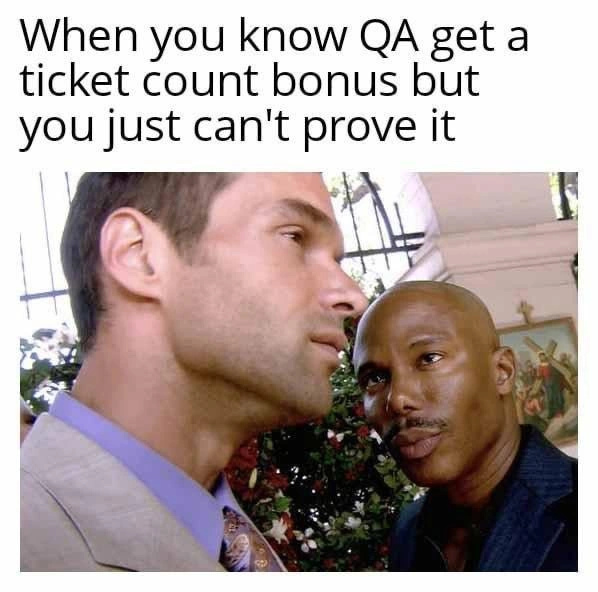
The close-up image supplies the emotional layer. Doakes studies Dexter's face as if waiting for one detail to expose him, while Dexter refuses eye contact. Developers know the same feeling when ticket number twelve arrives for what appears to be the same broken component. The right response is to investigate the common cause and the reporting process. The meme's response is more familiar: quietly construct a conspiracy theory during stand-up.

Level 3: Goodhart Joins Stand-up

The caption says, exactly, When you know QA get a ticket count bonus but you just can't prove it. Below it, James Doakes leans into Dexter Morgan's personal space while Dexter stares away with practiced innocence. In the television dynamic, Doakes's role is the relentless colleague who senses that Dexter's harmless professional surface conceals something darker. Here that suspicion is transplanted into software delivery: the developer sees an unnatural flood of bug reports and begins treating Quality Assurance like a suspect optimizing a secret compensation plan.

The target is a classic measurement failure. Ticket count is easy to query from a bug-tracking system, so management may mistake it for an objective measure of testing productivity. But once a number becomes a target, behavior shifts toward improving the number rather than the outcome it was meant to represent. One underlying defect can become five tickets; minor wording inconsistencies can outrank risky failures; duplicates can remain conveniently undeduplicated; and time spent preventing defects may look less productive than time spent documenting them after the fact. Goodhart's law has entered Jira and, naturally, requested its own dashboard.

Raw issue volume has no stable interpretation because its denominator and context keep changing. A high count could mean:

  • the release genuinely contains more defects;
  • QA explored more platforms, inputs, or workflows;
  • developers shipped a much larger change surface;
  • reporting became easier or more consistent;
  • old issues were split, duplicated, or reclassified;
  • the product is being held to a stricter quality bar.

That ambiguity is why the meme's can't prove it matters. The engineer has a pattern and a motive-shaped story, not causal evidence. To test the suspicion, a team would need to inspect severity distributions, duplicate rates, rejection reasons, defect clusters, time spent on exploratory testing, escaped production incidents, and whether reports lead to fixes. Even those measures can be gamed if tied mechanically to individual rewards. A person paid for “valid severe bugs” will eventually discover that severity is also a field with a dropdown.

The deeper dysfunction is treating quality as a contest between developers who create defects and testers who catch them. That incentive creates adversarial handoffs: developers minimize or reject tickets to protect their numbers, while testers maximize documented findings to protect theirs. Both sides can win their local scoreboard while users lose. Healthier teams reward shared outcomes such as reduced customer impact, faster risk discovery, clear reproducibility, useful automation, and learning that prevents recurrence. They also pair quantitative signals with human review because software quality includes judgment that a ticket count cannot encode.

There is some legitimate tension beneath the cynicism. QA must be independent enough to challenge optimistic developers, and developers should not dismiss inconvenient findings as metric inflation. Conversely, management should not turn a necessary challenge function into piecework. The reaction still is funny because every ambiguous ticket now looks like circumstantial evidence: the suspicious engineer may have identified perverse incentives, or may simply be Dexter-level skilled at avoiding responsibility for a buggy build.

Description

Black text on a white background reads, “When you know QA get a ticket count bonus but you just can’t prove it.” Beneath it is a close reaction still from Dexter: Dexter Morgan, in a light suit and purple shirt, looks away while James Doakes leans in and studies him with open suspicion; flowers, windows, and a framed picture fill the indoor background. The joke imagines an engineer noticing an implausible flood of defect reports and inferring that QA is financially rewarded for ticket volume. Technically, it mocks a Goodhart-style incentive failure in which measuring quality work by raw issue count encourages issue inflation rather than useful risk discovery.

Comments

1
Anonymous ★ Top Pick Goodhart’s law entered Jira and immediately filed itself as five separate bugs.
  1. Anonymous ★ Top Pick

    Goodhart’s law entered Jira and immediately filed itself as five separate bugs.

Use J and K for navigation