Skip to content
DevMeme
880 of 7435
In the beginning, there was 'import time'
Languages Post #995, on Jan 25, 2020 in TG

In the beginning, there was 'import time'

Why is this Languages meme funny?

Level 1: Time to Start

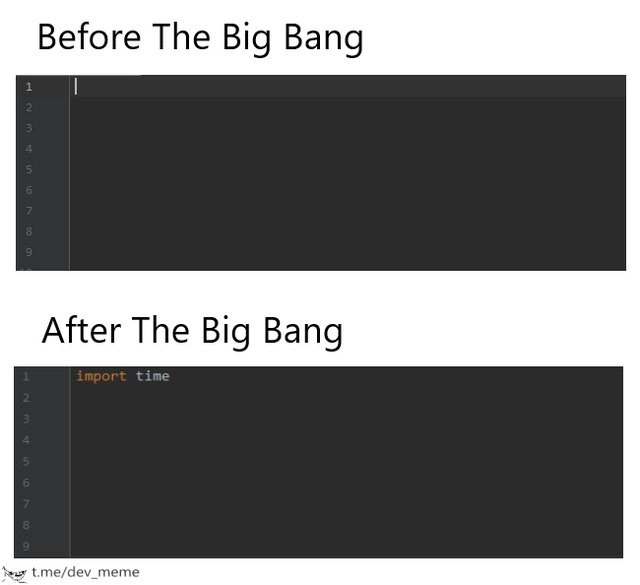
Imagine an empty stage before a play begins – everything is still and no time is passing in the story because the show hasn’t started. Then the director comes on stage and says, “Let the show begin!” and a giant clock on the wall starts ticking. Now the story can unfold. This meme is like that, but for the whole universe! Before the Big Bang, it’s as if nothing at all was happening – kind of like a blank page with no writing. It says “Before The Big Bang” and shows an empty code screen to represent that emptiness. After the Big Bang, it’s like someone finally started the clock. The picture shows the code words import time as the first thing in the once-empty file. In everyday terms, that’s like saying “okay, start the time now!”

So the joke here is imagining that the universe is a giant computer program, and in order for anything to happen, the program had to turn on time by typing in that import time command. Before that, there was no time at all (just like before you start a game, the timer is at zero and nothing is moving). After that, time exists (like hitting the start button on a stopwatch), and everything can begin. It’s funny because it mixes a big science idea (creating the universe) with a simple coding action (adding a line of Python code). Even if you’re not a programmer, you know that nothing can start until time starts ticking. The meme just shows that in a super geeky way: with a pretend piece of code responsible for the creation of time itself. Essentially, it’s saying “In the beginning, the first thing created was time” — and for a playful twist, it’s written exactly like a Python command. It makes us smile because it’s a very nerdy way to imagine the start of everything, using a little bit of computer humor to illustrate the point.

Level 2: Importing Time

Let’s break down the components of the joke in simpler technical terms. The image uses the Python programming language. In Python, an import statement is how you include external modules or libraries in your current script. A module is just a file containing code (functions, classes, variables) that you might want to use. When you see import time in Python code, it means “bring in Python’s built-in time module so I can use functions related to time.” The time module provides things like the current time, sleeping for a few seconds, measuring intervals, etc. For example, after doing import time, you can call time.sleep(5) to pause the program for 5 seconds, or time.time() to get the current timestamp. If you don’t import the module first, and you try to use it, Python will complain that it doesn’t know what time is.

Now, the meme shows two panels:

  • Before The Big Bang: an empty dark-themed code editor. There’s nothing in this file at all (just line numbers 1 through 9 with no code). This represents a state of “no code, no time, nothing exists.” In cosmic terms, it’s like the universe before creation – completely empty, not even time has started.
  • After The Big Bang: the same editor, but now on line 1 it says import time (with syntax highlighting: “import” appears in one color and “time” in another, indicating it’s recognized as Python code). All other lines are still blank. This suggests that as soon as the Big Bang happened, the first thing that “appeared” was this line of code that imports time. In other words, time began to exist.

The joke here is a play on the idea that time did not exist before the Big Bang (a concept from cosmology) and the way a new Python program might start by importing the time module. A greenfield codebase means a brand new project with no existing code. When you create a brand new Python script, initially it’s just an empty file (like the top panel). But you often quickly add import lines at the top as you realize you need certain functionality. The meme humorously implies that even the universe was a fresh project, and the very first dependency it needed was the concept of time itself. It’s saying “the universe’s first line of code was import time.” This is funny to developers because it’s taking a very geek humor approach: treating the Big Bang event like a moment in a programming project.

In simpler terms, think of import as “bring this tool into my project.” Here the tool is “time.” Before you bring in time, your program doesn’t know about clocks or waiting or timestamps. By writing import time, the program now has access to those time-related tools. The meme leans on the double meaning of the word “time” – it’s a module in Python, and it’s also literally the concept of time in the real world. So “Before The Big Bang” (before creation) no time exists (both in code and in reality), and “After The Big Bang” time exists (you’ve imported the time module, so now your Python program has time, and cosmologically the universe has a time dimension). It’s a clever LanguageQuirk reference because Python requires that explicit import. In some other contexts (or languages), certain basic things might be automatically included, but Python keeps even basic utilities like time in modules that you import as needed. That’s why forgetting an import is a classic gotcha for newcomers. If a newbie wrote:

# New Python coder might do this:
print(time.time())  # ERROR! 'time' is not defined because we didn't import it.

They’d get an error since they skipped the import time. It’s a common learning moment in Python – always import your modules. The meme takes that concept to an extreme scenario: “nothing works at all until we import time – on a universal scale.”

In summary, the bottom line for a junior dev or someone new to coding: this meme is showing a Python file that was empty (like an empty project) and then indicating that the first thing added to it was the line import time. It humorously compares that to the creation of the universe, suggesting that in the code that might run our universe, the first thing the programmer of the universe did was make time available. It’s a fun intersection of programming and a big science idea, typical of DeveloperMemes where understanding both the coding part and the science reference makes it funny.

Level 3: Primordial Import

On a more practical developer level, this meme is a prime example of DeveloperHumor blending coding with a cosmic joke. It shows an empty Python file labeled “Before The Big Bang” and then a file with import time as “After The Big Bang.” The humor comes from equating a greenfield codebase (a completely empty project) with the universe before creation – nothing there at all – and then pointing out that the very first thing added is an import of the time module. In Python (a beloved language often featured in TechHumor and language quirks jokes), import time is a common first line when you need to work with anything time-related, like pausing execution or getting the current timestamp. The meme implies that when the universe was created, the first “line of code” in reality’s codebase was to bring time into existence. It’s nerdy and geeky because it assumes the audience knows both about Big Bang cosmology and about how Python imports work. Essentially, it’s saying the universe’s very first import statement was import time. 🤓

This dual reference tickles developers because it operates on shared knowledge:

  • Cosmology context: Before the Big Bang, time itself didn’t exist (an idea from physics that time began with the universe).
  • Coding context: Before you write an import in a new Python file, you have no libraries or modules available – your code universe is empty.

For a seasoned developer, there’s an extra layer of language quirks and inside jokes: Python doesn’t automatically include even fundamental modules like time — you must explicitly import them. We’ve all experienced or heard of the classic gotcha where a novice tries to use a function like time.sleep() or time.time() without the import and gets a NameError because Python had no idea what time was. It’s like trying to schedule an event “before time exists” – it just fails. The meme’s punchline plays off that absurdity: of course you can’t have any delays or timestamps “Before The Big Bang” because you haven’t done import time yet! Only after this import can things like time progression, waiting, or timestamps work in our program (or metaphorically, in our universe).

From an experienced perspective, this also pokes fun at how even the most pristine greenfield project inevitably pulls in dependencies immediately. You start with a blank slate (maybe hoping to keep it lightweight), but the moment you need any functionality, you reach for an import. Time is one of the simplest examples – it’s almost elemental in programming (logging timestamps, measuring performance, scheduling jobs, etc.), just as time is a fundamental dimension of the physical universe. The meme exaggerates this to a cosmic scale: even a universe can’t stay dependency-free; it had to import one module to get started! There’s a shared chuckle in that for developers: no project stays truly standalone for long — the moment you want real-world capability, imports happen (here it literally had to import reality’s most basic dependency). This is existential_programming_humor at its finest, prompting us to imagine a coder behind existence doing import time as the first act of creation. It’s simultaneously a NerdHumor science joke and a commentary on coding habits. And for Pythonistas, there’s even a bit of pride or endearment seeing Python syntax used as the medium for a Big Bang joke, reflecting how ingrained Python is in our thinking that we use it to describe even cosmic events.

Level 4: Temporal Singularity

At the cosmological level, this meme cleverly equates the Big Bang with a program’s first execution step, drawing a parallel between the origin of time in physics and enabling time in code. In theoretical physics, asking “what happened before time began” is meaningless — time itself started at the Big Bang (a kind of temporal singularity). Similarly, in a fresh Python environment, the concept of “time” isn’t available until you explicitly import it. The code import time is like the universe’s t=0 moment: before this line runs, the program has no notion of time passing. This is a playful nod to the idea that even in a simulated universe-as-software scenario, someone had to bootstrap the very notion of time by importing it as a dependency.

From a deep technical perspective, the Python time module ultimately interfaces with the operating system’s clock. Under the hood, it calls C library functions or syscalls that retrieve the current system time (often as seconds since the Unix epoch – January 1, 1970, the zero-time reference for most computers). That Unix epoch is like computing’s own “Big Bang” - an arbitrary starting point from which time is measured. Before the epoch, system time can even be negative or undefined, echoing how cosmology treats “before the Big Bang” as undefined. This highlights a fun parallel: just as physics has the Planck epoch (the earliest moment we can talk about meaningfully), our programs also rely on a defined starting point for time. The meme thus operates on a meta level: it’s not just a silly pun, it hints at the fundamental requirement of an initial time reference in any system. Even the GeekHumor here has a kernel of truth – whether you’re simulating a universe or running a script, you need a clock tick to get things moving. In distributed systems or any timed computation, time provides the ordering of events (causality), much like how the arrow of time in our universe lets cause precede effect. Without an import like this, a Python program is essentially timeless in the same way the pre-Big Bang state is timeless – no ticks, no time.sleep(), no event scheduling. By highlighting the import time as the first line, the meme wittily implies this is the moment the cosmic clock starts. It’s a high-brow blend of astrophysics and programming language mechanics, wrapped in a simple code snippet that senior devs and science nerds find hilarious once they recognize the big_bang_cosmology_reference. The enthusiast in me loves how this joke operates on multiple levels of understanding, from the literal Python behavior to the existential pondering of a universe as a codebase being initialized.

Description

A two-panel meme contrasting the state of existence before and after the Big Bang, depicted through a code editor. The top panel, labeled 'Before The Big Bang', shows a screenshot of a dark-themed code editor with numbered lines (1-9) and a blinking cursor on the first line, but the file is completely empty, symbolizing a void. The bottom panel, labeled 'After The Big Bang', shows the same editor, but now the first line contains the Python code 'import time', with 'import' syntax highlighted in orange. A watermark for 't.me/dev_meme' is present in the lower-left corner. The meme is a clever pun that equates the cosmological Big Bang, the event that created the universe and the dimension of time itself, with the programming command to import the 'time' module. It humorously suggests that the very concept of time came into existence through a single line of code, a literal interpretation that resonates with developers who 'import' libraries to bring functionality into their programs


Comments

7
Anonymous ★ Top Pick This implies the universe is a single-threaded Python script, which would explain why everything seems to be blocked by the GIL of physics
  1. Anonymous ★ Top Pick

    This implies the universe is a single-threaded Python script, which would explain why everything seems to be blocked by the GIL of physics

  2. Anonymous

    Turns out even the universe couldn’t bootstrap until it resolved its first dependency injection: `time`

  3. Anonymous

    After 20 years of explaining to stakeholders that datetime calculations are non-trivial, I've finally discovered the root cause: apparently some junior dev imported time itself into our universe, and they didn't even pin the version

  4. Anonymous

    In the beginning, there was nothing - not even a requirements.txt. Then some architect decided the universe needed temporal awareness, so they imported time, and suddenly causality, deadlines, and sleep() functions came into existence. Ironically, this also marked the exact moment when 'time.sleep(1)' became the most overused debugging technique in production code, proving that even cosmic-scale architectural decisions have unintended consequences

  5. Anonymous

    The only big-bang rewrite that created time instead of destroying uptime - SRE still wants it measured with time.monotonic(), not wall clock

  6. Anonymous

    Every big‑bang rewrite starts at line 1 with import time - and ends with us debating clock skew, sleep() flakiness, and why the schedule expands faster than the universe

  7. Anonymous

    Python codebases confirm cosmic inflation: one 'import time' singularity births a namespace gobbling everything from numpy to the kitchen sink

Use J and K for navigation