The Infinite Loop of Vague Requirements
Why is this ProjectManagement meme funny?
Level 1: Going in Circles
Imagine you want to play a game with your friend. Your friend asks, “How long will it take to finish the game?” but they haven’t told you what game you’re going to play. You say, “Well, what game are we playing?” and your friend replies, “What do you need to know about the game to tell me how long it’ll take?” Now you’re both just confused, right? You’re basically going in circles.
This meme is like that. The boss is asking a programmer, “When will it be done?” but hasn’t said what “it” is. The programmer asks, “What do you want it to do?” and the boss says, “Tell me what you need to know.” It’s a funny loop where nobody is giving a real answer. It feels like a dog chasing its tail (or in the picture, a snake biting its tail). In simple terms: you can’t say how long something takes if you don’t know what that something is. The joke is that both people keep asking each other questions instead of one of them just saying what they actually want. So nothing moves forward, and it just keeps repeating – a silly and frustrating circle.
Level 2: Undefined Requirements Paradox
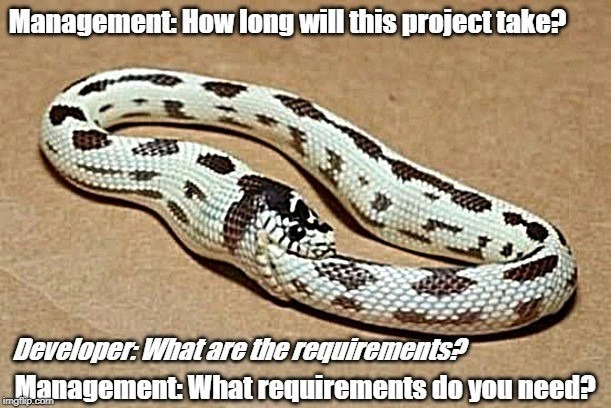
Let’s break down why this snake image and text are funny (and frustrating) to developers. The conversation in the meme goes:
- Manager asks: “How long will this project take?” – They want a project timeline or an estimate for completion.
- Developer responds: “What are the requirements?” – The developer is asking for a list of requirements (the specific features or needs for the project) because they can’t estimate time without knowing what needs to be done.
- Manager replies: “What requirements do you need?” – Now the manager is asking the developer to spell out what information is needed. Essentially, the manager is bouncing the question back, expecting the developer to define the project’s scope before the scope has been given to them!
This creates a circular conversation: each question leads back to the other, like a loop that never ends. It’s a communication breakdown in project planning. The meme uses the snake biting its own tail (an ancient symbol called the Ouroboros) to represent this never-ending loop visually. It’s as if the project plan is eating itself because it has no clear starting point or end point.
Why is this a problem? In software development (and any project, really), you usually figure out what to build (requirements) before figuring out how long it takes to build it (timeline). Requirements are things like “the app needs a login page and user profile” or “the system must handle 1000 users at once.” These give developers an idea of the workload. A timeline or deadline is only realistic if it’s based on known tasks.
When the manager in the meme asks for a timeline with no requirements given, the developer is understandably stuck. It’s like being asked to quote a price without knowing what the customer is buying. The developer’s question “What are the requirements?” is a polite way of saying, “I can’t answer that until you tell me exactly what this project involves.” That’s highlighting a requirements ambiguity – the details are undefined or unclear.
The manager’s comeback, “What requirements do you need?” shows they might not understand the process. Maybe the manager expects the developer to list out what should be specified. It’s a bit absurd because usually gathering requirements is a collaborative effort with input from stakeholders or clients, not something the programmer just makes up. This reflects MisalignedExpectations between roles: management might think the engineers should define the tasks if they want details, whereas engineers expect management or a client to provide the project goals. Each side thinks the other should provide the missing piece.
This scenario is a known project management anti-pattern (meaning a common but bad practice). It often happens when there’s pressure from stakeholders/clients to get a deadline or cost quickly. The manager, feeling the DeadlinePressure, asks the dev team for an estimate. But if the requirements gathering phase hasn’t happened, the dev can only shrug. Saying “two months” or “six months” out of thin air is risky – if you guess wrong, it could lead to major problems later (like delays or unhappy clients).
To a junior developer or someone new to the field, here are some key terms in play:
- Requirements: These are the things the software or project is supposed to do. Think of them as the instructions or features needed. They can be formal documents, user stories, or even just a list of needs from the client. Without clear requirements, developers don’t know what to build.
- Timeline/Deadline: How long you have to complete the project, or by when it must be done. Timelines depend on how much work needs to be done – more features or complex requirements usually mean a longer timeline.
- Stakeholders: People who have an interest in the project, like clients, managers, or end-users. Stakeholders often want to know the timeline because they have plans or promises riding on that date.
- Communication breakdown: A failure to communicate effectively. In this meme, the manager and developer are talking, but they aren’t understanding each other or following a proper sequence (first define, then plan). They’re effectively talking in circles.
The meme resonates with developers because it caricatures a real struggle: being asked to commit to a deadline without any blueprint. It’s a bit like if someone asked, “Build me something awesome, you have two weeks. How far will you get?” and you reply, “Sure... what am I building?” If they then say, “Tell me what you need to know to build something awesome,” you’d probably be frustrated. That’s exactly the frustration shown here.
The Ouroboros snake imagery adds a humorous flair – it’s a visual way to say “this conversation is going nowhere, just feeding on itself.” In programming terms, it’s like an infinite loop (while(true) { /* still waiting for requirements */ }) or a function that calls itself forever. Developers find it funny because it’s a bit of gallows humor: we laugh so we don’t cry about how often communication and RequirementsGathering go wrong in real projects.
Level 3: Ouroboros of Planning
This meme nails a classic project management nightmare: the circular dependency between undefined scope and demanded timelines. The image of an Ouroboros (a snake eating its own tail) is a perfect symbol of an infinite loop in planning. Here’s how the self-devouring cycle plays out in real life:
- Management: “We need a delivery date. How long will this project take?”
- Developer: “Okay... but what exactly do you want built? What are the requirements?”
- Management: “Just tell me what requirements you need in order to give a timeline.”
- Developer: (internally screaming in Agile) 😱
This tongue-in-cheek exchange highlights a requirements ambiguity problem that senior engineers know all too well. It’s a project planning paradox: management expects an accurate timeline, but won’t (or can’t) provide the requirements needed to calculate it. It’s like a recursive function with no base case – the conversation calls itself indefinitely. In the Software Development Life Cycle (SDLC), this is completely backwards; you normally define scope and requirements first, then estimate effort. But here the process is eating itself like that snake, forming a circular estimation deadlock.
From a seasoned developer’s perspective, this scenario is painfully familiar. It satirizes ManagementVsEngineering misalignment and the CommunicationBreakdown that ensues. The manager’s question “How long will it take?!” seems innocent to them (they have deadlines to commit to, budgets to plan), but it sends shivers down the engineer’s spine. Why? Because without clear specs, any answer is just a wild guess. And guess who gets blamed when that ProjectDeadline slips? The developer, of course. Classic.
This Ouroboros-like loop often starts with StakeholderPressure from above. Perhaps a client or VP demanded a date, so management, under DeadlinePressure, turns to engineering and hopes for a quick estimate. But the engineers are left thinking, “Build what, exactly?” There’s a huge MisalignedExpectations gap: management assumes the devs can magically derive scope from a high-level idea (or thin air), while devs expect management to define the project goals. It’s a standoff.
In many war stories from the code trenches, this ends badly. The team might cave and provide a SWAG estimate (Scientific Wild-Ass Guess) just to break the stalemate. Later, once actual features are defined (oh, we needed it to support internationalization and real-time updates?), that timeline becomes laughably unrealistic. Cue the inevitable scope creep, weekend panic commits, and a project crunch that feels as vicious as a snake bite. The Ouroboros eats its tail – the project starts consuming itself, with developers scrambling to adjust either the features or the deadline in a doomed attempt to meet MisalignedExpectations.
This meme’s dark humor lies in that recursive blame-loop: management effectively says “We want a date but won’t give you details,” then when dev asks for details, “Well, tell us what details you need,” pushing the onus back on dev. It’s management judo – flipping the requirements gathering responsibility onto engineering. A cynical veteran dev has seen this maneuver a hundred times. It often stems from laziness or ignorance: someone skipped the hard work of RequirementsGathering, and now the team is stuck in a paradox. It’s the undefined requirements paradox given meme form.
There’s also a whiff of Agile misinterpretation here. Some managers think Agile means “we don’t need detailed specs, we’ll just iterate”. In practice, Agile still needs a backlog of user stories (i.e., requirements in bite-size form). It’s not an excuse for no requirements pure chaos. When done right, developers and product managers collaborate to clarify at least what the next sprint entails. When done wrong, you get this meme: a sprint to nowhere, sprint planning meetings that go in circles, and a recursive Gantt chart (imagine a project timeline that loops back on itself!).
In short, the humor bites because it’s true: you can’t estimate what hasn’t been defined. But try telling that to upper management who only care about dates. 😅 The RequirementsVsReality is that an estimate without requirements is a pure fantasy. Every seasoned engineer has been pressured to produce a timeline for a feature set that’s basically a foggy idea. This meme is the battle-hardened chuckle of recognition, a nod to every Gantt chart built on wishes and every late-night email that began with, “We might need to adjust the timeline…”.
Description
A meme featuring a photograph of a light-colored snake with dark brown or black splotches, contorted into a circle and biting its own tail. This image, known as an Ouroboros, symbolizes a self-referential, cyclical process. Overlaying the image is a three-line dialogue presented in white text with a black outline. The first line reads, 'Management: How long will this project take?'. The second line, positioned lower, says, 'Developer: What are the requirements?'. The final line, at the very bottom, completes the loop: 'Management: What requirements do you need?'. The meme visually and textually represents a common and frustrating communication breakdown in software development. It highlights a scenario where management requests a time estimate without providing a defined scope, and then demonstrates their lack of understanding by asking the developer to define the very requirements they need to create the estimate. This creates a circular dependency and a conversational dead-end, perfectly captured by the snake consuming itself
Comments
7Comment deleted
Ah, the classic 'you tell me what you want me to tell you you want' planning phase. The estimate is somewhere between two weeks and the heat death of the universe, pending requirements
The Gantt chart for this project has officially become a Möbius strip - every dependency leads back to the missing PRD
After 20 years in tech, I've learned that 'How long will it take?' is management-speak for 'I need a number for the PowerPoint deck I'm presenting in 30 minutes,' while 'What requirements do you need?' actually means 'Can't you just read the CEO's mind like we pretend to do in leadership meetings?'
Ah yes, the classic O(∞) complexity problem: estimating project timelines in a requirements vacuum. Management asks for delivery dates before defining scope - it's like asking a compiler to optimize code that hasn't been written yet. The snake eating its tail is the perfect metaphor: you can't estimate without requirements, but apparently you can't gather requirements without first providing an estimate. This circular dependency has caused more project failures than any technical debt ever could. Pro tip: next time management asks 'how long?', respond with 'depends on the halting problem - I'll let you know when I prove it's decidable.'
We ran a Monte Carlo on zero requirements - P50 is “after discovery,” P95 is “heat death of the universe.”
Project management's CAP theorem: can't have Clear requirements, Accurate estimates, and Prompt delivery - pick any two, or enjoy the eternal loop
Estimating without requirements is the ouroboros of delivery: t = f(r), r = g(t) - recursion with no base case, only postmortems