The surprising offspring of boolean arithmetic
Why is this Languages meme funny?
Level 1: Yes + Yes = 2?
Imagine you ask a friend a yes-or-no question twice and they answer “yes” both times. Now you jokingly say, “Okay, yes plus yes equals… 2!” That sounds pretty silly, right? We don’t normally add “yes” and “yes” like numbers, so getting 2 as an answer is just nonsense. This meme is funny for the same reason. It’s showing something that shouldn’t logically happen: combining two “true” ideas and ending up with a number. It even uses a goofy picture – like a penguin and an elephant merged into one bizarre animal – to represent that nonsense result. You can’t help but go, “Huh?! That’s not supposed to happen!” and that surprise is what makes it laughable. Even if you don’t know anything about coding, the idea of two yeses magically making the number two is absurd enough to make anyone chuckle. It’s basically saying that if you mix things in the wrong way, you get a crazy outcome – and we find it funny because it’s so completely out of the ordinary.
Level 2: true + true = 2?
Let’s break down what’s happening. In programming, every value has a type – like number, text (string), or boolean (which is a true/false value). JavaScript is a language that is dynamically typed and often weakly-typed, meaning it can convert types automatically when needed. The expression true + true is adding two boolean values. In many other languages, adding booleans doesn’t make sense – you’d get an error or you’d have to convert them to numbers first. But JavaScript will happily try to make the operation work by coercing the booleans into another type behind the scenes.
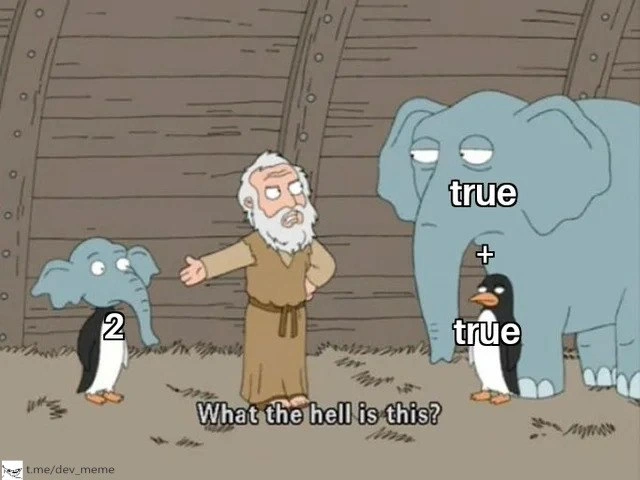
Here’s the rule: when you use the + operator on non-text values in JavaScript, it converts them into numbers. Boolean true becomes the number 1, and false becomes 0. So true + true effectively turns into 1 + 1 once JavaScript does its secret conversion. And of course, 1 + 1 = 2. The program ends up with the numeric result 2 (which in JavaScript is of type Number, not a boolean anymore). This automatic changing of types is called type coercion. It’s a feature (and sometimes a gotcha) of JavaScript’s design. The meme illustrates this by literally combining two animals (an elephant labeled “true” and a penguin labeled “+ true”) into one odd creature labeled “2”. Noah expected two normal animals of the same kind, but got a single bizarre hybrid – just like a coder might expect true + true to result in a boolean value and instead gets 2.
If we run the actual code, it looks like this:
console.log(true + true); // 2
console.log(typeof (true + true)); // "number"
The first line prints out 2. The second line uses typeof to confirm the type of the result is "number". So we started with booleans and ended up with a number. Type coercion is essentially JavaScript saying, “I’ll convert these to a common type for you.” This can be convenient in simple cases, but it also means the language won’t always warn you when you mix things in odd ways. A strongly-typed language with strict type safety would refuse to combine incompatible types without an explicit conversion. “Type safety” is like a strict zookeeper that says, “Hey, you can’t put a penguin and an elephant together – they’re different kinds!” In JavaScript, however, the zookeeper is more relaxed and says, “Eh, I’ll just call it something and move on,” resulting in that funny 2.
This is one of those JavaScript gotchas that beginners often stumble upon. It shows how JavaScript sometimes does surprising things to be helpful. The meme is basically pointing at this quirk and laughing. Once you learn the rule, it makes sense: true acts like 1 when you do math with it. But until you know that, seeing true + true yield 2 feels as weird as seeing a penguin with an elephant’s head. The key lesson is to be mindful of types. JavaScript will try to automatically convert values (that’s why we call it weakly-typed), which is powerful but can lead to unexpected results if you aren’t aware. Fortunately, experienced devs know these corner cases, and there are tools (like linters or TypeScript) to catch or prevent such odd combos. Now you know why Noah in the cartoon is so shocked – he just witnessed JavaScript’s booleans doing math, which is a pretty wild sight if you’re not expecting it!
Level 3: Two Truths and a 2
Noah: “What the hell is this?!”
That punchline is every seasoned JavaScript developer’s reaction when they first witness true + true evaluating to 2. This meme nails the absurdity by visualizing an implicit type coercion as a mutant animal on Noah’s Ark. On the right, we have two normal creatures labeled true (a hefty elephant) and + true (a penguin) representing the operands. On the left, instead of two separate animals boarding the ark, they’ve inexplicably merged into one freakish penguin-elephant chimera emblazoned with the number 2 – the outcome of the addition. The whole scene feels like a Family Guy cutaway gag, with Noah’s stunned reaction embodying the coder’s own disbelief. Noah’s disgust (“What the hell is this?”) mirrors the developer’s feeling upon encountering such a LanguageQuirk. It lampoons how weak typing in the JavaScript ecosystem can yield results that feel patently unnatural – almost like a coding bug turned into a sight gag.
Type coercion is the culprit here. In JavaScript, booleans aren’t sacred truth values in arithmetic contexts – they automatically turn into numeric equivalents (true -> 1, false -> 0) when needed. So what looks like Boolean math (true + true) is actually just 1 + 1 in disguise. The result is the number 2, a completely different species (data type) than the boolean values we started with. The humor lands because we expect adding two things of the same kind to stay in that domain (for example, 1 + 1 is 2, and true AND true is true). But JavaScript’s + operator breaks this expectation, spitting out a number when you add two truthy values. It’s a classic LanguageGotcha that has caused plenty of head-scratching in real life. Many a bug hunt has ended with a facepalm: “Why is this value 2 instead of true?!”
This inside joke speaks to larger LanguageWars about strong vs. weak typing. Veterans from strongly-typed backgrounds (Java, C#, etc.) love to poke fun at JavaScript with examples like this. In a language like Java, true + true wouldn’t even compile – the compiler would throw an error about incompatible types. But JavaScript cheerfully goes “eh, close enough” and produces a result anyway. That permissiveness can be a double-edged sword: convenient at times, but dangerous if you aren’t aware of the rules. Seasoned JS devs have been bitten by forgetting the difference between == and === or by subtle coercions turning strings into numbers and vice versa. The true + true = 2 oddity often comes up alongside other infamous gems:
console.log("5" - 3); // 2 (string "5" becomes number 5)
console.log("5" + 3); // "53" (number 3 becomes string "3", so it concatenates)
console.log([] + {}); // "[object Object]" (array and object both to strings)
console.log([] == 0); // true (empty array coerces to 0 in comparison)
Those are real JavaScript outcomes, not typos! There’s even a famous lightning talk called “WAT” that showcases these examples to comic effect. So when experienced devs see Noah baffled by a mismatched pair of animals, they immediately connect it to the chaos of weak typing. The ark signifies an ideal of order (each type in its place, two by two), and JavaScript’s coercion is the troublemaker sneaking in a mismatched stowaway. It’s the kind of thing that makes you laugh and cringe because it’s so relatable if you’ve ever debugged these issues at 3 AM.
The meme also carries a whiff of exasperation: “Seriously, what is this abomination doing in my code?!” It’s a gentle roast of JavaScript's design. Yet, as much as we roll our eyes at it, we also remember times we’ve leveraged it (for instance, using +true to get 1 intentionally or relying on truthy/falsy shortcuts). The humor works because it’s a shared experience – the JavaScript community collectively groans about these wacky behaviors, and tools like TypeScript or strict linters have emerged to keep such beasts off our boat. But deep down, even if we’ve moved on to safer practices, we can’t help but chuckle at the sheer ridiculousness of true + true giving 2. Noah’s outrage says it all: some things just don’t belong on a well-architected Ark, and to many devs, implicitly turning two booleans into a number is one of those things.
Level 4: Chimeric Coercion
In this meme, Noah’s Ark becomes an allegory for a programming type system deep dive. The cartoon depicts a bizarre chimera – an elephant’s head on a penguin’s body labeled 2 – representing the result of JavaScript’s expression true + true. This hybrid creature wouldn’t exist in a type-safe world, and that’s the point: JavaScript’s loose type coercion rules allow booleans (True/False values) to be automatically converted into numbers, producing an out-of-place offspring. In classical boolean algebra (the formal logic system for True/False), there is no concept of “adding” truth values – True ∨ True (logical OR) is True, and True ∧ True (logical AND) is True. But JavaScript treats the + operator as numeric addition here, silently casting true to 1 and summing to 2. The meme exaggerates this as an abomination on the “type-safety ark,” highlighting how such implicit conversions violate the usual type invariants that strong type systems enforce.
Under the hood, JavaScript’s engine follows well-defined coercion rules from the ECMAScript specification: when using the + operator, if neither operand is a string, both values are converted to numeric primitives. Thus true becomes 1 (and false becomes 0) before addition. The result 2 emerges as a legitimate Number type – semantically odd, but perfectly legal in a weakly-typed language. Strongly-typed languages (like Java or Haskell) prohibit combining disparate types without explicit conversion: adding booleans is either a compile-time error or requires an explicit cast (e.g. converting True to 1 manually). In type theory terms, JavaScript opts for implicit type polymorphism, sacrificing strict type safety for convenience. This design traces back to early web scripting philosophy: to avoid breaking pages, the language tries to accommodate operations rather than throw errors, even if it means forging a “penguin-elephant” hybrid of a result.
The “type-safety ark” narrative humorously frames type correctness as a biblical-scale mandate – only pure pairs of the same “species” (data types) are allowed aboard. By smuggling a Boolean-and-Number crossbreed (the value 2 produced from two true values) onto the ark, JavaScript violates this prime directive. It’s a playful jab at how unsound JavaScript’s type system can appear. In a formally sound system, an expression’s result type is predictable and consistent with its operands (two booleans would yield a boolean or a type error, but never a brand-new type). JavaScript flouts that expectation by blurring type boundaries. This fundamental difference – whether a language prevents or permits chimeric values – fuels endless discussion in language design and the perennial LanguageWars between static and dynamic typing advocates.
Interestingly, this quirk isn’t unique to JavaScript: many early languages allowed similar conversions (C historically treated 1 as true and any non-zero as truthy, and even Python lets True + True produce 2 since booleans subclass integers). The difference is context and intent – JavaScript’s pervasive coercion leads to a menagerie of oddball behaviors (famous examples like [] + [] yielding "", or "5" - 3 giving 2 while "5" + 3 gives "53"). Each of these is a “creature” born from mixing types. When codebases grow, such implicit behaviors can become bugs lurking in the dark. The emergence of TypeScript (a statically typed layer on top of JS) is a modern effort to restore order on this ark by enforcing explicit type agreements. But in pure JavaScript, the motto often feels like “if it can be coerced, it will be.” This meme’s absurd animal mashup perfectly captures that sentiment: a what-on-earth specimen that by all accounts shouldn’t exist, yet does, thanks to the permissive nature of weak typing.
Description
A meme taken from a "Family Guy" scene depicting Noah's Ark. Noah, an elderly man with a white beard and tan robes, looks bewildered and asks, "What the hell is this?". He is gesturing towards a bizarre creature: a small penguin with the head of a blue elephant. This creature is labeled with the number "2". To the right, standing behind the creature, are its "parents": a large, unimpressed-looking blue elephant labeled "true" and a small penguin also labeled "true", with a plus sign between them. The setting is the wooden interior of the ark. A watermark for "t.me/dev_meme" is visible in the bottom-left corner. This meme humorously illustrates the concept of type coercion in weakly or dynamically-typed programming languages like JavaScript and Python. In these languages, boolean values can be implicitly converted to numbers when used in an arithmetic operation. The boolean `true` is treated as the integer `1`. Therefore, the expression `true + true` evaluates to `2`. The strange hybrid creature represents this counter-intuitive but technically correct result, which often surprises developers accustomed to stricter type systems
Comments
7Comment deleted
A statically typed language developer sees this and asks 'What the hell is this?', while a JavaScript developer just calls it another Tuesday and checks if `[] + {}` is still a thing
In the grand design review of creation, JavaScript snuck in a feature flag where booleans autoconvert to integers - now Noah needs a linter before he boards any more animals
After 20 years of explaining to junior devs why JavaScript's type coercion is actually predictable and well-documented, you realize the real bug was defending it in the first place
This perfectly captures the moment a senior engineer realizes their junior just shipped code relying on JavaScript's type coercion where `true + true === 2` because booleans silently convert to numbers. It's the exact face you make during code review when you see production logic depending on `+` instead of `||` or `&&`, and you know the next bug ticket will be 'intermittent calculation errors' that take three days to trace back to this implicit cast. TypeScript evangelists keep this meme in their back pocket for a reason
Explains why my feature flag eval'd true in staging only
JavaScript and Python happily make 2 out of “true + true”; the senior move is stopping the Ark from breeding integers with types and linting before Finance starts counting them
Two truths make 2 in JS and Python - great for SUM() in analytics, catastrophic when your feature-flag math ships to prod