The Elusive Ideal Senior Developer
Why is this Juniors meme funny?
Level 1: Helpful Big Brother
Imagine you’re at home and you see an older brother and a little brother. The little brother keeps tugging on the older brother’s shirt asking, “Can you help me with this puzzle?” The older brother is busy playing a video game and usually just nods or says, “In a minute,” but that minute turns into an hour. The little brother sits there, puzzle pieces in hand, feeling a bit ignored and unsure what to do. Now picture the older brother looking in the mirror and imagining himself as a superhero who immediately pauses his game to help with the puzzle whenever his little brother asks. It’s a funny image, right? The idea that he has to visualize being this ultra-helpful version of himself – when really, he could just choose to help right now. It’s kind of sweet and silly at the same time. The joke is that helping someone younger or newer (whether it’s a sibling or a new kid at school) shouldn’t be such a big heroic dream – it should be normal. But sometimes people get so caught up in their own stuff that they forget to be helpful. So the meme is like a little story saying: Wouldn’t it be great if the “big kids” always remembered to help the “little kids” right away? That way, no one has to sit around waiting and feeling lost. It makes us smile because we all know big brothers or older friends who mean well but get busy, and we kind of hope they’ll see themselves in the mirror and decide to be a bit more responsive, just like the guy in the picture dreaming of being more helpful.
Level 2: Intern Ping Timeout
If you’re a junior developer or an intern just starting out, this meme probably feels both funny and painfully relatable. Let’s break down exactly what’s going on and some of the terms and situations involved:
- Intern – In a tech company, this usually means someone who is new or in a temporary learning role (often a student or recent grad). Interns are at the very beginning of their developer journey. They have a lot of questions as they learn the ropes.
- Senior Dev (Senior Developer) – This is someone with several years of experience who is expected to know the systems well and guide others. They often mentor juniors and make bigger project decisions. In theory, seniors should help interns by answering questions and reviewing their code.
- Slack – Slack is a popular workplace chat app (kind of like a Discord or WhatsApp specifically for offices). Team members send each other messages, ask for help, share links, etc. When the meme talks about responding to interns “on time,” it’s often implicitly about replying on Slack or email or whatever communication tool the team uses. If an intern “pings” a senior on Slack, it means they sent them a message or mention hoping for a quick answer.
- Code Review – When you write code as an intern or junior dev, a senior dev usually looks over it before it’s merged (added to the main codebase). They leave comments, suggest improvements, and catch mistakes. Timely code reviews are important: if the review comes late, the intern might be stuck waiting, unable to move forward with their task.
- Sprint – Many software teams use the Agile methodology, working in sprints. A sprint is a short cycle (often 2 weeks) where a set of tasks or features is completed. If the meme says “before the sprint ends,” it implies there’s a ticking clock. For example, if an intern asks a question at the start of a 2-week sprint, getting an answer before the end of that sprint (before those 2 weeks are up) is crucial for them to finish their work on time. A response that comes after the sprint ends is basically too late – the deadline has passed.
- Communication Gap – This phrase refers to a breakdown or delay in communication. In this context, it’s the gap between when the intern reaches out for help and when (or if) the senior dev replies. A big gap (like several days of silence) is problematic. The intern might feel stuck or even start doubting if they asked something wrong. Unfortunately, a communication gap between juniors and seniors is common when seniors are very busy.
- Mentorship – In a workplace, mentorship is when an experienced person (the mentor) guides and helps a less experienced person (the mentee). A senior developer acting as a mentor to an intern would mean they answer questions, provide advice, and help the intern learn. Part of good mentorship is being available and responsive. If a mentor takes days to reply to every question, the mentee might feel ignored or undervalued.
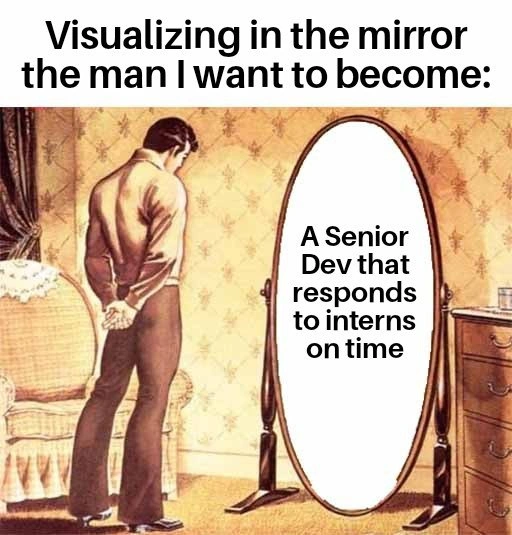
Now, what exactly is the meme scenario? We have an image of a man looking in a mirror, imagining his ideal self. The text in the image says that his ideal is “A Senior Dev that responds to interns on time.” This is a bit of tongue-in-cheek humor. No one’s literally aspiring to only that goal; it’s making a point. It’s saying that sometimes senior devs struggle to do something as straightforward as replying promptly to an intern’s question. It’s funny because it exaggerates reality: normally, you’d expect a senior team member to help juniors without much delay – that’s part of teamwork, right? But in many real situations, interns end up waiting hours, days, or even longer for feedback or answers. For a junior dev, those waits can be agonizing. You might post a question in the team chat in the morning, and by afternoon there’s still no reply. You see the senior active in other channels or checking in code, and you wonder, did they see my message? You might send a polite follow-up or ping them again (maybe with an @mention to get their attention). If you’ve ever watched a message you sent just sit there with no response, that experience is exactly what this meme is built on.
The mention of “before the sprint ends” is essentially saying: “I wish I could be the kind of developer who actually gets back to the intern before our 2-week deadline is up.” For an intern or anyone new, waiting a whole sprint for help is extremely frustrating. Picture this: you’re an intern tasked with building a small feature. On day 2 you hit a snag and ask a senior engineer for clarification on some API or for a code review. They don’t respond that day, so the next day you’re not sure if you should proceed or keep waiting. You don’t want to be too pushy (after all, you’re new and don’t want to annoy the experienced folks). Day 3 passes… day 4… Perhaps you send a gentle reminder, “Hey, just checking if you saw my question above.” Still nothing. By day 10 (end of sprint), they finally reply with “Oh sorry, here’s the answer…” This is technically “before the sprint ends,” but by then a lot of time was wasted. You likely had to scramble to finish your task or moved on without their input. That scenario, while exaggerated here for humor, definitely happens in real life. The intern might have felt like they were talking into a void for days. The senior probably feels a bit guilty once they realize, “Oops, I left them hanging that whole time.”
For a junior developer, learning to navigate this situation is part of the growth process. You might learn to ask questions in a different way, or maybe involve your manager or another teammate if one person is unresponsive. Some interns even develop a strategy of asking in a public channel so that any available senior can answer, rather than DMing one specific person. But the underlying issue is clear: timely responses really matter when you’re new and blocked on something. Experienced developers often forget what it’s like to be that stuck newbie – something that might take a senior 30 seconds to clarify could save the junior hours of confusion.
The meme is basically a humorous reminder to seniors: “Hey, remember that one of your professional growth goals should be to communicate better with the newbies.” It frames it in a lighthearted way – as if replying to interns is some aspirational New Year’s resolution – but it does reflect a real sentiment. Being responsive and helpful to junior devs is a trait of a truly great senior developer (not just one who’s good at coding). The professional_growth_goals tag hints at that; it’s saying that improving mentor response time is actually a form of professional self-improvement for a senior. If you’re a junior reading this, the meme might make you chuckle, thinking “Yes! I wish my mentor would see this.” And if you’re a senior reading it, you might laugh and think “Guilty as charged, I should probably answer my DMs faster.”
In simpler terms: the meme uses a funny old-timey picture to call out a common workplace dynamic – interns needing timely help, and seniors often dragging their feet. By showing the senior literally dreaming of being better at this, it pokes fun at how bad we can be while also subtly encouraging everyone to communicate a bit more. After all, in a healthy developer community, even the highest experts take a moment to help out the newcomers. And when that happens, everyone benefits: the intern learns and feels valued, and the team avoids delays and grows stronger together. It’s a win-win, which is why it’s ironically amusing that we treat it like some far-off ideal. The meme is essentially a small nudge packaged as a joke: “Don’t let your intern’s question become a ghost story – be the mentor you wish you had!”
Level 3: Mentor in the Mirror
At first glance, this meme juxtaposes a Victorian-era gentleman gazing into a mirror with a very modern developer aspiration. The top text sets a dramatic tone: “Visualizing in the mirror the man I want to become:” – as if the person is embarking on serious self-improvement. But then the “reflection” reveals the almost laughably mundane goal: “A Senior Dev that responds to interns on time.” This contrast is the core of the humor: it elevates a relatively basic act of workplace courtesy (timely replies) to the status of a heroic personal quest. In developer culture, where we often joke about our own bad habits, this hits close to home. It’s funny because it’s so true – many senior engineers recognize they’ve been that silent, non-responsive mentor at some point. By treating answering interns promptly like a lofty ambition, the meme wryly acknowledges the communication gap that often exists between senior vs. junior developers. It’s poking fun at how something that should be normal (helping out the new folks) has become rare enough to fantasize about. The vintage image style only amplifies the satire: here’s a formally dressed 19th-century man pondering profound life changes – except he’s essentially vowing, “I will start replying to Slack messages from interns before the sprint is over.” It’s an absurd elevation of an everyday DeveloperHumor scenario, which makes experienced devs smirk knowingly.
On a more serious note, the meme highlights a real collaboration challenge in many tech teams: senior developers get busy with pressing tasks (bugs in production, endless meetings, looming release deadlines) and junior team members’ questions often fall to the bottom of the priority list. The text “before the sprint ends” is especially telling. In Agile software development, a sprint is a short, time-boxed period (usually 1-2 weeks) where specific work is planned and completed. An intern might ask for feedback or a code review at the start of the sprint, and if the senior only responds “before the sprint ends,” it implies the poor intern has been waiting perhaps days for a simple answer. This is not just a hypothetical joke – it’s a painfully common scenario. Many of us have sat in daily stand-up meetings hearing a junior report, “I’m still waiting on feedback from [Senior Dev] to continue,” day after day. The intern’s progress stalls, and their task might even roll over into the next sprint, all because their mentor or reviewer didn’t reply in a timely manner. The meme captures that all-too-familiar tension with a chuckle: the ideal senior engineer would never let that happen. But in reality?
Intern (Monday 10:00 AM): Hi! I have a question about the code review guidelines…
Senior Dev (Friday 4:45 PM): Hey, sorry just seeing this now. Do you still need help?
This little imagined Slack exchange (unfortunately) speaks volumes. The senior wasn’t intentionally ignoring the intern – they were likely swamped or assumed someone else would chime in. By the time they respond, the sprint is almost over. Maybe the intern improvised a solution or sat idle; either way, it’s not great for team productivity or the intern’s morale. Experienced developers reading this meme can feel the awkwardness and guilt in that scenario. Many can recall being on one side or the other: either the newbie nervously pinging again and again with no reply, or the senior who opens the intern’s message in a rush, marks it as unread, and then utterly forgets until days later. The phrase “responds to interns on time” becomes both a punchline and a mirror reflecting our industry’s mentorship failings.
Why is this so prevalent? Part of the issue is systemic. Senior developer responsibilities often emphasize coding, architecture, code reviews, and putting out fires, while mentorship and communication are treated as soft, secondary duties. A senior dev’s performance reviews might focus on shipped features and system uptime, not on how many Slack questions they answered. So the incentive to prioritize intern communication isn’t always there. Additionally, there’s a bit of learned behavior in tech: many seniors were once juniors who struggled in silence because their questions went unanswered. That hazing-by-neglect can unintentionally propagate – not out of malice, but because it’s the only culture they know. Over time, this becomes a vicious cycle: “I had to figure it out on my own when I started, so now it’s your turn.” The meme slyly encourages breaking that cycle. By visually literally reflecting on the kind of person he wants to be, the senior developer in the image is shown engaging in professional growth introspection. It’s like he’s doing a code review on his own behavior. The humor works because we recognize the absurdity (needing a dramatic self-pep-talk to do something as simple as replying to an intern) and simultaneously the truth (it really does sometimes feel like developing a superpower to juggle all your tasks and mentor newbies effectively).
The choice of a mirror visualization is also a clever nod. In popular culture (and plenty of memes), looking into a mirror to see one’s aspirational self is a trope used for comedic effect. Here it implies self-awareness: the senior dev knows he’s not doing great at mentoring right now and literally envisions a better version of himself. This adds a layer of wholesome self-deprecation to the joke. It’s not just mocking lazy seniors; it’s also suggesting, “I want to improve.” In the developer community, this resonates because many senior engineers do genuinely want to be good mentors – they just struggle to find the time or habit. Seeing it framed as a New Year’s resolution-style goal earns a laugh but might also sting a little (“Ouch, I really should reply to John’s question from yesterday…”). The meme’s gentle call-out aligns with the idea that mentorship is an integral part of software team success. The tags like intern_communication and mentor_response_time highlight exactly that: quick, thoughtful responses to junior team members’ queries are a small act that yields big benefits in learning and team cohesion. The developer humor here is that we treat ourselves like heroes-in-training for trying to do this basic thing – but embedded in that humor is a cultural nudge. It’s as if the meme is whispering to every seasoned dev who scrolls past it, “Wouldn’t it be nice if this weren’t just a dream? You can be this person – just hit reply!” And the next time those devs see a little (1) notification from an intern in Slack or a pending code review from a junior on GitHub, maybe they’ll remember this mirror-man comic and aspire to live up to their mentorship responsibilities a bit more. After all, developer community thrives when knowledge flows freely and no one is left talking to an empty void. In short, the meme finds a sweet spot between sarcasm and sincerity: it makes us laugh about our own shortcomings, while subtly encouraging us to become the helpful Senior Developer we all wish we had when we were juniors.
Description
This meme uses the 'Man Looking in Mirror' format. A man in vintage-style clothing is shown from the back, looking into a large, freestanding oval mirror. The room has patterned wallpaper, giving it an old-fashioned feel. The top of the image has the caption: 'Visualizing in the mirror the man I want to become:'. Instead of a reflection, the mirror's surface is white with the text: 'A Senior Dev that responds to interns on time'. The humor lies in the juxtaposition of a profound, aspirational act (visualizing one's ideal self) with a seemingly simple, yet notoriously difficult, professional habit. For senior developers, who are often juggling complex tasks, code reviews, and meetings, being a responsive mentor to interns is an ideal that frequently clashes with the reality of their workload. The meme is relatable to both seniors who feel guilty for being bottlenecks and juniors who have felt the pain of being blocked while waiting for guidance
Comments
15Comment deleted
My response time to interns operates on the CAP theorem: I can be Consistent, Available, or Partitioned into a dozen high-priority tasks. They get to pick two
I tell the interns my 48-hour Slack silence is “reactive back-pressure” - my mirror calls it an un-awaited Future
The real senior dev superpower isn't writing elegant abstractions or architecting distributed systems - it's having the emotional bandwidth to respond to 'quick question: why is my localhost not working?' without first needing three coffees and a meditation session
The mirror reflects an impossible dream: a senior engineer who doesn't have 47 browser tabs open, 12 Slack channels on fire, 3 production incidents brewing, and a backlog of 200+ unread messages - yet still manages to unblock that intern waiting on a 'quick question' from 4 days ago. Truly, this is the unicorn of engineering leadership: someone who's mastered the dark art of inbox zero AND timely mentorship. Most of us are still stuck in the 'I'll get back to you' event loop that never resolves
My Q3 OKR: cut P95 intern DM latency from 'eventual consistency' to 'read-after-write' - without blowing the deep-work error budget
Goal: Senior dev whose MTTR for intern emails beats prod outage response
Someday I’ll set an SLO for intern DMs - p99 < 24h - instead of treating Slack like an eventually consistent bus with a dead-letter queue named Monday
Не-не-не. Пусть с джунами общаются те, кто разумом все еще в мясном теле и бесконечно далек от милости Бога-Машины. Comment deleted
english please @Hellsy Comment deleted
By the way, Dumbledore might have been kind of a programmer himself... Comment deleted
Those aren't programming socks though... Comment deleted
The artist that depicted it might not have been an expert on the topic, though. Comment deleted
yeah, those are clearly QA socks Comment deleted
the actual meaning is that this mirror totally sucks Comment deleted
It might also be that Dumbledore was just a wannabe-programmer, and thus did not have a firm understanding of how real programming socks look like. Comment deleted