Skip to content
DevMeme
4893 of 7435
Never forget the Arasaka Tower Incident of '23
Games Post #5355, on Aug 20, 2023 in TG

Never forget the Arasaka Tower Incident of '23

Why is this Games meme funny?

Level 1: Block Tower Crash

Imagine you spent all day building the tallest tower out of toy blocks. 🎲 You stack it super high, carefully adding one block at a time. By nighttime, it’s towering above you and you’re so proud – you can’t wait to show it off. You call your family over to see this amazing creation. But right at that moment, BOOM! The tower suddenly breaks apart in the middle. The top half of your block tower crashes to the ground, blocks scatter everywhere across the room, and you’re left staring at a broken lower half with a big gap above it.

You’re in shock. One second you were celebrating, and the next you have a pile of rubble. It’s such a crazy, over-the-top collapse that after you get over the surprise, you almost have to laugh at how bad it was. It feels like a scene from a cartoon where everything that could go wrong, does go wrong (with a big comic explosion to top it off).

That’s essentially what this meme is joking about, but in the software world. It’s comparing a real-life big project failure to your block tower’s spectacular crash. The feeling is the same: you worked hard expecting a great result, and instead you got a dramatic disaster. It’s funny in a “can you believe how horribly that went?!” kind of way. By using such an extreme and cartoonish example (a skyscraper blowing up or a tower of blocks exploding), the meme helps us laugh about those moments when our plans utterly fall apart – even though they’re stressful when they actually happen.

Level 2: When Prod Explodes

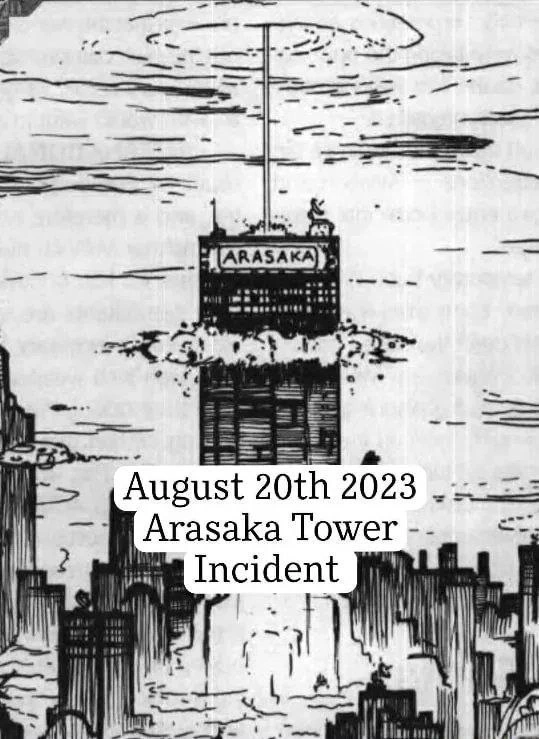
In simpler terms, this meme is comparing a software disaster to a giant sci-fi tower blowing up. Production is what we call the live system – the real website or service that users are interacting with. “When your production system pulls an Arasaka Tower on release night” means when your live system unexpectedly explodes on the night you roll out new code. The image is a black-and-white manga-style panel of a skyscraper labeled “ARASAKA” that has exploded in the middle. The text on it, “August 20th 2023 Arasaka Tower Incident,” looks like a news headline. This is a reference to the Cyberpunk game universe, where Arasaka is a mega-corporation and (spoiler!) its skyscraper HQ gets destroyed by a bomb. In this meme, that dramatic event is used as a metaphor for a huge production outage in real life. In other words, the meme jokes that our production deployment went so badly, it was like the Arasaka Tower blew up.

Let’s break it down: a release night is when developers deploy new features or updates to the production system, often after hours when traffic is low (say, midnight). It’s an exciting but nervous time, because you hope everything will work for real users. Here, the release night ends in disaster. The skyscraper exploding represents something going very wrong with the deployment. Think of the tower as your main servers or your database – and suddenly it’s gone! In plainer terms, they pushed out new code and the whole service crashed in a spectacular way. This is basically a worst-case scenario for any software team: you deploy an update and boom, the website/app goes down for everybody. It’s the kind of thing that keeps engineers up at night (literally).

Now, about on-call duty: many software teams have an on-call rotation, meaning at least one engineer is always available to respond if the system has issues, especially during off-hours. If your production system “pulls an Arasaka Tower,” that on-call engineer’s phone is going to blow up with alerts. We use tools (like PagerDuty) that will start ringing or texting the on-call person if errors spike or the site goes down. So imagine being that person: you’re asleep and suddenly you get emergency alerts because the service is down. It’s your responsibility to wake up, grab your laptop, and start figuring out what broke. This meme absolutely represents an on-call engineer’s nightmare scenario. The OnCallDuty tag and the whole vibe is about those dreaded late-night emergencies where something in production goes horribly wrong and someone has to jump in to fix it right away.

The mention of the incident as if it’s a titled event (with a date and name) is poking fun at corporate culture around big outages. In a serious company, when an outage happens, they give it a label (sometimes a nickname or an incident ID) and later conduct a post-mortem. A post-mortem is basically a meeting (and a report) after a big failure where the team talks about what happened, why it happened, and how to prevent it in the future. The meme calling it the “Arasaka Tower Incident” is like saying this failure was so epic, it’s going to be written in the company history books. Ideally, during the post-mortem they do a blameless analysis – meaning they don’t single out and punish a person for it, but rather find out how the process or system could be improved. This is where that CorporateCulture tag comes in: it hints at the way the company handles these situations (either constructively or with blame). But either way, everyone is going to remember that nightmarish release.

There’s also a hint of security in this meme. In the Cyberpunk story, Arasaka Tower was destroyed by a deliberate attack (a bomb set off by a character in the lore). In real life, sometimes outages are caused by security incidents – for example, a hacker might attack your system, or a major vulnerability might be exploited right when you deploy. The meme exaggerates the situation to feel like that kind of sabotage. It’s saying our deployment was such a disaster, it almost felt like someone blew it up on purpose (even if it was just a bad bug). That’s why you see tags like SecurityIncidents: it’s acknowledging that this “explosion” could well be the result of a security meltdown, not just a software glitch. (Don’t worry, in most cases it’s just a code mistake, not an actual villain with a bomb!)

In summary, this meme is a tongue-in-cheek way to describe a massive outage that happened at the worst possible time. It’s using the over-the-top imagery of a building exploding to get across just how big and shocking a production failure can feel. For a newcomer, you can think of it like this: the developers tried to launch something new, and it all blew up in their faces – so much so that they’re comparing it to a famous fictional disaster. It’s funny (in a dark way) because it captures that mix of panic and absurdity that comes with an unexpected, total failure. Developers share this kind of meme to laugh off the stress, basically saying “Haha, it was a disaster… wasn’t that insane?” and to bond over the fact that sometimes, in tech, things go spectacularly wrong.

Level 3: Production Fallout

From a senior developer’s perspective, this meme nails the nightmare of a massive production fiasco. Release night is notorious – it’s when everything that can go wrong often does go wrong. And here we have the ultimate example: the system blew up so badly it’s depicted as a literal tower explosion. The tall building labeled “ARASAKA” stands in for your core service or data center, shown with its mid-section obliterated. That’s a darkly funny visual metaphor for a production outage so severe that the service’s entire middle layer (say, the main application or database) is just gone. If you’ve ever been on on-call duty, you can practically hear the pager buzzing. It’s one of those 3 AM alerts where you rub your eyes and see all your dashboards blinking red. The new release was deployed... and moments later you’re looking at a smoking crater of a system. Engineering absurdity at its finest.

Why is this scenario so relatable in the dev world? Because big failures tend to cascade. Picture pushing a flawed update to production: the moment it goes live, one critical service throws a fatal error (boom, there goes the tower’s support structure). So much for “it worked on my machine,” right? The database might go offline next – maybe the new code overloaded it or wiped something important – and now every dependent subsystem starts timing out. One floor collapses and it brings down the whole skyscraper. In minutes, a chain reaction is underway: microservices crash, APIs return errors, and the site is effectively dead. All your monitoring alarms are going off at once. It’s the classic domino effect of a bad deploy, exaggerated to absurd levels. Here’s how a dramatized log of that release night might read:

# Timeline of chaos during the release
00:00:00 Starting deployment of version 2.0 to production...
00:00:10 ERROR: Service 'ArasakaCore' failed to start (segfault)
00:00:20 ALERT: Database 'arasaka-main' became unresponsive
00:01:00 WARN: 1000+ errors logged in 60 seconds (rate spiking)
00:02:00 CRITICAL: 100% of user requests are failing (HTTP 500s)
00:05:00 EMERGENCY: Initiating full rollback... WAITING (system hung)

Within a few minutes, a normal deploy has turned into a five-alarm fire. Experienced engineers have plenty of war stories like this. For instance, there’s the real case of a financial firm that lost $400 million in 45 minutes due to a bad software release – one buggy deployment essentially blew up the whole company’s operations. Or the times when a cloud provider’s mistake knocked out half the internet for a day. These meltdowns are rare, but when they happen, they’re legendary. They feel just as crazy as a skyscraper exploding, and they become cautionary tales passed around at conferences. The meme’s dark humor resonates because it captures that oh-no, everything’s gone moment when all systems fail at once and you’re left staring at rubble (or rather, an endless stream of error messages) wondering what the heck just happened.

Inside the company, an event like this “Arasaka Tower Incident” triggers full-on crisis mode. The on-call engineer has likely hit the panic button, pulling in every teammate on Slack and waking the seniors out of bed. Bleary-eyed devs, ops, and SREs pile into a virtual war room; everyone’s scrambling to triage. Logs flying, metrics spiking, people shouting out theories – it’s chaos. Someone’s desperately trying a rollback or hotfix, another person is digging through commit diffs to find the culprit. It’s an on-call nightmare come to life. Eventually (after what feels like an eternity), the team gets things back up. But the saga isn’t over. Now comes the corporate aftermath: the post-mortem. The meme’s caption framing it like a news event – “August 20th 2023 Arasaka Tower Incident” – is spot on. That’s exactly how it will be treated internally: as The Incident of the year. First thing Monday, there’s a meeting to dissect the failure. Everyone from engineers to managers (even VPs) will huddle to ask, “What went wrong? How do we make sure this never happens again?” In a healthy DevOps culture they’ll do a blameless analysis, meaning no single person gets publicly flogged; instead they’ll look at process issues (lack of testing, missed warnings, etc.). But in some corporate cultures, when something this big blows up, the blame game is inevitable. There might be hushed conversations about who approved that deploy or which team missed the bug. It’s a serious corporate meltdown moment — memos from the CTO, all-hands meetings, maybe even folks updating their résumés afterward.

By this point, the absurd gap between plan and reality is clear. Before the release, everyone promised a smooth night; after, we got the exact opposite. A quick comparison highlights it:

What We Promised What Actually Happened
Seamless deploy, zero downtime Hours of outage and frantic recovery efforts
Thoroughly tested release code A critical bug slipped through and blew everything up
On-call will probably stay quiet PagerDuty lit up like a Christmas tree at 2 AM
"Just a normal release night." Entire team in a war room, pulling an all-nighter

For seasoned engineers, this meme is both hilarious and a little traumatic. It exaggerates a release-night failure as a literal futuristic explosion, and we chuckle because we’ve felt that kind of explosion in spirit. It’s the kind of dark humor you earn after surviving real production disasters. The phrase “pulls an Arasaka Tower” might become team slang for “our app nuked itself.” You laugh about it later to cope, saying things like “Remember that time we deployed a nuke on prod?” – with a nervous smile. In short, the meme gives us a way to bond over those absurd, gut-wrenching incidents that every experienced dev either has gone through or anxiously fears. We’re laughing, but we’re also quietly praying to the tech gods: please, not our tower, not tonight.

Level 4: Single Point of Boom

For all the talk of building distributed, fault-tolerant systems, it’s still far too common to have a giant Single Point of Failure (SPOF) lurking at the center of a production architecture. The towering Arasaka skyscraper in this meme represents that monolithic core system we’ve staked everything on. When that single core fails explosively – as depicted by the top of the tower being blown clean off – it takes down the entire operation in one spectacular go. In reliability engineering terms, the blast radius of this failure is total: there’s no graceful degradation, no failover kicking in. One moment everything’s humming along, the next you have a crater where your service used to be. So much for having five-nines uptime when a single blast can wipe out the whole stack!

At a deeper design level, this scenario shows what happens if you neglect redundancy and fault isolation. In an ideal world, critical infrastructure wouldn’t be all in one “tower” – you’d have multiple data centers, shards, or microservices to contain the damage. But here, the system was a monolith with no safety nets. If a single release-night bug or a malicious exploit (imagine an attacker planting a hidden logic bomb in the code) gets through, it triggers a chain reaction that cascades into full system collapse. There’s zero partition tolerance here: all the eggs were in one basket, and that basket just got nuked. The result? Instant, catastrophic failure with a blast radius as big as your entire business.

It’s exactly the kind of worst-case scenario that chaos engineering tries to uncover before it’s too late. In a well-prepared system, teams simulate disasters – even “nuking” their own services in tests – to ensure that killing one component (or one tower) won’t crater the whole thing. Clearly, no such Game Day resilience drill was run here. They discovered this architectural weakness the hard way: in production, on release night, with everything on fire.

Description

This is a black and white, manga-style illustration depicting the catastrophic explosion of a skyscraper. The building, clearly labeled with the name 'ARASAKA' near its peak, is shown with smoke and debris billowing from an explosion partway up its structure, while a thin spire extends from the very top. The cityscape below is also sketched in a similar style. Overlaid on the image is a white text box with black letters that reads: 'August 20th 2023 Arasaka Tower Incident'. The meme is a direct reference to the lore of the 'Cyberpunk' franchise, particularly the 'Cyberpunk 2020' tabletop RPG and the video game 'Cyberpunk 2077'. In this fictional universe, the Arasaka Tower was famously destroyed by a mini-nuke on this exact date. The humor comes from treating a significant event from a video game's history as a real-world historical moment to be remembered, especially as the actual date passed in reality
Comments

17
Anonymous ★ Top Pick The Arasaka Tower incident was just the world's most violent legacy system migration. They successfully deleted the monolith, but the blast radius of the change request was slightly larger than estimated
  1. Anonymous ★ Top Pick

    The Arasaka Tower incident was just the world's most violent legacy system migration. They successfully deleted the monolith, but the blast radius of the change request was slightly larger than estimated

  2. Anonymous

    “Let’s split the monolith so half can live in the cloud,” they said - five minutes post-cutover we’ve got Arasaka Tower architecture: stateless top half drifting in K8s, stateful bottom half smoldering on-prem, connected by one timing-out gRPC call

  3. Anonymous

    When your production database goes down and you realize the last successful backup was from before the company pivoted to microservices - some incidents become legendary enough that future developers speak of them in hushed tones, like the great Arasaka Tower collapse of our timeline

  4. Anonymous

    When your Friday afternoon hotfix has a slightly larger blast radius than anticipated. The incident report will simply read: 'Deployment successful. All services now in a superposition of down and extremely down. RTO: undefined. RPO: we had backups, past tense. Root cause: someone approved the merge request.' At least the monitoring dashboards are showing consistent metrics now - consistently zero

  5. Anonymous

    One bad relic driver update and your entire megacorp stack implodes - SREs know it's not fiction, just Monday's page

  6. Anonymous

    Arasaka learned that “reduce blast radius” isn’t a metaphor - ship a monolith, ignore change freezes, and your SLOs become a crater-shaped N/A

  7. Anonymous

    Arasaka’s postmortem: we adopted microservices to “reduce blast radius”; turns out the service was a micro‑nuke - RTO now measured in “when the crater cools.”

  8. dev_meme 2y

    Huh

  9. @callofvoid0 2y

    what ?

  10. @ItIs_AJ 2y

    Explanation.

  11. @SomeWhereIBelong 2y

    This is from cyberpunk 2077 lore how is this dev related

    1. @rglrd 2y

      It's cYbErBuNk.

  12. @UncleDankle 2y

    08/20

  13. @AndrewEastwood 2y

    ?

  14. Felix 2y

    What the cyber?

  15. @Johnny_bit 2y

    DO EET!!!

  16. @ZgGPuo8dZef58K6hxxGVj3Z2 2y

    I don’t get it I haven’t played the game yet

Use J and K for navigation