The Senior Developer's Mantra for Debugging
Why is this Debugging Troubleshooting meme funny?
Level 1: Plugging One Leak at a Time
Imagine you have a small boat with a bunch of leaks in it. You notice one big leak and patch it up, feeling happy that you fixed the problem. But as soon as you start sailing again, water starts leaking from another hole that you hadn’t seen before! So you plug that second leak. You try again, and oh no – now a third leak starts spraying water. It’s almost comical: every time you fix one hole, the boat floats a bit further, only to reveal another hole letting water in. At some point, instead of telling your friend “Alright, the boat is definitely fixed now,” you’d probably say, “Let’s sail a little and see where it leaks next.” That way, you’re not jinxing it – you’re admitting with a little laugh that there might be more problems, and you’ll handle them one at a time.
This is exactly what the developer in the meme is doing, but with software instead of a boat. Fixing a bug in code is like plugging one leak. Often, once that bug is fixed, the program runs further and then “leaks” (breaks) somewhere else. It can be a bit frustrating, kind of like playing a game of whack-a-mole where as soon as you whack one mole down, another pops up. But it’s also funny in a way – you have to just keep trying and not celebrate too early. The phrase “try it again and see what error you get this time” is the programmer’s version of “let’s see where it leaks next.” It means they’re ready to tackle the next problem if there is one. It’s funny because it’s an honest, slightly sarcastic way of handling something that happens all the time: fix one thing, then find the next thing to fix. Instead of confidently (and maybe foolishly) saying “I fixed it for good!”, the developer is basically chuckling and saying, “I fixed one issue, but who knows, maybe something else will break – let’s find out.” This kind of honesty makes the situation less stressful and a bit more lighthearted, which is why developers find it so relatable and humorous.
Level 2: One Bug at a Time
For a less experienced developer (or someone new to coding), this meme is highlighting the reality of debugging in simple terms: fixing software problems is often an iterative process, not a one-and-done deal. A bug is a flaw or error in the code that causes the program to behave in unexpected or incorrect ways. When a bug happens, the program usually throws an error message – basically a notification or text output saying what went wrong (often including a type of error and maybe a file name or line number). For example, if a piece of code tries to use a variable that wasn’t set to anything, you might get an error message like NullReferenceException or “Undefined variable X on line 42.” That message is a clue for the developer: it points to the location and nature of the problem.
Debugging, then, is the act of tracking down these bugs and fixing them so the error goes away. But here’s the catch that the meme jokes about: in any non-trivial program, you might have multiple bugs hiding. You typically fix the first error you see and then run the program again to test. If the program manages to get past the first problem, it might then encounter the next bug and crash again, producing a new error message. You fix that one, run it again, and maybe now it gets further, but then hits another issue. This cycle continues until finally the program runs from start to finish without errors (or you hit a point of diminishing returns). Each fix is like clearing one obstacle, allowing the code to progress, sometimes literally to the next line, where it then trips over the following obstacle.
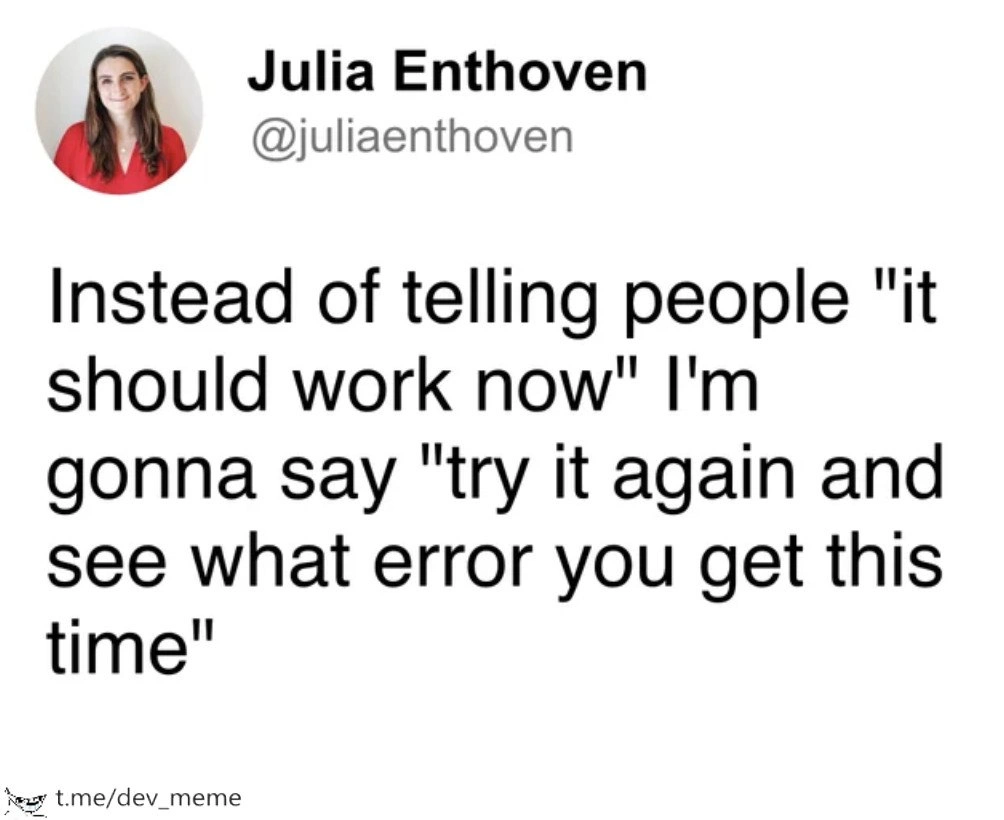
The tweet in the meme humorously suggests a better way to talk about this process. Instead of a developer telling someone, “It should work now,” after one fix, they propose saying, “Try it again and see what error you get this time.” Why would they say that? Because an experienced dev knows there’s a good chance that after fixing one bug, the user or tester might encounter another bug. Saying “it should work now” can set false expectations that everything is resolved. If something else breaks, the user might feel disappointed or think the dev didn’t test anything. On the other hand, saying “give it another try and let’s see what happens” sets the expectation that we’re in a troubleshooting phase with potentially several rounds. It’s a more realistic communication of where we are in the fix/test cycle. Essentially, the dev is admitting, “I fixed one issue, but there could be more – let’s find out.”
This is very relatable for many developers (RelatableDevExperience is basically what this meme banks on). For example, imagine you wrote a small program to fetch data from a website and process it. The first time you run it, it might crash because you spelled the website URL wrong – that’s bug #1. You fix the URL typo and run again. Now it connects to the site successfully, but crashes with a new error: you didn’t handle the case where the data is missing a field – oops, bug #2. So you add a check for that missing field. Run #3: it gets past the previous issues but now you get a stack-trace complaining about a division by zero in your calculations (bug #3). You fix that by adding a condition to avoid dividing by zero. Run #4: finally, the program runs to the end and prints the result you expect. Victory! 🎉 But notice, it took four tries and three separate fixes. This is iterative debugging in action – tackling one bug at a time.
Now, during that process, suppose your teammate or your manager was waiting for the program to work. After your first fix (the URL typo), if you cheerfully said, “It’s all good now, try it!” you’d have egg on your face when they come back and say “Uh, now it’s crashing with a different error…” That’s why the meme’s advice is funny and sound: it’s better to say something like, “I fixed one issue; go ahead and run it again and let me know what error comes up next.” This way, the other person knows you’re not guaranteeing perfection yet – you’re basically asking them to help identify if there’s another bug. It’s a humble and practical way to troubleshoot. In developer culture, this approach is sometimes jokingly called “error-driven development” (a play on the term test-driven development). Instead of writing tests for every scenario upfront, you often end up writing code and then reacting to each error as it comes, especially when dealing with a new feature or complicated system integration.
The meme is also highlighting a bit of self-deprecating troubleshooting humor. The developer is poking fun at their own tendency to be too optimistic. By vowing to use the phrase “see what error you get this time,” they acknowledge that their earlier assurances (“It should work now, I promise!”) have often been wrong. It’s a light-hearted way of saying “I’ve learned my lesson. No more bold claims; let’s just test again and find out step by step.” For a junior dev, the takeaway is: don’t be discouraged if fixing one bug leads to discovering another. That’s normal! Writing software is complex, and even senior devs find that problems can come in chains. The key is to tackle them one by one, learn from each error message, and communicate honestly about the process. Ultimately, each error you solve gets you closer to a working program, and that next error message is not a sign of failure, but just the next task on the path to success.
Level 3: Error-Driven Development
The meme captures a seasoned debugging mindset: instead of triumphantly declaring “It should work now” after a code fix, the developer deadpans, “try it again and see what error you get this time.” This witty twist hits home for any senior engineer who’s been burned by optimistic bug fixes. It reflects the reality that squashing one bug often unearths the next lurking issue. In complex systems, there’s a perverse iterative debugging loop: you deploy a fix, run the app, and immediately confront a new stack trace or error message. Fix that, run again, and surprise – yet another error surfaces. It’s basically software development by successive approximation (or as the meme implies, “error-driven development”). Each iteration reveals the next failure mode, almost like peeling layers of an onion (that makes you cry every time). Experienced devs have adopted this mantra as a form of dark humor and pragmatic truth. By saying “let’s see what error comes up now,” we implicitly acknowledge the shared pain of bug-fixing whack-a-mole. Everyone on the team knows the battle isn’t over with the first “fix,” so we might as well buckle up for the next exception in the log.
This humor resonates strongly with DeveloperHumor because it satirizes the overly-optimistic assurances we’ve all given at some point. Telling a teammate or a QA tester “It should work now” is almost like daring Murphy’s Law to strike. Seasoned developers cringe at those words – they’ve learned that should is a dangerous word in this field. The minute you say “should,” fate (or your code’s hidden bug cache) finds a way to prove you wrong. The tweet’s proposed response is basically a tongue-in-cheek communication strategy to save face and sanity: instead of claiming victory too soon, invite the tester to run the code again and actively look for the next failure. It’s a subtle way of admitting, “I’m not 100% sure it’s fixed, there might be something else broken – let’s find out together.” This kind of honesty is both funny and wise. It turns the debugging process into a collaborative, almost scientific exercise of troubleshooting: gather data (the next error), formulate a fix, run again, repeat.
In many real-world scenarios, this optimistic bug fixing -> new bug discovered pattern is painfully familiar. Picture a late-night deploy: the on-call dev patches a critical bug in production and confidently announces in Slack, “Deployed the fix, everything is good now.” Five minutes later, a new alert pings: something else just crashed. The root cause might be an edge-case the team never anticipated, or a byproduct of the last fix. Now the same dev has to sheepishly tell everyone, “Alright… found another issue. Trying again.” After a few rounds of this, any veteran learns to stop promising a silver bullet fix. Instead, they communicate like a battle-weary field medic triaging a chaotic scene: address one wound at a time and expect more wounded to emerge from the smoke. The meme’s quote is basically a devops doctor saying, “We stabilized one patient, bring in the next!” This all-too-realistic cycle is why the joke lands — it’s riffing on a truth of our profession: software is never truly done, just a bit less broken than before.
There’s also an underlying commentary on bugs in software and how we approach quality. Ideally, we’d catch issues with unit tests, integration tests, code reviews, etc., aiming to prevent this cascade of runtime errors. But in practice, especially in large or legacy codebases, you often don’t discover certain problems until you run the code in a real (or realistic) environment. Each error message at runtime is like a clue in a scavenger hunt leading you to the next problem. The tweet acknowledges this reality with a shrug and a laugh. It pokes fun at the fact that we basically do QA in production sometimes – fixing one defect just advances the program to hit the next defect. In fact, there’s a running gag among developers that goes like this:
Q: How many bugs are there in the code?
A: “99 little bugs in the code,
99 little bugs.
Take one down, patch it around…
117 little bugs in the code.” 😅
This parody of the “99 Bottles” song humorously exaggerates how each fix can not only reveal but potentially introduce new bugs. It’s a cynical veteran take on debugging: sometimes solving one problem accidentally causes another. The meme’s tagline “see what error you get this time” aligns with this sentiment – it’s half-joking that new errors are almost guaranteed. Seasoned devs have seen this happen often enough that it’s become a coping mantra. Rather than over-promising, they preemptively frame each fix as just one step forward in a longer journey of bug bashing.
From an organizational perspective, this kind of phrasing is also about expectation management and good communication. Telling your project manager or QA, “It’s fixed, we’re all set!” only to have them discover a new crash moments later can erode trust. On the other hand, saying “Give it another try and let me know what happens,” is a realistic and blameless way to continue the investigation together. It shows you’re not closing the ticket until the user confirms things truly work. It’s a subtle shift from a promise to a process. The humor, of course, comes from the absurd reliability of unreliability – as if the developer is so jaded that they expect failure as the norm. But beneath the sarcasm is solid engineering wisdom: complex systems fail in complex ways, and one deploy rarely fixes everything. The best way forward is iterative improvement – or as this meme lampoons it, “try, fail, fix, repeat.”
Description
This image is a screenshot of a tweet from user Julia Enthoven (@juliaenthoven). The tweet, in a standard, clean interface, presents a resolution that resonates deeply with software developers. The text reads: 'Instead of telling people "it should work now" I'm gonna say "try it again and see what error you get this time"'. A small watermark for 't.me/dev_meme' is visible in the bottom-left corner. The humor stems from its cynical but highly accurate portrayal of the debugging process in complex systems. The optimistic phrase 'it should work now' often proves false, leading to frustration. The proposed alternative is a pragmatic and honest reflection of iterative troubleshooting: a fix for one problem often reveals the next layer of issues, and the new error message is a crucial piece of data for the next step. This mindset is characteristic of experienced engineers who understand that a single 'fix' is rarely the end of the story
Comments
7Comment deleted
'It should work now' is the optimistic junior dev. 'Let's see what error you get now' is the battle-hardened senior who knows the first fix just uncovers the *real* bug
We’ve fully adopted STDD - Stack-Trace-Driven Development: ship, wait for Sentry to cough up a UUID, then iterate until the logs reference a microservice no one remembers owning
After 20 years in the industry, you learn that 'it should work now' is just asking the universe to introduce a race condition you've never seen before, while 'let's see what error we get' at least gives you stack traces to blame when the CEO asks why production is down
This is the senior engineer's version of 'trust but verify' - except we skip the trust part entirely and go straight to collecting stack traces. After 15+ years, you learn that 'it should work now' is just an optimistic hypothesis awaiting falsification by production, while 'what error do you get this time' is proper scientific method applied to distributed systems where every fix is really just a state transition to a new, more interesting failure mode
Our new RCA workflow: Monte Carlo in prod - rerun until the stacktrace distribution stabilizes
Upgrading support from cargo-cult 'should work' chants to error-message forensics - because Heisenbugs don't reproduce without observation
New policy: replace “should work now” with “retry and tell me which downstream 500 pops next” - our budget APM is the refresh button