A Legacy System's Recipe for Immediate Failure
Why is this LegacySystems meme funny?
Level 1: Too Many Cooks Spoil the Soup
Think of building a project like cooking a big soup. Ideally, you want one good recipe and a few cooks working in sync. Now imagine five different cooks each randomly dumping their own ingredients into the same pot without talking to each other. One cook adds sugar, another dumps in salt, the next throws in hot chili peppers, someone else adds chocolate, and the last one pours in pickle juice. đ€ą What kind of soup do you think thatâs going to be? Pretty awful, right? It might even just overflow or curdle â basically, itâs going to be a disaster that you definitely donât want to taste.
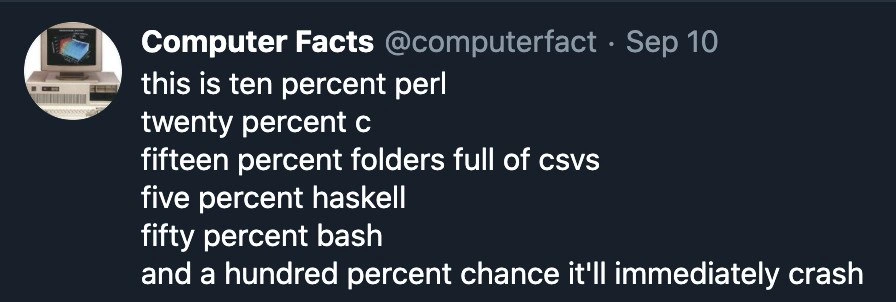
This meme is joking that the code in question is just like that messed-up soup. Each programming language in the list (Perl, C, Haskell, Bash, plus those CSV files) is like a different cookâs ingredient. They donât naturally mix well together. So when you throw them all into one project, itâs almost guaranteed the âsoupâ (the program) will be bad â in fact, it will break entirely (or âcrashâ as computers call it). Saying thereâs a â100% chance itâll immediately crashâ is a funny, exaggerated way to say âthis is so obviously flawed that failure is certain.â
Why is that funny to developers? Itâs the contrast: normally people brag about their code being reliable, but here weâre bragging (in a mock way) that itâs 100% going to fail! Itâs humor born from experience â like knowing a tower made of mismatched blocks will fall. Even if youâre not a programmer, you can imagine that if you build something out of totally incompatible parts, itâs not going to work. Itâs the same feeling as watching someone stack five different sizes of cards and expecting a stable tower: you just know itâs going to collapse, and when someone deadpans that it definitely will, it makes you smile.
In simple terms: too many clashing ingredients spoil the soup, and too many clashing languages spoil the code. The meme takes a fun route (copying a songâs style) to share that age-old lesson. Even if you donât catch the song reference, the idea of â10% this, 20% that⊠100% messâ gets the point across. Itâs a silly way to say âthis thing is doomed from the start,â and everyone who hears it can nod and laugh because we all know a recipe for disaster when we see one, whether in the kitchen or in code.
Level 2: What's in the Code Soup?
Letâs break down the âingredientsâ of this code soup and why developers find it funny (and horrifying). The tweet lists several programming languages and tools by percentage. Hereâs what each one is and does:
Perl â Perl is a programming language that was super popular for scripting in the 1980s and 1990s. Itâs great at text processing (for example, writing one-liners to find and replace text in files). System administrators and early web developers often used Perl for quick tasks. Perlâs slogan is âThereâs more than one way to do it,â which hints at its flexibility. But that flexibility can lead to very messy code: itâs easy to write a Perl script that works but is hard for others (or future you) to understand. So if 10% of a project is Perl, it usually means thereâs a bunch of old PerlScripting doing something behind the scenes â possibly something like log parsing or glue logic â and it might not be well documented.
C â C is a low-level programming language famous for being super fast and powerful. Itâs part of the C family languages (C, C++, C# are in this family, though C# is much higher-level). Many operating systems and high-performance tools are written in C. The downside is that C doesnât have safety nets: you manage memory manually. If a C program has a bug (like writing past the end of an array, or using a pointer that isnât valid), it can cause a crash immediately. That crash is often called a segfault (short for segmentation fault). So, 20% C in the mix means a significant chunk of this project is a compiled C program or library. C might have been used to speed up something slow. It contributes power, but also potential instability â one wrong move in C and the whole program can terminate unexpectedly.
CSV files â CSV stands for Comma-Separated Values. Itâs a simple file format to store data in a table form (like rows and columns) using plain text. For example, a CSV might look like:
name,age Alice,30 Bob,25Here each line is a record, and commas separate the fields. Itâs an easy way to exchange data because nearly any language can read a CSV by splitting on commas. When the meme says âfolders full of CSVsâ making up 15%, it implies that the project stores a lot of its data in these text files scattered in folders. That often happens in quick-and-dirty solutions where instead of setting up a database or a robust data pipeline, the program just writes out intermediate data to files. Itâs convenient but very brittle. For instance, if one of those CSV files is missing, or if someone edits it and puts an extra comma somewhere, any script or program trying to read it might break. Thereâs no strict schema (format enforcement) with raw CSV files. A newbie might think âdata in a text file, thatâs fine,â but in a big system, dozens of CSV files can become a maze of manual data management. Itâs a classic unstable_legacy_scripts move to have lots of CSVs laying around because it usually means âwe never properly structured our data.â
Haskell â Haskell is a more obscure language in this list. Itâs a purely functional programming language, which is quite different from imperative languages like C or scripting languages like Perl and Bash. Functional means itâs built on mathematical functions; Haskell emphasizes immutability (not changing data in-place) and has very strict type safety (the compiler catches a lot of errors). Haskell is often taught in computer science to illustrate elegant software design principles and monads (an advanced concept) â it has a bit of a reputation as a professorâs or enthusiastâs language. Only 5% of the code being Haskell is a bit odd. That suggests maybe one small component or tool in the project was written in Haskell. Perhaps a specific feature or calculation was easier or more reliable to do in Haskell, or someone on the team really wanted to use it. Itâs uncommon to see Haskell mixed with, say, Perl and Bash in the same codebase, because Haskell operates so differently. While Haskell itself is usually reliable (if it compiles, it often just works), integrating it with other parts can be tricky. For example, to use Haskell output in a Bash script, maybe they run a compiled Haskell program as part of the pipeline. If anything in that integration is off (like passing data incorrectly to the Haskell program or vice versa), it can fail. So Haskellâs 5% presence is like a weird puzzle piece in this set â interesting, but it might not fit smoothly with the rest.
Bash â Bash is the shell language on Linux/Unix systems (the name âBashâ stands for Bourne Again SHell). When you open a terminal on a Mac or Linux and type commands, youâre likely using Bash. Bash scripting means writing those command-line instructions in a file so you can automate tasks. For instance, a Bash script might run a series of commands: compile a program, run it, move some files, etc., all in one go. Bash is extremely handy for automation and gluing software together because it can call anything: you can invoke a Perl script, run a C program, call a Haskell executable, all from one Bash script. If Bash is 50% of the project, that means half of the code base (by whatever measure) is just shell scripts coordinating everything else. This hints that the project doesnât have a single coherent program, but rather a bunch of scripts that call each other. Bash being so large a portion is usually a sign of something originally hacked together quickly. Bash scripts are powerful but can become hard to maintain if they get too big or complex. They also have pitfalls: for example, by default Bash doesnât stop on errors â if one command fails, the script will blithely continue to the next unless you explicitly tell it to stop (
set -eis needed). So error handling is manual. A lot of production issues come from shell scripts that didnât account for a failing command or unexpected input. If half the system logic is in Bash, you can imagine how many corner cases might not be handled.
When you put all these together (Perl + C + CSV files + Haskell + Bash), you get a mixed_language_codebase thatâs very complicated. Each âlanguage layerâ speaks its own tongue, and the only thing bridging them might be those CSV files and shell commands. For a junior developer, think of it like this: Itâs as if one part of the app is written in Spanish, another in Chinese, another in French, and they communicate by passing notes in a very basic common code (CSV, like broken English). Itâs doable, but a lot can get lost or messed up in translation.
The meme jokes that thereâs a â100% chance itâll immediately crashâ when you run this hodgepodge. Of course, in reality nothing is 100% except death, taxes, and maybe off-by-one errors. đ But theyâre exaggerating to make a point: the system is so perilously constructed that it feels inevitable it will break. Why? Because system crashes often happen at the weakest link in the chain. Here we have many potential weak links:
- The Perl script could output something malformed and the next step wonât handle it.
- The C program could have a bug that only appears with certain input from that Perl output (like a line in the CSV thatâs longer than expected causing a buffer overflow).
- The Bash script might not check for an error code from the C program and just blunders on, using half-baked data.
- The Haskell part might expect perfectly formatted input (since Haskell is strict) and any slight deviation could make it throw an exception and quit.
- Even file paths or environment setups for these scripts could go wrong (maybe the Bash script assumes the CSV files are in
/tmpbut they arenât there).
Unless a miracle of engineering happened, this kind of ad-hoc integration doesnât have comprehensive tests. (Notice how the memeâs breakdown doesnât include any percentage for testing or documentation!) Itâs likely there are no automated tests covering the whole chain â otherwise someone would have refactored it out of sheer pain. So from a code quality standpoint, this is basically an unstable stack of cards.
Itâs worth noting that the meme is structured after a famous song lyric. The account âComputer Factsâ on Twitter took Fort Minorâs âRemember the Nameâ chorus (which goes â10% luck, 20% skill, 15% concentrated power of will, 5% pleasure, 50% pain, and a 100% reason to remember the nameâ) and remixed it into a programming joke. In the song, those percentages poetically describe what makes an athlete/musician successful. In the joke, the percentages describe what makes a program⊠a disaster đ. This kind of reference is common in DeveloperHumor: combining tech frustrations with pop culture makes the jokes extra shareable. If you recognize the song, it adds an extra layer of chuckle because you can almost sing the meme lines to the beat. Even if you donât know the song, the meme still works as a clear list of âwhatâs in this code and whatâs going to happen.â
So, for a junior developer or someone new to this joke: itâs saying âOur project is 10% made of one thing, 20% another, ⊠and overall 100% likely to crash.â It highlights the idea that using so many different tools in one project is usually a sign of trouble. Most well-designed systems use one primary language (or a few well-chosen ones) and have structured ways for components to talk to each other (like defined APIs or protocols). Here, itâs implied everything was slapped together without such discipline. Thatâs why developers find it funny â weâve either seen this Frankenstein monster in real life or had nightmares about maintaining something like it. Itâs a tongue-in-cheek way of saying âthis is a really bad system design.â
In summary, the tweet is both a joke and a little cautionary tale. It lists those languages and tech (Perl, C, CSV, Haskell, Bash) to poke fun at a jumbled project. And the punchline â100% chance itâll crashâ is basically the comedian (the tweet author) winking at us: we all know where this is heading. It resonates with anyone whoâs dealt with unstable_legacy_scripts or inherited a project thatâs a mishmash of different technologies: you laugh, then you shudder a bit, remembering the last time you had to fix something like that.
Level 3: Mixed-Language Meltdown
This meme paints a painfully familiar picture of a mixed-language codebase held together by duct tape and prayer. It parodies the song "Remember the Name" by Fort Minor, replacing the original lyrics with a breakdown of a chaotic project: 10% Perl, 20% C, 15% folders full of CSVs, 5% Haskell, 50% Bash, and âa 100% chance itâll immediately crash.â For seasoned developers, the humor hits hard because itâs a CodeQuality cautionary tale wrapped in a pop culture reference. Each component in those percentages is a notorious culprit in brittle systems:
- Perl (10%) â Likely some legacy PerlScripting from the â90s lurking in the codebase. Perl is powerful at text processing (think of quick regex hacks), but itâs infamous for producing write-only code (code so cryptic even the author struggles to read it later). In a large system, a mysterious Perl script can become a black box: it works⊠until it doesnât. When that one-liner fails at 3 AM, youâll be combing through
$@variables and line-noise regex trying to figure out what went wrong. - C (20%) â The presence of C family languages code (specifically C here) suggests a performance-critical core or an old library that everything else relies on. C gives you speed and control â along with glorious segmentation faults if you mismanage memory. One stray pointer or buffer overflow in that 20%, and the whole process can blow up. C doesnât politely error out; it just crashes the program outright (ever seen
Segmentation fault (core dumped)? đ„). Mixing C with higher-level scripts is like putting a racecar engine in a go-kart: it might go fast, but if anything isnât bolted down perfectly, somethingâs flying off. - âFolders full of CSVsâ (15%) â This implies that instead of a real database or structured storage, the system uses a bunch of CSV files dumped in directories as a makeshift data exchange. CSV (Comma-Separated Values) files are essentially bare-bones spreadsheets in text form. Theyâre easy for any language to read, which is why sloppy integrations love them: one part of the system writes out
data.csv, and another part later reads it. But thereâs zero schema or safety. If one component writes an extra column or a malformed line, the next component might choke on it. A folder full of CSVs tends to become a minefield of Bugs: different files with slightly different formats, missing values, encoding issues â you name it. Itâs the âquick and dirtyâ solution that becomes a persistent source of crashes when scripts canât parse what they expected. - Haskell (5%) â Ah, the wildcard! Haskell is a pure functional language with a strong type system; itâs the outlier here, often seen as academic or clean in contrast to Perl/Bash. A mere 5% suggests maybe one specific module or microservice in an otherwise scrappy system. Perhaps some former team member was a functional programming enthusiast and slipped in a Haskell component (maybe for a complex calculation or just to show off). Haskellâs reliability comes from its purity and type safety, but that advantage evaporates if itâs glued into this mess via foreign function interfaces or by reading those unruly CSVs. The joke here is that even the presence of a theoretically âcorrectâ language like Haskell canât save this system â itâs like installing a state-of-the-art filtration unit in a plumbing system made of leaky pipes and duct tape. In a chaotic integration, Haskell might as well be writing its output to
/dev/nullbecause the surrounding code wonât know how to handle it. - Bash (50%) â A full half of this monster is BashScripting, meaning the primary orchestrator is a tangle of shell scripts. Bash is the glue holding all these disparate parts together: one script calls the Perl script, then invokes the compiled C program, shuffles some CSV files around, then maybe calls a Haskell executable, and so on. Bash is great for quick automation, but at this scale itâs a nightmare. Shell scripts are notoriously easy to write and notoriously hard to get right on the first try. Miss one
&&to chain commands or forget to quote a$variablewith spaces, and your script will blithely do the wrong thing. In a mixed_language_codebase like this, the Bash layer is the fragile connective tissue â if any command in the sequence fails and the script doesnât handle it, the whole pipeline collapses. Picture hundreds of lines of Bash with complex logic and no proper error handling: itâs a ticking time bomb. Half the code being Bash also screams âno one ever rewrote the prototype.â Itâs like someone wrote a quickrun_all.shscript to integrate everything, it grew and grew, and now 50% of the âproductâ is still that script. Scary.
Now, why does all this guarantee a crash? Because each piece by itself has a non-zero chance of failing; put them in series, and the probability of something going wrong skyrockets. Imagine a SystemCrashes waiting to happen: the Perl script might unexpectedly output an extra column, the C program might not handle that and throw a memory error, the Bash script doesnât check for the error and tries to feed the bad output into the Haskell part, which then also fails spectacularly⊠Itâs a chain reaction. In systems engineering, the overall reliability is like the product of each componentâs reliability, and here every component is dodgy. The 100% in the meme is hyperbole, but it feels true when youâve lived through such deployments. The humor has an edge of truth: if youâve ever been on-call for a patchwork system like this, you know it tends to crash at the worst possible moment (probably Friday at 5 PM, right when youâre logging off).
Crucially, the memeâs lyric structure (âten percent X, twenty percent Y, ⊠and a hundred percent chance to crashâ) is a nod to shared nostalgia and DeveloperHumor. Developers love sneaking in pop culture; here itâs riffing on a famous Fort Minor lyric to sum up a codebase_percentage recipe for disaster. The original song talks about what % of different qualities make someone successful; this joke flips it to what % of tech ingredients make a program an epic failure. And unlike the inspirational tone of the song, this breakdown is dripping with sarcasm. Itâs essentially calling out a Tower of Babel architecture â so many languages thrown together that nothing understands each other perfectly, much like the biblical story where confusion of languages leads to collapse. Every experienced dev reading this tweet can practically hear the crash. Itâs funny because itâs true: weâve seen projects exactly like this, where no one planned the tech stack coherently. Over years, new pieces got bolted on in whatever language was handy or whatever unstable_legacy_scripts were lying around, until the whole thing became a giant Jenga tower of tech debt. And what do Jenga towers do eventually? Crash.
In short, this meme uses a witty parody to highlight code quality nightmares. Itâs both a laugh and a wince of pain recognition. The bug is practically baked in from the start with such a design. Seasoned engineers chuckle (or groan) because they know any system built with these proportions is guaranteed trouble. Itâs a humorous reminder that just because you can glue five different technologies together doesnât mean you should â and if you do, donât be surprised when the whole thing goes down in flames.
Description
This image is a screenshot of a tweet from the account 'Computer Facts' (@computerfact), which has a retro computer as its profile picture. The tweet parodies the lyrics of the Fort Minor song 'Remember the Name' to describe a comically fragile and poorly architected software system. The text reads: 'this is ten percent perl, twenty percent c, fifteen percent folders full of csvs, five percent haskell, fifty percent bash, and a hundred percent chance it'll immediately crash'. The humor is rooted in the chaotic and incompatible mix of technologies. It describes a nightmare 'big ball of mud' architecture: Perl for legacy scripting, C for low-level components, Haskell for a random, out-of-place functional piece, mountains of Bash scripts for glue, and fragile CSV files instead of a proper database. For experienced engineers, this is a deeply relatable horror story, representing the worst kind of technical debt and the entropy that plagues unmaintained legacy systems
Comments
7Comment deleted
This isn't a tech stack; it's a technology Jenga tower built during a series of competing acquisitions. The five percent Haskell is from that one intern who was a genius but never documented anything
I just diagrammed this exact stack: Perl glue, C binaries nobody dares recompile, âdatabase-as-CSV,â a token Haskell service for rĂ©sumĂ© padding, all orchestrated by Bash - guaranteeing the only thing reliably scheduled is the PagerDuty alert
The real horror isn't the 100% crash rate - it's that someone, somewhere, is maintaining a production system where a PhD's abandoned Haskell experiment is held together by Perl one-liners and bash scripts that nobody dares to refactor because the original developer left in 2003 and the only documentation is a README that says 'good luck'
Ah yes, the classic 'works on my machine' stack: a Perl script from 2003 that nobody dares touch, some C code with pointer arithmetic that would make Dijkstra weep, fifteen directories of CSVs serving as your 'database layer,' a Haskell module someone wrote during their functional programming phase that's now critical infrastructure, all held together with 3,000 lines of Bash that's one unquoted variable away from rm -rf'ing production. The hundred percent crash rate isn't a bug - it's a feature that keeps you employed debugging it at 3 AM
Polyglot ETL: 10% Perl, 20% C, 15% folders of CSVs, 5% Haskell, 50% Bash - the only deterministic type in the whole stack is exit code 1
Classic enterprise ETL: a Bash orchestrator gluing Perl, a C shim, and a virtuous Haskell one-liner to a graveyard of CSVs - aka CFA: Crash-First Architecture
CAP theorem perfected: it always prioritizes Crash over Availability or Partition tolerance