Skip to content
DevMeme
4856 of 7435
The Two Words That Kill All Developer Confidence
API Post #5317, on Aug 4, 2023 in TG

The Two Words That Kill All Developer Confidence

Why is this API meme funny?

Level 1: Big Talk, Quiet Doubt

Imagine a kid showing off on the playground. He proudly tells his friends, “Yeah, I can totally do a skateboard trick!” Everyone around looks impressed and he’s grinning ear to ear, happy he said it. But then, a second later, he quietly mutters, “...I think,” as it dawns on him that he’s not actually sure he can pull it off. He’s smiling on the outside but suddenly feeling nervous inside. This meme is just like that. At first, the person is super confident – they promise they can do something easily. But immediately after, they feel a bit of doubt and go, “uh, maybe?” in a small voice. It’s funny because we’ve all done this: we brag or agree to something to look good, then realize we might have spoken too soon. The big happy face turning into a worried face in the picture shows that change from feeling sure to feeling unsure. It’s a silly reminder that sometimes we say “yes, no problem!” and then moments later think, “oh no… can I really do it?”

Level 2: The “I Think” Moment

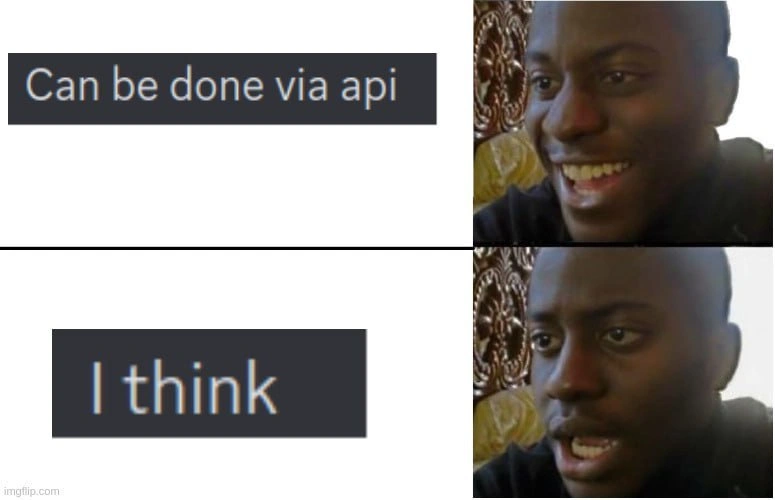
This meme is all about a programmer saying something a bit too confidently, then immediately second-guessing themselves. In the first panel, we see a chat message that says, “Can be done via api,” and a developer smiling brightly. Let’s unpack that: API stands for Application Programming Interface. An API is like a contract or a set of rules that one piece of software offers so that other programs can talk to it. Think of it as a menu at a restaurant: it lists what you can ask the software to do (for example, “get user data” or “send a message”), and if you ask correctly, the software (the kitchen) will serve up what you requested. So when a developer says “can be done via API,” they mean, “We don’t have to build this functionality from scratch – we can use an existing service’s features by calling its API.” It’s a common phrase in software teams, basically suggesting an integration between systems. For instance, if someone asks, “Can our app post tweets automatically?”, a dev might reply, “Sure, Twitter provides an API for that.” The developer is effectively saying yes to a request because they assume there’s a straightforward way to plug into another system’s capabilities.

Now, why the big smile on the right side in panel one? That smile represents the developer’s confidence and relief. They believe they’ve found an easy solution and likely impressed their teammate or boss with a quick answer. In many tech workplaces, being able to say “Yes, we can do that!” feels good – it shows you’re knowledgeable and proactive. Here, the developer was likely thinking, “No problem, I’ll just use the other service’s API, it’ll be quick and easy.” This is a moment of optimism. It might also indicate a bit of people-pleasing: the dev wants to keep the stakeholder (maybe a project manager or a client) happy by delivering good news. The stakeholder hears “via API” and, even if they don’t know the technical details, they catch the confident tone and assume everything’s under control. This is where a communication gap can start – the non-technical person just registers the confidence, not the subtle technical caveats that might be hiding.

Then we get to the second panel. It shows another chat bubble, now saying “I think”, and the same developer’s face has turned from happy to worried. This captures the exact moment doubt creeps in. What changed? Probably nothing external – it’s all in the developer’s mind. Right after promising the API solution, the developer’s inner voice likely whispered, “Uh oh... do I actually know that for sure?” It’s like when you answer a question in class confidently, then second-guess if you heard the question right. In a developer’s context, a few realizations might hit:

  • “I haven’t actually checked the API docs yet.” Documentation is the instruction manual for how to use an API. Perhaps the dev recalled that sometimes things which “should” be available aren’t, or they remember that an API might have limitations (like it might not give the exact data needed, or it might require an API key or permission they’re not sure they have).
  • “Does that system even have a public API?” It’s possible the developer assumed something exists that actually doesn’t. Not every piece of software has an open API ready for use. For example, a junior dev might think, “Oh, we can just fetch the data from that old accounting system via API,” only to later discover that the system is so old it doesn’t expose any API at all.
  • Past experiences and warnings surface: If this developer has been through a few projects, they might have been burned before by underestimating tasks. Perhaps they once said a feature was easy and then spent days struggling with it. The phrase “I think” is a cautious retreat – a sign they remember those lessons.

The humor here is very relatable for developers new and old. If you’re a junior developer (or even an enthusiastic student), you might recall times you said “Yes, I can do that!” to a programming task before fully understanding it. Maybe you told your team lead, “I can integrate the payment system by this afternoon,” thinking there’s a quick API call for it, and then found yourself reading through dense documentation all night. It’s common early in your career to overestimate your understanding of a system. You hear buzzwords like “API” and know theoretically what they are, so you assume usage will be straightforward. The meme’s second part, “I think,” is basically the person remembering oh no, things in programming are rarely that simple.

This situation is also about managing stakeholder expectations. A stakeholder is anyone who has an interest in the project – often a non-developer like a manager or client who is counting on you. When a developer innocently says something is doable via API, the stakeholder might take that as a guarantee. They might start planning around it (“Great, we’ll have that feature next week then!”). If you’re a junior dev, you might not yet be used to how literally some non-technical folks can take your initial estimates or ideas. The “I think” is a soft way to add a disclaimer. It’s the developer trying to communicate, “I’m pretty sure, but I haven’t verified it fully.” However, that little add-on often doesn’t register with the stakeholder as much as the original promise. They might skim past the uncertainty. In everyday team communication, it’s a lesson: saying “I think” or “probably” is not the same as saying “I need to check first.” Clear communication would be something like, “It should be possible via an API, but I will confirm when I look at their documentation.” In the heat of the moment, though, developers often blurt out the optimistic part and only mumble the cautionary part – just like in the meme.

Finally, let’s talk about why the developer’s expression changed. It’s practically a rite of passage in the developer experience (DX) to encounter unexpected hurdles in what seemed like an easy integration. The moment of sudden worry might come when the dev actually starts implementing the solution or drilling into details. Perhaps they remember they’ll need an API key (a special password to use the API) and are not sure how to get it from the third-party service quickly. Or they realize the API might have rate limits (meaning you can only call it so many times per minute), which could be a problem. All these little details can take something from “one-line fix” to “multiple days of work”. The meme humorously compresses that entire journey — from bold promise to uneasy reality check — into two captions and facial expressions. For newer developers, it’s a relatable lesson: always double-check the requirements and external system capabilities before promising a quick solution. The phrase “I think” in that second panel is a tiny peek into the developer’s mind saying, “Oops, maybe I should verify that.”

Level 3: The Over-Promise Pattern

In the top panel of this meme, a developer confidently proclaims, “Can be done via API,” as if it’s a magic spell to solve any integration request. This phrase is practically a design pattern of over-promising in software teams – a knee-jerk reassurance to stakeholders that of course our app can talk to that other system. It’s a bold, happy assertion that leverages the ubiquity of APIs (Application Programming Interfaces) in modern software. Seasoned engineers recognize this as the moment of false confidence in estimations: the developer assumes an external service surely exposes the needed functionality. After all, these days everything from your fridge to your website has an API, right? Famous last words.

But then comes the punchline – in the second panel, a tiny addendum: “I think.” Suddenly, the same developer’s face falls from exuberant to panicked. Why? Because reality set in milliseconds after hitting Enter. That trailing “I think” is the quiet gulp of uncertainty that every experienced engineer has felt. It’s the instant replay of their mental checklist: Did I actually verify that? Do I know the API exists? What if it requires some auth token or isn’t documented? The humor hits home because we’ve all been that person who speaks too soon and then silently doubts their life choices.

This meme nails a common communication gap in tech. The developer’s big grin in panel one represents how good it feels to confidently assure a teammate or a manager, especially under pressure. Maybe a project manager asked, “Can we integrate this new analytics tool with our system?” and the dev, eager to please (and perhaps a bit overconfident), replied with the go-to solution: “Sure, can be done via API!” At that moment, the stakeholder hears certainty and sees no obstacles – expectations are set. The developer likely earned a quick nod of approval or a smile. That’s the high captured in the first image.

However, the second image – the same man now wide-eyed and concerned – reflects the internal nightmare that surfaces right after the promise. The short phrase “I think” might have been typed as a follow-up message or maybe just whispered under their breath. It’s the dawning realization that they might have over-simplified the problem. In real life, this is when the developer frantically opens the API documentation (if it even exists) or googles whether the feature is supported. They might recall a horror story where “via API” turned into parsing unending XML or encountering a mysterious HTTP 404 Not Found for an endpoint that should exist.

This pattern of immediate doubt is funny because it’s true. It highlights the contrast between techno-optimism and technical reality. We like to reassure stakeholders quickly, showing we’re on top of things, but complex integrations often hide nasty surprises. Perhaps the API requires OAuth 2.0 dance for authentication and the developer hasn’t set that up before. Maybe the feature is only available in a premium version of the service’s API, or it’s a brand-new API with skimpy docs. There’s a moment of “uh-oh, what did I just sign up for?” as the developer imagines all the ways this could go wrong.

To seasoned devs, this meme also pokes at the culture of saying “yes” too early. Teams often face pressure to deliver features fast. A confident “via API” can feel like the safest answer – it implies we’ll reuse existing capabilities rather than building from scratch. But if that assumption is wrong, you’ve essentially promised to invent a solution on the fly. Cue the late nights and frantic Stack Overflow searches. In meetings, nobody wants to be the naysayer; it’s much easier to say “yes, we have an API for that” than “let me investigate first.” The result? An entire Slack channel’s worth of memes like this, where the initial euphoria of closing a task quickly flips into the dread of unknown complexity.

Let’s break down why this scenario is so relatable and painful in real software development:

  • Assumed “Easy” Integration: Modern architectures make us believe everything is plug-and-play via APIs. The developer’s smile in panel one channels that optimism. But APIs vary wildly – some are straightforward RESTful endpoints returning JSON, and others are arcane SOAP services last updated in 2005. The moment “I think” kicks in, the dev is remembering an API integration from hell (maybe a funky pagination or an undocumented rate limit).
  • Stakeholder Expectations Set in Stone: The instant you say “It can be done via API,” the stakeholder (be it a manager or client) mentally checks that requirement off as solved. They likely don’t catch the softening that comes after. In the stakeholder’s mind, you’ve committed. The meme’s abrupt mood change embodies the dev’s realization that if they can’t deliver, they’ll have to backpedal and explain why this “easy API fix” isn’t so easy – an awkward conversation no one wants to have.
  • Developer DX (Experience) Reality: In panel one, the dev imagines a smooth experience: great documentation, clear endpoints, maybe even an existing SDK. Panel two is the possible reality: outdated docs, an API that only returns half the needed data, or needing to write a custom connector from scratch. The emotional rollercoaster here is a hallmark of real developer experience – initial excitement about using a new Web Service or API swiftly turning into frustration when confronted with its quirks.
  • The “I Think” Safety Net: Adding “I think” (even if only internally) is a developer’s attempt to hedge their bet. It’s a tiny cushion for their pride: if things go wrong, well, they did say “I think.” It’s funny because it’s too little, too late. Everyone ignores the uncertainty except the developer themself. That I think is basically the sound of imposter syndrome gremlins giggling in the background.

In essence, this meme resonates with engineers because it distills a common experience into a simple two-frame story. The left side of each panel – the chat bubbles – represents what’s being communicated outwardly. The right side – the man’s facial expressions – represents the developer’s inner emotional state. Panel 1 = outward confidence + inner excitement at being the hero. Panel 2 = outward slight retreat + inner panic as reality checks in. The humor lives in that stark contrast. It’s a gentle jab at our tendency to speak with certainty before certainty exists. And it implicitly advises: maybe check the API docs before you beam with confidence – otherwise you’ll end up starring in this meme, experiencing the “happy-then-worried” split second in real life.

Description

This is a two-panel meme using the 'Disappointed Black Guy' format. In the first panel, a young Black man is smiling brightly, looking happy and relieved. To his left is a dark-mode chat bubble with the text 'Can be done via api'. In the second panel, the man's expression has changed dramatically to one of shock and dawning horror. The chat bubble next to him now contains the single, ominous phrase: 'I think'. The humor captures a universally painful moment in software development: when a confident, simple solution is instantly undermined by uncertainty. The initial statement suggests a task is straightforward, but the addition of 'I think' reveals it as an unverified assumption, instantly transforming a clear path into a potential quagmire of undocumented features, API limitations, or a complete dead end. It resonates deeply with experienced developers who understand how quickly such a small qualifier can derail a project or sprint
Comments

10
Anonymous ★ Top Pick That 'I think' is the sound of a 2-point story spontaneously evolving into a 13-point epic during sprint planning
  1. Anonymous ★ Top Pick

    That 'I think' is the sound of a 2-point story spontaneously evolving into a 13-point epic during sprint planning

  2. Anonymous

    “Can be done via API - well, after we excavate the vendor’s WSDL from SharePoint, negotiate the SOAP-over-JMS tunnel, and pray their 2-requests-per-day rate limit is still ‘beta’.”

  3. Anonymous

    Every senior engineer knows that 'can be done via API' is code for 'I haven't checked the rate limits, authentication requirements, or whether they deprecated half the endpoints last Tuesday without telling anyone.'

  4. Anonymous

    The classic API enthusiasm cycle: 'Everything should be API-first!' → reads the actual API documentation → discovers rate limits, authentication flows, webhook reliability, eventual consistency issues, and that one endpoint that returns XML for no documented reason → 'Maybe a direct database call isn't so bad after all.' Bonus points if the API you're excited about is one you're supposed to build yourself

  5. Anonymous

    “Can be done via API… I think” - senior translation: haven’t read the docs; odds are it’s SOAP with nightly CSVs over SFTP, and we’ll still call it integration

  6. Anonymous

    APIs: Where 'plug and play' means authoring your own idempotent client because theirs ghosts on schema changes

  7. Anonymous

    Translation: it’s in the sales deck, not the OpenAPI spec - start a spike, add it to the RAID log, and brace for Postman 401s

  8. @gistrec 2y

    I pray 🙏

  9. @Fanyatsu 2y

    Literally me

  10. @SamsonovAnton 2y

    That awkward moment when the API was designed by yourself.

Use J and K for navigation