The Ultimate Viewing Experience: Oppenheimer in Emacs
Why is this IDEs Editors meme funny?
Level 1: One Tool for Everything
Imagine you have a friend who has a favorite toy or gadget that they insist on using for absolutely everything. Let’s say your friend has a special multi-tool (like a Swiss Army knife) that they love a lot. If you ask, “How are you going to eat cereal?” they might joke, “With my Swiss Army knife spoon!” If you say, “Don’t you mean a normal spoon from the kitchen?” and they go, “Nope,” you’d probably giggle because it’s such a silly, over-the-top answer. They’re basically saying they’ll do a very ordinary thing in a ridiculously difficult way just because they really love their one tool.
That’s exactly what’s happening in this meme. The movie Oppenheimer is a big, exciting film that people usually want to watch on a giant movie screen (that’s what IMAX is — a kind of super huge movie screen for an awesome experience). But the jokester here says they’ll watch it in Emacs, which is actually a computer program for typing code. It’s as if someone said they’ll watch a movie on a little calculator screen instead of in a movie theater. One person thought they misheard and asks, “You mean IMAX (the huge screen)?”, but the friend goes, “No,” meaning they really did mean the tiny computer window.
The funny part is how ridiculous that is. It’s like your friend who loves their gadget so much they try to use it even when it makes no sense. Picture someone insistently watching the latest superhero movie on a refrigerator display or playing a video on their microwave’s little clock screen because “Hey, it has a screen, so why not?!” You’d laugh because it’s a goofy and absurd choice. Here, the “tool” the friend loves is Emacs (a coding tool), and they’re exaggerating that love by saying, “I’ll even watch a blockbuster movie on it!”
So in simple terms: The meme is funny because one friend is so obsessed with their special coding program that they joke about using it in a way nobody ever would. It’s the contrast between doing something the cool normal way (big movie theater) and doing it the nerdy silly way (inside a coding app) that makes it silly. Even if you don’t know Emacs, you can understand it as “using the wrong tool for the job on purpose, just to show how much you love that tool.” It’s just like using a tiny toy hammer to cook dinner when you have a full kitchen – completely bonkers, and that’s why we laugh!
Level 2: Terminal Movie Night
Let’s break this down in simpler terms. This meme is joking about Emacs, which is a very powerful text editor that programmers use – and how one developer is so committed to Emacs that they’ll even use it to watch a movie. Emacs is not just any editor; it’s an old-school, highly customizable program (you can think of it as a programmer’s version of a Swiss Army knife). People often say you can do anything in Emacs. Want to write code? Of course. Need to check your email or browse Reddit? Emacs can, with the right plugins. It even has games like Tetris built in! Emacs fans are proud of staying inside this one program for as much as possible, using Emacs as a do-everything environment. This is part of a long-running lighthearted rivalry known as the editor wars – especially Emacs vs. Vim (another famous editor). Each side jokes about how their editor is superior or can perform crazier feats.
Now, the conversation in the meme: one person asks “How are you gonna watch Oppenheimer?” Oppenheimer is a big blockbuster movie (released in 2023, known for amazing visuals). Normally, you might watch it in a cinema, maybe even in IMAX – which is a format of movie theater with huge screens and advanced sound, meant to give you an incredible viewing experience. IMAX is the opposite of a small computer display; it’s literally the biggest screen experience for movies. So it’s funny when the developer answers, “In Emacs,” and the friend clarifies “You mean IMAX?” and the dev just says “No.” The friend expects “IMAX” (because that sounds similar to “Emacs” and would make sense for watching a grand movie), but the dev really did mean Emacs, the text editor. The humor comes from this misunderstanding and the sheer absurdity: watching a cinematic movie inside a coding tool.
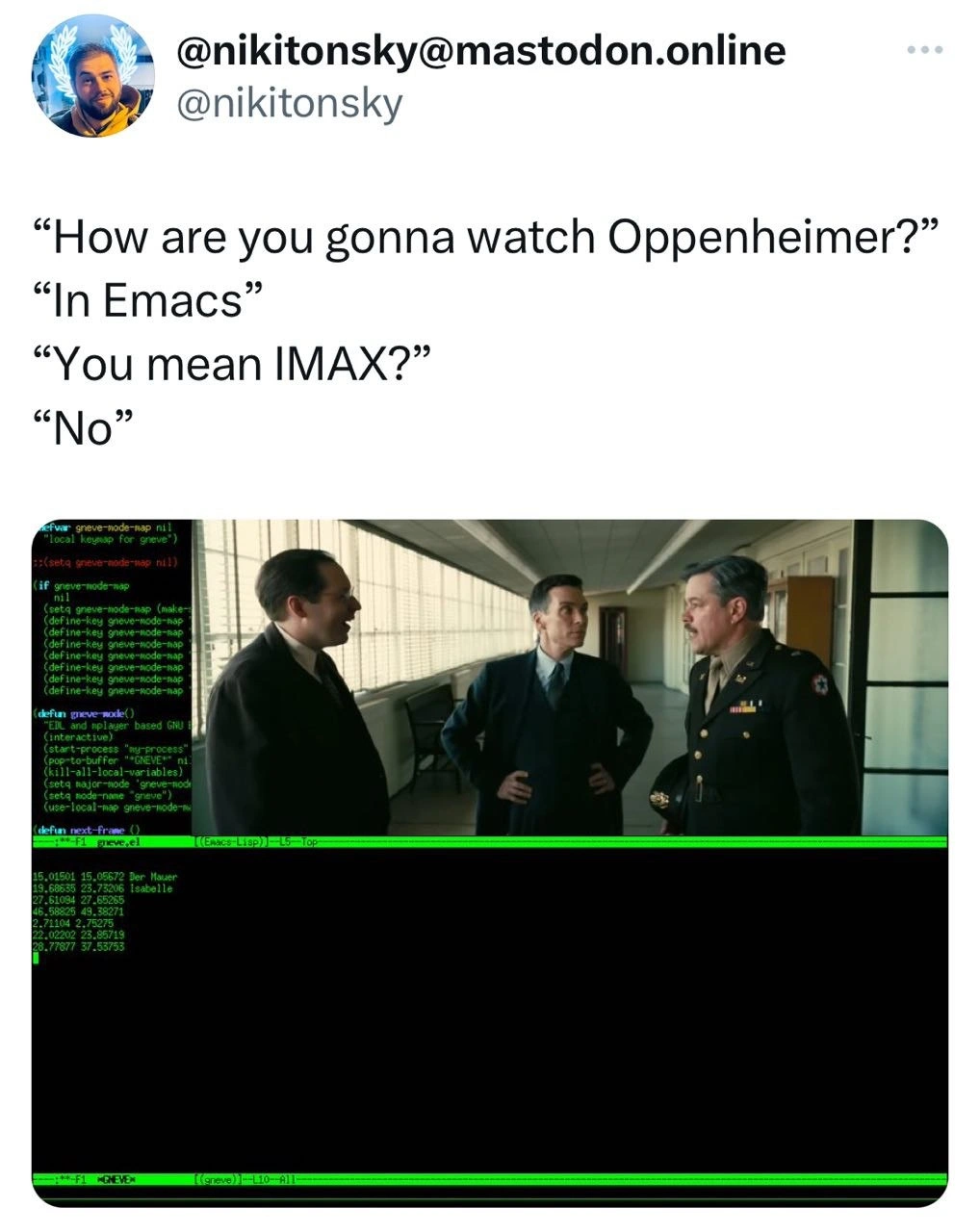
What does watching a movie “in Emacs” even mean? Emacs normally shows text in a window or terminal. However, Emacs is very extensible via a built-in programming language called Emacs Lisp. This means clever users can write scripts to make Emacs do all sorts of non-standard things – even display images or play animations. The meme’s image actually shows Emacs running in a terminal window (black background with bright green text, very “hacker style”) that’s split into sections (Emacs can split your screen into multiple panes, which it calls windows or buffers). On the left, there’s some green text which is actually Emacs Lisp code defining new keyboard shortcuts and functions – basically, the user has coded a mini video player mode inside Emacs. On the right, believe it or not, a frame from the movie Oppenheimer is playing inside that Emacs window. Below that are some numbers and an empty prompt – likely debug info or output from whatever script is running.
So practically, the person probably used a plugin or a hack that allows Emacs to play video frames. One common trick is converting the video into ASCII art or using a special terminal protocol to show images, so the movie appears in a very low-resolution text form inside Emacs. Alternatively, if Emacs is running with a GUI (graphical mode), it can render images, so a script could feed each video frame to an Emacs image viewer buffer quickly (though that’s pretty slow and not the intended use-case!). Either way, the result is a super nerdy version of movie watching – no mouse, no standard media player interface, just your text editor and some custom key bindings to control playback. The CLI (command-line interface) vibe is strong: everything is done with text commands or keyboard shortcuts. This is why the category tags mention CLI and IDEs_Editors – Emacs is a text editor often used in a terminal, and this joke pushes that to the extreme.
To a newer developer or someone early in their career, here are some key concepts to know to appreciate the joke:
Emacs: One of the oldest and most versatile text editors out there. It’s beloved by many programmers, especially those who like to deeply customize their environment. You can program Emacs itself using Emacs Lisp, making it do almost anything. For example, you can open a terminal inside Emacs, edit files, manage project files, and so on. Some devs basically live in Emacs all day – coding, writing documents, reading email, etc., without switching applications. Emacs is often compared to an IDE (Integrated Development Environment) because it can integrate so many developer tools (hence the category DeveloperExperience_DX – it’s about how devs experience their tools).
IMAX: A high-end movie theater format. It means a gigantic screen with very high resolution and immersive sound. People often say, “This movie is so epic, you should see it in IMAX.” Oppenheimer, for instance, was famous for being shot with IMAX cameras, so movie buffs insisted on the IMAX experience. The joke contrasts this with Emacs – which obviously is not a theater at all.
Editor Wars: This is the fun rivalry between programmers over their preferred text editors or IDEs. It’s mostly tongue-in-cheek. Historically, the big rivalry was Emacs vs. vi/Vim. People would poke fun saying things like “Emacs can do everything except make coffee” vs “Vim is lightweight and everywhere, who needs Emacs bloat,” etc. Nowadays, there are also fans of modern editors like VS Code, but Emacs and Vim have very passionate communities with decades of history and inside jokes. EditorWars is an oft-used tag for jokes that reference these debates.
TerminalLife: Many developers, especially those who grew up on Unix/Linux, love the command line interface – the text-based environment to control your computer. “Living in the terminal” means you do most tasks with text commands or text-based tools rather than graphical interfaces. Emacs can run in a terminal (as shown in the meme) or in a GUI, but hardcore users often stick to the keyboard-driven, terminal look. It’s fast and efficient once you learn it, and it looks super technical. This meme cranks TerminalLife up to 11 by doing even a leisure activity (movie watching) in a terminal editor window!
Use your editor for everything: This phrase is basically a tongue-in-cheek motto. Some developers get so comfortable with their editor that they try to extend it to handle tasks outside typical coding. For example, an Emacs user might use Org-mode (an Emacs plugin) to organize their to-do list and calendar, play music through Emacs, or even control smart home devices using Emacs scripts. It sounds crazy, but it’s possible, and it’s part of the fun/enthusiasm of being in that ecosystem. The meme exaggerates this idea to the point of hilarity: everything includes watching a feature film now!
So, bringing it together: the developer in the meme is basically the ultimate Emacs fan demonstrating to their friend that “Who needs an IMAX theater? I have Emacs!” It’s a perfect storm of developer humor because it requires knowing what Emacs is and why using it to play a movie is over-the-top. The misunderstanding (“Emacs” vs “IMAX”) makes it accessible even at a surface level – anyone can see they sound similar – but fully “getting it” comes from recognizing that Emacs is a text editor, something you’d never associate with movie playback. It’s the clash between DeveloperCulture and normal expectations.
In summary, the meme is funny because it shows a coder taking their favorite tool to a ridiculous extreme. It highlights the almost absurd versatility of Emacs and pokes fun at how devs sometimes choose ridiculously complex solutions just because they’re loyal to their workflow. If you’re new to this joke: imagine someone saying they’ll watch a movie on a command prompt window instead of on a big TV – that’s the vibe. It’s hilariously impractical, but within the coding community, it’s a badge of honor to even know it’s possible. Emacs truly is that all-in-one tool… to the point of comedy!
Level 3: Buffering Oppenheimer
At the highest level, this meme highlights the absurd power-user culture of Emacs in a way that makes seasoned developers smirk. The conversation reads:
Friend: “How are you gonna watch Oppenheimer?”
Dev: “In Emacs.”
Friend: “You mean IMAX?”
Dev: “No.”
Here, an Emacs fanatic literally plans to watch a blockbuster movie inside the Emacs editor. It’s a hyperbolic riff on the idea that Emacs can do everything (the classic joke that Emacs is not just an editor, it’s practically an operating system). The humor lands because IMAX is the ultimate cinematic experience – gigantic screens, booming audio – while Emacs is a text-based editor beloved by programmers. The mere suggestion of swapping an IMAX theater for a code editor window is hilariously incongruent. It’s like saying, “Why go to a high-tech cinema when I have my trusty text terminal?”
Why it’s funny to experienced devs: Emacs has a legendary ability to handle any task via customization, thanks to its built-in Lisp interpreter. Long-time Emacs users brag (semi-ironically) that they never need to leave Emacs – they edit code, check email, browse the web, manage tasks, even play games like Tetris, all inside one Emacs session. So watching a movie in Emacs is an over-the-top extension of this “use your editor for everything” philosophy. It pokes fun at the EditorWars culture: Emacs vs Vi vs modern IDEs. Emacs fans are notorious for extreme multitool enthusiasm – if there’s any task to do, someone will try to do it in Emacs. Viewing a Hollywood film in a green-on-black terminal window is an absurdly geeky flex, something only a developer deeply entrenched in CLI and editor culture would attempt. It satirizes the pride programmers take in bending their tools to their will, even when it’s clearly impractical.
The tweet-style format (actually from Mastodon, but mimicking a tweet) delivers the joke as a snappy dialogue. The friend expects to hear “IMAX” – the logical choice for Oppenheimer, known for its spectacular IMAX cinematography – but the developer deadpans “In Emacs,” turning the conversation into a classic misunderstanding pun. The one-letter difference between IMAX and Emacs makes for a perfect play on words. Seasoned devs instantly recognize “Emacs” and likely chuckle because the scenario is simultaneously ridiculous and strangely believable in tech circles. After all, Emacs can display images and even video (with enough tweaking). The screenshot under the quote shows Emacs split into multiple windows (buffers): on the left, bright green Emacs Lisp code defining new keybindings and a gnevc-mode (perhaps “GNEmacs Video Client”?—the details are deliberately cryptic and funny). On the right, there’s an actual frame from Oppenheimer rendering inside Emacs! The bottom panels show either debug output or maybe frame statistics – it looks super technical, reinforcing how over-engineered this stunt is. The Emacs interface has that retro hacker vibe (green text on black) giving the impression of a developer who lives in a terminal.
To a senior developer, this is loaded with inside jokes: Emacs Lisp code customization, splitting Emacs into windows to multitask, and the sheer audacity of doing something so off-label. It brings to mind the proverb "When all you have is Emacs, everything looks playable". It’s a tongue-in-cheek commentary on developer experience: some devs go to extreme lengths to integrate all activities into their development environment (often out of comfort or bragging rights). They’ll watch logs, edit files, chat, and now even watch movies in the same interface. It’s an ultimate expression of the “terminal life” – preferring text interfaces for tasks that normally have dedicated GUIs. There’s also a wink at how Emacs enthusiasts love their Lisp so much, they’d practically script a full movie player in it just to prove Emacs can do it. (In fact, the code snippet suggests new Emacs keybindings were created, likely to control playback – think C-c p for Pause, etc. It wouldn’t be surprising if they bound Ctrl+Alt+M to “enjoy movie”).
This meme also subtly mocks the trade-off of such geeky dedication: yes, you can play a movie via Emacs by piping video frames through some ASCII-art or X11 image hack, but why on earth would you actually do that? The contrast is everything:
| IMAX Theater 🎞️ | Emacs Editor 💻 |
|---|---|
| 6-story tall screen, ultra-wide format | 15-inch laptop screen with monospaced text |
| Cutting-edge projection & surround sound | ASCII/Pixelated movie frames in a buffer, PC speakers |
| Fully immersive cinema experience | Nerd-level immersive in code environment |
| Built solely for watching movies | Built for coding, bent to play a movie (because nerds) |
The table above exaggerates the IMAX vs Emacs showdown. It’s the ultimate theater versus the ultimate text editor. For veteran devs, the joke also harkens back to the long-running editor wars: Emacs users have always touted how their editor can do X, Y, and Z (often teasing Vi/Vim users who stick to a more specialized philosophy). Here, the Emacs user metaphorically “wins” by doing something so outrageous (playing a movie) that no Vim user would even attempt 😅. It’s a playful one-upmanship. Of course, a Vim guru might retort with their own absurd hack (there have been jokes about playing Tetris or running an email client in Vim as well). This kind of arms race of features is exactly what DeveloperHumor thrives on.
In terms of DeveloperExperience (DX), the meme underscores that developers often optimize for personal convenience in ways outsiders would find bizarre. Emacs is highly extensible – it’s essentially a Lisp machine where you can write elisp code to modify behavior on the fly. Need a calculator? Emacs has one. Need to manage Git? Emacs Magit mode has your back. Want to control your music or even play videos? Sure, someone wrote a package for that too (for example, EMMS – the Emacs Multimedia System – can play audio, and tinkering minds extend it to video). The bright green text and keystroke hints in the screenshot show this user probably wrote a custom Emacs mode to interface with a video player or process. It’s inefficient and quirky, but it demonstrates mastery over the tool – a badge of honor in certain dev circles. Seasoned programmers appreciate the insane level of commitment (or stubbornness) it takes. They might joke, “I bet they even have Emacs set up to make popcorn.”
Ultimately, the meme gets a nod of recognition from experienced developers because it captures a real sentiment in tech culture: if you truly love your tools, you’ll use them for EVERYTHING. It exaggerates reality (few people actually watch entire movies in Emacs… hopefully!) to celebrate the endless customization and the slightly crazy pride of being a power-user. It’s an insider laugh at how far “all-in-one editor” thinking can go. The next time someone brags about their editor themes or plugins, you can quip: “Oh yeah? Can it run Oppenheimer in a split buffer?” and watch them either crack up or shake their head. The meme perfectly encapsulates that because you can hacker spirit that senior devs find both ridiculous and admirable at the same time.
Description
This meme is a screenshot of a Mastodon post by a user named nikitonsky. The post presents a short, humorous dialogue: 'How are you gonna watch Oppenheimer?' 'In Emacs.' 'You mean IMAX?' 'No.' Below the text is an image that proves the point: a scene from the movie Oppenheimer is displayed within an Emacs text editor interface. The classic green Emacs mode line is visible at the bottom, and a buffer with Lisp code is shown on the left side of the movie frame. The humor comes from the pun between 'IMAX' and 'Emacs' and the long-running joke in the developer community that Emacs is so powerful and extensible that it's practically an operating system capable of doing anything, including playing movies. It's a classic example of developer humor, where technical feasibility and absurdity are celebrated over practicality, resonating with senior engineers who appreciate the history of the 'editor wars' and the culture of extreme tool customization

Comments
8Comment deleted
Compiling the movie from source in Emacs is still faster than waiting for the webpack build to finish on a modern frontend project
IMAX is cute, but I prefer Oppenheimer in Emacs - mplayer-mode on one pane, org-capture for existential dread, and if the chain reaction drags I just hot-reload the timeline with C-x C-e
When your text editor has been feature-creeping for 40 years, watching movies in it isn't a bug, it's just another major mode. Next up: someone's going to implement IMAX support as an Elisp package and call it 'emacs-imax-mode'
Of course they're watching Oppenheimer in Emacs - after all, it's the only editor powerful enough to handle both splitting atoms and splitting windows. The real question is whether they're using evil-mode or staying pure to the Ctrl-X Ctrl-C lifestyle. IMAX may offer 70mm film and immersive sound, but can it run M-x butterfly to flip cosmic rays and edit the movie in real-time? Checkmate, cinema
IMAX? I prefer M-x: Oppenheimer in one pane, init.el in the other - C-x 3 to split the atom and the window
IMAX for plebs; Emacs users stream Oppenheimer via M-x atomic-render-mode, CRT glow included
IMAX gives you 70mm; Emacs gives you 70 keybindings - stream it over TRAMP, C-x 3 for split-screen, and bind rewind to git bisect
Gnu emacs video editor. 😁 Comment deleted