Generative AI: The Art of the Expensive Proof-of-Concept
Why is this AI ML meme funny?
Level 1: What a Legend
Imagine a dad who had a huge amount of money and managed to spend it super fast, but at the end of it all, he had nothing useful to show. It’s like if someone gave you a million dollars for your birthday, and you spent it all in a week buying hundreds of toy kits and gadgets. Every day you opened a new toy, played with it just a little to show it off, and then tossed it aside. After doing this a hundred times, you’ve burned through all the money. Now you’ve got a room full of half-assembled toys, and nothing that’s actually finished or working.
Now picture that dad smiling proudly and telling his kids this story: essentially confessing, “I wasted all that money on a bunch of experiments that went nowhere.” It sounds pretty silly, right? Normally, you’d expect someone to be embarrassed or upset if they spent all their money and ended up with nothing. But this dad is oddly proud, like he achieved something great. That’s the joke!
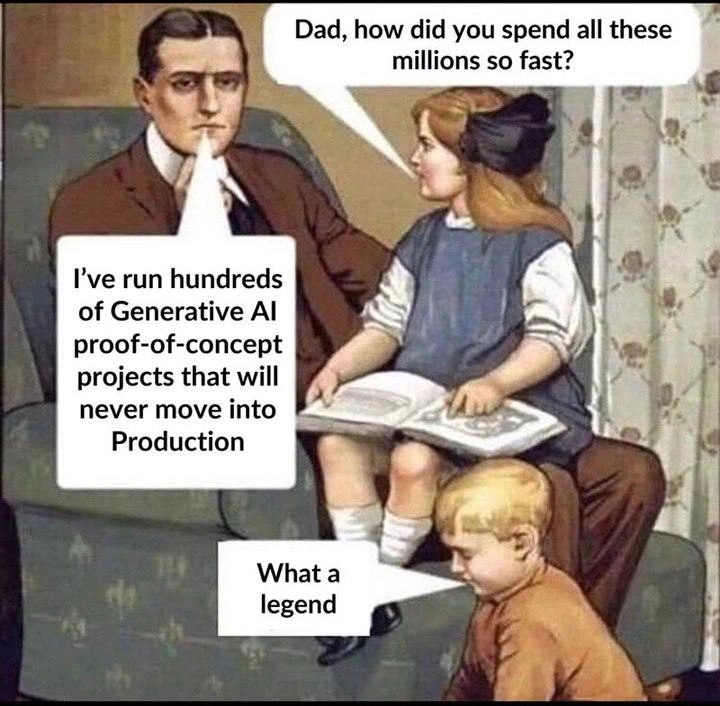
When the daughter asks, “Dad, how did you spend all these millions so fast?”, she’s basically saying, “What happened to all the money?” And the dad’s answer is laughable: he used it to run a bunch of tests and demos of AI projects that never became real products. In simple terms, he poured the money into trying lots of ideas that he never actually completed or delivered. The little brother saying “What a legend” is the punchline. Calling someone a “legend” is usually a big compliment – like they did something amazing or heroic. Here, the kid is saying it about something that’s actually a failure (blowing a fortune without results). It’s sarcasm – the kid doesn’t really mean that Dad is a legend; he’s poking fun at how ridiculous the situation is.
Why is this funny? Because it flips our expectations. We expect an adult (especially a father figure) to be responsible with resources and proud of real accomplishments. Instead, this dad is bragging about irresponsibility and waste, and the kids are cheerfully admiring him for it as if it’s something great. It’s a bit like if a student proudly told their friends, “I started working on 100 school projects and finished none of them!” and the friends high-fived and said, “Whoa, you’re the best!” That would be pretty absurd, and it highlights the folly of what the student did.
In real life, the meme is teasing a common scenario in companies: bosses get excited about a new technology (like AI) and spend a lot of money trying it out in many different ways, but they don’t follow through to make any one of those efforts actually useful. It’s all show and no substance. The humor comes from seeing someone act like that’s an achievement.
So, in the meme, Dad is a “legend” for spending a ton of money really fast and ending up with nothing to show – which is obviously not a great thing in reality. The kids playing along with this joke just emphasize how crazy it is. Even if you’re not into tech at all, you can laugh at the basic idea: boasting about doing something that was totally wasteful, and getting praise for it as if it were wonderful. It’s a bit of silliness and irony that makes the point: being caught up in a craze (and burning money because of it) is not truly admirable, even if someone tries to spin it that way.
Level 2: PoC vs Production
Let’s break down the scenario in simpler terms, especially if you’re newer to the tech world. The meme is talking about Generative AI, which means AI systems that can create content. Think of things like ChatGPT (which can generate text that reads like a human wrote it) or image generators that can make artwork from a prompt. In recent times, everyone got very excited about using these tools in all sorts of products and projects – that excitement is the AI hype we hear about.
Now, what’s a proof-of-concept (PoC)? It’s basically a quick and dirty project to prove an idea might work. Imagine a science fair experiment or a rough draft. In software, a PoC is often a throwaway prototype. For example, a team might whip up a simple app in a week that uses an AI to answer customer questions just to see if it’s interesting or to show it off to their bosses. It’s not built with long-term use in mind – it’s more like a demo or a sample.
“Moving to Production” means taking a project and actually deploying it for real users in the real world. Production is where the software has to run reliably, handle lots of users, and be maintained over time. It’s the difference between a concept car (the shiny model they show at auto shows that isn’t actually for sale) and the real car model that goes to dealerships with proper safety tests and manufacturing. In software terms, production means the code is polished, tested, monitored, and is part of the official product or service offering.
The meme jokes that the dad ran hundreds of generative AI PoCs but none went to production. In plainer words, he started hundreds of little AI demo projects and not a single one became a real app or tool that people could use. And he spent millions of dollars doing this! So you might wonder, how do you spend so much money and end up with nothing launched? This can happen in companies when there’s a lot of buzz about a technology. Executives say “We need to be doing AI!” so they fund lots of small teams or efforts to try ideas out – without thinking through what it takes to actually deploy them. It’s like being so caught up in the excitement of a new toy that you buy many versions of it, but you never figure out how to integrate any of those toys into your daily life.
To understand why going from a prototype to production is difficult, here’s a comparison:
| Proof-of-Concept (Prototype) | Production-Ready System |
|---|---|
| Built quickly to show an idea works once or in a very limited scenario. | Built to work reliably all the time for many scenarios and users. |
| Often made by one person or a small team in a short time, maybe cutting corners. | Made by a larger team with proper processes, taking the time to do it right (design, code review, testing). |
| Very simple and brute-force under the hood. For example, it might call a third-party AI service with a fixed prompt and just print out the result. | Complex under the hood: it needs to handle different inputs, maybe train or fine-tune an AI model, and integrate with databases and other services. |
| Little to no testing. It works on the developer’s machine for the demo, and that’s good enough. | Thoroughly tested. It has unit tests, integration tests, and goes through QA to ensure it works on all supported devices, with different kinds of data, etc. |
| Not secure or scalable – might even use dummy data or no authentication, since it’s just a demo. | Secure and scalable – ready for real user data, has encryption, login systems, and can serve many users without crashing. |
| No maintenance plan – often abandoned after the demo. | Maintained over time – developers will update it, fix bugs, and add features as needed once users start depending on it. |
| Success is “It worked once for the demo!” | Success is “It keeps working every day, and people are happily using it.” |
As you can see, doing a quick demo with generative AI might just involve writing a short script and using an API key to call an AI service a few times. It might cost some money (if you’re using a paid API or renting computing power), but it’s manageable for that short burst. However, turning that into a full product means spending a lot more time and money to address all the things the demo didn’t. You have to consider MLOps – which is a fancy term for the practice of deploying and managing machine learning in production (things like keeping the model updated, monitoring its performance, automating the pipeline from data to model to serving the results). It’s non-trivial, and it often requires specialized skills.
In many companies, the gap between having an idea and making it a real product is where projects falter. Higher-ups love the initial excitement and may even approve big budgets for experimentation. But when engineers come back and say, “This was a cool demo, now we need 6 more months and a lot more resources to make it production-ready,” sometimes there’s hesitation or shock. Maybe the project doesn’t have a strong enough business case, or maybe the company just wanted the PR buzz of saying “we’re experimenting with AI” and wasn’t committed to fully launching it.
So in the meme, the dad basically confesses: all those millions went into playing with AI, but we never actually launched any of it for real. And the kid sarcastically says “legend.” For a junior engineer or someone just starting out, the takeaway is a bit cautionary but important:
- Prototypes are easy, production is hard. It’s often relatively quick to get something working in ideal conditions, but making it work for everyone, all the time, requires a lot more effort.
- Hype can cloud judgment. Just because everyone is excited about a technology doesn’t mean every project with that tech will succeed. One should always ask, “How will this actually work when real people use it? What will it take to support this long-term?”
- Value delivery matters. In the end, a project isn’t very valuable if it never makes it to users. It might be valuable as a learning experience, sure, but you generally don’t want to be the person known for spending tons of money with nothing launched to show for it (despite how the meme jokes about it).
Think of it like this: you could spend a lot of time and money building dozens of model rocket prototypes that look amazing in your room. But if none of them actually fly, and you never launch a single one, you’ve just got an empty wallet and a floor full of rocket parts. A single rocket that actually soars into the sky would beat fifty fancy duds that never left the ground.
Level 3: The PoC Graveyard
For experienced engineers, this meme hits painfully close to home. It’s a satirical look at how companies can fall into the trap of hype-driven development, especially with the recent craze around generative AI. The father in the vintage illustration, in his sharp suit, represents a proud executive or manager. The dialogue has his daughter ask, “Dad, how did you spend all these millions so fast?” to which he replies, “I’ve run hundreds of Generative AI proof-of-concept projects that will never move into Production.” The younger child adds in awe, “What a legend.” The humor here is razor-sharp: he’s bragging about something that is actually a huge failure (wasting money on unreleased projects), and the kids are treating him like a hero for it. It’s a great poke at the absurdity we sometimes witness in tech organizations.
Why would someone be proud of burning cash on prototypes that lead nowhere? That’s exactly the point – they shouldn’t be. But in the real world, during a tech hype cycle, this scenario (unfortunately) plays out a lot:
- Hype-fueled initiatives: An exciting new technology emerges (in this case, generative AI that can produce text, images, etc.). There’s media buzz, perhaps some competitor made a splash with it, and now every executive’s fear-of-missing-out kicks in. They hastily allocate large budgets – sometimes millions of dollars – for “AI innovation.” No one wants to be the laggard in the latest AIHypeCycle. It becomes a top-down directive: “We need AI projects, ASAP!”
- Demo-ware galore: With money available and urgency from leadership, teams spin up Proof of Concept projects at breakneck speed. The mandate is to impress, not to worry about longevity. So maybe one team integrates a GPT-based chatbot into a demo app, another team generates some cool images for marketing using a generative model, yet another scrapes together an AI-powered recommendation engine prototype. These demos are often held together with fragile code and manual steps — a lot of smoke and mirrors. They get presented in glossy executive demos with carefully chosen scenarios where the AI performs well. The goal is to get the “oohs and aahs” in the boardroom. And often, they succeed in that moment.
- The MLOps gap: After the demo, though, the excitement fades and hard questions emerge: “Okay, what will it take to actually launch this for our customers?” This is where many projects die. To go to production, the prototypes need serious work: thorough testing, integrating with the company’s databases or products, setting up proper model deployment (MLOps), addressing security (can we send customer data to that AI service?), and ensuring it can handle real user volume. Frequently, those considerations were either an afterthought or not thought of at all during the rush. The team might realize that the fancy demo was using, say, an open API that can’t be used due to privacy rules, or that scaling it would require 50x the budget. In corporate slang, this is where the project “doesn’t have a clear path to production.” It stalls.
- Rinse and repeat: Instead of solving those messy production issues (which are less glamorous and take time), leadership sometimes prefers to chase the next shiny demo. After all, the first round of demos got them praise for being “innovative.” So why not do another round with a slightly different AI application? It’s easier to make a new splashy prototype than to grind through making one of them actually real. Thus the cycle continues: money gets spent on new proofs-of-concept, each gets its moment of glory in an internal demo day, and then joins its fallen brothers in the PoC graveyard.
(One dark silver lining for the ops team: if a system never makes it to production, it can’t crash at 3 AM and wake anyone up. Of course, that’s cold comfort when you consider the money and time already wasted.)
This pattern is funny in the meme, but in real life it’s a mix of frustrating and tragically common. The phrase “What a legend” is dripping with sarcasm. Within engineering teams, calling someone a legend for wasting resources is a tongue-in-cheek way to cope with the absurdity. It’s like saying, “Wow, great job boss – you achieved literally nothing except emptying our budget, amazing!”
Seasoned developers have seen similar hype waves before. Remember the blockchain frenzy? Tons of blockchain pilots were kicked off in enterprises around 2017: proof-of-concepts for everything from supply chain tracking to grocery loyalty points on a blockchain. Millions were spent. How many of those are mainstream today? Almost none – most quietly died off, because after the initial hype it turned out those solutions were impractical or not actually needed. Go back a bit further and you’ll find the Big Data craze, or the IoT (Internet of Things) buzz. In each case, executives would pour money into experimental projects (“Let’s install smart sensors on everything!”) without fully thinking through maintenance, integration, or real use cases. A year later, you’d find a bunch of disconnected systems and a memo about “refocusing our strategy.” The AI hype of the 2020s followed this familiar script but on an even grander scale, because generative AI demos are highly telegenic (a chatbot that talks like a person! an image generator that makes artwork!) and easy to get excited about.
The meme resonates strongly with engineers who value results over hype. The father’s proud expression is comically at odds with what he’s actually saying. It’s a parody of those end-of-year company meetings where a director pats themselves on the back: “We initiated 100 cutting-edge AI projects this year,” expecting applause – while the engineers in the audience exchange knowing glances, aware that none of those projects made it to customers. The kids calling him “a legend” is the icing on the cake. It’s as if the next generation has been taught that burn rate (how fast you can spend money) is something to admire in tech, rather than actual innovation or revenue.
In truth, no engineer considers a failed PoC spree legendary (except as a cautionary tale). The meme’s dark humor lies in treating a budgetary fiasco as an achievement. It’s cathartic for developers who’ve been through crunch times delivering real, working systems while watching other teams get accolades for pie-in-the-sky prototypes that quietly evaporate. As the meme’s title bluntly says, “Millions Burned on Generative AI PoCs, Yet Zero Reach Production.” For the veterans, reading that is a bitter laugh – it succinctly captures an entire dysfunctional cycle we’ve seen time and again.
Ultimately, behind the laughter is a sober reality: shipping to production is hard, unsexy work, and those who ignore that reality might win short-term praise but often at the cost of long-term success. The real “legend” in a tech company is the team that actually takes one of those ambitious AI ideas and successfully launches it in production, delighting users and delivering ROI. But that team rarely makes the news in a hype cycle – more often, they’re silently toiling away while the hype-chasers move on to the next craze. This meme gives a nod to that irony, and that’s why so many seasoned folks smirk when they see it.
Level 4: No Free Launch Theorem
At the deepest technical level, this meme highlights a hard truth reminiscent of the No Free Lunch theorem in machine learning – here cheekily rebranded as “No Free Launch Theorem.” In essence: you don’t get a production system for free just because you had a cool demo. There’s an unavoidable complexity cost to taking a generative AI model from a tidy Proof-of-Concept (PoC) into a full-scale production service. The father in the meme blew through millions on quick AI prototypes, essentially overfitting his investments to flashy demos while ignoring the fundamental work needed for real deployment.
In machine learning theory, the original No Free Lunch theorem tells us there’s no one model that magically works best for every problem. By analogy, a generative AI solution that seems to work in a controlled demo won’t automatically work in all the messy scenarios of the real world. These PoC projects often overfit to cherry-picked conditions – they look impressive on one or two prepared inputs, but start failing as soon as the input data or context varies. In real deployments, things like concept drift and distribution shift kick in: the data the model sees in production might be quite different from the lab examples, causing its performance to degrade. Without continuous retraining, rigorous evaluation, and careful handling of edge cases, a once-impressive AI model can turn into a clueless mess when confronted with real user queries. The meme’s joke is grounded in this reality: those hundreds of generative AI demos likely never tackled these hard problems, so of course none made it to production.
Moving an AI system to production exposes the hidden technical debt lurking in that fancy prototype. There’s a well-known Google research paper titled “Hidden Technical Debt in ML Systems” which pointed out that the ML code – say, the notebook code for a generative text model – is only a tiny tip of a huge iceberg. Surrounding that are all the support systems: data pipelines to feed the model fresh data, transformation and feature extraction code, configuration management, model serving infrastructure, monitoring, logging, and continuous integration and deployment (CI/CD) for model updates. In a hasty PoC, most (if not all) of these aspects are missing. It’s easy to spin up a demo where you call an API like generate_text(prompt) and show the output. It’s an entirely different ballgame to incorporate that into a scalable, robust architecture that real users can rely on. The father in the meme basically skipped addressing that entire iceberg of complexity – a decision that, from a software engineering standpoint, almost guarantees failure to ship.
Consider some of the deep technical challenges glossed over in hype-driven prototypes:
- Inference latency & scaling: That impressive generative model (e.g., a large language model like GPT) might take a couple of seconds per request on a high-end GPU. In a demo, nobody notices or cares about a 5-second wait. But if you deploy this to production, and 10,000 users hit it at once, you face a scalability nightmare. To serve real traffic, you’d have to employ techniques like model quantization, spinning up clusters of GPU servers, or distilling the model into a smaller one – none of which are trivial. The PoCs likely ignored this, so any attempt to scale them up would hit a wall.
- Cost explosion: The meme explicitly mentions “millions” burned. Generative AI models, especially large ones, are computationally expensive. During a prototype, teams often use generous cloud credits or one-time budget allowances to run heavy workloads or call expensive third-party APIs. If you tried to run the same service continuously for real users, the cloud bills would skyrocket. It’s not unheard of for an AI demo that cost $5,000 in cloud fees to scale to an estimated $5,000 per day if rolled out to all customers. Without major optimization (or a clear business ROI), it’s financially unsustainable. In other words, these PoCs can be demo-ware that only works when you’re willing to burn cash for the wow factor.
- Reliability & safety: In prototypes, teams often ignore error handling and edge cases. If the AI produces a wrong or nonsensical answer in a demo, the developers simply try again or laugh it off. But in production, every failure counts. What if the AI writes something offensive or reveals private data? What if the service goes down? You need guardrails: content filters to prevent inappropriate outputs, fallback rules when the AI’s uncertainty is high, and rigorous testing for bias or errors. Implementing these means additional layers of software and review (often involving legal and ethics teams, especially with generative content). The PoC projects skip all that by nature – they’re usually optimistic “happy path” scenarios only. Confronting the full range of real-world inputs often reveals that the model needs significant tuning or that the concept isn’t as sound as it seemed.
The humor (and pain) here is that these limitations are as unavoidable as physical laws. It’s like trying to violate gravity: if you go up (build a flashy AI app), you must come down (deal with gravity a.k.a. operational reality). Our rephrased “No Free Launch Theorem” means you can’t get a production launch without doing the hard engineering. The father figure in the meme tried to ignore this theorem by running a hundred isolated experiments and hoping that somehow quantity would trump quality. But no amount of budget can cheat fundamental constraints: systems entropy, scalability challenges, and the need for solid architecture.
In fact, one can think of it in terms of a black hole analogy – an “MLOps event horizon.” Once you have plunged a project into the black hole of countless disjointed PoCs, the escape velocity (effort needed) to pull any one of them out into a stable product becomes enormous. Without early planning for production, a prototype gets inexorably pulled into that black hole and disappears (just like all the father’s projects). The punchline is that, from a theoretical and engineering standpoint, this outcome was predictable. There’s no magic AI pixie dust that lets you skip software engineering fundamentals. In summary, the meme’s scenario illustrates a collision between executive over-enthusiasm and the brute facts of technology – a collision that obeys the No Free Launch Theorem every time.
Description
A meme using a vintage-style illustration of a father sitting in a chair with his two children. The image is overlaid with speech bubbles to create a dialogue. The daughter, sitting on her father's lap, asks, 'Dad, how did you spend all these millions so fast?'. The father replies from a large speech bubble, 'I've run hundreds of Generative AI proof-of-concept projects that will never move into Production'. At the bottom, the young son looks up in admiration and says, 'What a legend'. The meme satirizes the massive corporate investment and hype surrounding Generative AI. It highlights the common reality where companies spend fortunes on numerous exploratory 'proof-of-concept' (PoC) projects that ultimately never become production-ready products, effectively burning through cash on the latest tech trend. The son's ironic praise adds a layer of humor relatable to developers who have seen such expensive 'innovation theater' firsthand

Comments
7Comment deleted
The fastest way to burn through a Series B funding round is to create a 'GenAI Initiatives' department and measure their KPIs in the number of PoCs, not products
In other words, they solved the classic MLOps problem by skipping the ‘Ops’ part entirely - an architecture pattern formally known as ‘Jupyter Notebook as a Service.’
The real generative AI breakthrough isn't in the models themselves - it's in generating endless PowerPoint decks about POCs that generate more POCs, creating a recursive loop that burns cash faster than a Kubernetes cluster mining Bitcoin in production
Ah yes, the classic enterprise AI strategy: achieve 'AI transformation' by accumulating a Kubernetes cluster full of Jupyter notebooks that haven't been touched since the demo to the C-suite. It's not technical debt - it's a 'strategic portfolio of dormant innovation assets' that definitely justify next quarter's GPU budget increase
We hit SOTA on PoC throughput - P95 time-to-prod is undefined, but the burn rate autoscaled
We’ve reached SOTA - Slide-Only Tech Adoption; POC-to-prod is 0%, but the GPU burn rate scales linearly
AI PoCs: 100% success at torching budgets, 0% at ever torch.serving in prod