The Two Wolves of Developer Careers: LeetCode vs. Building in a Tough Job Market
Why is this Career HR meme funny?
Level 1: Two Approaches, No Prize
Imagine you’re preparing for a big competition at school. You really want to win a prize. You decide to prepare in two different ways. On one hand, you spend a lot of time solving puzzles and riddles from a book – like tricky math problems or brain teasers – because you heard the competition judges love those. This is like practicing coding puzzles: it’s all about sharpening your problem-solving skills. On the other hand, you also spend time making a really cool project – say, building a little robot or a fancy science fair experiment – because maybe the judges care about seeing something real that works. This is like building an actual app or program: it shows creativity and practical skills. Now, you have these two sides of you, each like a wolf inside you: one loves solving those abstract puzzles, and the other loves creating real stuff. You’d think with all that hard work, you’d surely win the competition, right? But then imagine that, unfortunately, the competition gets canceled or is so tough that neither effort leads to a prize. You end up with no trophy, even though you did everything you could.
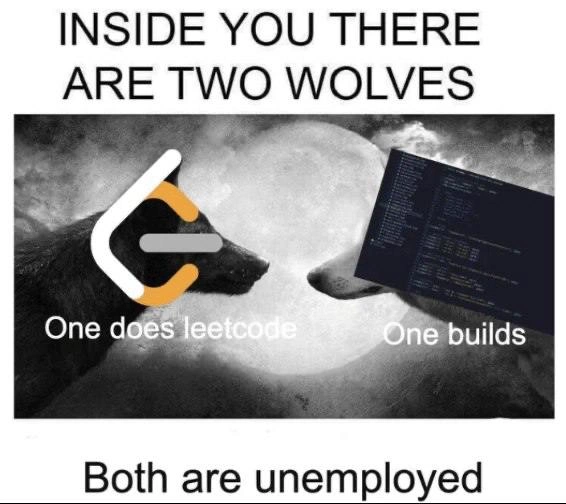
That’s what this meme is joking about, but in terms of getting a job as a programmer. One part of a programmer (one “wolf”) is practicing lots of coding puzzles (like the riddles), and the other part is building projects (like the cool robot). The text says “Inside you there are two wolves. One does leetcode. One builds.” which means the person has these two different strategies inside them. But then it says “Both are unemployed,” which is the funny-sad punch line meaning: even with both strategies, they haven’t gotten a job (no prize). It’s comparing a job to the prize you were aiming for. The emotional core of the joke is a mix of frustration and humor – it’s saying sometimes you can try really hard in every way you know how, and things still don’t work out immediately. For a kid-friendly analogy: it’s like studying hard for a test and doing an extra credit project, but still not getting a good grade because maybe the test was canceled or graded on a curve that didn’t go your way. It feels unfair, but you can’t help but chuckle a little at how unlucky that is. The meme makes people laugh because it’s a way of sharing that “ugh, I know right?” feeling – it’s funny in a relatable way. Even if you don’t know the technical details, you can understand it as two characters (the two wolves) inside one person, each doing their best in different ways, and yet the person is still waiting for a victory that hasn’t come. It’s a lighthearted way to vent about trying hard and being patient when results are out of your control.
Level 2: Coding Puzzles vs Real Projects
This meme plays on the contrast between interview coding puzzles and actual software building. On one side is the “LeetCode” wolf. LeetCode is a popular website where programmers practice solving coding problems. These problems are like brainteasers or math puzzles that test knowledge of data structures and algorithms (think of things like sorting algorithms, searching through trees, or dynamic programming). Many tech companies use these types of questions in job interviews to see how well you can problem-solve under pressure. A developer who “does LeetCode” often spends hours practicing how to, say, find the shortest path in a graph or how to optimize an algorithm to run faster (that’s where terms like Big-O notation come in, which is a way to describe an algorithm’s efficiency). This wolf represents the part of a developer that focuses on interview preparation – grinding through hundreds of practice problems, memorizing solutions to common questions (like reversing a linked list or checking for balanced parentheses), and generally training to perform well in a whiteboard coding session or timed online test. It’s like the academic or theoretical side of being a programmer, where the emphasis is on solving well-defined puzzles correctly and optimally.
On the other side is the “builder” wolf, symbolized by the code editor screenshot. This represents a developer who “builds” real projects – writing code that becomes software people can actually use. Instead of solving abstract puzzles, this wolf might be developing a website, a mobile app, or a piece of system infrastructure. For example, the builder wolf might write code using frameworks or libraries (like building a web app with Django or Express, or a mobile app with Swift/Kotlin). They deal with things like making sure the app works for many users, fixing bugs when something breaks, writing tests to ensure quality, and deploying updates. This side is all about practical engineering: using tools, frameworks, and teamwork to create a product or service. It’s the kind of coding that ends up on GitHub repositories and in real-world use, not just on a whiteboard.
The caption “Both are unemployed” is highlighting a bit of CareerHumor and the tough reality of the job market. Being “unemployed” here means not having a job as a software engineer at the moment. The meme jokes that even though the person has two very different skill sets – one in acing coding interviews and one in building actual software – they still haven’t landed a job. This resonates with developers because in recent times, the tech industry has seen a lot of lay-offs and fewer job openings (JobMarketTrends). Many really skilled engineers find themselves job hunting. The meme is saying, in a tongue-in-cheek way, that it can feel like no matter what you focus on (practicing interview problems or working on real projects), you might still struggle to get hired in a bad market. It’s a nod to the frustration of doing “everything right” and still not getting an offer.
By using the phrase “INSIDE YOU THERE ARE TWO WOLVES,” the meme references a popular internet meme template. Normally, that phrase is used to joke about two conflicting sides of one’s personality or choices. Here those two sides are “one does LeetCode” and “one builds.” Developers often feel torn between two priorities: Should I spend my free time preparing for interviews by doing algorithmic puzzles, or should I build cool projects to showcase my skills? It’s a tough balance, especially for someone looking for a job. The meme humorously personifies this dilemma as two wolves fighting inside you. And the final punch line “Both are unemployed” adds an ironic twist – implying that despite internal struggles and hard work on both fronts, external factors (like hiring freezes or intense competition) mean you’re still not employed. This falls under DeveloperHumor and InterviewHumor because it’s poking fun at something very familiar in tech culture: the sometimes absurd journey of getting a software job. It’s like saying, “Whether you spent your time learning how to invert a binary tree or building the next cool app, you might still be waiting for that offer letter!” Developers, especially those early in their careers or recently laid off, can relate to this dual effort and the exasperation that comes when it doesn’t immediately pay off. The meme uses a bit of dark humor to convey solidarity – if you’re in that boat, at least you know you’re not alone (many of us have inside_you_there_are_two_wolves and we get the joke). It emphasizes the current climate where even being good at both leetcode_vs_builder aspects, which normally would make you a strong candidate, isn’t guaranteeing a job, likely because of broader industry conditions.
Level 3: Whiteboard vs Keyboard
In the developer’s internal battlefield, this meme pits algorithm grind against product-building grind. On the left, the LeetCode wolf is a master of whiteboard wizardry – flashing the LeetCode logo like a badge of honor. This wolf spends nights implementing clever solutions to reverse linked lists and balance binary search trees in $\mathcal{O}(n \log n)$ time. It thrives on Big-O notation, dynamic programming puzzles, and finding the most optimal path through a maze of coding challenges. It’s the part of an engineer that memorizes how to invert a binary tree or write atoi from scratch because technical interviews demand it. On the right, the builder wolf embodies hands-on coding prowess – the screenshot of a dark-themed code editor on its snout symbolizes real-world development. This wolf debugs messy legacy code, crafts new features with frameworks, sets up CI/CD pipelines, and can deploy a microservice faster than you can say “stand-up meeting.” It’s the side of an engineer that just wants to ship product and see real users benefit.
The meme’s punchline lands with dark humor: “Both are unemployed.” 🤦 In today’s bearish tech job market, even a two-wolf combo of skills isn’t a silver bullet. Senior engineers recognize the satire: you can grind LeetCode for months (becoming an algorithms ace) and build impressive side projects (becoming a system architect in your home lab), and still find yourself without a job offer. This hits on a painful truth of Career_HR and InterviewHumor: tech interviews often prioritize puzzle-solving prowess over practical coding ability, yet companies also want candidates with real project experience. It’s a Catch-22 that many seasoned devs joke about to hide the frustration. One wolf has cracked hundreds of LeetCodeProblems (from two-sum to designing LRU caches) and can whiteboard data structures in their sleep. The other has a GitHub portfolio of shipped apps and a knack for fixing real production issues at 3 AM. According to logic, feeding either wolf should lead to success – nail the coding interview or impress with builder experience – yet the JobMarketTrends aren’t so kind. Whether you feed the algorithm wolf or the builder wolf, the outcome feels out of your hands when companies impose hiring freezes or filter resumes by buzzwords.
This meme channels the weary voice of the veteran developer who’s seen colleagues burn out on both fronts. It nods to developer_culture where folks swap war stories: “I solved 150 LeetCode questions and built a full-stack app during lockdown, and all I got was ghosted by HR.” The inside_you_there_are_two_wolves template accentuates this internal struggle with a familiar folkloric absurdity. In the original proverb, the wolf you feed is supposed to win; here, the cynical twist is that no matter which wolf you feed – algorithm expertise or practical building skills – the current market might leave you feeding on instant noodles instead of a salary. It’s a wry commentary on software_unemployment: sometimes being extremely qualified in two very different ways still isn’t enough to land a job. Seasoned devs smirk (or maybe cringe) because they’ve lived this dual life. They know the feeling of cramming LeetCode solutions on weekdays to prep for an interview, then on weekends tinkering with a passion project to keep their coding chops sharp – all while scrolling LinkedIn and seeing no callbacks. The humor is equal parts InterviewHumor and survival instinct: if you don’t laugh, you might cry. This meme resonates as an IT’S FUNNY ‘CAUSE IT’S TRUE moment, capturing that collective frustration of being caught between what the industry says it wants and what it actually hires for (or doesn’t hire for, as layoffs and hiring freezes strike). In a way, it also lampoons the absurd expectation that a “rockstar” engineer should be both a LeetCode grandmaster and a seasoned builder – and yet even those rockstars can end up on the sidelines due to forces beyond their control. The two_wolves imagery perfectly dramatizes the split identity many devs feel: half Interview Prepper, half Software Craftsman, 100% exhausted. The only thing more ferocious than those two wolves inside is the brutal job market outside. As one might joke in dev circles, landing a job in this climate is itself starting to feel NP-hard (a reference only our LeetCode wolf would love) – requiring both luck and optimal substructure. Meanwhile, the builder wolf grumbles that deploying a flawless app in the cloud was easier than navigating the leaky abstraction known as HR. In short, the meme strikes a chord with anyone who’s ever had to toggle between cracking algorithms and cranking out real code, only to find both approaches lead to the same outcome: a LinkedIn profile with that open-to-work banner.
Description
A two-panel meme based on the 'Inside you there are two wolves' format. The top text reads: 'INSIDE YOU THERE ARE TWO WOLVES'. The main image is a dramatic black and white photo of two wolves facing each other, with a large, glowing full moon behind them. The left wolf, representing one archetype, has the LeetCode logo overlaid on its face, with the caption below reading, 'One does leetcode'. The right wolf, representing the other archetype, has a screenshot of a code editor with a dark theme on its face, and its caption is 'One builds'. The final punchline at the bottom of the image declares, 'Both are unemployed'. This meme humorously critiques the dichotomy in developer skill development and the harsh realities of the tech job market. It pits the 'LeetCode grinder,' who focuses on algorithmic challenges to pass interviews, against the 'builder,' who focuses on practical project experience. The punchline, 'Both are unemployed,' subverts the expectation that one path is superior, suggesting that in a difficult economic climate, neither strategy is a guaranteed path to employment. This resonates with experienced developers who are critical of hiring processes that over-emphasize abstract problem-solving at the expense of practical engineering skills
Comments
11Comment deleted
The third wolf inside me just caches the LeetCode solutions and forks the repos. It's a senior staff engineer
Recruiter: "We need someone who can whiteboard an AVL tree while deploying to prod." My inner wolves: *howl in concurrency but still fail the ATS filter*
After 15 years of watching the industry oscillate between 'we need algorithm wizards' and 'we need builders who ship,' I've realized the real pattern is that hiring managers want someone who spent their evenings solving N-queens while simultaneously maintaining a production Kubernetes cluster for their side project that has more stars than users
The real wolf you should fear is the one that spent six months optimizing their resume parser to get past the ATS, only to discover the company went with an internal referral anyway. At least the LeetCode wolf can solve 'Two Sum' in O(n) time, and the builder wolf has a GitHub green squares addiction - but neither prepared them for the O(∞) complexity of actually landing an offer in this market
The modern hiring pipeline is a CAP theorem exhibit: we picked consistency (DSA scores) over availability (actual builders), so both wolves live in a permanent partition called “rejected_by_ATS.”
Whether you invert a binary tree or ship a reliable service, the hiring pipeline still throws ReqFrozenException - headcount=0 and the ATS drops your packet
LeetCode wolf crushes O(n) constraints; builder wolf deploys to prod chaos - recruiter wolf ghosts them both
Yeah, but overall chances of being employed sooner or later is higher for the one, who builds than for a "leetcode fella"🌚 Comment deleted
Its a blessing if you are getting good job with a single 1 hour tech interview talking 20 minutes about oop principles and garbage collector. It means there is little to no competition for this job and pay. If you are aiming for Google, you are ending up with 5 leetcode interviews, just because you are competing with a bunch of math heads who can do it in 3 minutes per task. Comment deleted
At least building is way more fun. Though there are these times where I get a random leetcode burst and tackle some problems Comment deleted
I'm happy none of my wolves vibe code Comment deleted