My Impostor Syndrome Graduated with Honors
Why is this MentalHealth meme funny?
Level 1: I Feel Like a Fraud
Imagine you got a fancy award at school, like a trophy for being great at reading and writing, but deep down you feel it was a mistake. You might think, “Did they really mean to give this to me? I’m not that good, am I?” Now you see a silly story online about a girl who got a top prize from her school even though she couldn’t even read or write at all. Your worried little inner voice jumps up and says, “See! If she can get an award without knowing how to read, maybe your award was a mix-up too! Maybe you’re not really good at this, and everyone just hasn’t figured it out yet.” 😧 The meme is joking about that exact feeling. It’s comparing our secret fear — that we didn’t truly earn our success — to an extreme, funny example. In simple terms, it’s like your mind playing a prank on you: even when you’ve done well, it finds a crazy reason to say “maybe you didn’t deserve it.” The reason it’s funny is that the comparison is so over-the-top and unlikely. It helps us laugh at how ridiculous that self-doubt can be, and reminds us that just because we feel like a fraud sometimes doesn’t mean we actually are.
Level 2: Credential Crisis
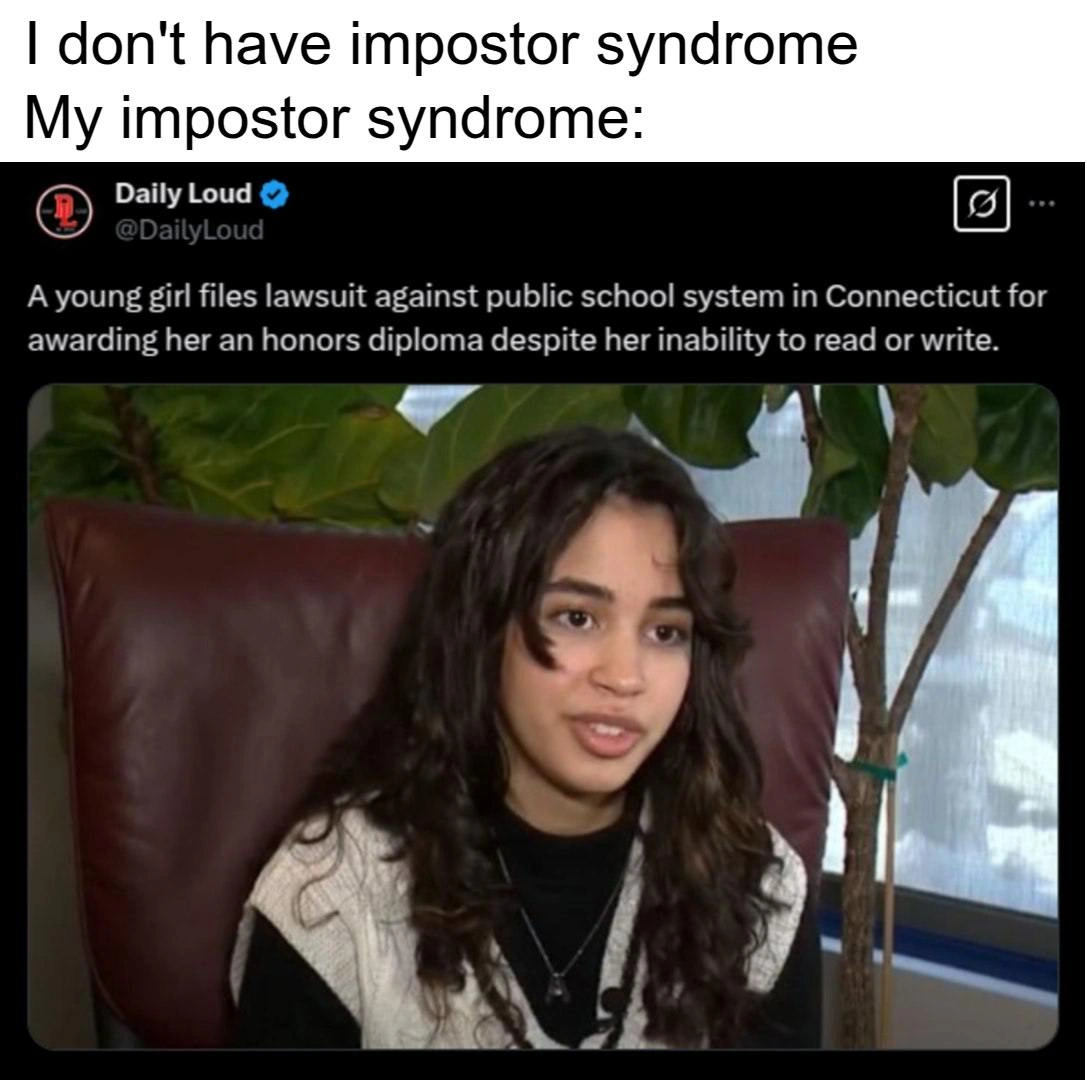
Let’s break down what’s happening in this meme. The term impostor syndrome refers to the persistent feeling that you’re not as competent as others think you are, and that you’ll be exposed as a “fraud” despite your accomplishments. It’s surprisingly common among developers. Here, the meme uses a simple two-line caption to set up a dialogue between the person and their own self-doubt. The first line, “I don’t have impostor syndrome,” is the person essentially saying, “Nah, I’m confident in my abilities.” The very next line, “My impostor syndrome:” signals that impostor syndrome is about to speak up with a rebuttal – almost like a separate character or a little voice in your head. And what does that voice say? Instead of a direct quote, it shows a screenshot of a tweet as its “mic-drop” argument.
The tweet in question is from an account called Daily Loud, and it reports an outrageous story: “A young girl files lawsuit against public school system in Connecticut for awarding her an honors diploma despite her inability to read or write.” In plain terms, this means a girl was given a special high-ranking diploma (something you usually earn with top grades or skills) even though she literally cannot read or write. That scenario sounds almost unbelievable – normally, reading and writing are the basics you’d expect someone to have if they’re getting an honors diploma. The meme’s punchline is that your impostor syndrome seizes on this tweet and basically tells you, “See? It’s totally possible to have fancy credentials without any real ability. That’s what you are – someone who somehow has everyone fooled into thinking you’re good, when really you don’t even know the ‘alphabet’ of coding!” It’s a wild exaggeration, which is exactly why it’s funny and hits close to home at the same time.
For a junior developer or someone new to tech, it helps to know this meme is poking fun at a shared experience. Many developers, even experienced ones, have moments where they feel like they don’t truly know what they’re doing, even if their resume or job title says otherwise. Maybe you landed a great job or aced a coding bootcamp (your “honors diploma”), but you still Google basic syntax or have trouble understanding part of the codebase (feeling like you “can’t read or write” code). Your brain then worries that you’re like that student in the tweet – that somehow you got given an A+ in programming by mistake. In reality, if you’ve made it this far in software development, you do have skills. But impostor syndrome is that nagging doubt ignoring reality. It’s an internal critic that loves self-deprecating humor and dramatic comparisons. The use of a Twitter screenshot is also common in memes – here it serves as a humorous piece of “evidence.” It’s like your inner doubt is holding up this tweet yelling, “Exhibit A!” to prove you don’t deserve your success. Developers find this relatable and laughable because we’ve all been there mentally. Importantly, memes like this also serve to remind us (in a light-hearted way) that mental health in tech matters; feeling like an impostor is a known struggle, and sharing jokes about it makes it a bit easier to cope and remind each other that we’re not alone and probably more capable than that voice claims.
Level 3: Degrees of Doubt
In the developer community, impostor syndrome can feel as persistent and gnarly as a memory leak in a legacy codebase. This meme captures the phenomenon with a dark twist of humor: the coder says "I don’t have impostor syndrome," and immediately their internal critic slaps down a sensational tweet as irrefutable proof that they’re a fraud. Seasoned engineers recognize this all too well. You might have a cabinet full of honors – degrees, certifications, successful projects – yet still fear you “can’t even read or write” code properly. The top text sets up a defiant denial, and the punchline is how quickly that denial is undermined by our own psyche. It’s a parody of those moments in code review or architecture discussions when a little voice inside whispers, “You only got this far by mistake, like someone gave you an honors diploma in programming even though you have no idea what you’re doing.” The meme hits home because that little voice often feels like it has receipts, dredging up any evidence (no matter how absurd) to support its case. Here, it finds a whopper of an example – a tweet about a student granted high honors despite being illiterate – as the ultimate dramatic analogy for “yep, that’s you in tech.”
The humor resonates strongly with experienced devs because it exaggerates a truth we rarely admit openly. Even the 10x engineers and principal architects have nights where they stare at a gnarly codebase they wrote and think, “Was this just luck? Do I actually know how this works?” We’ve all been in that meeting discussing a complex system design where everyone else seems to nod wisely at acronyms and scaling strategies, and you’re internally panicking that you’re missing something fundamental. It’s as if you’re holding an “honor roll” title in Software Architecture but secretly feel illiterate in the system’s complexity. The meme’s tweet – a real facepalm news snippet – is funny because it’s so extreme. No developer literally lacks the ability to read or write code at all (that would be like a computer that can’t process 0s or 1s), but our impostor syndrome convinces us that we’re essentially that unqualified. It’s a classic case of confirmation bias coded into our brains: out of all the data, we cherry-pick the most outrageous story to confirm the narrative that our success must be a fluke.
For the battle-hardened programmer, there’s also an ironic recognition: tech is one field where you constantly feel like a beginner. The more you learn, the more you realize you don’t know. This creates a paradox where highly competent people underestimate themselves (Impostor Syndrome), while less experienced folks sometimes overestimate their prowess (the famous Dunning-Kruger effect). The meme plays on that paradox. The veteran dev chuckles (maybe a bit bitterly) because they’ve seen fresh graduates with fancy honors who struggle with real-world coding, and conversely self-taught gurus who doubt themselves despite moving mountains in code. It’s a shared joke about developer psychology: no matter how many bugs you’ve slain or features you’ve shipped, that sneaky impostor voice can make you feel like you just blundered your way into an “A+” without knowing the ABCs. By quoting an absurd tweet as evidence, the meme cleverly externalizes that irrational inner monologue. It’s both cathartic and comedic – acknowledging the mental health in tech struggle while laughing at how ridiculous that inner logic can be. After all, if our brain is going to act like a troll, at least it picked a pretty on-the-nose meme-worthy example!
Description
A two-part meme about imposter syndrome. The top section contains white text on a black background that reads, 'I don't have impostor syndrome / My impostor syndrome:'. Below this is a screenshot of a tweet from the verified account Daily Loud (@DailyLoud). The tweet's text says, 'A young girl files lawsuit against public school system in Connecticut for awarding her an honors diploma despite her inability to read or write.' The tweet includes a photo of the young woman in question, who has long, dark, wavy hair and is sitting in a chair. The meme uses this real-life, absurd situation as a humorous and hyperbolic representation of the intense feelings of fraudulence that can accompany imposter syndrome in the tech industry. It resonates with developers who, despite their accomplishments, often feel they are unqualified and will be 'found out,' much like someone holding a diploma for skills they don't possess
Comments
9Comment deleted
My imposter syndrome is convinced my entire career is built on a legacy system of Stack Overflow answers that would be deprecated in any modern environment
My impostor syndrome is like a rogue static analyzer: it flags every line I write as ‘undefined symbol: competence’ and still blocks the merge
After 20 years in tech, I've finally realized my imposter syndrome isn't a bug - it's a feature that keeps me from confidently shipping code that passes all tests but nobody, including me, understands why it works
This is the software equivalent of passing all your CI/CD checks, getting deployed to production with full test coverage showing green, and then realizing the entire test suite was just `assert(true)`. We joke about imposter syndrome when we actually know our craft, but imagine shipping to prod with literally zero ability to read the logs or write a single line of code - yet somehow still getting the 'Senior Engineer' title and stock options. It's the ultimate nightmare scenario for anyone who's ever worried their technical interview performance didn't reflect their actual skills: what if the system just... stopped validating competency altogether?
My promotions increasingly look like resume-driven development - honors diploma issued by KPIs, yet I'm still scared to request read/write on prod
The tech parallel: Staff engineer title despite inability to grok the monolith's business logic or defuse a prod incident
Some days it feels like my career got an honors diploma from the same CI that reports success because every test is @Ignore
Peak murica Comment deleted
I used to have imposter syndrome, but then some fucker from an adjacent department just casually deleted all the build system files from the company repo, and nobody noticed for a week Comment deleted