When the eight-hour workday fills up long before the deadline lands
Why is this Deadlines meme funny?
Level 1: The Day Overflows
Imagine you have a small box that represents all the time you have in a day. In the morning, you fill that box with the things you plan to do – say you want to finish your homework and then play your favorite game. That’s your plan, and the box is nicely full with those planned activities. But then reality starts throwing more stuff at you. First, your mom and dad call you for a long family discussion or an extra chore – that’s like a big heavy object dropped into your box, pushing your plans aside (kind of like a meeting an adult might have at work). Then, just as you try to get back to your homework, your little brother spills juice all over the floor and you have to stop and help clean it up. That’s an unexpected problem (like a “bug” in this scenario) that gobbles up more of your time. Now your day’s box is overflowing – it’s crammed with your homework, the long talk, and the clean-up job. Finally, bedtime arrives – think of bedtime like the final deadline when all activities must stop. In the comic, bedtime is shown as a giant rock dropping onto everything. It doesn’t matter that you wished for more time to play or finish homework; when it’s bedtime, it’s game over for the day. Everything in your box – your plans and the unexpected tasks – gets squashed because the day is done. The funny (and familiar) part of this comic is how it shows that feeling when you have way more to do than time allows. It’s using a silly picture with bricks and bugs and a huge boulder to say something we’ve all felt: “I had all these plans, but then so much stuff happened that my day just got completely filled up and then ended before I knew it!” We laugh at the comic because it’s a lighthearted way of showing a frustrating situation – having your day overwhelmed by unplanned things – that pretty much everyone can relate to, whether you’re a busy developer or a student with too much homework.
Level 2: Overbooked Schedule 101
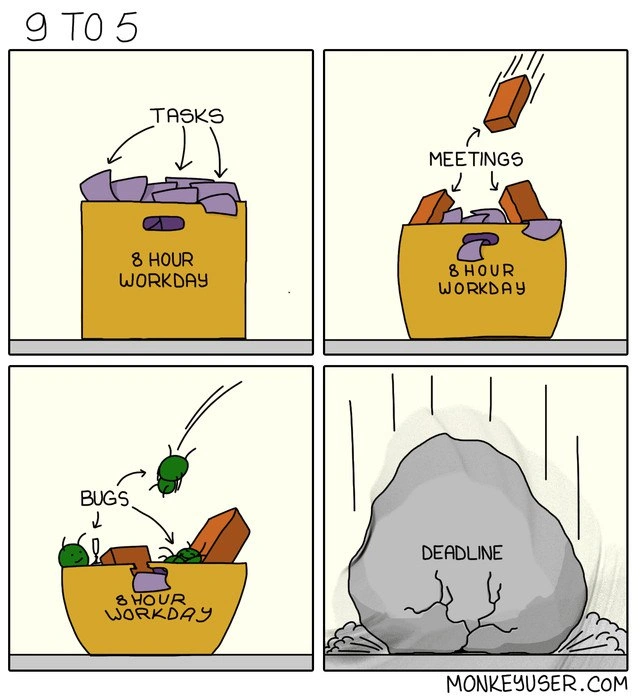
Let’s break down what’s happening in this comic in simple terms. It’s illustrating why a developer’s day often doesn’t go as planned. The yellow box labeled "8 HOUR WORKDAY" stands for the typical workday (about 8 hours of work, usually from 9 AM to 5 PM, hence the title "9 TO 5"). In an ideal situation, a developer would spend most of those hours writing code and completing their tasks. Tasks, in this context, are the planned pieces of work a developer needs to do — for example, coding a new feature, fixing a known issue, writing tests, or reviewing a colleague’s code. In the first panel, those tasks are shown as purple blocks filling up the workday box. At 9 AM, the developer might think, “Alright, I have 8 hours, and I know exactly what I’ll get done today,” fitting those tasks neatly into the schedule.
Now, enter the meetings – depicted in panel two as big brick-like blocks falling into the same box. A meeting is a period of time where you have to stop your solo work and interact with other people, usually to discuss something. Common developer meetings include daily stand-ups (where each team member says what they’re working on), planning meetings, sprint retrospectives, design discussions, or one-on-ones with your manager. Meetings are often necessary for coordination, but they take away time from coding. In the comic, meetings are drawn larger than the task blocks to show how just a few meetings can occupy a large chunk of your day. For example, if you have a 2-hour planning meeting in the afternoon, that’s 2 out of 8 hours gone. And meetings can be mentally tiring – after a long meeting, you might need time to refocus on coding. This is why developers sometimes complain about meeting overload: having so many meetings that there’s barely any time left to do the “real work” (the coding tasks). In an overbooked day, you might see your calendar full of back-to-back meetings, and wonder “When am I supposed to actually code?” The comic humorously shows the meetings physically crowding the tasks in that workday container, meaning the planned tasks are now getting squeezed out or delayed.
Moving to panel three, we see little green bug icons dropping into the box. These represent bugs in the software. A bug is a mistake or error in the code that causes the program to not work as intended. For example, a bug could be a calculation error on a shopping site that makes prices show up wrong, or an app that crashes when you click a certain button. Bugs often pop up unexpectedly — maybe a tester or user finds a serious problem and alerts the development team. When a significant bug appears, a developer often has to pause whatever feature or task they were working on and fix the bug first, especially if it’s affecting users (this is often called “firefighting” in developer slang, because you’re putting out a fire in the software). In the comic, the bugs are shown as unplanned green critters falling into an already full day, which is exactly how it feels: you thought you had your schedule under control, and suddenly you get an urgent message like, “We have a bug in production, drop everything and fix it!” Fixing bugs wasn’t on your agenda, so it’s extra work that doesn’t fit neatly into your original plan. This often leads to developers working late or pushing other tasks to the next day. It’s a big reason schedules slip. In summary, the bug icons illustrate those surprise bug influxes that can derail your day. No developer, especially juniors, likes seeing high-priority bug tickets come in, because it means your planned work is on hold.
Finally, panel four zooms out to reveal a giant gray boulder labeled Deadline crashing down. A deadline is a due date by which something must be finished. For example, your team might have a deadline of Friday to deliver a new feature to a client, or perhaps an app release has to go out by the end of the month. Deadlines are usually set in advance and are meant to keep projects on track. In the comic, the deadline is drawn as huge and heavy to show how imposing it is. It dwarfs the little 8-hour workday box. This implies that when the deadline arrives, it dominates everything. If you haven’t finished your tasks by the deadline (because meetings took time, and bugs popped up, etc.), it’s still game over — the day of the deadline, the work is due whether you’ve managed to do it or not. The humor here is that the deadline comes "crashing down" abruptly. Every developer knows the stress as a deadline nears: you start worrying if you can get all your features completed and bugs fixed in time. That stress is exactly what we call deadline pressure. Even if you’ve been delayed by things outside your control, you feel the pressure to somehow meet the due date. When the comic shows the deadline boulder flattening everything, it’s a comic way to say, “once the deadline hits, it crushes all the remaining work and excuses.” It’s also hinting that often the reaction to a deadline that you’re not ready for is to work extra hours (the equivalent of the workday box breaking, spilling over) – developers might end up staying late, coming in on weekends, or rushing frantically to try to catch up because the deadline won’t budge.
So, putting it all together: this “9 TO 5” MonkeyUser comic is highlighting a day in a developer’s life where everything that could eat up your time does. Your workday capacity is limited (you only have so many hours and so much mental energy in a day). Tasks are the work you want or need to get done. Meetings are work-related obligations that take up time but don’t directly move your coding tasks forward. Bugs are unexpected problems that suddenly demand your attention. And the deadline is the fixed time by which the work must be completed. The reason developers find this comic funny is because it’s extremely relatable. You might start your day optimistic: “I’ll get A, B, and C done today.” Then you have a surprise meeting about project X, then your manager asks you to help debug an urgent issue. Before you know it, it’s 5 PM and that big project deadline looms closer, but you haven’t finished your planned work due to all the interruptions. It’s a tongue-in-cheek way of saying developer frustration is real when your day doesn’t go as planned. The comic uses exaggerated visuals (bricks, bugs, a giant boulder) to make a point: a developer’s day can get overfilled very quickly. If you’re a junior developer (or even just an intern observing the team), this is a sneak peek into why some days everyone sighs and jokes, “I got nothing done today, but I was working non-stop!” It’s because their time was eaten by meetings and emergencies. Understanding this balance is a key part of working in tech: good time management and a bit of buffer for the unexpected can help, but as this comic shows in a funny way, some days the unexpected just wins. At least we can laugh about it together with memes like this, since every programmer has been there.
Level 3: Schedule Overflow Exception
This MonkeyUser comic brilliantly captures a classic developer productivity meltdown: the fixed 8-hour workday is treated as a container with limited capacity, and it’s quickly overfilled by reality. In the first panel, that yellow box labeled "8 HOUR WORKDAY" holds a neat stack of purple blocks marked Tasks. Those represent the coding, code reviews, and feature work you planned to do from 9 to 5. In an ideal world, those tasks would exactly fill your day. But software engineering seldom unfolds ideally — enter the avalanche of everything except coding.
By panel two, large reddish-brown bricks (literally dropping from above) are labeled Meetings. Each meeting slams into your schedule like a heavy block, consuming space and time. Ever notice how a one-hour meeting can derail an entire morning? That’s because of context switching hell: switching out of coding mode to sit through a meeting (and then trying to get back into the flow afterward) carries overhead far beyond the meeting’s calendar duration. The comic exaggerates this by depicting meetings as chunky bricks bigger than the original tasks. It’s a nod to meeting overload – too many Zoom calls, stand-ups, planning sessions, and pointless status meetings that eat away at the day. Every senior dev knows the routine: your calendar gets peppered with enough meetings that your actual coding time shrinks to a few interrupted fragments. The task vs meeting tradeoff is real – each meeting forces some work to spill over or get delayed. The result is an overbooked schedule where even though you technically “worked” all day, you barely wrote any code. As the veteran joke goes, "I survived another meeting that should have been an email."
Then panel three arrives with two little green beetle-like icons plummeting into the crammed container. Yup, those represent bugs – those lovely surprise defects in the software that show up at the worst times. In a developer’s day, a bug is like a high-priority interrupt. One moment you’re implementing a feature, and the next moment an urgent bug report comes in: Production is on fire, drop everything! So the comic shows these bugs literally dropping into your already full work box, causing it to overflow. This is painfully accurate: unplanned bug fixes can take hours of your day, and you can’t exactly schedule them in advance. A critical bug is the kind of surprise that transforms a calm day into firefighting mode. It’s analogous to an operating system getting an interrupt signal – whatever the CPU was doing gets put on hold to handle the interrupt. Here developer time is the CPU resource, and bugs are high-priority interrupts that preempt your regular tasks. Each bug you must fix is time stolen from feature development. Cue the developer frustration: you had a plan, and now you’re chasing a flaky null-pointer exception or a weird memory leak instead. If you’ve ever heard the phrase “surprise bug influx,” this is it in cartoon form – a swarm of unexpected issues piling on when you least need them.
Finally, we zoom out in panel four to see the coup de grâce: a gigantic gray boulder labeled Deadline dropping from the sky. This Deadline is drawn so huge that it dwarfs the 8-hour container and everything in it. That right there is deadline pressure personified – an immovable, heavyweight presence that crushes anything beneath it. The deadline represents the project due date or sprint end that was set possibly weeks or months ago. It’s not flexible or considerate; it’s coming down regardless of how cluttered your workday was with meetings and bugs. The humor (tinged with dark reality) is that the deadline arrives with a mighty crash even though your day was already 110% full. In real life, when a deadline looms and your scheduled tasks have been derailed by meetings and emergency fixes, you’re headed for crunch time. It means late nights or weekends, because the work didn’t magically disappear – you still have to deliver. The comic’s boulder squashing the work box is essentially saying, “Time’s up, ready or not!” It’s a scenario every seasoned developer recognizes: all the planned work that didn’t happen now collides with an unmovable due date. If you’ve ever watched scope creep, meeting creep, and bug creep lead to a disastrously rushed release, this frame hits home. It’s like the universe throwing a TimeOverflowError and then unceremoniously calling throw DeadlineException("Out of time"). Murphy’s Law of software development: the one day you really needed full coding time is exactly when back-to-back meetings and a sev-1 bug will happen. Of course, the deadline doesn’t care – it’s coming down on your head anyway.
What makes this meme so on-point is the shared trauma it satirizes. It highlights that absurd contrast between plans vs. reality in a dev’s workday. The fixed-size “9 to 5” container is a lie we tell ourselves to feel in control. In theory, with proper timeboxing and agile planning, we allocate our 8 hours to specific tasks and expect to hit our deadlines. In practice, people keep tossing more bricks and bugs into our bucket. There’s a rich irony here familiar to any senior engineer: managers often assume an 8-hour workday means 8 hours of coding, but by 5 PM you’ve maybe written 10 lines of code because you spent your day in meetings and emergency triage. The comic exaggerates it for effect (giant boulder and all), but not by much! The time management pain it depicts is very real. It’s essentially showing a workday capacity problem: too much input (tasks, meetings, bugs) for a fixed output (hours in a day). We’ve all seen projects where no buffer was left for unexpected work – and inevitably, something unexpected always comes. The result? A mad scramble at the end as the deadline barrels down. The humor has a cathartic edge; we laugh because we’ve been there, and it’s better to chuckle than to cry about it. This comic is a gentle nod that says, “You’re not alone – everyone’s day gets wrecked like this sometimes.” And it’s also a bit of a sly critique: maybe, just maybe, if we want to avoid being flattened by the deadline boulder, we need to stop overstuffing our days. Until then, welcome to the developer’s nine-to-five reality – which often means nine-to-nine once the dust settles (8 12-hour workdays, anyone?). In summary, the meme hits on a fundamental truth in tech: there’s always more stuff to do than time allows, and something’s gotta give – usually your sanity, as you watch that deadline hurtle toward your overflowing day.
Description
Four - panel MonkeyUser comic titled “9 TO 5”. Panel 1 shows a yellow tote-shaped container labeled “8 HOUR WORKDAY” already packed with purple blocks; arrows point to them with the word “TASKS”. Panel 2 shows the same container as large reddish-brown bricks rain down; arrows label them “MEETINGS”, visibly reducing free space. Panel 3 has two green insect icons falling toward the container; arrows label them “BUGS”, and the box now looks stuffed and unstable. Panel 4 abruptly zooms out to a gigantic gray boulder labeled “DEADLINE” crashing onto the scene, dwarfing everything beneath it. The bottom right corner bears the credit “MONKEYUSER.COM”. Technically, the strip satirizes typical developer days where scheduled tasks, unexpected meetings, surprise bugs, and looming deadlines all compete for the fixed capacity of an eight-hour work window, showcasing productivity trade-offs and time-management pain familiar to engineering teams

Comments
6Comment deleted
Our eight-hour workday is an immutable struct; leadership keeps treating it like a resizable vector - so when the deadline meteor lands, everyone acts surprised at the SIGABRT
After 20 years in tech, I've learned that Sisyphus had it easy - his boulder didn't spawn critical production bugs at 4:45 PM or require a 'quick sync' meeting to discuss why it keeps rolling back down
The real tragedy isn't the deadline boulder - it's that the 'TASKS' from panel 1 are still somewhere in that pile, untouched, while you're in your fifth meeting explaining why the bugs from the previous sprint's rushed delivery are now blocking this sprint's rushed delivery. At least the boulder is honest about its weight
The classic workday stack overflow: push tasks, memcpy meetings, leak bugs, segfault on deadline
Capacity planning assumes Tetris packing; reality is NP-hard bin packing with adversarial items called 'meetings' and 'bugs', and the deadline arrives as a non-maskable interrupt
My calendar is a single-core CPU: tasks run until meetings get real-time priority, bugs fire interrupts, and then the scheduler drops “Deadline” like a kernel panic