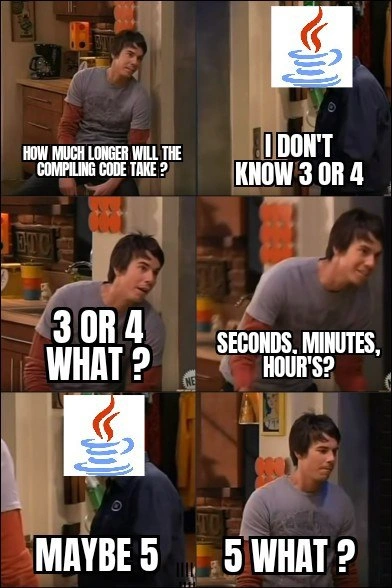
Java compile time estimate goes from “3 or 4” to “maybe five”
Why is this Compilers meme funny?
Level 1: Are We There Yet?
Think about a time you were on a long car ride and you asked the driver, “How much longer until we get there?” Maybe your mom or dad answered, “Almost there, about 5 more.” Five more what, you wonder? 5 minutes? 5 hours? 😕 It’s super confusing when someone doesn’t finish the sentence. You’d probably ask again, “5 what?!” because there’s a big difference between 5 minutes and 5 hours in a car! If they then nervously said, “uh, maybe 5 more, I’m not sure,” you’d be pretty annoyed, right?
This meme is exactly like that, but for computer programmers waiting for their code to finish processing. The programmer is asking his computer “How much longer?” The computer’s answer is basically “I dunno, 3 or 4… (something).” That’s like a parent saying “we’ll arrive in 3 or 4” and not saying if it’s minutes or hours. It’s a silly, frustrating answer. When the programmer yells “3 OR 4 WHAT?!”, the computer realizes it hadn’t specified and goes, “seconds, minutes, hours?” Now the programmer is really exasperated 😤 — it’s clear the computer actually has no idea how long it will take. Then the computer changes its guess to “maybe 5,” still without saying the unit (5 could be minutes, could be hours!). The poor programmer ends up just as confused as before, just like a kid in the backseat not getting a straight answer.
Why is this funny? Because it’s a big exaggeration of a real feeling: waiting without knowing how long you’ll be waiting is frustrating, but in a ridiculous way. We laugh because we’ve all been in that situation where the answer we get is hilariously unhelpful. It’s making a joke that even a computer can act like that parent who doesn’t give a clear answer. In real life, programmers often joke that when their code is “compiling” (which means the computer is busy turning their code into something it can run), they never know if it’ll finish super quick or if they have time to go grab a coffee.
So, picture yourself eagerly waiting for something – like cookies baking in the oven – you ask “How much longer till the cookies are done?” and imagine the person watching the oven shrugs and says “I dunno, 3 or 4.” You’d laugh and say “3 or 4 what, minutes? hours? days?!” It’s funny because the answer is so incomplete it’s useless. In the end, the joke is a playful way to say: sometimes we just have to wait, and even the one in charge (the computer, the parent, the oven) can’t tell us exactly how long – and that uncertainty is both funny and a little annoying!
Level 2: Coffee Break Compilation
Let’s break down the situation in simpler technical terms. The meme is about compiling code (specifically Java code) and the frustratingly vague time estimates that come with it. First off, what does compiling mean? When you write code in a language like Java, you can’t run it directly on your computer’s processor. A program called a compiler has to translate your human-readable source code (those .java files full of classes and methods) into a lower-level form the machine or a virtual machine understands. In Java’s case, the compiler produces bytecode (inside .class files), which the Java Virtual Machine (JVM) will execute. This translation process is the compile, and it’s one part of the overall build process.
Now, Java is known to have a pretty involved build process, especially for large projects. A typical build pipeline for a Java application might involve:
- Compilation: converting all your source code into bytecode. If you have hundreds of source files, the compiler goes through each. Modern build tools will only compile files that changed, but sometimes a change in one file forces many others to recompile (for example, if you change a widely-used interface).
- Running tests: Most projects automatically run a suite of unit tests after compiling to make sure nothing is broken. Tests themselves take time, and if there’s a lot of them, that’s additional waiting. This can blur the line of “compiling time” versus “overall build time” – developers often lump it together when they complain “Ugh, my build is still running.”
- Packaging: After compiling, tools like Maven or Gradle might bundle the classes into a JAR (Java Archive) or WAR (Web Archive) file. Packaging might involve compressing files, copying resources, etc. Usually not huge, but it’s a step.
- Integration steps: In a CI/CD (Continuous Integration/Continuous Deployment) setup, the pipeline could also deploy the build to a test server or run integration tests. These steps go beyond compiling, but if someone is waiting to see their code run, any of these steps can be part of the “time it takes.”
Now imagine a junior developer or anyone new, watching the build output scroll by and wondering “how much longer?” If they ask the senior dev or just talk to the screen (we all do that, right?), “How much longer will the compiling take?”, they’re hoping to hear something like “Oh, about 30 seconds more.” But often, you don’t get a clear answer. Build tools typically show either a percentage or just logs of what file is being compiled. They might not say “2 minutes remaining” because it’s hard to estimate accurately. So, in this meme, the Java compiler is personified and answers “I DON’T KNOW 3 OR 4”. That is deliberately incomplete: 3 or 4 what? It’s funny, but it reflects reality — without more info, “3 or 4” could mean 3 or 4 seconds, 3 or 4 minutes, or maybe even hours 😨 for a huge project!
The questioner yelling “3 OR 4 WHAT?” is exactly the confusion a newer dev might have. If someone told you “this will take 3 or 4,” you’d naturally ask, 3 or 4 what unit of time? Because 4 seconds vs 4 hours are very different outcomes! The compiler then sheepishly replies “SECONDS, MINUTES, HOUR’S?” basically listing possible units — not helpful at all! It’s basically saying “I’m not sure if that ‘3 or 4’ was in seconds, minutes, or hours.” This is a playful take on how imprecise progress indicators can be.
In many IDEs (Integrated Development Environments) or build tools, you might see something like “BUILD SUCCESSFUL in 3m 27s” after it’s done, but while it’s running you often have no idea if it’s nearly finished or not. Some tools show you how many modules or files are left to compile, but even then, some files might be much larger or trigger more work. So an estimate like “3 or 4” is as good as anyone can do without detailed profiling. New developers quickly learn that compiling code can sometimes be quick (seconds) for small changes, or painfully slow (minutes to hours) for big projects or initial builds. This meme dramatizes that learning in a funny way: the Java compiler basically says “Could be a few seconds… or maybe a few hours… who knows?”
Let’s define a few key terms and tags that were mentioned:
- Compilers: A compiler (like
javacfor Java) is the program that converts source code into another form (machine code, bytecode, etc.). It performs checks and optimizations as it does this. A fast compiler might be done in blink for a small project; a slow one might churn for a while, especially if the code triggers complex analysis. - Build Process / Build Pipeline: This is the series of steps to go from code to a runnable application. It often includes compiling, testing, and packaging steps as mentioned. In modern development, a CI pipeline (continuous integration pipeline) automates this every time code is pushed or merged. So developers experience this waiting regularly. The tags like
BuildSystems_CICDhint at tools (like Jenkins, Travis CI, or GitHub Actions) that run these pipelines. Those systems might queue jobs, and if multiple projects are building, your job might wait (increasing uncertainty of when it finishes). - DeveloperFrustration / DeveloperPainPoints: Slow and unpredictable compile times are a classic developer pain point. They disrupt your flow of thought. Imagine you’re writing code, you compile to test it, and then you have to sit idle for a few minutes – you lose momentum. This frustration has led to many jokes and coping habits. For instance, there’s a running joke: if someone asks a programmer “why aren’t you working right now?” they might respond “My code is compiling.” It’s almost an excuse built into the culture because everyone understands you can’t do much until the computer finishes building the code. The meme plays on exactly that: the person wants to keep working (or see the result), but they’re blocked waiting, and the compiler isn’t giving a straight answer on how long that block will last.
- CompilingCode & CodingHumor: The idea of code compiling has been fertile ground for humor. There are T-shirts and stickers saying “Go away, I’m compiling” and as mentioned, comics depicting devs relaxing or doing something else during long compiles. It’s humorous because it’s a shared experience of downtime. In fact, in some workplaces, engineers might literally go for a coffee break or chat at the water cooler while waiting for a build – hence our subtitle “Coffee Break Compilation.” 😉 The meme shows that comically: by the time the compiler changes from “3 or 4” to “maybe 5,” the person waiting is so exasperated, likely thinking “I could have made coffee by now!”
- Java’s reputation in this context: Java isn’t the only language with compilation delays (C++ can be even slower to compile large code, for example), but Java’s build tools (Maven in particular) are known to sometimes take their sweet time, especially if doing more than just compiling. Also back in the early 2000s, Java IDEs like Eclipse would continuously compile in the background (which was nice), but bigger projects still lagged. By 2020 (when this meme was posted), many Java devs had moved to Gradle builds or newer tools – some improvements, but the fundamental wait still exists on big projects. So it’s a well-understood joke in the Java community that build time estimates are unreliable. If you see that little coffee-cup logo (the Java icon) next to a progress bar, you know you might be waiting a bit – how long exactly is anyone’s guess.
An example from personal experience: The first time I worked on a Java enterprise project, I ran the build expecting it to finish in a minute. Five minutes later, I was staring at the console logs thinking “did it freeze?”. Then it finally finished after ~8 minutes. The build output said something like “BUILD SUCCESSFUL in 8m 12s”. I remember wishing it had told me at the start that it would be 8 minutes, because I would have gone to grab a snack. 😅 This meme encapsulates that exact sentiment: if the compiler just said “hey, go take a break, I need ~10 minutes,” it’d be less frustrating than it saying “almost there… or not.”
To connect it to a very simple everyday concept: think of waiting for a file download or an update on your computer. It sometimes says “2 minutes remaining” then jumps to “10 minutes remaining” unexpectedly. As a user you’re like, “Which one is it?!” Developers face the same with compile times. Early in your career, you learn that these time guesses are often unreliable. That’s why devs joke about them instead of trusting them. The tags like TechHumor and DeveloperHumor indicate this is squarely in the realm of “jokes only programmers would fully get.”
So to summarize the technical part in plain terms: The meme is showing a programmer asking how long a Java code compilation will take. The Java compiler (as a character) gives a super vague answer “3 or 4” (with no unit of time). When pressed if that’s seconds or minutes, the compiler basically admits it could be either, or even hours. Then it ups the number to “maybe 5” (still not saying 5 what). This is funny to programmers because it dramatizes the terrible feedback we sometimes get from our tools. It’s like the compiler is trolling the user. Building software can sometimes feel like watching a pot that refuses to boil when you’re in a hurry. Developers have to learn patience, or use tricks (like incremental builds, or having powerful computers) to reduce the wait. But nearly everyone in coding has experienced the “just one more minute… okay maybe a few more… actually not sure” situation, and that’s exactly what’s being joked about here.
Level 3: Compiler Time Dilation
For any seasoned developer, the humor in this meme is painfully relatable. It’s riffing on the common experience where build times seem to stretch and stretch — what you thought would be a quick recompile turns into an interminable wait. The dialogue “3 or 4… Seconds, minutes, hours? Maybe 5…” nails that scenario where an initial optimistic estimate keeps getting revised upward. It’s basically the compiler saying: “Oh it’ll be done soon… well, ‘soon’ is relative… actually, I have no idea when it’ll finish.” If you’ve ever stared at your screen waiting for a build to complete, you’ve lived this joke.
Why is this combination of elements so funny to developers? It’s because it perfectly captures a shared frustration in software development:
- Uncertain feedback loops: A key aspect of good Developer Experience (DX) is a fast, predictable edit-compile-run cycle. When you ask “How much longer will the compiling code take?”, you’re eager to get back to coding or see your app run. The meme’s answer is a hilarious non-answer – "3 or 4" – which is exactly what you don’t want to hear. It’s the compiler’s equivalent of a shrug.
- Ambiguous estimates: “3 or 4 what?” hits home for anyone who has dealt with vague time estimates in tech. It’s reminiscent of those moments where a build tool or installer says “a few moments remaining” but doesn’t specify if that’s seconds or eons. The humor is amplified because the Java compiler logo first gives a number with no units (as if it’s so sure it doesn’t even specify), and then admits even the units are up in the air. It’s a classic comedic escalation: the more the questioner tries to pin down the answer, the more the answer itself inflates (“maybe five”) and still no units! This pattern tickles developers because we’ve all watched a 30-second compile creep into minutes.
- Shared pain and anti-patterns: In real projects, long compile times often signal bloating codebases or heavy processes. There’s an unspoken camaraderie (and trauma) among devs who work on large Java or C++ projects where a full build takes ages. The meme indirectly satirizes the “just a quick rebuild” lie we tell ourselves. We recognize the scenario: you make one small change, expecting a lightning-fast recompile, but your build tool insists on recompiling the world, running a battery of tests, bundling everything… and here you are, staring at a progress bar that’s stuck. The text “SECONDS, MINUTES, HOUR’S?” is funny because it’s exactly the range of possibilities that flash through a dev’s mind when the build seems sluggish – “Is this going to finish in a blink, or should I go get lunch?”.
- Real-world production of this situation: Consider a big enterprise Java application built with Maven. You ask a teammate, “Hey, can I run the app soon?” and they say “couple more minutes, I think.” Five minutes later, tests are still running, some CICD post-compile step is packaging a fat JAR, and your teammate sheepishly updates: “Maybe five more.” This meme could literally be a conversation overheard during a team build session or a daily stand-up: "Build’s 90% done... oh wait, integration tests started, so... 3 or 4... something." Everyone groans, because they’ve been there.
There’s also a cultural reference in the meme’s format: the six-panel, sitcom-style confrontation. The tags hint at a “Big Bang Theory” or similar sitcom meme format, where a character asks a question and gets absurdly unsatisfying answers. The Java logo on one character’s face personifies the Java compiler as this clueless, awkward friend who just doesn’t have a straight answer. The questioner’s escalating exasperation (“3 OR 4 WHAT?!” and later “5 WHAT?!”) mirrors a developer’s rising irritation when the build time keeps expanding. It’s funny because it’s true — we often joke that our tools have a mind of their own. Here Java (the compiler) is portrayed as that friend who always says “I’ll be ready in 5 minutes” but never specifies whether they mean literal minutes or “five-minutes-ish”.
Industry patterns/anti-patterns being satirized: This meme is poking fun at the unreliability of time estimates in software tasks. Whether it’s story point estimates in Agile or a compiler’s progress, tech work is notorious for unexpected delays. A senior dev reading this might recall the classic rule: “Always double your time estimate”. The Java compiler’s “maybe five” is literally an upward revision of an earlier guess — an all-too-familiar scenario when deploying or compiling: “It’s 99% done… actually maybe give it another few minutes… or hours.” It also reflects an anti-pattern in build processes: monolithic builds that take forever. Modern best practice is to keep builds fast (with microservices or incremental builds), but reality often falls short. Many teams still endure a single huge codebase that rebuilds entirely even for a small change, yielding these unpredictable wait times.
Systemic issues making this “too real”: Why do we keep ending up with slow, nebulous compile times? Often because of:
- Large dependency graphs: Java projects can have thousands of classes and tons of library dependencies. One tweak might invalidate caches and require recompiling numerous modules. The build system (Maven/Gradle) tries to manage this, but if a low-level dependency changes, everything above it must be checked or recompiled. It’s like a house of cards – pull one and a huge section gets rebuilt.
- Build pipelines doing more than just compile: In continuous integration (CI) environments, a “build” might also run static code analysis, style checks, unit tests, integration tests, packaging, and deployment steps. Each of those can add unpredictable duration (tests might hang or vary in runtime). So the question “how much longer compiling will take” might really mean “how long until the whole pipeline finishes”. The meme’s open-ended units (seconds? minutes? hours?) reflect that unknown: maybe compilation finishes soon, but then you discover there’s a long test suite running or an artifact uploading slowly.
- Tools and scripts that lie: Some build tools attempt to give ETA updates but often do so poorly. Ever see “Building (ETA: 2 seconds)” and then it stays stuck for 30 more seconds? We have, and it’s infuriatingly funny in hindsight. The compiler in the meme is basically one of those tools caught in the act of making up estimates. It’s calling out how progress bars or timers can be more optimistic fiction than reality.
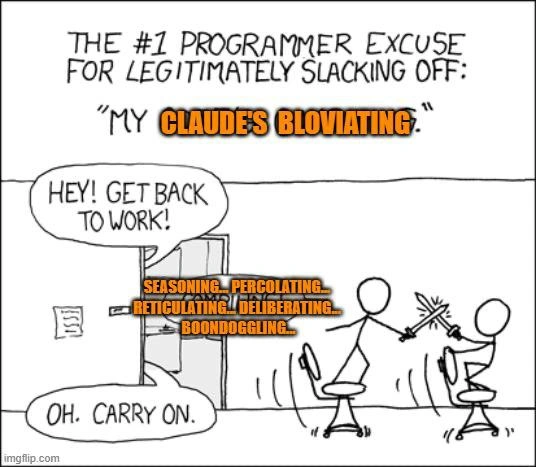
The human cost and coping mechanisms: The frustration captured in the last panel (“5 WHAT?” with the questioner’s face-palming expression) is something devs bond over. Long compile times break your flow and can even lead to burnout or context-switch fatigue. You might start a compile and then… scroll Twitter or wander off for coffee. In fact, there’s an unwritten rule in offices: if someone’s pacing around or doing nothing at their desk, just nod — they’re probably “compiling.” This meme is essentially developer humor as therapy. We laugh so we don’t cry about all the hours lost staring at progress bars. One famous XKCD comic even shows programmers engaging in a sword fight, justifying it with “compiling…”. That’s exactly this phenomenon – when the build is running, developers feel both frustrated and freed to do something else (because they can’t do much until it’s done!). It’s a running joke that compiling time is when developers get to goof off or grab a snack. So the meme’s situation, while absurd in wording, is totally relatable: we’ve all asked a teammate or our computer “are you done yet?” and gotten a useless answer.
Trade-offs and why we repeat this: You might wonder, why not fix these slow builds once and for all? Often, shortening compile time requires significant changes: breaking the project into smaller modules, investing in faster build tools, or even choosing a different programming language. Those solutions have their own costs: more complex project structure, new toolchains, or losing some benefits of the current language. Many teams decide to live with a 5-minute (or 30-minute) build because refactoring everything is deemed more painful or risky. Plus, there’s a kind of inertia: “It’s been this way for years, we just schedule our coffee breaks around it.” Over time, a sort of dark humor develops around it – exactly what this meme exemplifies. It’s the kind of inside joke you’ll hear in companies: “Our build says ‘a few minutes’ but we know that means go take a walk.”
In summary, from a senior developer’s perspective, this meme is funny because it’s true. The Java compiler's wildly vague estimate lampoons every overly optimistic build progress bar and every “almost done” claim that turned out false. It packages a whole developer pain point in one joke: the lack of real-time feedback during long compile processes. Anyone who’s fought with a slow build pipeline can sympathize with the guy in the meme demanding “3 or 4 what?!” – we’ve mentally shouted that at our screens. And the compiler’s clueless “maybe 5” is the cherry on top: it’s practically saying “I have no idea what I’m doing”, a hilarious admission from software that’s supposed to be deterministic. It’s comedic exaggeration, sure, but not by much – and that’s why experienced devs crack a knowing smile (or a groan-laugh) at this meme.
To drive the point home, here’s a lighthearted pseudo-code for how some build time estimators must be working internally:
// A pseudo-random "smart" compile time estimator (satirical)
int time = Math.random() < 0.5 ? 3 : 4; // randomly choose 3 or 4
String[] units = {"seconds", "minutes", "hours"};
String unit = units[new java.util.Random().nextInt(units.length)]; // pick a random unit
System.out.println("I don't know, " + time + " or " + (time+1));
System.out.println("What? " + time + " or " + (time+1) + " what?!");
System.out.println(unit + "? Maybe " + (time + 1));
System.out.println("Maybe " + (time+1) + " " + unit + "...");
// Output might be: "I don't know 3 or 4" -> "3 or 4 what?" -> "seconds, minutes, hours? ... Maybe 5" ⇒ Exactly like the meme! 😜
This tongue-in-cheek code block mirrors the meme’s dialogue and winks at the reality that sometimes the build system might as well be guessing. As a senior dev, you find it funny because you’ve seen multi-million dollar tools essentially do just that — throw out a number and then revise it. It’s humor rooted in truth, and the truth is: “Maybe five more minutes” is the oldest lie in a programmer’s book, second only to “I’m almost done debugging.”
Level 4: Time Complexity: It's Complicated
At the deepest technical level, this meme highlights the inherent unpredictability of compile times — almost like a mini halting problem for developers. The Java compiler (represented by the coffee cup logo) isn't being intentionally evasive; rather it's comically underscoring that predicting exact compile durations is hard.
When you hit "build" on a large Java project, under the hood the compiler goes through multiple stages: lexing your source code into tokens, parsing into an AST (Abstract Syntax Tree), performing semantic analysis (type checking, enforcing Java’s rules), and finally generating bytecode (.class files). The time each stage takes can vary wildly with the size and complexity of the code. In Big-O terms, many compiler operations run in roughly linear time relative to code size, but there are edge cases where things can blow up:
- Certain optimizations in compilers can be computationally expensive. For example, register allocation in low-level compilers is NP-complete (Houston, we have an exponential problem!), so compilers use heuristics. If a Java compiler or build tool tries any heavy optimization or analysis, a seemingly small code change might spike compile time unexpectedly.
- Annotation processors (Java’s compile-time plugins) can run arbitrary code during compilation. If an annotation processor scans your entire codebase (looking for annotations like Lombok or Dagger might do), the compile time can jump from seconds to minutes. It’s practically Turing-complete at compile-time – meaning a bad processor could even loop or do extremely complex calculations, making “how long will this take?” nearly undecidable beforehand.
- The build pipeline involves more than raw compilation: your build tool (Maven/Gradle) might be resolving dependencies, running unit tests, bundling JARs, etc. Each sub-step has its own workload and sometimes external factors (like network speed for downloading libraries) introduce chaotic variability. A network hiccup while fetching a dependency can turn a 3-second compile into a 3-minute wait.
The meme’s punchline “3 or 4 … maybe 5” with ambiguous units humorously echoes the way progress bars and IDE build estimates often behave. This is reminiscent of the uncertainty principle in computing: measuring progress precisely can be as hard as the task itself. Many developers have watched a progress bar jump from 2 minutes remaining to 20 minutes remaining 😖 because the early estimate didn’t account for a slow phase later on. In fact, some compilers don’t even try to estimate time; they just report which file they’re on or a percentage of files compiled. Estimating “time to compile” is as hard as solving a complex scheduling problem with many variables (file sizes, CPU load, disk I/O, parallel tasks, etc.). It’s safer to just say “3 or 4” of something rather than commit to a unit!
From a theoretical standpoint, predicting exactly how long a given program will take to compile can approach intractability. It’s a bit like asking “how hard will this code be to solve?” – that edges toward questions of computational complexity. If your code triggers worst-case behavior in the compiler’s algorithm (imagine a super large method that stresses the optimizer or a deeply nested generic type that makes type inference struggle), compile time might grow superlinearly. There’s a known quip that the fastest code to compile is the one you don’t change: once you modify something fundamental (say, a core interface that everything uses), the compiler has to re-check everything that depends on it. That dependency graph traversal can make a normally 3-second compile balloon into a multi-minute rebuild.
In short, at this level we see the meme isn’t just joking about one lazy compiler — it’s poking fun at the complex systems problem behind every build. There are so many moving parts and algorithmic challenges in compiling and building software that precise timing becomes a guessing game. The Java compiler’s “I DON’T KNOW 3 OR 4” is a tongue-in-cheek nod to the reality that, beneath the friendly IDE progress bar, the build system is juggling parsing, optimization, I/O, and possibly concurrent tasks. It can’t objectively declare “2.5 seconds left” because, like forecasting the weather, small unforeseen factors (a cache miss, a background process stealing CPU cycles, etc.) could skew the outcome. The compiler’s follow-up of “SECONDS, MINUTES, HOUR’S?” lays bare this temporal uncertainty — it’s essentially saying “I have phases of work left... whether that’s a blip or an eon depends on things I can’t fully predict.” This might remind seasoned devs of the adage: the first 90% of a build takes 90% of the time, and the last 10% of the build… also takes 90% of the time! 😅
Historically, as projects and codebases scaled up, the problem of long compile times led to innovations like incremental compilation and distributed build systems. Tools such as Bazel (from Google’s internal Blaze) were born because monolithic codebases could literally take hours to compile from scratch — you’d only get reliable output by actually running the build to completion (sound familiar? 😉). Instead of one giant step, Bazel tries to cache intermediate results and only rebuild what's necessary. But even these smart systems can sometimes give you that “3 or 4… maybe 5” feeling: cache misses or slight misconfigurations and suddenly a full rebuild kicks in unexpectedly.
So, at the deepest level, this meme lands because it exaggerates a real computer science conundrum: building a non-trivial program is a complex, multi-step computation, and estimating its remaining time with certainty is almost as hard as doing the computation itself. The Java logo character essentially throws up its hands and admits: "Hey, I can lex and parse code deterministically, but estimating time? That’s a shot in the dark!"
Description
Six - panel sitcom-style meme with blurred actors in an apartment set. One character’s face is overlaid with the Java coffee-cup logo, symbolizing the Java compiler; the other character has a blurred face. Panel-by-panel on-screen text: 1) “HOW MUCH LONGER WILL THE COMPILING CODE TAKE ?” 2) Java logo replies “I DON’T KNOW 3 OR 4”. 3) Questioner shouts “3 OR 4 WHAT ?” 4) Java logo answers “SECONDS, MINUTES, HOUR’S?” 5) Java logo, now unsure, says “MAYBE 5”. 6) Questioner, exasperated, asks “5 WHAT ?”. The joke highlights the notoriously vague and expanding estimates developers get while waiting for long Java build/compile cycles, poking fun at compiler latency, build pipelines, and the frustration of uncertain feedback loops during development
Comments
12Comment deleted
Java compile ETAs obey quantum mechanics: the instant you ask, they collapse from “3 or 4” to “maybe five” - and by the time Jenkins stops spinning, the PO already wants it rewritten in Go
The real answer is it'll finish compiling right after you've context-switched to something else, optimized your local Gradle daemon settings for the 47th time, and your PM has already promised the feature to stakeholders based on your '3 or 4' estimate from last sprint
The real answer is 'yes' - it's simultaneously 5 seconds for a trivial change and 5 hours when you've touched a core interface that triggers a full rebuild cascade through your 47 microservices. The uncertainty principle of Java compilation states that you cannot simultaneously know both the scope of your change and the time it will take to compile. Senior architects have learned to simply answer 'enough time for a coffee run' and calibrate their caffeine intake accordingly
Java compile ETA: “3 or 4” - seconds if the Gradle daemon’s warm, minutes if Maven decides “clean” means re-downloading the internet, hours when the CI cache key is off by one. Maybe 5
Java builds: where '3 or 4' invokes the uncertainty principle - seconds or epochs, you won't know until it's done
In JVM land, “3 or 4” is a dimensionless ETA - after dependency resolution, annotation processors, and a cold daemon, it implicitly casts to hours
- Yes Comment deleted
- Years Comment deleted
java.lang.time.JavaTimeAbstractFactory Comment deleted
abstract factory of factories of factories of robots processing adapters for proxy iterators of boxes Comment deleted
This is what Scrum is all about Comment deleted
why are you cheating, that's not the point Comment deleted