Skip to content
DevMeme
4669 of 7435
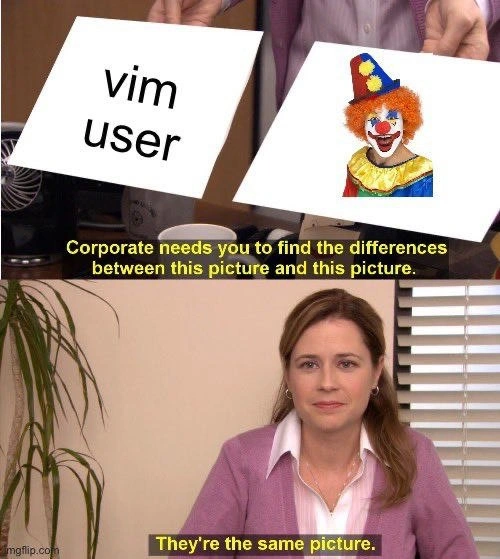
The Archetype of the Young, Pedantic Formalist in Academia
CS Fundamentals Post #5119, on Apr 12, 2023 in TG

The Archetype of the Young, Pedantic Formalist in Academia

Why is this CS Fundamentals meme funny?

Level 1: Proving the Obvious

Imagine you and your friends are trying to solve a simple problem, like deciding where to eat lunch or fixing a small kitchen leak. Now picture one friend who, whenever a tiny issue comes up, insists on doing something ridiculously complicated before you can move on. For example, say you spill a glass of water on the table. Most people would just grab a towel and wipe it up, right? But this one friend jumps in and says, “Hold on, I need to prove that the towel will absorb the water,” and then writes a 10-page report with diagrams about the absorbency of fabrics and the physics of water molecules – before actually cleaning the spill. By the time he’s done “proving” it, the water has already dripped onto the floor and made a bigger mess. 🙄

This meme is joking about that kind of person, but in a programming context. It’s the kid who just learned a bunch of super fancy math and thinks every little thing needs a formal proof or a big theory to back it up. To everyone else, it’s like, “Hey buddy, we already know 1+1=2, you don’t need to write a whole book about it – just add the numbers and move on.” It’s funny (and a bit frustrating) because he’s overthinking and overcomplicating the obvious. The heart of the joke is about the difference between people who just fix problems directly and people who feel the need to show off or reassure themselves by over-proving every solution. In simple terms, it’s making fun of someone who would rather write a huge proof that a light switch works than just flip the switch to turn on the light. It’s a goofy reminder that sometimes, especially in real-life problem solving, being practical beats being super fancy.

Level 2: LaTeX Overkill

Okay, let's break this down for a newer developer or student encountering these ideas. This meme is contrasting someone who is super theoretical versus the more practical approach to programming. The image labels this character the “20 year old proover” (spelled like “prover” to pun on proving theorems). He’s basically a young math whiz or computer science student who thinks every programming issue needs to be solved with maximum mathematical rigor.

One big giveaway is the line about “10 pages of LaTeX for every problem he’s given, no matter how simple.” LaTeX (pronounced “lah-tek” or “lay-tek”) is a document preparation system that academics use to write papers, especially when they have a lot of formulas and symbols. It’s what mathematicians use to type out fancy proofs with all the Greek letters and integrals looking perfect. So if someone writes 10 pages of LaTeX, it means they’re writing a long formal document (like a mini thesis or research paper) solving a problem. Now, imagine if the “problem” is just a small bug in code. Writing a 10-page formal explanation is total overkill – it’s like using a sledgehammer to crack a peanut. The meme finds humor in that overkill. Most software bugs are resolved with a few lines of code change and maybe a short explanation in the commit message. But this hypothetical junior guy produces a whole proof written in LaTeX, as if that’s required to ensure the bug is truly gone. That’s why I call it LaTeX overkill.

Another term thrown around is formal verification. This is a fancy way to say “proving with math that a program has no bugs.” It’s a real field in computer science. For example, people use formal verification to prove critical software (like airplane control systems or encryption algorithms) work correctly. They create a mathematical model of the code and then prove properties about it, essentially making bugs theoretically impossible (if done right). It’s very cool, but also very hard and time-consuming. In the meme, the junior insists on that kind of treatment for every single bug. That’s like insisting on doing a full proof of correctness for a one-line fix. In the real world, that’s rarely done because it’s just not efficient, except in special cases. Instead, we usually rely on testing, code reviews, and static analysis tools to catch bugs – more practical methods.

The meme also references category theory and set theory. Let’s clarify those: Set theory is basically the foundation of modern mathematics – it’s about how you can build all math using sets (collections of objects). When you define numbers rigorously, or define what < means, you can do it in set theory. It’s very low-level, foundational stuff. Category theory is another high-level field of math that looks at patterns and relationships abstractly across different areas of math. It’s sometimes jokingly called “abstract nonsense” even by mathematicians because it’s so generalized. In computer science, category theory concepts show up in things like Haskell’s design (if you’ve heard of monads or functors, those come from category theory). The meme says this guy “studies category theory just to formalize set theory”. That implies he’s going even more abstract than necessary – instead of using set theory as a tool, he wants to rebuild it in category-theoretic terms, which is like adding extra layers of abstraction for bragging rights. It’s the equivalent of someone learning an advanced, esoteric technique purely to re-express something basic, just to say they did it. If you’re a junior dev, you might not have encountered category theory yet (it’s not usually in a standard CS curriculum beyond maybe some mentions in advanced topics), but you can imagine it as this super theoretical toolkit that usually isn’t needed for day-to-day coding.

Now, what’s with the “homotopy” mention? Homotopy is a concept from advanced math (topology). It’s definitely not something you need to know to program an app or write a typical program. The meme jokes that this guy “thinks knowing the definition of homotopy validates his existence.” That’s poking fun at the kind of person who measures their self-worth by knowing very advanced or obscure math terms. In a team setting, that might be the colleague who always brings up some theoretical concept that no one else has heard of, just to feel important. It usually doesn’t help solve the problem at hand, it’s more like showing off knowledge. If you’ve ever been in a study group or a meeting and someone keeps dropping super technical vocabulary to seem smart, you know the vibe. The meme is highlighting that as a negative trait (proof_snobbery, as tagged): being a “proof snob” who looks down on simpler reasoning.

One of the captions directly quotes him: “Not to be pedantic, but could you make this more rigorous?” If you’re new to software, this is the kind of thing someone deeply into theory might say during a code review or a design discussion. Maybe an engineer explains a solution in plain terms, and this person jumps in with “well, is it rigorous enough?” They basically want a formal proof or a more mathematically exact explanation. Being pedantic means focusing on tiny details or formal rules even when it’s not necessary. So the meme is making him say that to show how he nitpicks others for not being as formal as he is. For a junior developer reading this: in practice, it’s good to be precise, but if you constantly ask your teammates to prove every little thing “rigorously,” you’re going to annoy them. There’s a balance between practical clarity and pedantic rigor.

Another phrase: “Thinks converting math into set theory somehow makes it more valid.” This refers to a mindset where someone doesn’t trust an idea until they’ve translated it into the most fundamental mathematical language (like set theory or formal logic). It’s like if you gave a straightforward explanation of how a function works and they respond with, “I’ll accept it only after I’ve seen it derived from the axioms of logic.” It’s over-the-top skepticism toward intuitive reasoning or empirical evidence, insisting that only formalized versions count as truth. In software terms, imagine not trusting that a sorting algorithm works just because it passed 100 test cases – instead, you demand a formal proof of its correctness and complexity before you’re satisfied. While formal proofs are nice, in most coding jobs you simply don’t have time (nor the need) to formally prove everything. Working code and good tests are usually enough validation.

The meme text also jokes “I hate theoretical computer science, it’s so hand-wavey.” You might think, wait, theoretical computer science is quite math-heavy (think algorithms, complexity theory, computability). Why would he call it hand-wavey? This is irony. The character is such a stickler for strict proofs that even the standard rigor of computer science theory isn’t enough for him. “Hand-wavey” means not fully rigorous, like when someone glosses over a tricky part of a proof by saying “it’s obvious” or “you can fill in the details.” In research papers or lectures, sometimes minor steps are skipped for brevity – that’s considered a bit of hand-waving. A normal theoretical CS student wouldn’t mind that too much, but this meme’s character minds a lot. He basically demands absolute formal detail in everything, to the point of absurdity. It’s like a student in a lecture who keeps interrupting the professor: “Actually, you need to prove that step, you’re hand-waving here.” Technically, precision is good, but if you take it too far, you annoy everyone and slow down the discussion.

Now, what does this have to do with software engineering or bugs? The contrast here is with a practical approach: engineers vs. theoreticians. The engineer’s motto might be “Works? Great!” whereas the theoretician’s motto is “Prove it (literally)!” This meme exaggerates an engineer’s nightmare scenario: a teammate who refuses to accept a fix until it’s proven like a math theorem. The tags like math_vs_engineering and AcademicVsPracticalSkills highlight this divide. If you’re new to the field, you might eventually see a lighter version of this in real life – for example, someone who over-documents or over-analyzes a simple issue, or someone who is reluctant to use a common library because they’d rather implement it themselves to fully understand it (the “not invented here” syndrome’s brainy cousin).

The mention of “hasn’t done an ounce of manual labor in his life” is just an extra comedic jab – implying this person lives entirely in the world of books and theory, possibly looking down on anything ‘hands-on’ or practical (whether it’s manual labor or practical coding tasks). It reinforces the stereotype of a certain kind of academic who is all brain, no brawn, and perhaps proud of it. In software terms, “manual labor” could be analogous to actually writing and testing code (as opposed to theorizing about it).

So, to sum up the scenario in simpler terms: we have a young, smart, overzealous math/CS nerd on a software team. He handles every bug or task not by straightforward coding and testing, but by trying to apply the full weight of academic knowledge – writing formal proofs, using extremely abstract math, and demanding absolute rigor. This annoys his colleagues who just want the software to work and be delivered on time. The humor comes from how absurdly disproportionate his approach is to the everyday problems at hand. It’s like bringing a textbook on quantum field theory to fix a squeaky door hinge – yes, you’re intelligent, but that’s not the tool we need right now!

Level 3: Proofs vs Patches

From a seasoned developer’s perspective, this meme is a riot because it exaggerates a real-world dynamic: the clash between academic purity and pragmatic engineering. Picture a new junior developer fresh out of a theoretical computer science program, overflowing with excitement about category theory, logic, and formal methods. Now drop that person into a fast-paced software team where the top priority is fixing bugs ASAP and shipping features. You can almost hear the senior engineers groaning when the junior says, “Not to be pedantic, but could you make this more rigorous?” during a stand-up meeting about a simple bug fix. It’s the classic academic vs practical skills conflict, cranked up to comic levels.

In real teams, you occasionally meet someone who insists on super high rigor in situations that just don’t warrant it. For instance, imagine a bug is reported in a web application: a calculation is off by one. A typical engineer would reproduce it, identify the off-by-one error in code, write a quick unit test, patch the logic, and call it a day. Our “20-year-old prover”, by contrast, would dive into writing a mini-research paper about why the algorithm produces an off-by-one, complete with lemmas and corollaries, probably typeset in LaTeX with impeccably formatted equations. It’s as if he’s trying to formally prove the bug cannot happen again. While everyone else is pushing a one-line fix, he’s Latex-ing up a storm of Greek symbols. By the time he’s finished ensuring the fix is derived from first principles, the customers might have moved to a competitor! This mismatch is exactly what the meme is poking fun at.

Senior developers find this funny because many of us have seen a bit of that impulse either in ourselves early on or in new team members. Fresh graduates (especially those who did a lot of math or theoretical CS) sometimes struggle to switch gears from the academic mindset (where rigor and proofs are king) to the engineering mindset (where results and working code are king). In school, proving things like the correctness of algorithms, or writing formal proofs in discrete math, is common. In industry, we rarely write proofs; instead, we write tests, documentation, and monitoring checks. So when a junior math wiz treats a production bug like a theorem-proving exercise, it’s both exasperating and humorous to more experienced folks. It’s the learning_curve every academic-minded coder goes through – realizing that “good enough and working” often trumps “perfectly proven” in a business environment.

The meme’s many sarcastic captions highlight specific anti-patterns of an over-the-top theoretical purist. For example, “Makes fun of engineers; in reality is wasting his life on useless, self-indulgent abstraction.” This reflects a tension where the academic-inclined person looks down on software engineers for being “sloppy” or not rigorous (O(1) proofs instead of 10-page proofs), while the engineers see that attitude as ivory-tower indulgence that doesn’t deliver value to users. It’s a two-way snark: the theorist calls engineers hand-wavey, and the engineers call his work useless abstraction. In healthy reality, of course, both theory and practice have value, but this meme thrives on the exaggerated extremes. It reminds experienced devs of those meetings or code reviews where someone nitpicks a correct solution because it’s not “mathematically beautiful” enough. Or that intern who refused to use a well-known library because he wanted to derive the solution from scratch “to be sure it’s correct.”

Another pointed caption: “Thinks formalizing intuitions changes his epistemic justification for accepting them.” In plainer terms, the junior believes that rewriting something we already kinda know (an intuition) in a fully formal way changes how justifiable or valid that knowledge is. To a senior dev, this is humorously pedantic. If our intuition tells us a fix will work, we test it, maybe code review it, and then trust it. We don’t need to formalize every intuition in set theory to accept it. The meme exaggerates this mindset to the point where the junior won’t trust a simple solution until he has derived it from fundamental axioms! Seniors reading that line will likely chuckle because we’ve been in situations where a team member over-explained or over-quantified something that was already obvious to everyone in the room. It’s that “Okay, we get it, you don’t have to prove gravity exists, just pick up the apple and move on” feeling.

Then there’s the “filthy formalist” label and the crack about “parasitic existence” through knowledge of homotopy. This is clearly the meme going all-in on insult comedy – painting the young theorist as a kind of elitist parasite who just clings to esoteric knowledge to justify himself. While harsh, it resonates in a comedic way with those who’ve met someone who constantly name-drops ultra-abstract concepts (like homotopy or category theory) in irrelevant contexts. Senior devs might recall a meeting where a junior engineer references something like monoidal functors or Turing completeness just to sound smart, while everyone else is trying to figure out how that helps build the new feature. That behavior comes off as insecure intellectual peacocking – using theoretical jargon to prove one’s worth. The meme brutally satirizes that by implying this person “tells himself he’s appreciating the beauty of higher mathematics” but really he’s just feeding a superiority complex. Ouch! Experienced team leads might nod knowingly here: mentoring sometimes involves helping brilliant but arrogant juniors realize that no amount of theory compensates for teamwork, clarity, and actually delivering something useful.

This meme also touches on the academic humor of someone focusing on topics with no practical application, which is a stereotype of math/CS students who get engrossed in things like category theory for their elegance. The caption “Won’t study anything unless it has absolutely no applications whatsoever” is an obvious hyperbole, but it jabs at the idea that some purists consider practical fields “dirty” or lesser. A senior engineer with a mortgage and on-call rotation will find that hilariously unrelatable—if it doesn’t have applications, why on Earth are we spending time on it? Yet, truth be told, many of us in software have gone through a phase (often around college age) where impractical but intellectually pure topics were mesmerizing. The meme dredges up those memories and lets us laugh at our younger selves or that one colleague who never outgrew it.

In practice, software engineering vs theoretical computer science is an age-old cultural divide. This meme encapsulates it in one exaggerated individual. The math_vs_engineering culture clash can sometimes lead to friction: say, a research-oriented hire who insists on using a dependently typed language or creating a formal specification for a feature, versus a product-oriented team that just wants working software using proven, simpler methods. The senior perspective recognizes that balance is key. We appreciate the value of solid CS fundamentals and mathematical rigor (nobody wants buggy code!), but we also know the reality: you often achieve reliability with pragmatic layers of testing, code review, and iteration, rather than a Q.E.D. at the end of a code commit. And if someone actually tried to attach a formal proof of correctness for each bug fix, they’d grind development to a halt and likely drive their teammates up the wall.

Thus, the experienced dev laughs at this meme with a mix of been-there-done-that and thank-goodness-we-don’t-do-that. It’s a humorous reminder that while formal methods and deep theory have their place (NASA, medical devices, etc.), for most of us, “proofs vs patches” isn’t a real contest – patches win 99% of the time. Shipping a patch that fixes the bug today beats a 10-page proof that theoretically guarantees no bug (delivered next month). The senior take-away: it’s great to know your theory, but don’t be the person who brings a proverbial rocket-science solution to a leaky faucet problem.

Level 4: ∀ Bugs, ∃ Proof (Formalism Overdose)

At the deep theoretical end, this meme jabs at an extreme form of formal verification obsession. The 20-year-old prover caricature is essentially a parody of someone who treats every programming bug as a rigorous math problem requiring a full proof of correctness. In theoretical computer science, proving a program correct (with mathematical certainty) is the holy grail – often done with theorem provers or proof assistants like Coq, Isabelle, or Agda. These tools let you specify your code’s behavior in logic and then prove that the code meets its specs, eliminating entire classes of bugs. It’s powerful, but it’s also insanely time-consuming and complex for everyday software. The meme humorously imagines a junior developer who insists on this level of rigor for even trivial issues, generating “10 pages of LaTeX” for every bug fix. LaTeX, a typesetting system for mathematical documents, is beloved in academia for writing formal proofs with beautifully rendered equations. So when the meme says he writes 10 pages of LaTeX, it means he literally writes a mini-thesis to prove the code is correct – as if each bug were a theorem to be formally verified. This is proof overkill, and it’s the kind of latex_overkill only a theory-obsessed newbie would think is necessary (or even feasible) in daily programming.

One caption references “Have you seen the proof that 1+1=2?”. This is likely alluding to the famous rigorous proof in Principia Mathematica by Russell and Whitehead, where it took hundreds of pages of formal set theory to derive the basic truth that $1+1=2$. In other words, even the simplest facts can require a mountain of formalism to prove from first principles. Our meme’s protagonist apparently loves that kind of thing – he’d gleefully rederive fundamental truths from scratch just to feel rigorous. The meme calls him a “filthy formalist” (pointing to his gigantic, overworked brain in the image) which is a tongue-in-cheek insult. In mathematics, formalism is a philosophy that math is just manipulation of symbols with strict rules (Hilbert’s program being a classic example). A filthy formalist here is someone who’s almost perversely proud of doing everything in the most formal, symbol-pushing way possible, even when it’s overkill. It’s the kind of person who won’t accept a solution unless it’s been reduced to set theory or some logical foundation, believing “converting math into set theory somehow makes it more valid.” The meme mocks this by showing him describing something as simple as the < relation (less-than) in an absurdly formal way: “Calls < the unique total order defined on ℝ×ℝ such that for all pairs (x,y) …” – basically turning "x < y" into a verbose set-theoretic definition. It’s both hilariously pedantic and an accurate portrayal of how a pure math purist might speak.

Speaking of foundations, one corner of the image quips “Studies category theory just to formalize set theory.” Category theory is an extremely abstract branch of mathematics that deals with objects and morphisms (arrows) in a very general sense – it’s like math about the structure of math. In computer science, category theory famously underpins concepts in functional programming (like monads, functors, etc., in Haskell). But here the joke is that this person dives into category theory solely to put existing math (like set theory) on an even more abstract footing. It’s like an abstraction-on-abstraction obsession. This is theoretical purity to the max – the meme calls it theoretical_purity, where our prover won’t study anything **“unless it has absolutely no applications whatsoever.”* That line encapsulates the attitude: practical relevance is viewed with disdain; only the purest math, preferably entirely detached from real-world use, is worthy of attention. It’s poking fun at the academic trope that usefulness somehow cheapens the beauty of mathematics. The inclusion of textbook covers on Differential Geometry and Algebraic Topology (some pretty abstract math fields) flanking the meme reinforces this – these are the kinds of heavy math topics the character surrounds himself with, probably “appreciating the beauty of higher mathematics” while sneering at anything more applied.

Another advanced reference is the word “homotopy”. The meme says “Thinks knowing the definition of homotopy validates his parasitic existence.” Homotopy is a concept from algebraic topology about continuously deforming one shape into another (like morphing a donut shape into a coffee mug – they are homotopy equivalent). It’s esoteric stuff far removed from writing software. By bragging about knowing what homotopy is, our overzealous junior is trying to signal “Look how advanced I am!” In reality, knowing homotopy theory has virtually zero impact on debugging a web app or building a login form. The meme uses it to highlight the character’s proof_snobbery: he clings to advanced math trivia as evidence of superiority, despite it being irrelevant to the task at hand.

This whole scenario also has echoes of the tension between theoretical computer science and software engineering. For example, theoretical CS folks might complain “I hate theoretical computer science, it’s so hand-wavey” (as one caption says). This line is intentionally absurd because theoretical CS is itself quite formal, but to an even more mathematical mind like our prover, computer science proofs might still cut corners or use intuitive leaps (hand-waving) compared to pure math. It’s a caricature of the kind of person who considers even the rigor in algorithm proofs or complexity theory to be too lax, because they’re not reducing everything to first principles in ZFC (Zermelo-Fraenkel set theory) or not writing the proof in the style of formal logic he prefers. There’s also a hint of irony: actual theoretical CS researchers do value rigor, but they also understand practical limits – something our 20-year-old does not.

Importantly, the humor here comes from misapplied brilliance. Concepts like formal verification, category theory, homotopy type theory (yes, there’s a thing called Homotopy Type Theory, blending homotopy and logic in a wild foundational stew), etc., are all fascinating and valuable in the right context. For instance, formal verification can catch bugs that testing might miss, and it provides a guarantee of correctness crucial for software like spacecraft navigation or cryptographic protocols. Category theory has led to elegant software abstractions and deeper understanding of programming language theory. But treating everyday coding as if it demands the same level of abstract proof as a published math theorem is impractical to the point of absurdity. It’s as if our junior math wiz took the mantra “prove your code is correct” way too literally. There’s a kernel of truth under the joke: in an ideal world, we would like software to be mathematically proven correct (no bugs at all!). The CAP theorem or a type soundness proof in a compiler are real theoretical results that matter. Yet, in practice, most bugs are fixed with debugging, testing, and pragmatic reasoning, not 10-page proofs. The constraints of time, complexity, and diminishing returns mean that formal proofs are used sparingly in software projects. That fundamental mismatch – between an ideal of absolute rigor and the reality of shipping useful software quickly – is what this meme exaggerates for comedic effect. It’s math_vs_engineering at the extreme: one side seeks eternal truths in code, the other just wants the app not to crash by Friday.

Description

A 'starter pack' style meme titled 'THE 20 YEAR OLD PROOVER', featuring a Wojak-style 'brainlet' character with an oversized, exposed brain, representing supposed but impractical intelligence. The character is surrounded by numerous text snippets and covers of advanced mathematics textbooks (e.g., 'Algebraic Topology', 'Abstract Algebra'). The text satirizes a specific archetype of a young, arrogant academic obsessed with pure mathematical formalism. Key phrases include: 'Not to be pedantic, but could you make this more rigorous?', 'Studies category theory just to formalize set theory', 'Makes fun of engineers; in reality is wasting his life on useless, self-indulgent abstraction', and 'I hate theoretical computer science, it's so hand-wavey'. This meme critiques the 'ivory tower' mindset where theoretical purity and rigor are valued above all practical application, often coupled with a superiority complex and a disdain for applied fields like software engineering
Comments

7
Anonymous ★ Top Pick This is the intern who argues that your CRUD app isn't sound because its implementation lacks a formal proof in ZFC set theory, while completely missing the SQL injection vulnerability in the login form
  1. Anonymous ★ Top Pick

    This is the intern who argues that your CRUD app isn't sound because its implementation lacks a formal proof in ZFC set theory, while completely missing the SQL injection vulnerability in the login form

  2. Anonymous

    Prod’s on fire, but the new hire won’t merge the one-line null check until his 30-page Lean proof shows it’s a natural transformation - turns out the outage doesn’t care about functors

  3. Anonymous

    "Hired a PhD who spent 6 years proving P≠NP in Coq. Now he's requesting formal verification for our CRUD endpoints and won't merge until someone peer-reviews his 47-page proof that our REST API is idempotent."

  4. Anonymous

    This is the architect who insists on formally verifying the type system of their internal CRUD API using dependent types and proof assistants, then wonders why the startup ran out of runway before shipping a single feature. They've proven the absence of all possible bugs in a system that will never exist in production - a perfect monument to mathematical purity over pragmatic engineering

  5. Anonymous

    Our new grad replaced a 3-line comparator with a 50-page Lean proof that R×R is totally ordered; gorgeous, until prod fell over when NaN reminded us the real world isn’t ZFC

  6. Anonymous

    Our new 20-year-old “prover” wrote 10 pages of LaTeX proving our API is a small category and pagination is the unique total order on RxR - still no morphism from “build passes” to “prod deployed”

  7. Anonymous

    Formalized total order on PRs with ZFC, but merge hell stays Rice-undecidable

Use J and K for navigation