Skip to content
DevMeme
4670 of 7435
The Infinite Recursion of Problems: A Mandelbrot Set Metaphor
Mathematics Post #5120, on Apr 12, 2023 in TG

The Infinite Recursion of Problems: A Mandelbrot Set Metaphor

Why is this Mathematics meme funny?

Level 1: Hall of Mirrors

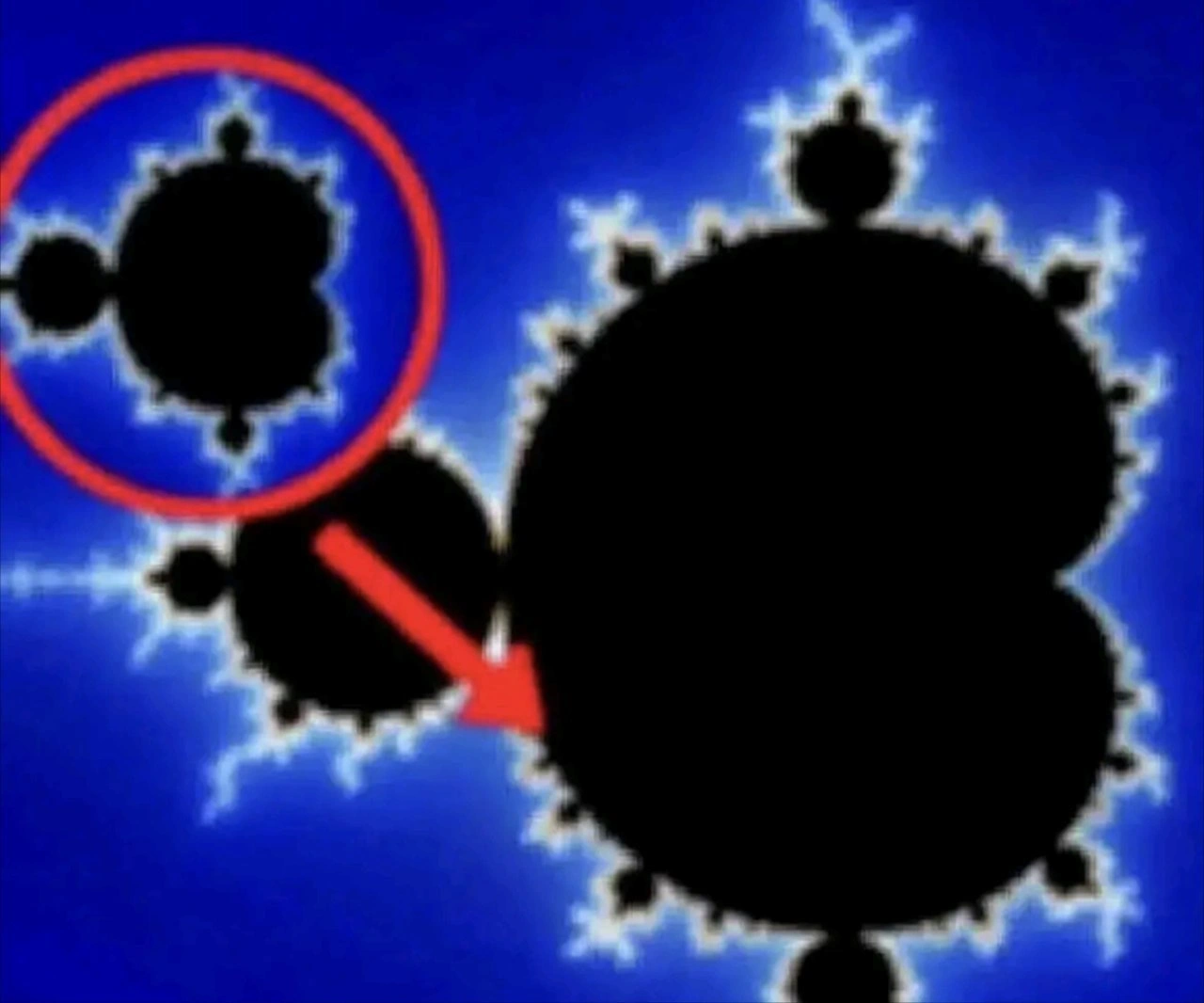
Imagine you’re in a carnival’s hall of mirrors, the kind where two mirrors face each other. You see your reflection repeating over and over – a copy of you, then a smaller copy behind that, and an even smaller one behind that, seemingly without end. Kinda wild, right? This picture of the black fractal shape is doing exactly that: the big shape has a smaller copy of itself attached on the left, circled in red. And if you looked even closer at that smaller copy, it would have an even smaller twin on it. It’s like looking at something in a mirror, and then that mirror is reflected in another mirror, on and on.

The joke here is comparing that infinite mirror effect to a programming idea. In coding, a function is like a little machine that does a job. Sometimes, a function can decide, “I’ll do my job by using myself again.” It’s as if a chef making a big batch of pizza says, “Hold on, to make this pizza, I need to first make a smaller pizza!” – and then to make that smaller pizza, they decide to make an even smaller pizza, and so on. If the chef never stops, they’ll be making tinier and tinier pizzas forever! That’s what we call recursion in simple terms: something defined in terms of a smaller version of itself. It’s a powerful idea, but if you don’t plan a stopping point, it can go on endlessly.

So, the meme is a playful way to show a function that never stops calling itself. The Mandelbrot set (the image’s name) is kind of a poster child for “never-ending-ness” because no matter how much you zoom in, you find more detail. It’s like a story that contains a smaller version of the same story, which contains another version of the story... you get the idea. If you’ve ever seen those pictures where someone holds a photo of themselves holding a photo of themselves, and it seems endless – that’s the vibe here.

Why is it funny? Because it takes a complex idea and makes it visual and simple. It’s saying, “See this crazy endless shape? That’s basically what your code is doing right now if a function keeps running itself over and over!” Anyone who’s seen a computer program freeze up can appreciate the humor: it’s a lighthearted warning. But even if you’re not a programmer, the image itself is fascinating – it’s a never-ending pattern. In one glance, you get the feeling of infinity. And honestly, there’s a bit of childlike wonder in that. It’s the kind of thing you might have doodled or imagined: a picture that contains itself which contains itself...almost like an infinite mirror. So the meme gives a little chuckle and a little marvel at the same time. It’s saying “whoa, cool!” and “uh-oh, careful!” in one picture. Whether you get the coding reference or just see the endless pattern, it captures the idea of something that goes on and on, in a fun, eye-catching way.

Level 2: Functionception

Let’s break down what’s going on in simpler terms. The meme title says, “When your function keeps calling itself.” In programming, a function is just a reusable set of instructions – think of it like a step-by-step recipe to do something. Recursion is when a function decides, as part of its instructions, to call itself again. It’s like if a recipe for baking bread said, “now go back and follow the bread recipe for a smaller loaf.” That can be useful – many problems can be solved by solving a smaller piece of the same problem and building back up – but you have to be careful to stop at some point! Typically, a recursive function includes a base case, which is a condition where it stops calling itself. For example, a function that counts down might call itself with smaller and smaller numbers, but it needs a rule like “if you reach 0, stop.” Without a base case, the function would call itself forever, which a computer really doesn’t handle well (you’ll either crash or freeze – essentially a software equivalent of falling into a bottomless pit).

Now, what does all that have to do with this Mandelbrot set image? The Mandelbrot set is a famous fractal – a kind of mathematical picture that has infinite detail. Fractals are known for self-similarity, meaning if you zoom in on a part of the image, you’ll see a miniature version of the whole pattern. The picture highlights exactly that: see the red circle? It’s magnifying a small bump on the big black shape, and that small bump is basically a tiny copy of the big shape! If you zoomed in further on the copy, you’d find an even tinier copy on its own edge, and so on forever. It’s like those Russian nesting dolls, where inside each doll is a smaller doll with the same look, and inside that an even smaller one, etc. In programming terms, that’s a visual metaphor for recursion: a function call that leads to another function call that leads to yet another, each time dealing with a smaller or “nested” version of the same task. Hence our playful subtitle “Functionception” (a nod to the movie Inception, where there’s a dream within a dream within a dream… here we have a function within a function within a function).

So, the Mandelbrot set is generated by a specific algorithm (the escape-time algorithm). This algorithm works point by point (pixel by pixel). For each point in the image, it repeatedly applies a formula – essentially looping or recursing – to see what happens to that point’s value. The formula involved, $z_{n+1} = z_n^2 + c$, might look scary, but you can imagine it like this: you take a number (start at 0), square it and add the address of the point (its coordinates treated as a complex number c), get a new number, and do it again and again. If the number shoots off to infinity (in practice, if it grows beyond a certain big limit), we say “it escaped!” and we color the pixel based on how long it took to escape. If it never escapes within a set number of tries, we consider that point part of the fractal (and color it black). That’s the “escape-time” aspect – essentially how long until we bail out. This is very much like a function that keeps calling itself until some condition is met (in this case, “until the value escapes beyond the threshold” or “until we’ve iterated X times”). If the condition never happens, you’d theoretically loop forever, which is why in practice we always have a max iteration limit acting like a safety net (a built-in base case: “stop no matter what after, say, 1000 iterations”).

Let’s connect this to code a bit. Here’s a simple analogy in Python-like pseudocode for a safe vs. unsafe recursive function:

def recursive_print(n):
    if n <= 0:
        return "done"            # base case to stop recursion
    else:
        print(n)
        return recursive_print(n-1)  # recursive call with a smaller problem

def runaway_recursion():
    return runaway_recursion()   # no base case - this will call itself forever!

In recursive_print, we have a clear stopping point: when n reaches 0, we return without making another recursive call. So recursive_print(3) would print 3, then 2, then 1, then stop at 0 and return. On the other hand, runaway_recursion() has no such safeguard – calling it will immediately call itself again and again with no end. If you actually run runaway_recursion(), it’ll keep going until the program crashes with a stack overflow error (basically the computer saying “Too many nested calls! I’m out of memory!”). The Mandelbrot fractal, conceptually, is like what runaway_recursion() is doing: it can keep “calling itself” (applying the formula) infinitely because there’s always more detail. The only thing that stops it is us deciding on a cutoff (like our base case in code) for practical reasons.

Now, the picture makes this concept easier to grasp. The big black shape (often called the “bug” or “snowman” shape of the Mandelbrot) is analogous to the original function call. The little copy circled in red on its side is like the function’s recursive call – a smaller sub-problem that looks just like the big one. And if you look closely, the little copy even has teeny-tiny bumps on its edge that are also Mandelbrot-shaped – those would be like deeper recursive calls. It’s recursion illustrated as an image rather than lines of code. This kind of visual is super helpful when first learning recursion because it shows why a stopping condition is needed. If we didn’t stop, we’d keep zooming in forever finding new copies, just like a function without a base case keeps running forever.

Some key terms and concepts here:

  • Recursion: when a function calls itself to solve a smaller piece of the problem. It’s like a loop, but defined in terms of function calls. Every recursive approach needs a base case (a condition to stop) or it will go on forever.

  • Fractal: a complex geometric shape made by a simple process repeated over and over. Fractals often have self-similarity – smaller parts look like the whole shape. They’re a mix of art and math. Famous examples besides Mandelbrot include the swirling Julia sets, the branching lightning-bolt patterns, or even natural ones like Romanesco broccoli (where each floret is a mini version of the whole head of broccoli!).

  • Mandelbrot set: one of the most famous fractals, named after mathematician Benoit Mandelbrot. It’s defined by that formula $z_{n+1} = z_n^2 + c$. When people talk about the Mandelbrot set, they often mean the image you get by plotting it – as in this meme. All the black points in the image are points $c$ that never escaped to infinity (within the iteration limit), and the colored points escaped after some number of steps (color indicates how fast). The overall shape and the infinitely wiggly boundary come from the pattern of which points escape and which don’t.

  • Complex plane visualization: The image is essentially a graph of complex numbers. The horizontal axis (x-axis) is the real part of $c$, and the vertical axis (y-axis) is the imaginary part. So each pixel corresponds to a complex number $c = x + yi$. When we run the formula on that $c$, we’re testing if that complex number produces an ever-growing sequence or not. The fact we treat the plane as a grid of numbers and color it based on an algorithm is very much a computer graphics task – we’re programmatically generating an image. This is where graphics programming meets math and algorithms.

  • Escape-time algorithm: This is the step-by-step method used to draw many fractals like Mandelbrot. It’s called that because you literally time (count) how many steps it takes for a point’s value to escape a certain bound. If a point’s value doesn’t escape within the max steps, you assume it’s stuck (inside the set). This algorithm involves a lot of repetition (looping/recursion), but it’s conceptually straightforward. If you’ve written a loop that continues until some condition is true (like “keep adding until the sum exceeds 1000”), you’ve done something similar to an escape-time algorithm. In code, that might look like:

    iterations = 0
    z = 0
    while iterations < MAX_ITERATIONS and abs(z) <= 2:
        z = z*z + c        # The recursive step (squaring and adding c)
        iterations += 1
    # Now use 'iterations' to decide color (or black if iterations == MAX_ITERATIONS)
    

    Each run of this loop is like a single “recursive call” in mathematical terms. We check abs(z) as our escape condition (just like checking a base case in recursion: have we met a criterion to stop?). If abs(z) stays $\le 2$ up through the last iteration, we never escaped – that’s analogous to a recursion hitting the base case of “max depth reached.”

For a junior developer or a student, the meme is a fun reminder of why those concepts of recursion can be mind-bending. It’s showing a visual infinite loop. The CS_Fundamentals lesson hiding here is: when you break a task into identical subtasks (like drawing a smaller Mandelbrot as part of drawing a Mandelbrot, or computing factorial(n-1) as part of computing factorial(n)), you have to know when to stop. Otherwise, you get an infinite regress. The Mandelbrot set lovingly demonstrates what infinity looks like when you forget to stop – it’s awesome to look at, but obviously you can’t compute it to absolute completion. In practical coding, you’d crash before you ever got there.

And of course, beyond the teaches-you-a-lesson aspect, fractals like this are just plain cool! They show how a simple rule can create something very complicated. Many new programmers, after learning loops and functions, try making graphical patterns or fractals to see their code create art. It’s a rewarding project: you get to apply math, manage recursion or iteration, and the result is this intricate image that feels almost magical. The Mandelbrot set in particular has a reputation in the programming world – it’s like a flagship demo for showing off what a few lines of code can do. So seeing it used in a meme about recursion is like two worlds colliding: the beauty of math and the quirky truth of programming wrapped into one. It says, “Our code can create this infinite beauty, but also, watch out, it might loop infinitely if you’re not careful!”

Level 3: No Escape Condition

For the seasoned developer, this fractal image immediately screams “recursion!” It’s the coding joke literally drawn out: when your function keeps calling itself, you get copies on copies on copies. The meme cleverly uses the Mandelbrot set – famed for its self-repeating shape – to poke fun at what happens if a function has no end condition. The large black blob in the picture is like our original function call, and the smaller black blob circled in red is like the function calling itself again as a subroutine. Zoom in, and you’d find an even smaller clone (a function call of a function call), and so on. It’s basically a visualization of a recursive call stack: each level of zoom is another level deeper in the function’s self-calls. No escape condition in code means the function never hits a point where it stops calling itself – exactly like how the Mandelbrot’s detail never truly ends.

Every experienced programmer knows the base case is king in recursion. Forget to include a base case (the condition under which the function returns without recursing), and you’ve written an accidental fork bomb for your call stack. Here, the meme’s red arrow pointing to the mini-Mandelbrot is a tongue-in-cheek reminder: “Hey, you called yourself again!” – implying our function just went one level deeper with the same shape and logic. It’s the programming equivalent of looking into a mirror and seeing a mirror behind you reflecting into infinity. The escape-time algorithm that generates this fractal has a built-in escape condition (stop iterating when $|z| > 2$ or after max loops), but the joke is imagining what if it didn’t – the poor function (or loop) would just keep going, drawing Mandelbrot upon Mandelbrot forever. A senior dev has likely seen what happens when such runaway recursion goes unchecked: a stack overflow error, or a program that hangs until you manually kill it. The lightning-like white tendrils around the fractal’s edge even look a bit like the chaotic stack trace you might get when the runtime finally cries “Enough!” after recursive calls spiral out of control 😅.

Another layer to the humor is the sheer ComputerScienceFundamentals nostalgia. Recursion is one of those concepts every CS student learns early, often with classic examples like computing factorials, Fibonacci numbers, or printing a directory tree. It’s drilled in that each recursive call must simplify the problem and eventually terminate. To drive the point home (and to spice things up), professors and programming textbooks love using fractal examples. Ever coded the Sierpinski triangle or the Koch snowflake in a freshman class? Those exercises visually demonstrate recursion – each function call draws a smaller triangle or segment, recursively, until a tiny base case is reached. The Mandelbrot set is a bit advanced for a first assignment (since it involves complex numbers and a lot of iteration), but it’s the same spirit: simple rules, mind-blowing outcome. For many, seeing a fractal generated by a short recursive program is an eye-opening “wow” moment in learning algorithms. This meme taps into that shared memory – we remember that mix of awe and caution the first time we wrote a recursive algorithm that actually worked (and the subsequent time it didn’t and blew up our stack!).

There’s also an AlgorithmDesign lesson disguised in here. The Mandelbrot image is computed by repeating a simple operation z = z² + c – essentially a loop that could be implemented with recursion. In practice, most fractal programs use iterative loops for speed and to avoid deep call stacks, but conceptually it’s the same as a recursive function. An old-school graphics hacker might chuckle, recalling how we optimized our fractal routines in C: using tight for loops, avoiding function-call overhead, maybe unrolling loops or using SIMD instructions – anything to squeeze more iterations per second. And yet, despite those optimizations, the fact remains: you increase the max iterations or zoom in one level further, and boom, you’ve doubled or tripled your computation time. It’s a brute-force algorithmic grind, and it reminds us of those notorious computational complexity gotchas in programming. Experienced devs see the Mandelbrot and think of efficiency tricks: can we bail out early if a sequence is definitely diverging? Can we skip calculations for points we already know? These are the same kind of thoughts we have when dealing with heavy recursion or big algorithms in code – how to cut down the work so we don’t get stuck in an endless loop.

The phrase “when your function keeps calling itself” in the title is basically the definition of recursion, stated in plain English. And indeed, a classic tongue-in-cheek definition in programming goes:

Dictionary: Recursion (noun)See "Recursion".

👆 This little joke (a dictionary entry that sends you in circles) is exactly what the Mandelbrot visual does too! It’s one of those winks that seasoned devs and CS students recognize and appreciate. We laugh not because it’s a knee-slapper, but because we’ve been there – staring at a recursive function that’s stuck in a loop and thinking, “Yep, it’s doing the Mandelbrot thing again, same process inside itself.” The image’s infinite detail is mesmerizing, just like a well-written recursive algorithm can be elegant. But it also comes with that cautionary undertone: don’t let it run wild without constraints, or it’ll consume all your stack memory or CPU time. Countless late-night debugging sessions have taught us that infinite recursion is usually a bug, not a feature (unless you’re deliberately modeling something like a fractal!).

On a lighter note, this meme might stir memories of screensavers and demoscene graphics. Back in the day, generating the Mandelbrot set on your screen was the hello world of GraphicsProgramming enthusiasts. It was so cool to watch the computer iterate complex equations and slowly draw those psychedelic colors. If you ever cranked up the iteration count or zoom level too far, though, your program would chug… and chug… possibly forever. That experience translates to a fundamental developer lesson: any recursive or iterative process needs an exit plan. We joke about it now, using the most iconic recursive image known, because who wouldn’t love a good fractal as an inside-joke illustration? This is classic algorithm humor – taking a concept as dry-sounding as an “escape condition in a recursive function” and making it visual, epic, and a bit absurd. It’s the kind of joke you share with colleagues after surviving a gnarly debugging session where the issue turned out to be (drumroll) an out-of-control recursive call. Everyone nods, laughs, and maybe shudders a little, remembering how easy it is to get lost in an endless maze of your code’s own making.

Level 4: Infinite Self-Similarity

At the deepest technical level, this image encapsulates recursion in its purest mathematical form. The Mandelbrot set – the black fractal shape in the picture – is defined by a recursive rule on the complex plane. In formal terms, each point $c$ (a complex number) is tested by iterating the function $f(z) = z^2 + c$ starting from $z_0 = 0$. We get a sequence:

$$ z_{0} = 0, \ z_{n+1} = z_{n}^2 + c, $$

and so on. If this sequence never escapes to infinity (more practically, if $|z_n|$ stays below a certain threshold like 2, even after many iterations), then $c$ belongs to the Mandelbrot set. Describing it in code terms, it's like a function that calls itself for each new $z_{n+1}$, using the previous output $z_n$ as the next input. This mathematical recursion produces the famous fractal shape: a plotting of all $c$ values that do not diverge under infinite iteration. The image’s striking detail – the glowing tendrils and miniature clones – arises from this simple recursive rule applied over and over.

To actually draw this, computers use what’s poetically called an escape-time algorithm. For each pixel (representing a complex number $c$), the algorithm repeatedly applies $z \leftarrow z^2 + c$ in a loop, incrementing an iteration counter $n$. If $|z|$ exceeds 2 (meaning the value “escaped” toward infinity), the loop breaks – the pixel is outside the set, and its color can be chosen based on how many iterations it took to escape. If the loop hits a maximum iteration limit without escaping, we treat $c$ as likely inside the set (colored black in the Mandelbrot image). The term escape-time reflects exactly what it checks: how long (how many iterations) until the value escapes a boundary. This is a recursive process at heart – conceptually, the algorithm is ready to call itself indefinitely, testing one value after the next, until an escape condition is met. Each pixel’s color reveals a tiny timeline of this recursive computation: points that escape quickly might get cooler colors, and those that stubbornly never escape (even after hundreds or thousands of iterations) form the black, in-set region. It’s a beautiful synergy of mathematics and algorithm design – a simple iterative formula produces endlessly complex art.

The humor of the meme is rooted in the self-similarity of the fractal. Notice the red circle highlighting a bump on the Mandelbrot’s boundary: that “mini-brot” is an almost perfect copy of the entire set, sitting right on the parent’s shoulder. In fractal geometry, we call this self-similarity – parts of the image resemble the whole. The Mandelbrot set exhibits infinite self-similarity: if you zoom into certain regions, you’ll find smaller Mandelbrot-shaped figures, and on their mini-boundaries, even smaller ones, ad infinitum. It’s recursion visualized: the shape contains a slightly tweaked copy of itself, which contains another, and so on, like a function that keeps calling itself with no base case. In theoretical terms, the Mandelbrot’s boundary is infinitely detailed. It has a fractional Hausdorff dimension (a type of fractal dimension), indicating a coast-line style complexity where measuring it is mind-bending – it’s not 1-dimensional like a smooth line, but it’s not fully 2-dimensional either; it’s something in between. Each “lightning bolt” filament in the image can be zoomed into to reveal new patterns endlessly. This infinite regress of detail is a direct consequence of the recursive definition: a simple equation yielding complexity that never bottoms out.

From a computational complexity standpoint, generating the Mandelbrot set is both straightforward and intensive. For each pixel, we perform up to M iterations of the recurrence, so an image of width W and height H might need $O(W \times H \times M)$ operations. There’s no clever closed-form shortcut – you really have to simulate those iterations for each point (there’s an almost philosophical link to the Halting Problem here: determining with absolute certainty that a given $c$ will never escape is undecidable without essentially “running” it infinitely, so we settle for a large finite limit). This brute-force approach makes fractal rendering compute-intensive. Early programmers would leave their graphics programs running overnight to plot high-resolution fractals. Fortunately, the problem is embarrassingly parallel – each point’s calculation is independent – so modern implementations harness GPUs for massive parallelism. A GPU can spawn thousands of threads crunching the $z = z^2 + c$ loop for many points simultaneously, dramatically speeding up the visualization. But even with powerful hardware, as you zoom deeper, the required iterations grow and the detail complexity explodes. It’s a bit like a recursive function that keeps spawning more work the deeper it goes. Without an escape condition (or practical cutoff), both the function and the fractal zoom would run forever. In practice, we always impose a max iteration depth – analogous to a recursion depth limit – to ensure the computation terminates. This way, the escape-time algorithm finds a balance: it explores recursion deep enough to draw the beautiful fractal recursion patterns, but not so deep that the stack (or processor) blows up. In short, the Mandelbrot set is a glorious case of a simple recursive rule leading to infinite complexity – a theoretical mathematician’s dream and a reminder to developers that unbounded recursion (in math or code) can create wondrous, but non-terminating, results.

Description

A low-resolution image depicting the Mandelbrot set, a famous mathematical fractal, rendered in black against a vibrant blue background. The image serves as a visual metaphor. A prominent red circle highlights a smaller, satellite bulb on the main set, which is a miniature, self-similar copy of the entire Mandelbrot set. A thick red arrow points from this smaller, circled copy to the main, larger body of the set. This visual gag requires no text, as it perfectly illustrates the concept of self-similarity or recursion. For a technical audience, it's a powerful metaphor for debugging or system design, where solving a small problem reveals it to be a miniature instance of the exact same, larger problem plaguing the entire system
Comments

7
Anonymous ★ Top Pick That feeling when you zoom into a microservice to fix a bug and discover it's just a perfectly self-similar, miniature version of the same monolithic design flaw you were trying to escape
  1. Anonymous ★ Top Pick

    That feeling when you zoom into a microservice to fix a bug and discover it's just a perfectly self-similar, miniature version of the same monolithic design flaw you were trying to escape

  2. Anonymous

    Our recursive YAML include looked harmless until we realized we’d basically implemented a Mandelbrot escape-time algorithm - each config revealed a smaller, identical override, and the only thing that finally diverged to infinity was the cloud bill

  3. Anonymous

    The Mandelbrot set is just Conway's Law visualized: no matter how deep you zoom, you'll find the same organizational dysfunction repeating at every scale

  4. Anonymous

    The Mandelbrot set: proof that O(∞) complexity can produce something beautiful. It's the only codebase where 'just zoom in more' is both a valid debugging strategy and an existential crisis - because no matter how deep you go, you'll find the same patterns you started with, much like refactoring legacy code only to realize you've recreated the original architecture at a different scale

  5. Anonymous

    We decomposed the monolith into microservices and accidentally built a Mandelbrot: same shape at every zoom, with an infinite incident surface area

  6. Anonymous

    Enterprise microservices are the Mandelbrot set: zoom into any “bounded” domain and you find a slightly smaller monolith - plus yet another Kafka topic

  7. Anonymous

    That 'simple fix'? Zoom in, and it's a Mandelbrot set of entangled microservices

Use J and K for navigation