A Cold War Hardware Pun: If the GDR Was So Good, Why Was There No Sequel?
Why is this Hardware meme funny?
Level 1: The Surprise Second Meaning
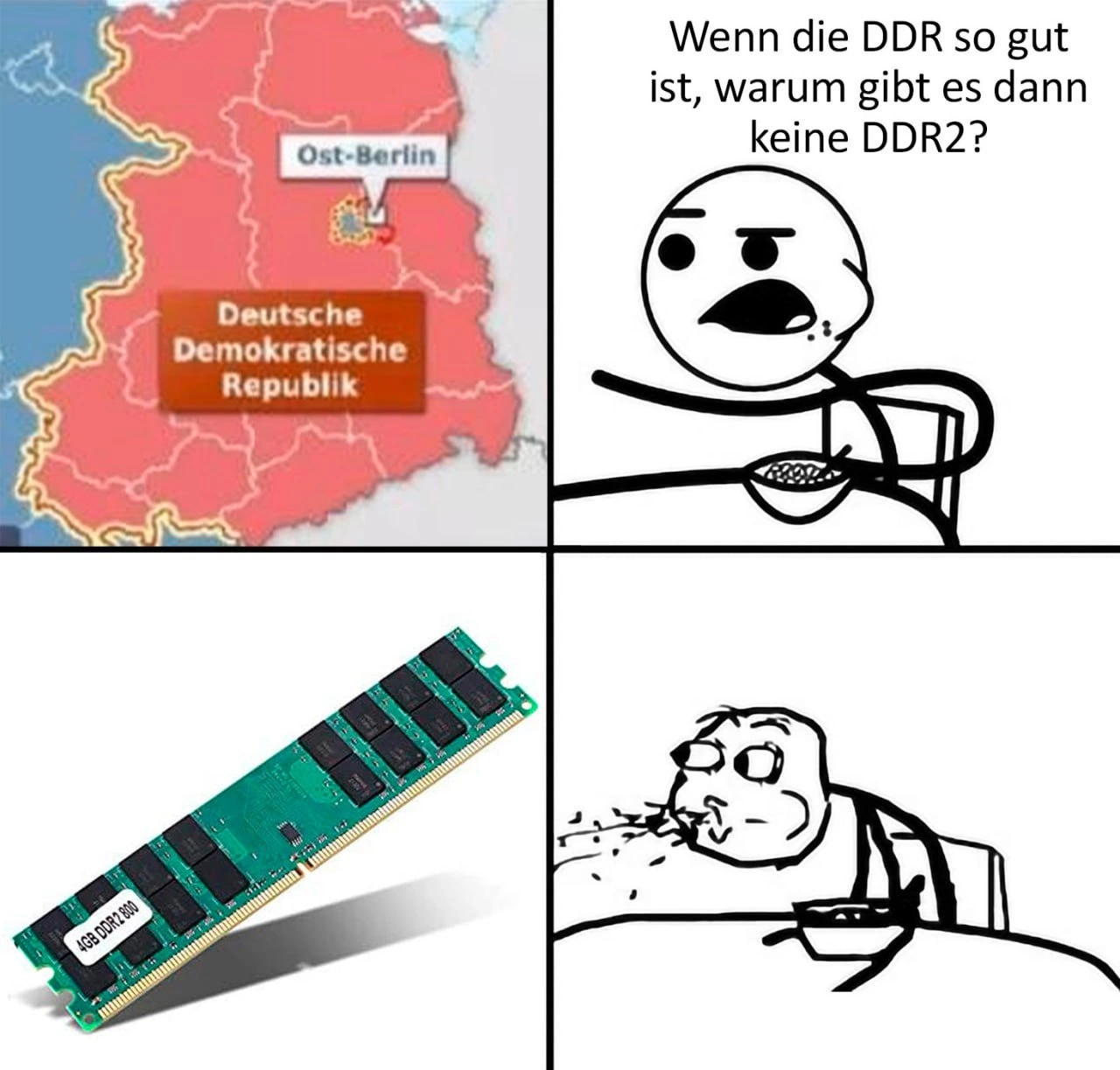
Imagine you have a word or name that you think means one thing, but someone else uses it to mean something totally different. This confusion can lead to a funny surprise. In this meme, the person sees “DDR” and only knows it as the name of an old country (East Germany). He asks, “If that country was so great, why isn’t there a DDR2?” – kind of like asking why there’s no sequel to that country. That’s a silly question, because we don’t make “part 2” countries in real life. The funny part comes when the answer to the question turns out to be DDR2, the computer memory! In the next picture, we see a computer’s memory stick labeled “DDR2”. The guy is so shocked at this unexpected answer that he spits out his cereal! It’s like he said, “Why isn’t there an East Germany 2?” and someone showed him a gadget and said, “Here it is!” The humor is in that surprise twist – he was thinking about history, but the answer came from technology. It’s as if you asked a serious question and got a completely literal but off-the-wall answer. Just like if you thought Apple meant only the fruit, and someone responded by handing you an Apple computer – you’d be pretty startled! The meme makes us laugh because the misunderstanding is huge and the answer is so unexpected, turning a simple question into a goofy moment of learning.
Level 2: Double Meanings, Defined
Let’s break down the joke and the terms for a newer developer or someone not deeply familiar with the lingo:
DDR (Deutsche Demokratische Republik) – This is the German name for the German Democratic Republic, commonly known as East Germany. It was a country in Cold War-era Europe, existing from 1949 to 1990. The map in the top-left panel (the red shape) is a map of East Germany, with “Ost-Berlin” (East Berlin) marked, since East Berlin was its capital. People sometimes talk nostalgically or critically about the DDR, since it was a socialist state behind the Iron Curtain. In German everyday language, “DDR” always refers to that country. There was never a DDR2 country – history doesn’t work like software versions! After 1990, East Germany simply reunited with West Germany, so the "series" ended there, so to speak.
DDR2 (Double Data Rate 2) – Completely unrelated to Germany, this refers to a type of computer memory. Specifically, it’s a generation of DDR SDRAM used in PCs. RAM (Random Access Memory) is the component in a computer that stores data that the CPU can access quickly. In the bottom-left panel, that green stick with black chips is a DDR2 RAM module (a DIMM). The sticker on it says
4GB DDR2 800, meaning it has a capacity of 4 gigabytes and runs at a speed called DDR2-800 (approximately 800 MT/s data rate). DDR2 was commonly used in computers around the mid-2000s. It’s called “DDR2” because it was the successor to DDR (DDR1) memory, offering faster speeds and improvements. Over the years, we’ve had DDR3, DDR4, and as of now DDR5 RAM in newer machines – each new number is a new generation with higher performance. The key point: DDR2 is not a “version 2” of the country; it’s the version 2 of a memory technology. The abbreviation “DDR” in computing stands for Double Data Rate, referring to how the memory doubles the amount of data it can transfer each clock cycle (by sending data on the up and down ticks of the clock signal).Naming collision / Abbreviation confusion – This is a general concept where an abbreviation or name has two different meanings in different contexts. In this meme, “DDR” is a prime example: one meaning in history (a country) and one in technology (a type of RAM). Such a collision can cause confusion if you don’t know the context. It’s like how “SQL” can refer to the database language (pronounced "sequel") but someone unfamiliar might just see random letters, or how “MAC” could mean a MAC address in networking or an Apple Mac computer. Context is what lets us figure out which one is meant. In everyday life, plenty of acronyms overlap between domains, and it often becomes a source of jokes or misunderstandings.
Cereal Guy meme – The format used here is a classic meme template. The top-right panel shows the cereal guy: a simple stick figure character drawn sitting at a table, eating a bowl of cereal. He’s known for spitting out his cereal in surprise when confronted with an unexpected truth or comeback. In the first instance, cereal guy is usually shown smirking or making a bold statement while spooning cereal; in the next, he’s spewing cereal everywhere because he’s been proven shockingly wrong or surprised. In our meme, the top-right panel has him asking (in German) why there’s no DDR2 if DDR was so good. This is the setup. Then the bottom-left shows the surprising answer (a DDR2 memory stick). Finally, bottom-right, cereal guy does the dramatic spit-take – implying “I can’t believe DDR2 does exist (just not in the way I assumed)!” It’s a visual metaphor for mind = blown.
Now you can see why the meme is funny: It plays on the double meaning of DDR. Essentially, a person who only knows about the DDR country is jokingly treating it like it’s a product that could have a sequel (DDR2). The meme answers that literally by presenting DDR2 RAM – the only real “DDR2” that exists – which completely catches our questioner off guard. It’s hardware humor because the punchline is a piece of computer hardware, and it’s wordplay because it relies on the pun of one term meaning two things. This kind of joke might appear in geeky forums or among friends who have mixed interests in history and tech. If you’re not familiar with one of the two meanings (say you didn’t know DDR2 memory), the meme would be confusing. But once you know both, it clicks.
To avoid any confusion, here’s a quick comparison of the two DDRs mentioned:
| DDR (in history) | DDR2 (in tech) |
|---|---|
| Deutsche Demokratische Republik (German Democratic Republic), a country in Central Europe during the Cold War era (1949–1990). Often just called East Germany. It was a nation with its own government, economy, and society (and no, it never had a “part 2”). | Double Data Rate 2 memory, the second generation of DDR RAM used in computers (around 2004–2009). It’s a physical computer component (a module that you stick into the motherboard). “DDR2” is basically version 2.0 of DDR memory technology (followed by DDR3, DDR4, etc.). Completely unrelated to the country, aside from the coincidental reuse of the acronym “DDR.” |
By laying it out, you can see how someone might hear “DDR2” and, if they only knew the historical term, it would sound like a sequel to East Germany – which is a funny idea because countries don’t get sequels! Tech folks, on the other hand, instantly think of plugging DDR2 RAM into an old PC. The meme brings those two worlds crashing together.
In summary, the meme is a perfect blend of TechHistory and Hardware humor. It requires a bit of interdisciplinary knowledge: knowing about the Cold War and knowing about computer memory. If you have both, you’re in on the joke. If you didn’t know one of them before, well, now you do – and the meme just taught you something in a roundabout way!
Level 3: Naming Things is Hard
At a senior developer or tech historian level, the humor of this meme arises from an abbreviation confusion that many seasoned folks instantly recognize. The cereal-guy’s question — “Wenn die DDR so gut ist, warum gibt es dann keine DDR2?” (“If the DDR was so great, why is there no DDR2?”) — sets up a classic wordplay pun. Here DDR has a double meaning: in everyday German discourse, DDR refers to the German Democratic Republic, the former East Germany. But to anyone in tech, DDR2 immediately rings a different bell: it’s a type of computer RAM module. The meme’s punchline lands when the third panel reveals a green DDR2 RAM stick (with that unmistakable sticker 4GB DDR2 800), literally answering the question in the most unexpected way. The final panel’s spitting cereal reaction represents shock and disbelief — the comedic “spit-take” moment when the naive questioner realizes DDR2 does exist, just not as a geopolitical sequel!
Why is this so funny to those in the know? It’s tapping into a shared understanding that context is everything. Experienced developers and techies have all encountered scenarios where two completely unrelated concepts share a name or acronym. We often chuckle (or groan) about such naming collisions. In this case, the collision is between Cold War history and computer hardware lingo. It’s the absurdity of treating a country like a software version that makes us smirk. Nations don’t get sequels or “2.0” releases — history doesn’t use semantic versioning. 😄 But the cereal guy in the meme is unknowingly applying software/version logic to a sovereign state: a fundamentally misplaced analogy that sets the stage for humor.
The cereal guy meme format amplifies this humor. It’s a familiar template in internet culture: a stick figure is shown eating cereal, confidently making a statement or question, only to be proven wildly wrong in the next panel, leading him to spit out his cereal in surprise. Here, the confident (if somewhat ignorant) question is why there’s no “DDR2” country if the original DDR was so good. This echoes a tongue-in-cheek internet trope: “If X was so great, how come there’s no X 2?” — usually a facetious way to criticize something from the past. The twist is that DDR2 does exist, just not in the realm of politics. The meme takes that rhetorical question literally and answers it with a hardware punchline. For those of us who know both meanings, it’s a perfect collision of TechHumor and a history joke.
This kind of humor resonates particularly with folks who have one foot in tech and one in general knowledge. Anyone who has struggled with abbreviation soup in engineering can relate. We know that the computing world is full of acronyms that mean one thing in tech and something entirely different outside. (For example, “SSD” means a fast storage drive to engineers, but to many others it might just be random letters; or “MAC” is either an address on a network card or a popular hamburger or a makeup brand, depending on whom you ask!) In fact, there’s a classic joke in development circles:
“There are only two hard things in Computer Science: cache invalidation, naming things, and off-by-one errors.”
Naming things is notoriously tricky, and the meme is a lighthearted case of a naming mishap. Here, engineers named a new memory technology “DDR2” without worrying that DDR already meant something to millions of people as Die Deutsche Demokratische Republik. It’s a benign example of how naming conventions in one domain can unintentionally overlap with terms from a completely different domain. The result? A recipe for engineering humor. An old-time hardware nerd might joke, “DDR2? I didn’t know we were planning to bring back East Germany with a version bump!” Meanwhile, a history buff might double-take hearing about “DDR3” (“Wait, did East Germany come back again?!”) before realizing it’s just about the latest gaming PC’s memory specs.
Digging a bit into tech history, it’s worth noting how these acronyms ended up colliding. The original DDR (the country) was established in 1949 and existed throughout the Cold War until German reunification in 1990. The term “DDR” was ingrained in history textbooks and everyday language for decades in Germany. Fast forward to the late 1990s: computer engineers develop Double Data Rate SDRAM and abbreviate it as DDR around 1996-2000. At that point, East Germany was a memory (pun intended), and the acronym was free real estate. By the time DDR2 memory was standardized (~2003), the acronym “DDR” was firmly part of PC jargon, with zero relation to geopolitics. No one in the JEDEC standards committee likely thought, “Better not use DDR, it might confuse it with a defunct socialist state.” Why would they? The realms of hardware engineering and 20th-century politics seemed a world apart. It’s only in whimsical hindsight (or internet memes) that the overlap becomes apparent and hilarious.
Seasoned developers also appreciate how the meme plays on versioning semantics. In software and hardware, when something gets a “2” or “2.0” after its name, it implies a new and improved version. The cereal guy applies that logic to a country — suggesting a hypothetical “DDR 2.0”. The absurdity is obvious to us: countries aren’t software releases. (You don’t just roll out Germany 2.0 after a brief beta test of reunification… that release cycle was figurative and one-time!) The meme’s creator then delivers the clever retort by presenting DDR2 the memory stick as if it were the answer to that question. It’s a classic case of literal answer to a facetious question, which catches our seasoned humor sensors off guard in a delightful way.
To add an extra layer, this all unfolds in German. The choice to have the cereal guy speak German (“Warum gibt es keine DDR2?”) grounds the misunderstanding in a cultural context. In Germany, the abbreviation DDR unequivocally means the former East Germany to most people, especially outside of tech circles. That makes the question feel like something an uninformed teen or a cheeky contrarian might actually ask, provoking eye-rolls. The meme then responding with a piece of Hardware humor – showing a literal DDR2 RAM module – is the kind of geeky punchline that tech folks love to share. It’s the intersection of a history joke and an engineering inside-joke. And of course, seeing the classic stick-figure spit out his cereal is the perfect visual confirmation that “You just got served… a fact you weren’t expecting!” The shared experience here is the Gotcha! moment when technical knowledge answers a non-technical question in an over-literal way. Those of us who’ve spent years in engineering or IT have probably experienced a similar comedic misunderstanding, where a non-tech friend uses a term that we only know as something completely different. This meme captures that scenario to a tee, making it meme-worthy and memorable among EngineeringHumor circles.
Level 4: From Socialism to SDRAM
At the highest technical level, this meme highlights a collision between historical acronyms and hardware terminology. In computing, DDR2 refers to Double Data Rate 2 SDRAM, a specific generation of computer memory. Technically, DDR2 memory uses a dual-edge clocking technique: data is transferred on both the rising and falling edges of each clock cycle. This double pumping effectively doubles the data transfer rate without increasing the fundamental clock frequency. For example, a module labeled DDR2-800 operates with an internal clock of 200 MHz but moves data at an effective rate of 400 MHz, achieving ~800 million transfers per second (800 MT/s). Internally, DDR2 employs a 4-bit prefetch buffer (fetching 4 data bits per cycle) and other architectural improvements over original DDR (DDR1), such as lower voltage operation and improved signal termination. All these hardware innovations allowed DDR2 SDRAM to reach higher bandwidths (like the ~6.4 GB/s of a DDR2-800 module) compared to its predecessor, while mitigating electrical noise and timing skew.
It’s a marvel of hardware engineering: by exploiting physical clock edges and parallelism, DDR2 provided a significant leap in memory throughput during the mid-2000s PC era. The designation “DDR2” was purely a technical naming convention, denoting the second iteration of the DDR SDRAM standard as defined by JEDEC (the memory industry consortium). Engineers chose this name to signal an evolution of the technology (much like DDR3, DDR4, etc. in later years) with no regard for non-technical meanings. In computer science terms, we’d call the confusion in the meme a naming collision or namespace overlap – the acronym DDR means two entirely different things in two separate “namespaces”: one in Cold War geopolitics and one in computer memory architecture.
From a tech history perspective, it’s ironically apt that the original DDR (Deutsche Demokratische Republik) ceased to exist in 1990, a decade before DDR memory technology emerged. By the time DDR2 RAM was standard (circa 2004–2008), the term “DDR” had been completely repurposed by hardware enthusiasts to discuss RAM modules rather than socialist republics. This highlights a fundamental (and somewhat humorous) aspect of technology evolution: abbreviation reuse is almost inevitable as new innovations seek short, punchy names. There are only so many two- or three-letter combinations, and sometimes a double entendre is coincidental. In formal terms, this is akin to how identical labels can refer to different objects in disjoint contexts—like having two variables named DDR in different modules of a program, each resolved by its own namespace (history vs. hardware). No compiler error occurs in real life; instead, the collision lives on in cross-discipline conversations waiting to cause confusion or, as in this meme, a punchline.
Beyond the acronym itself, there’s a subtle interplay of systems and history. Memory technology evolves with constraints of electronics (capacitance, clock synchronization, signal integrity), while political entities don’t version themselves—they rise and fall due to social forces and historical events. It’s almost poetic: the German Democratic Republic and Double Data Rate RAM share three letters but live in entirely different worlds governed by different rules. One world concerns constitutions and ideologies; the other deals with transistors and timing circuits. Putting them together sets up a collision of contexts that only a technically versed (and historically aware) audience would spot. This kind of unlikely overlap is what makes the meme’s punchline possible. In a sense, DDR2 did get a “sequel” – but only in silicon, not in statecraft. The meme banks on the reader knowing this dual meaning, effectively creating a lookup table in your brain that maps “DDR2” to either an alternate-history country (absurd) or a RAM stick (the reality). When those map entries suddenly swap, the result is equal parts edification and entertainment for the tech-savvy.
Description
A four-panel rage comic that creates a multilingual pun using the acronym 'DDR'. The top-left panel displays a map of the former German Democratic Republic (Deutsche Demokratische Republik, or GDR/DDR), also known as East Germany. The top-right panel features the 'Cereal Guy' stick figure asking in German, 'Wenn die DDR so gut ist, warum gibt es dann keine DDR2?' which translates to, 'If the GDR was so good, why isn't there a GDR2?'. The bottom-left panel provides the punchline with a picture of a DDR2 RAM stick, clearly labeled '4GB DDR2 800'. The final panel shows the Cereal Guy spitting out his cereal in a classic 'spit take' reaction of sudden, shocked realization. The humor hinges on the identical acronym 'DDR' for a historical socialist state and 'Double Data Rate,' a standard for computer memory. For a technical audience, this is a clever juxtaposition of geopolitics and computer hardware history, as DDR memory has had many successful successors (DDR2, DDR3, DDR4, DDR5), unlike the political state
Comments
7Comment deleted
The GDR had issues with memory leaks, but mostly of its own citizens. DDR2, on the other hand, just had faster clock speeds and better memory management
Proof that poor namespace governance predates Git: someone reused “DDR,” and now half the onboarding session is spent explaining why your RAM didn’t collapse with the Berlin Wall
Unlike East Germany's DDR, memory DDR actually delivered on its promises of parallel performance improvements without requiring a wall to prevent cache misses from escaping to the West
The real tragedy isn't that there was no DDR2 (the country), but that we're now on DDR5 and still dealing with memory leaks. At least the original DDR had a wall to contain its problems - modern RAM just lets everything overflow into production
Only in tech can “DDR2 upgrade” require both JEDEC specs and a Cold War fact-check - namespaces for acronyms, please
Political DDR got sunsetted after v1; hardware DDR iterated to v5 with zero fork drama
Classic namespace bug: ask for DDR2 and half the org orders RAM while the other half prepares a Cold War sequel - namespace your acronyms