Art Experts Dissect Why an AI 'Monet' Falls Short of the Real Thing
Why is this AI ML meme funny?
Level 1: The Photocopied Hug
Imagine your grandmother writes you a birthday card every year in her wobbly handwriting, and one year someone hands you a machine-printed card in a font that looks like her writing. It says the right words. The letters wobble in the right places. But you'd know instantly — because the real card mattered for the choices behind it, not the shapes on it. This picture shows a computer's "fake Monet" painting surrounded by dozens of people patiently explaining all the little ways you can tell it's the printed card and not grandma's. It's funny because the computer got so close, and somehow that makes it feel further away.
Level 2: Style Is Not a Texture
The concepts in play, decoded:
- Generative image models (diffusion models, the engines behind text-to-image tools): They learn from millions of images and generate new ones by gradually refining noise into a picture that statistically resembles the prompt. "In the style of Monet" means "match the patterns found in Monet-labeled training data."
- Impressionism / impasto: Monet's school painted quick, visible brushstrokes capturing fleeting light, often with thick, layered physical paint (impasto). Real canvases have 3D texture and strokes that follow the painter's hand and intent — exactly the properties the replies say are missing.
- Uncanny valley for art: The closer an imitation gets to the real thing, the more its remaining flaws bother us. A child's pond drawing charms; a 95%-convincing Monet unsettles.
- Crowd-sourced critique: This screenshot collage is essentially a distributed code review for a painting — many reviewers, each catching a different defect, collectively producing a more complete bug report than any single expert.
If you work in tech, the lesson generalizes beyond art: a model can reproduce the surface statistics of expertise — code style, prose tone, brushwork — while missing the underlying chain of decisions that produced it. That gap is precisely what reviewers (of paintings or pull requests) learn to smell.
Level 3: Minimizing Loss, Losing Monet
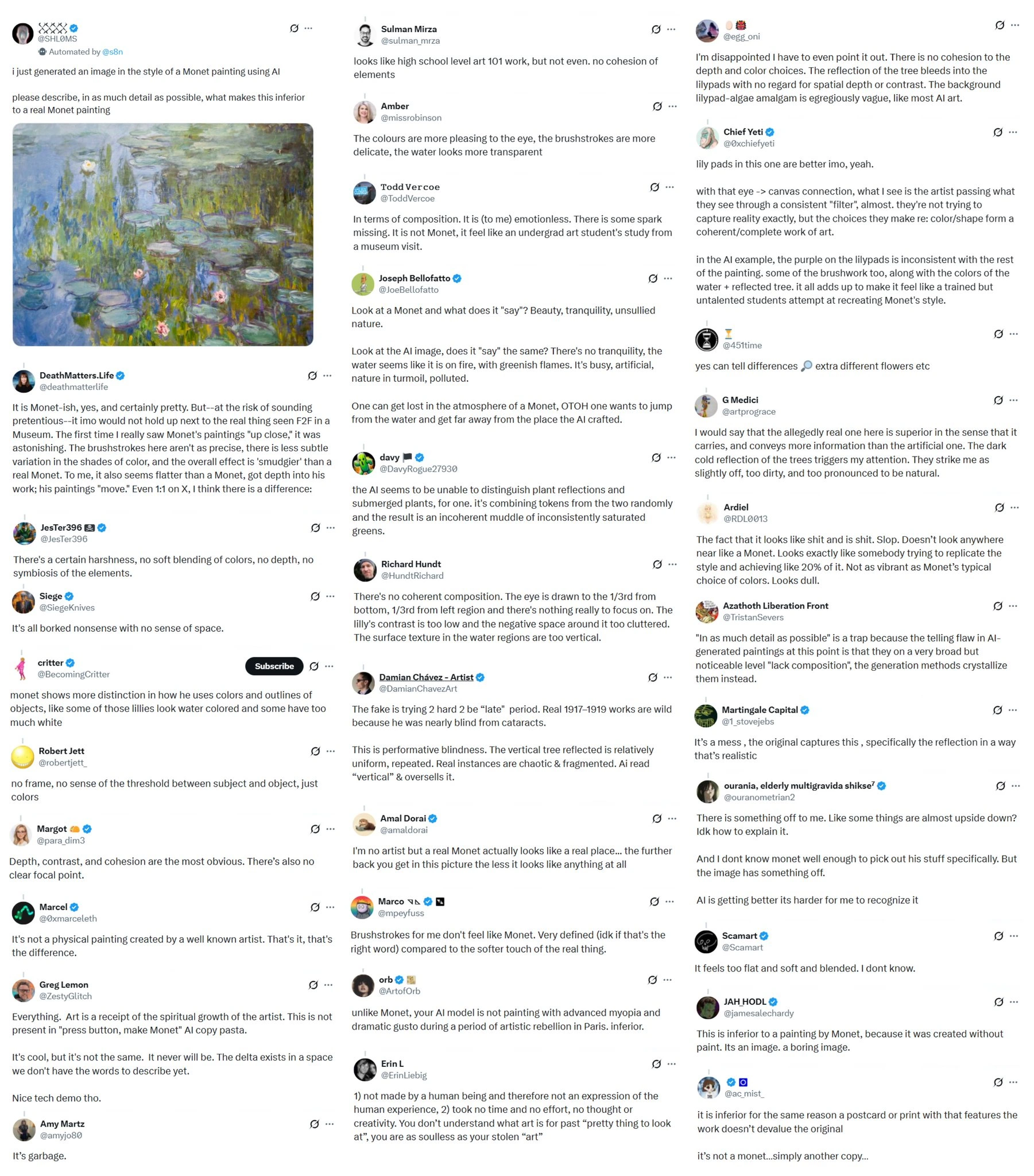
What makes this collage remarkable isn't the AI-generated water-lily pond tucked into the top-left corner — it's the wall of dozens of tiny reply screenshots surrounding it, a crowd-sourced peer review of a single generative image model output. Someone asked the internet to articulate, in detail, why a Monet-style AI image is inferior to a real Monet, and the internet delivered: one visible reply dismisses it as having "no cohesion of elements"; another notes the reflected vertical tree is "relatively uniform, repeated" where "real instances are chaotic & fragmented — AI read 'vertical' & overdoes it"; another says the brushstrokes are "very defined... compared to the softer touch of the real thing"; one simply renders the verdict "It's garbage."
The technically interesting part is that the critics, mostly without ML vocabulary, are independently describing regression toward the mean. A diffusion model trained on every Impressionist canvas ever digitized learns the statistical texture of "Monet" — color palette, subject matter, soft edges — and then samples from the high-probability center of that distribution. But Monet's actual marks were locally decisive: each stroke was a commitment made by a person squinting at real light at a specific hour. The model has no light source to observe, so the crowd correctly notices there's no coherent direction of illumination, no compositional focal point ("nothing really to focus on"), edges that are smoothed rather than placed. Averaging genius gives you the median, and the median of a thousand intentional decisions is indecision rendered at high resolution.
There's a second satirical layer aimed at the AI hype cycle itself. The prompt is a perfect troll: it flips the usual "look what AI made!" flex into an invitation for forensic demolition, and it works because the uncanny near-miss quality of generated art is legible — people can't always say why an image feels hollow, but given permission and a comparison target, they articulate it with surprising precision. One reply nails the philosophical endgame: "It's not a Monet... simply another copy" — the same reason a postcard doesn't devalue the original. The thread becomes an accidental essay on provenance, intention, and why style transfer captures the what of a painting while structurally excluding the why. Another reply lands the historical haymaker: the AI "is not painting with advanced myopia and thematic gusto during a period of artistic rebellion in Paris. Inferior."
Description
A dense collage of dozens of small social media reply screenshots responding to a prompt that reads roughly: 'I just generated an image in the style of a Monet painting using AI. Please describe, in as much detail as possible, what makes this inferior to a real Monet painting.' A small AI-generated water-lily-pond image in Monet's style appears at top left. The replies, from many users, offer detailed critiques: brushstrokes that are 'mushy' and lack intentionality, no coherent direction of light, uniform texture without the layered impasto of real oil, water lilies that don't sit convincingly on the water plane, 'no cohesion of elements', edges that are AI-smudged rather than confidently placed, and observations that Monet painted from sustained observation while the model interpolates statistical averages. The piece functions as a meme about AI image generation's uncanny near-miss quality and the crowd's ability to articulate exactly why it feels hollow
Comments
25Comment deleted
The model minimized loss against every Monet ever painted and produced the one painting Monet never would - turns out averaging genius gives you the median
lemme guess, this is a real monet painting? Comment deleted
"Interstate 60" -moment Comment deleted
Grok is this real Comment deleted
The fact that you all also questioning is a sign we are rational, but not knowing real monet shows me how much we strained from experiencing beauty outside the digital world Comment deleted
I don't think most people knew much paintings before digitalization of the human experience either Comment deleted
What about copies? Amateurs imitating Comment deleted
What about them? I don't get your point Comment deleted
There used to be amateur auteurs that would replicate great arts and in great quantities to either practice or try to scam collectors So they would spread the knowledge of the great art around Comment deleted
But did people outside of said collectors and art nerds spend any time seeing all that? I imagine my parents didn't Comment deleted
If they went to any kind of art community they would have Comment deleted
Well yeah but now you also can visit a museum AND look up any art online Comment deleted
yeah, but original point was that before people had access to art as well, even the great one Comment deleted
If it's an automated account, doesn't it mean that a bot is ragebeaiting people with a real painting? Not the other way around Comment deleted
Finally we can all come to the conclusion that real monet is actually hyped up shit Comment deleted
https://en.wikipedia.org/wiki/File:Batch_Mattes_20130310_NP_(13).JPG seems to be real, it's in Munich - https://en.wikipedia.org/wiki/Water_Lilies_(Monet_series) there's definitely prettier paintings in that list though Comment deleted
and all these are probably just AI bots farming engagement and conversation history to look legit when they will be used for propaganda Comment deleted
internet is dead Comment deleted
Especially twitter dot com. May as well throw a shrimp jesus into Facebook Comment deleted
xitter moment Comment deleted
Is Monet a new Claude model? Comment deleted
No, that is not actually a Monet painting. It is a really close copy of the "Water Lilies" Painting from Claude Monet. Comment deleted
Did you even google. Comment deleted
https://en.wikipedia.org/wiki/File:Batch_Mattes_20130310_NP_(13).JPG Comment deleted
Well, no.The painting I saw looked familiar to me, so I Googled the name of the painting I mentioned, and when I compared them, I saw they’re not the same. Thanks i didn't know about that one you sent. Comment deleted