Skip to content
DevMeme
316 of 7435
The Duality of Developer Priorities: Features vs. Testing
Testing Post #374, on May 18, 2019 in TG

The Duality of Developer Priorities: Features vs. Testing

Why is this Testing meme funny?

Level 1: Candy Before Dinner

Imagine you’re supposed to eat your vegetables and dinner before you get dessert. Eating veggies might be the “boring” part, and dessert is the exciting sweet treat. Now, picture a kid who’s so excited about the cake or candy (the fun stuff) that they secretly toss their plate of veggies in the trash to get straight to dessert. It sounds funny and a bit naughty, right? But later that kid might end up with a stomachache or no energy because they skipped the healthy food. This meme is joking about a very similar idea, but with programmers: the new features they want to build are like the yummy dessert, and the testing (making sure everything is safe and works correctly) is like eating vegetables. The developers are shown literally throwing “Testing” away (like tossing the veggies) so they can hurry to enjoy the new features (the dessert). It’s funny in the way that doing something silly and short-sighted is funny – we laugh because we recognize people sometimes do this even though they shouldn’t. Just like a kid skipping the important dinner, the developers skip the important testing step. In both cases, there’s an immediate reward (tasty cake or shiny new feature) but a risk of trouble later (tummy ache or software bugs). The meme makes us grin because it’s a cartoonish reminder of a simple idea: if you ignore the “responsible” stuff completely, you might pay for it afterwards, no matter how tempting the fun part is.

Level 2: Features First, Tests Later

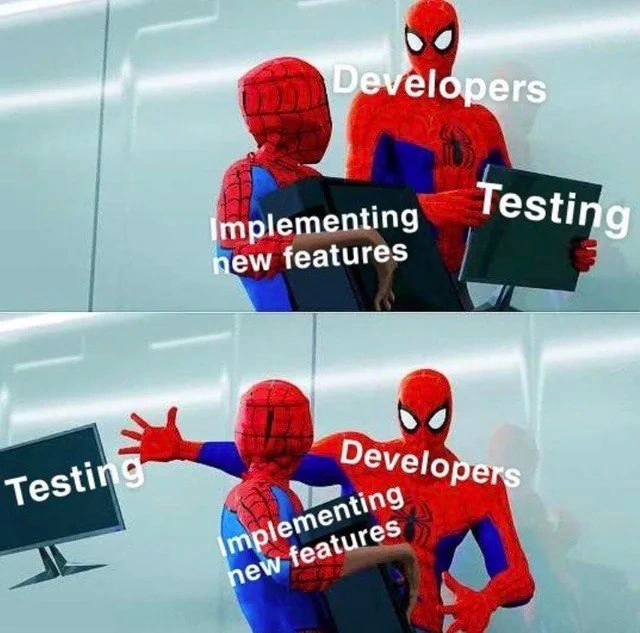
This meme spotlights a common software development issue in a funny way. We see two Spider-Man characters labeled as “Developers” and “Implementing new features,” and a computer monitor labeled “Testing.” Essentially, it’s showing a developer physically discarding testing in order to focus on adding new features. In practical terms, testing refers to writing and running checks on the code – like unit tests (small tests for individual pieces of code) or integration tests (tests that check if different parts of the system work together). These tests are crucial for good CodeQuality, because they catch bugs and prevent regressions (which are bugs that creep back in or new bugs introduced when something changes). However, writing tests doesn’t always feel as exciting or immediately rewarding as coding up a shiny new feature. Hence the joke: developers often neglect testing when they’re in a rush or under pressure, which is what the big Spider-Man yeeting the monitor represents.

Why would developers shove testing aside? One big reason: Deadlines. In many projects, there’s high pressure to deliver new functionality by a certain date – maybe a client demo, a product launch, or just the end of a sprint. When the clock is ticking, teams sometimes cut corners by skipping comprehensive testing. They might say things like “we’ll write the tests later” or “it’s a small change, it’ll be fine”. The smaller Spider-Man clinging to the computer (captioned “Implementing new features”) stands for that urge to grab the new code and ship it quickly. The larger Spider-Man (“Developers”) who tosses the “Testing” monitor away shows the developers actively pushing the testing task out of the picture to meet those time goals. It’s an exaggerated visual metaphor for a real phenomenon: feature_over_testing prioritization.

When developers do this in real life – focus on new code and ignore tests – they accumulate what’s known as technical debt. Tech debt is a term for the extra work you create for your future self by taking shortcuts now. For example, if you don’t test properly today, you might have to spend a lot more time later debugging issues that tests would have caught. It’s like skipping upkeep on a car; eventually, something breaks that’s much costlier to fix. The meme hints at this with its chaotic second panel. You can imagine the Testing monitor flying off might crash and break something – similarly, skipping tests can lead to crashes in your software down the road. Testing is a kind of insurance. Without it, new features might introduce bugs that go unnoticed until users or clients find them (ouch!).

For a junior developer or someone new to coding, this meme is a cautionary tale wrapped in humor. It highlights a lesson many learn early in their career: Always test your code. The labels make it clear: “implementing new features” is the fun part of coding – building something new that users will see or that adds functionality. “Testing” is the less glamorous part where you double-check that everything works correctly and that you didn’t break anything that used to work. New developers often find testing tedious or may not know how to write good tests yet. They might think, “It works on my machine, so it’s done.” This meme is basically the dev community laughing at itself because we’ve all had that moment where skipping tests seemed fine… until it wasn’t. A classic scenario for a junior dev might be merging code without running the test suite (or not having tests at all), and then the next day hearing that the latest release has a bug. The panic and late-night debugging that follow are the “I told you so” punchline of neglecting tests.

The Spider-Man theme is just a funny wrapper. Spider-Man is a hero with the mantra “with great power comes great responsibility.” Here, implementing new features is the “great power” that developers have – it can really advance a product. But the “great responsibility” is to ensure those features don’t break anything, i.e., to test them. The meme humorously shows the dev ignoring that responsibility. In more straightforward terms, this image is a DeveloperMeme calling out how teams sometimes behave: Everyone cheers for rapid feature development, but few cheer for thorough testing, even though the latter is what keeps the software stable. It’s part of DeveloperPainPoints and TestingHumor because any programmer who’s been burned by a bug will look at this and chuckle nervously, remembering how they once said “I’ll just skip writing tests this time” and lived to regret it. The lesson packaged in the humor is clear: neglecting testing might save time today, but it often causes bigger problems tomorrow.

Level 3: Test-Driven Out the Window

In this Spider-Man office showdown, the Developers (the bigger Spidey) are literally throwing Testing across the room to clutch "Implementing new features." It’s a brutally honest snapshot of an all-too-familiar DeveloperHumor scenario: new code is treated like the shiny prize, while unit tests and QA get tossed aside like an old CRT monitor. The humor cuts deep because it highlights a classic industry anti-pattern in TestingHumor fashion. We’ve all seen it: a team under crushing Deadlines decides that writing or maintaining tests is optional homework they’ll "do later". Spoiler: “later” never comes until a Sev-1 outage forces it. This meme nails that painful trade-off between racing to deliver and pausing for quality – a trade-off that usually comes back biting harder than a radioactive spider.

Why is this so funny (or rather, darkly funny) to seasoned engineers? Because it’s DeveloperPainPoints 101. The Developers label on Spider-Man implies it’s often devs themselves making the choice to sideline tests in favor of pumping out features. Maybe product management is breathing down their neck, or maybe the devs are just excited to ship something cool – either way, CodeQuality and safety nets are the victim here (much like that poor monitor labeled Testing flying off-screen). This scene exaggerates reality: in real life we don’t physically yeet our test servers, but we do mentally shelve tests by commenting them out, ignoring failing builds, or convincing ourselves "it works on my machine, ship it". The sleek, white office walls in the background even accentuate how pristine and polished we want our new feature launches to appear… until the untested code blows a hole through that façade.

From a senior perspective, this image riffs on the gap between ideal and actual software practices. Ideally, Test-Driven Development (TDD) tells us “with great power (new features) comes great responsibility (writing tests)”. In practice, as this meme shows, that responsibility often gets defenestrated (thrown out the window) the moment crunch time hits. Every veteran dev can recount war stories of when skipping tests led to nightmare regressions: that one tiny change that broke the payment gateway on Friday night, or the “quick refactor” without unit tests that unleashed chaos in production. The meme’s second panel, where Developers-Spidey flings Testing away while dragging New Features-Spidey closer, perfectly captures how we knowingly incur technical debt. We prioritize the immediate win (feature delivered!) at the cost of unseen cracks in stability. And just like real debt, that tech debt accrues interest – paid in early-morning hotfixes and angry user reports. CodeQuality suffers, and the promised “we’ll write tests later” usually translates to a backlog item that gets endlessly deprioritized.

Notice also the size difference in the meme: the big Spider-Man (Developers) overpowers the smaller one clinging to the “Implementing new features” tower. This hints that developers have the power to either enforce quality or steamroll it. Here they’re using that power irresponsibly, manhandling the process to get what they want. The text labels are stuck on their respective characters through both panels, meaning it’s consistently the devs choosing to behave this way. The meme exaggerates the physical struggle, but metaphorically it’s exactly what happens in many sprint plannings: testing tasks are wrestled out of the active queue and thrown to “next time” so the team can pull in another sparkly feature. It’s funny in the "laugh so you don’t cry" way – anyone who’s been on call at 3 AM due to a production bug knows the punchline too well. In short, the meme speaks truth to the Testing vs Features feud: we keep repeating this cycle of feature_over_testing madness, even though every experienced dev’s Spidey-sense tingles when tests are neglected.

Let’s be clear: skipping tests might seem to speed things up in the short term, but it’s a well-trodden path to tech_debt_accumulation. The meme distills that irony into one visual gag. It resonates because it’s part of CodingHumor canon – the kind of inside joke born from collective pain. Seasoned devs smirk at this and think, “Yup, been there, done that, got the burnt T-shirt.” They remember the stand-ups where someone said “we didn’t have time to write tests, we had to push the feature” and everyone subtly face-palmed. They recall how that choice resulted in regression bugs that Testing would have caught, leading to far more work later. The meme’s comedic timing (two panels going from tussle to outright ejection) mirrors how quickly “we might skip one test” escalates to “we have no tests at all” in real projects. It’s essentially showing the slippery slope of cutting corners.

In real organizations, this behavior is fueled by incentives: new features get praise, demos, and customer excitement, while solid tests and fewer bugs are kind of invisible – nobody throws a party because “our login still works correctly!”. The cynical truth underlying the joke is that many companies reward speed over sustainability. It’s a classic DeveloperPainPoints situation: engineers want to do good CodeQuality work, but tight Deadlines and pressure make them compromise. The result? A shaky Jenga tower of code where nobody wrote UnitTests for the base. And when that tower inevitably wobbles, guess who’s wrestling production issues late at night? The same developers who sidelined the tests – just like Spider-Man, we end up fighting the very problems we created. The meme gets a nod and a chuckle from veterans because it encapsulates that entire saga in one slapstick Spidey scene. It’s absurd, it’s true, and it’s a gentle reminder (or not-so-gentle) of the motto: “Test early, or forever chase bugs.” But clearly, in this meme, the devs chose the latter, hurling testing aside with superhero strength and a perhaps misguided grin.

Description

This is a two-panel meme using the 'Spider-Man Presenting to Spider-Man' format from the movie 'Spider-Man: Into the Spider-Verse'. In the first panel, an older, mentor-like Spider-Man, labeled 'Developers', is showing a younger Spider-Man, labeled 'Implementing new features', a computer monitor labeled 'Testing'. This represents the knowledge and intention of developers to follow best practices. In the second panel, the roles are reversed in action; the younger Spider-Man, still labeled 'Implementing new features', is now dismissively pushing away the 'Testing' monitor, while the 'Developers' persona looks on. This meme perfectly illustrates the internal conflict many developers face: they know testing is crucial for code quality and long-term stability, but the pressure and excitement of building and shipping new features often leads them to neglect or postpone writing tests
Comments

8
Anonymous ★ Top Pick I have a solid TDD approach: Ticket-Driven Development. If there's no ticket for a failing test, the test doesn't exist
  1. Anonymous ★ Top Pick

    I have a solid TDD approach: Ticket-Driven Development. If there's no ticket for a failing test, the test doesn't exist

  2. Anonymous

    Sprint velocity hack: when CI goes red, we just mv failing_spec.rb tests/disabled/ - instant green build, 100% future-interest tech-debt APR

  3. Anonymous

    We've successfully shipped 47 features this quarter and our test coverage dropped from 80% to 12%, but don't worry - we're calling it 'shift-right testing' and letting production users find the bugs for us

  4. Anonymous

    Testing gets slapped away every sprint, then rehired as a contractor at 3am under its production name: the incident postmortem

  5. Anonymous

    The eternal triangle: Developers, Features, and Testing. Two can be friends, but someone's always getting thrown off the building. Spoiler: it's never the feature deadline, and the production incidents that follow are just 'unexpected user acceptance testing.'

  6. Anonymous

    The dev monolith: one team implements features with 100% confidence in their untested 'local verification' - until prod partitions the blame

  7. Anonymous

    We made the quality gate “soft” to hit velocity targets; now PagerDuty is our integration test runner

  8. Anonymous

    We keep trying to “shift left” testing; product keeps shifting it right - straight into the on-call rotation

Use J and K for navigation